
Agentic AI for field service has quickly moved from pilot programs to daily operations, mostly because the average technician's day has so much room to improve.
Field technicians can waste up to 40% of their workday on administrative tasks that don’t add value: filling out timesheets, tracking down parts, and waiting on information that should already be on their phone. Multiply that lost productivity across a 20-person crew, and you're paying full-time wages for work that never touches a wrench.
This is a guide to agentic AI in field service that’s built around one idea: Start with the repetitive workflows you see every day, then fix the mistakes that stall everything else. That's how to transform field service operations without disrupting crews that are already stretched thin. It's also the approach built into Simpro®, the platform trade businesses already run on.
What Makes AI "Agentic," and Why It Matters
Most AI systems require human oversight at every step. Someone has to review a recommendation and click a button to act on it. Agentic AI works differently. Here’s a view of AI agentic behavior in miniature:
- The system monitors incoming requests.
- It evaluates variables like technician availability, certifications, and truck inventory.
- The agent decides and acts, all inside guardrails a business owner sets in advance.
Modern agents are typically built on large language models, but paired with tools that let them take action instead of only generating text.
The difference between regular AI and agentic AI is speed. A scheduling decision might take a dispatcher several minutes to work through by hand — checking who's certified, who's closest, and who's already booked. An AI agent only needs seconds because it has the relevant information. It’s not searching for information across five systems. When something changes — cancellations, emergency calls, a technician calling in sick — the agent reoptimizes the schedule and notifies affected customers on its own.
Field service is a hard environment for AI to operate in. Work orders arrive without warning, technicians work remotely with no one looking over their shoulder, equipment varies job to job, customer expectations keep rising, and skilled labor gets harder to find.
Add in tight margins, typically 5–10% for trade businesses, and there's no room in the budget to absorb more inefficiency. That combination is precisely why agentic AI has moved from an enterprise curiosity to something trade businesses are actively adopting. Roughly 40% of field service organizations already use generative AI for uses including task automation and technician guidance.
The appeal isn't just financial. The biggest drags on field service productivity are poor visibility into technician activities and a reactive approach to dispatching instead of a planned one. Closing that visibility gap saves money and structures the technician’s workday around complete jobs rather than chasing information. In an industry where skilled labor is the tightest constraint facing most owners, every minute counts.
The Field Service Workflows Where AI Agents Can Make the Biggest Impact
Not every area of a field service business benefits equally from automation. The workflows below are where agentic AI produces the clearest, fastest, most measurable results, as seen in real-world use by trade businesses today.
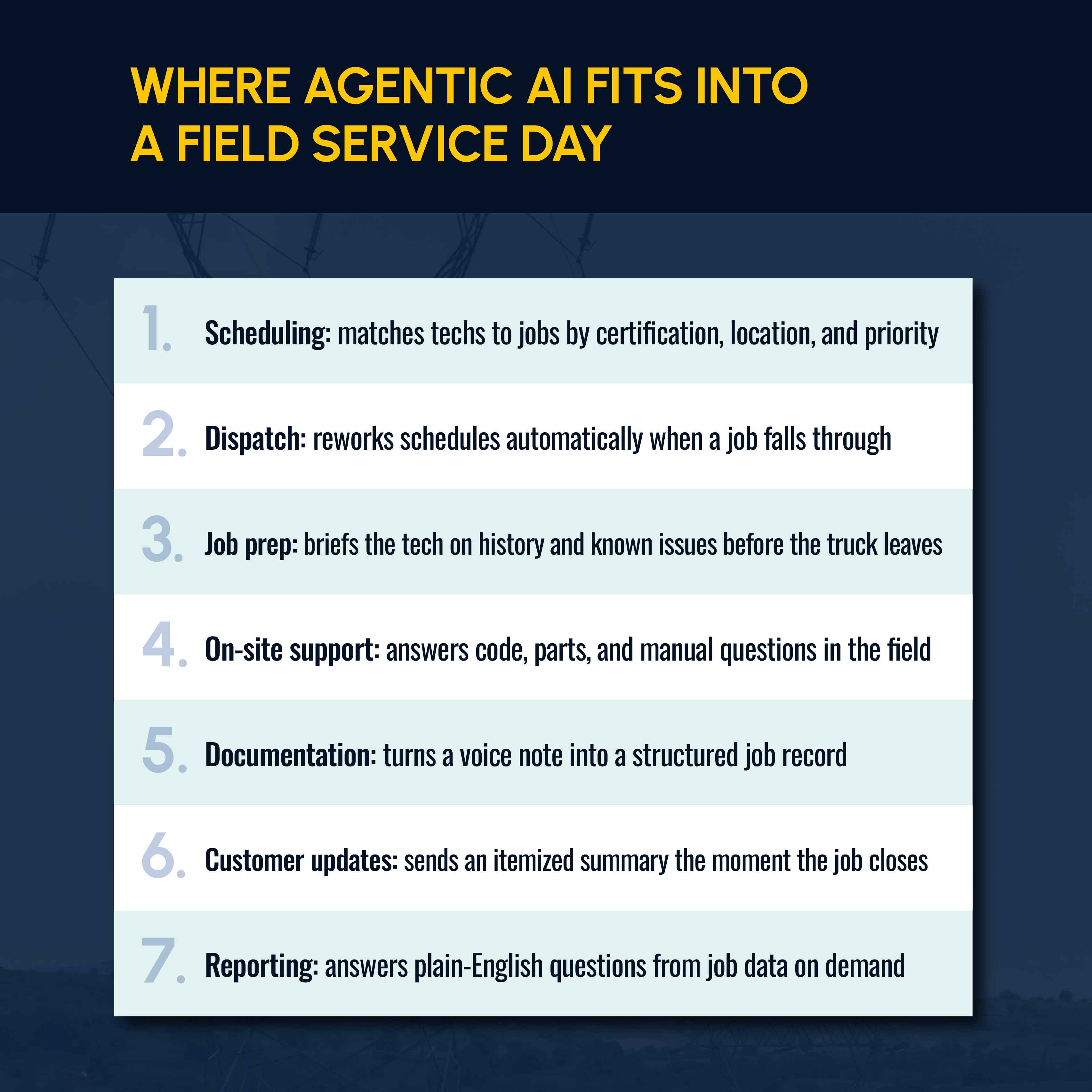
1. Scheduling Jobs Based on Priority, Availability, and Location
Scheduling is where most businesses see the first payoff, as it's high-frequency, data-rich, and easy to measure.
When a job comes in, whether it’s an emergency or routine, an AI agent evaluates technician skill certifications, current location, drive time, and job priority using real-time data, then assigns the job automatically instead of routing it through a dispatcher's inbox. For teams planning the next release, AI Scheduler for field service management in Simpro RAIN is the relevant RAIN release-wave update.
2. Reworking Dispatch Plans When the Day Changes
A schedule built at 7 a.m. rarely stays intact until noon. Picture this scenario: Two techs call in sick, a restaurant calls about a burst pipe during the lunch rush, and a $4,200 water heater replacement is on the board for a tech who's down a truck's worth of stock.
Traditionally, a dispatcher would manually reshuffle the schedule, all while the phone kept ringing. An AI agent handles that disruption quickly and efficiently. The agent reruns the optimization across every open job and available technician, then sends updated ETAs to customers automatically. That's AI-driven scheduling in practice — adjusting on its own instead of waiting for someone to notice.
Related: Learn how AI in field service management is already changing day-to-day operations across the trades.
3. Preparing Technicians Before They Arrive On-Site
A technician who shows up without the right parts, the equipment history, or the customer's prior complaints is starting at a disadvantage. An agent can create a pre-dispatch briefing with job history, equipment specs, and known issues. The tech gets all the necessary info before getting into the truck.
The payoff shows up in first-time fix rate. The industry average is 75%, but businesses using pre-job briefing agents report first-time fix rates climbing to 90% or higher. That matters because a truck roll isn't free. Once you count wages, benefits, vehicle costs, and drive time, the real cost of sending a truck out is nearly $85 an hour. Multiply that by the number of trucks in your fleet and average callbacks per month, and the savings add up.
The operational fix: if your technicians show up to the same problem they’ve previously diagnosed, the job briefing isn't reaching them in time. Have an agent assemble that briefing so the office’s knowledge is in the technician’s hands.
4. Supporting Technicians During the Job
Once a technician is on-site, an agent is an on-demand resource that can access equipment manuals, code requirements, or parts availability without a call to the office. For electrical contractors, in particular, confirming a code citation or a compliance requirement mid-job keeps the job moving and keeps the paperwork defensible later.
Picture a six-person electrical crew handling a commercial panel upgrade. Mid-job, the technician runs into a configuration that doesn't match the original permit drawings. Historically, that means calling the office, waiting for someone to track down the right code section, and a running clock on a two-hour labor block. But an agent with access to the relevant code library and the job's permit history can surface the answer immediately. The technician keeps working, and the crew doesn't lose an hour waiting on a callback.
The operational fix: if technicians are routinely stopping mid-job to call the office for information that already exists, that's an access problem. An agent that can answer in the field closes the gap without adding to your payroll.
5. Capturing Job Notes, Photos, and Documentation
Manual documentation is one of the biggest time sinks in field service — and one of the easiest for an agent to absorb. A technician describes what happened out loud. The agent turns that into a structured job record, removing 30 to 60 minutes of paperwork per technician per day and cutting billing disputes by roughly 40% because the record matches what happened on-site.
6. Creating Customer Updates After the Job Finishes
Customers who receive a clear, itemized summary of what was done and why are less likely to dispute the invoice or leave a vague review. Prompt, thorough service delivery is also what keeps customers coming back.
Automated post-job summaries can reduce billing disputes by 25 to 35% and speed up payment by 15–20 days, simply by sending the invoice when the job closes instead of letting it linger on someone's desk.
Related: Agentic AI accounts receivable applies the same agent logic to chasing down unpaid invoices.
7. Giving Managers Plain-English Answers From Field Service Data
Field service platforms contain years of job records, technician performance data, and customer history. But most of it goes unused because you can’t get a simple answer without running a report or query.
An agent changes that. Ask a plain-English question — “Which technician has the highest callback rate this quarter?” or “What's driving late invoices in the plumbing division? — and it answers in seconds. That turns stored data into something a manager actually uses to analyze trends in technician utilization or customer satisfaction.
Where Field Service Businesses Should Start With Agentic AI
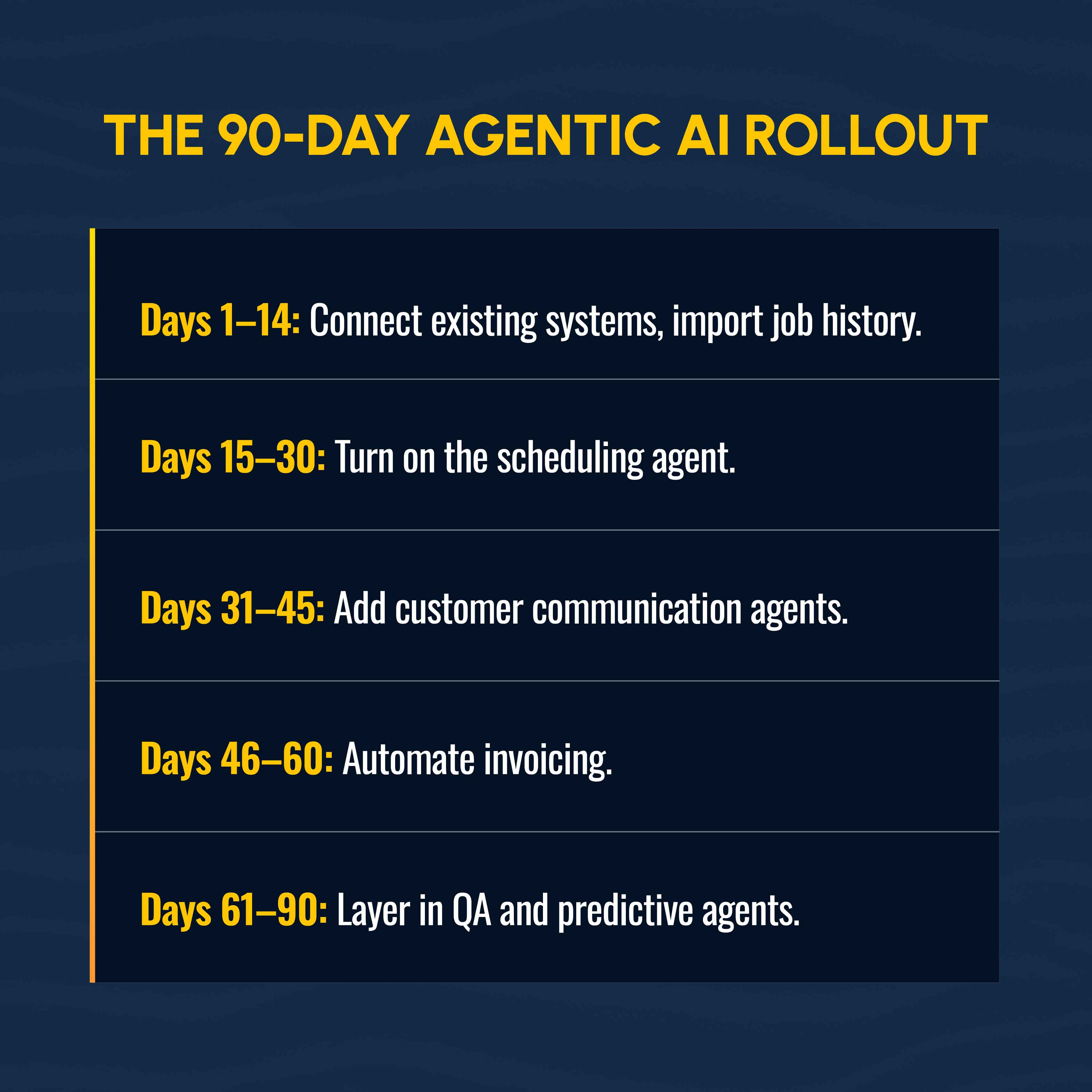
Rolling out agentic AI across your entire operation at once isn’t recommended. That’s how businesses end up with five disconnected tools that don't share context and don't build trust with the operations team.
A phased approach gets better results, and it maps roughly to a 90-day rollout. In the first two weeks, connect existing systems and import job histories. By day 30, turn on the scheduling agent. Layering in customer communication agents by day 45, invoice automation by day 60, and quality assurance or predictive agents by day 90.
Here are three principles to remember:
- Start with repetitive tasks that slow down operations. Scheduling and dispatch are the highest-volume and most measurable starting points. Because the workflow repeats dozens of times a day, an agent shows whether it's working within days, not months. Run the AI scheduling agent alongside the existing dispatcher for the first week, then compare results. Many businesses can see the agent matching or beating human dispatch quality by day three.
- Focus on one measurable business problem first. Pick a number — such as jobs per technician per day, days to invoice payment, or first-time fix rate — and measure the agent against it before expanding to a second workflow. Trying to fix scheduling, documentation, and invoicing simultaneously makes it impossible to tell which changes are driving results. Getting buy-in is also harder when your team sees three things change at once.
- Keep humans involved where judgment matters. Agents excel at handling routine, high-volume, pattern-matching work. Emergency judgment calls, upset customers, and edge cases still need a person. The businesses that get the most value run a supervised model: The agent handles the routine work, a person handles the exceptions, and every action the agent takes stays visible and reversible so nobody's guessing what changed or why.
Common Mistakes to Avoid When Adopting Agentic AI in Field Service
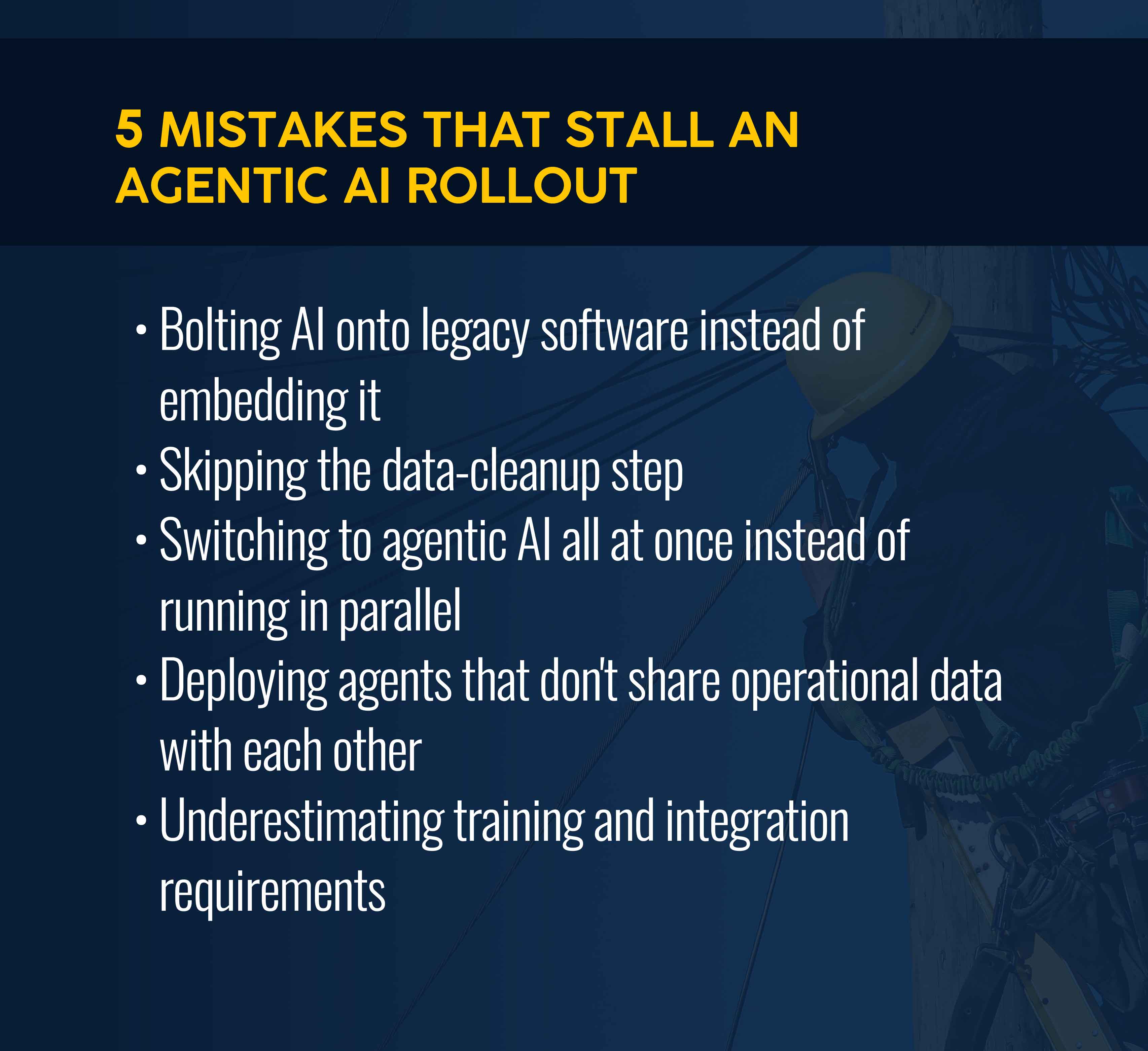
Knowing how to use agents in field service industries starts by avoiding the mistakes that account for most stalled or failed AI rollouts.
- Bolting AI on top of legacy software instead of embedding it. When standalone AI tools aren’t connected to years of job history, technician performance data, and billing records, they’re working with incomplete information. Agents can't make the best scheduling decision if they don’t know which technician finished similar jobs fastest last quarter. Agents embedded into the platform containing key data make better decisions from day one.
- Skipping the data cleanup step. An agent is only as good as what it's reading. If work orders are missing symptoms, diagnostics, or resolution notes, the agent inherits those gaps. The first step in your agentic AI rollout is auditing job history for completeness.
- Cutting over all at once instead of running in parallel. When businesses run a new scheduling agent alongside the existing dispatcher for a week, then compare results, they can build trust and catch problems before they affect customers. Businesses that flip the switch on day one tend to generate the loudest internal pushback, even if the agent performs well.
- Deploying AI agents that don't talk to each other. Agents handling different areas on disconnected systems with no shared context will simply re-create the same gaps the business had before AI. Multi-agent systems only pay off when they share the same operational data instead of working in silos.
- Underestimating training and integration. Owners often brace for pushback from the crew. But the bigger challenges are usually related to training and integration strategy. Technicians tend to come around quickly once an agent saves them time. The real work is on the setup side — making sure the agent is connected to the right systems and that the team knows how to work alongside it.
How Simpro Supports Agentic AI for Field Service Businesses
Simpro is built as an AI-first, cloud-based operating platform for trade businesses, covering quoting, scheduling, dispatching, inventory, and invoicing in one system. That especially matters for agentic AI because agents perform better when they’re embedded inside the platform with years of job history, technician records, and customer data already attached.
AI field service management with Simpro Lightning is built around Cooper, an AI operating layer that functions less like a chatbot and more like a team member who already knows how the business runs. Cooper can answer questions, flag issues early, and rely on continuous learning of each business's operational patterns over time.
Four purpose-built agents run inside Lightning today:
| Agent | Role | What It Changes |
|---|---|---|
| FieldReady | Technician training and onboarding | Cuts onboarding time from 12–16 weeks down to days |
| JobReady | Pre-dispatch job briefing | Lifts first-time fix rate from around 75% to 90%+ |
| JobScribe | Voice-to-job documentation | Removes 30–60 minutes of paperwork per technician per day |
| JobBrief | Automated customer summaries | Cuts billing disputes and speeds up payment by 15–20 days |
More specialist agents are on the roadmap, extending the same approach to procurement, customer service, and workforce management. These are crucial functions for trade businesses, but not usually areas where they can justify a dedicated hire.
The businesses seeing the strongest results — 30% productivity increases and 10x faster estimates — are running scheduling, documentation, and customer communication through agents that share the same operational data, rather than stitching together separate tools.
That's the core distinction between generic AI solutions bolted onto old software and an AI layer that’s built into field service management software. A standalone tool has to guess at context: which technician closes out jobs fastest, which customers pay late without a follow-up call, and which equipment models generate the most callbacks. An agent built into Simpro already has that history because it's the same data the platform uses for quoting, scheduling, and invoicing.
Agentic AI Is Becoming the Next Layer of Field Service Operations
If you're still assigning jobs by hand, chasing down documentation after the fact, and calling customers to explain an invoice they're disputing, you're running the same operation from a decade ago, just with a few apps layered on top. Truly transforming field service operations requires agentic AI, a genuinely different way of running the business where software handles repetitive decisions and your team handles judgment calls.
The businesses building that operating model are pulling ahead of competitors who still email invoices and rebuild schedules by hand. Simpro customers have seen 25% revenue increases running on a platform purpose-built to put that data to work.
Ready to see what agentic AI could do inside your operation? Schedule a demo.


 Back to top