
Most HVAC business owners open a second location with the same instinct and hustle they used to start the first. Managing a multi-branch HVAC business shatters that illusion on day one of branch two.
The manager who sits three miles away doesn't make the calls you would. The technician you trained personally isn't the one answering the emergency call at the new shop. The numbers that used to live in your head now live in two QuickBooks files that don’t talk to each other.
This is the playbook for how to scale an HVAC business to multiple locations, starting from one successful shop and building toward two, three, or more branches, without the second one turning into an entirely different company. A successful multi-branch operator standardizes certain things across every location while leaving flexibility for local market conditions. We’ll explain which is which.
Is Your HVAC Business Ready to Open or Acquire Another Branch?
Most HVAC contractors open a second branch for the wrong reason. Here’s an example: A commercial account needs coverage two counties over, so the HVAC contractor leases a bay and hires a crew. But they quickly realize that the original location can’t function without daily oversight from the owner. That's an expensive lesson to learn.
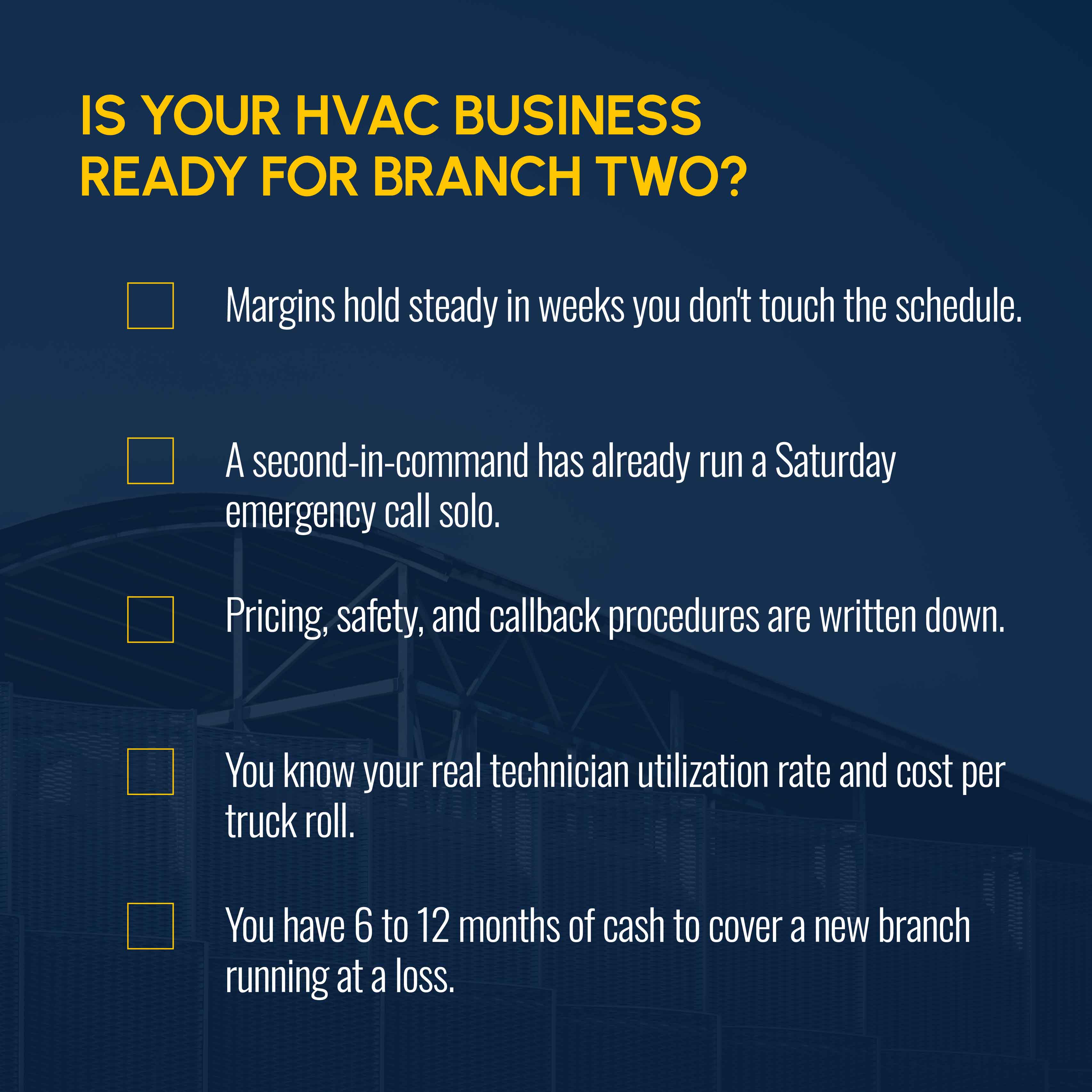
Scaling HVAC operations across multiple branches requires a few conditions at the first location:
- Your current location's margins hold steady even in weeks you don't touch the schedule or the job costs.
- A second-in-command has already run a Saturday emergency service call, priced a job, and handled an unhappy customer without a phone call to you.
- Pricing, safety, and callback procedures live in writing, not in your head. Crews follow them without you micromanaging them.
- You know your real technician utilization rate and cost per truck roll for the current shop, rather than the estimate you'd give to a banker.
- You're carrying enough cash to cover six to 12 months of a new branch running at a loss on top of what the first branch needs.
Consider a commercial contractor chasing a run of new-construction work. The new branch had four technicians and a $1.8 million backlog by its first quarter, but no one on-site could approve a change order over $500 without reaching the owner. That was a problem, because he sat three counties away on his own calls. Jobs sat half-finished for days while waiting on a signature.
The operational fix: Before you sign the lease, name a branch leader and give them real decision authority. You can’t grow your HVAC business if crews don’t know whose orders to follow.
Related: Learn how to scale an HVAC business at the first location, including adding trucks and raising prices, before setting up a second address.
7 Systems for Managing and Scaling a Multi-Branch HVAC Business
After a business decides a second branch is needed, the work shifts to building systems that keep two locations from becoming two different companies. Here are seven tips for running a multi-location HVAC business so you’re scaling cleanly, not just adding overhead with every new address.
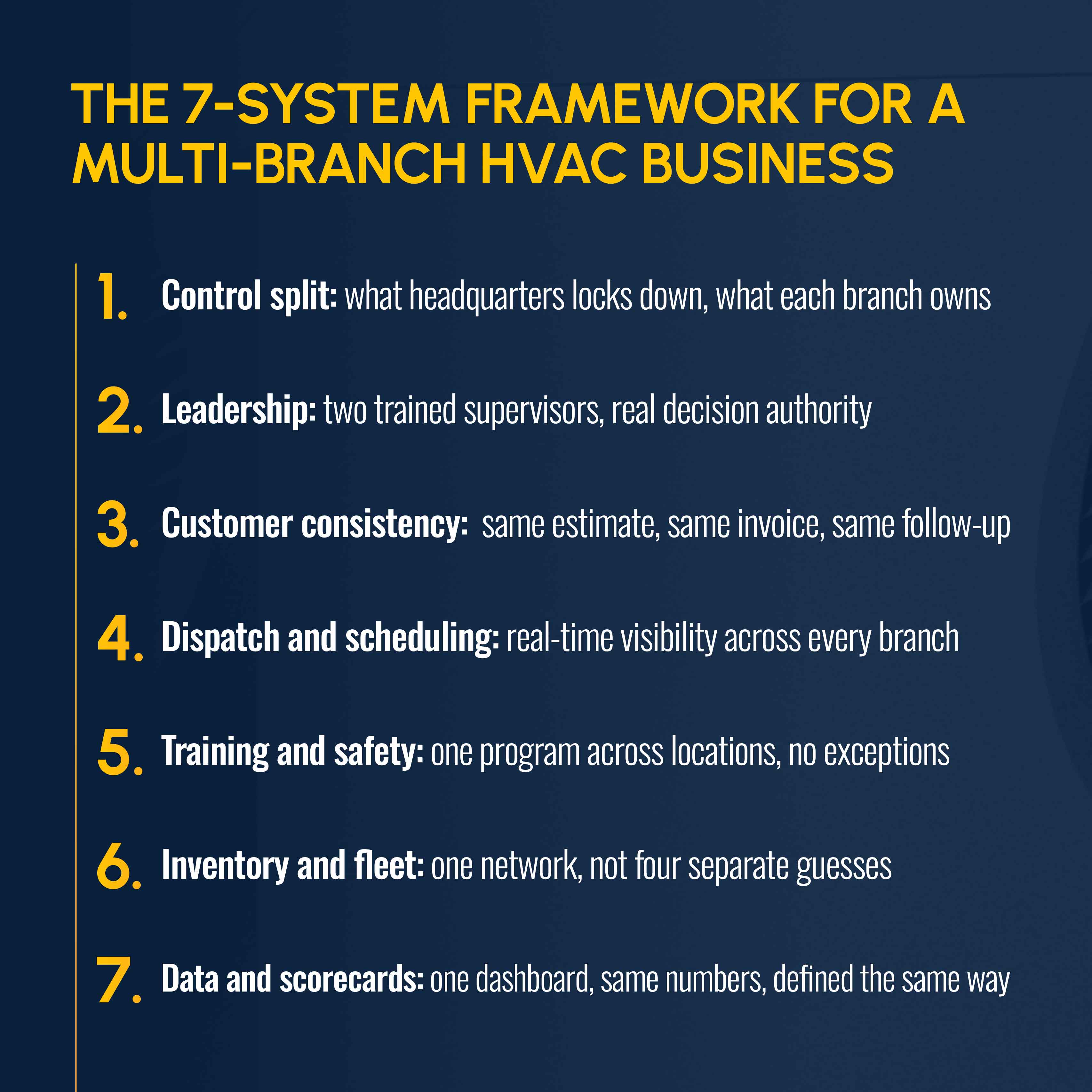
1. Define What Headquarters Controls and What Each HVAC Branch Owns
Every multi-branch operator eventually has to draw a line between what lives with corporate and what a branch manager decides. Most wait too long. Pricing structure, safety protocols, billing rules, and the chart of accounts belong at headquarters. No branch manager should invent a change-order threshold or skip a safety checklist because a customer is in a hurry.
Some decisions can flex by market, like scheduling priorities, technician territories, and how a branch handles a slow Tuesday. A fast-growing suburb needs a different staffing rhythm than an older, built-out neighborhood.
One thing can never flex, no matter the market: How every branch measures itself. If one branch marks a job "closed" on the scheduled date, but another branch doesn’t close it until the paid date, headquarters is getting two sets of data.
Write a one-page document listing what’s non-negotiable versus branch-flexible before branch two opens. Give it to every branch manager you hire.
2. Give Every Branch Accountable Leadership and Clear Decision Rights
A branch without a real leader runs on whoever's phone rings first. Put two trained supervisors at every new location before the doors open: one who runs daily operations, the other who can step in if the first gets poached, is promoted, or takes vacation. Training is key: Promoting your best technician without preparing them is how a great technician becomes an ineffective manager.
Give that leader real authority over daily calls: which jobs get bumped, which customer gets a discount, when a crew clocks out. If every decision above $200 needs a call to headquarters, you've built a satellite office, not an actual branch.
Stay visibly involved for the first year, then step back for the long term. Weekly calls beat monthly ones, and an in-person visit when the numbers look off beats a text asking what happened.
3. Standardize the Customer and Job Life Cycle Across Every Location
A customer calling different branches should get the same estimate range, maintenance-plan pitch, and invoice format to the point where they might not know which location they called.
That consistency is worth real money. A commercial account managing three properties across your service area thinks they’re dealing with one company, not three pricing sheets stapled together. Consistent maintenance agreements are even more important, as predictable recurring revenue evens out the cash-flow gap between slow branches and busy ones.
Try to hold that consistency together with a spreadsheet and a QuickBooks file per branch, and it slips by the third estimate: pricing drifts, a checklist gets skipped, and the customer's history lives on whichever laptop last touched the account. Better tech can help. You can:
- Build the job lifecycle once, book to invoice, and lock it into one shared platform instead.
- Use digital checklists to ensure the same quality for an A/C changeout, furnace tune-up, or compressor swap, even if the technician hasn't met the customer before.
- Have AI to flag a missed step or an out-of-range quote before it goes out the door instead of after the callback.
- Make sure customer histories automatically follow the account, not the branch. A 10-year existing customer shouldn't start from scratch just because a different crew shows up.
The same consistency is needed with potential customers, too. When people search for HVAC services near your new branch, they should find the same reviews and reputation you’ve built at the flagship shop. Consistent HVAC marketing across every location is an important way for multi-branch groups to build trust in a new market.
4. Coordinate Scheduling, Dispatch and Workforce Capacity Across Branches
During a heat wave, one branch's board fills up by 9 a.m. while a branch 20 minutes away has three technicians with nothing booked past lunch. If your dispatchers only see their building’s schedule, rather than the entire business, a $9,500 same-day system replacement will go to whoever answers the phone fastest. This lack of visibility shows up on the P&L every time.
That kind of visibility doesn't come from dispatchers trying harder. It comes from working off one shared board instead of two systems that don't talk to each other.
For example, a whiteboard at Branch A and a separate calendar at Branch B can't route a same-day job across town, no matter how good either dispatcher is. Dispatchers at every location need real-time visibility into every technician in every branch, so they can route jobs to whoever's free instead of waiting for a local slot. Some platforms use AI to automate routing decisions, surfacing the closest available tech instead of guessing. Every avoidable truck roll and every idle technician shows up in your avoidable dispatch rate, which is worth tracking across branches.
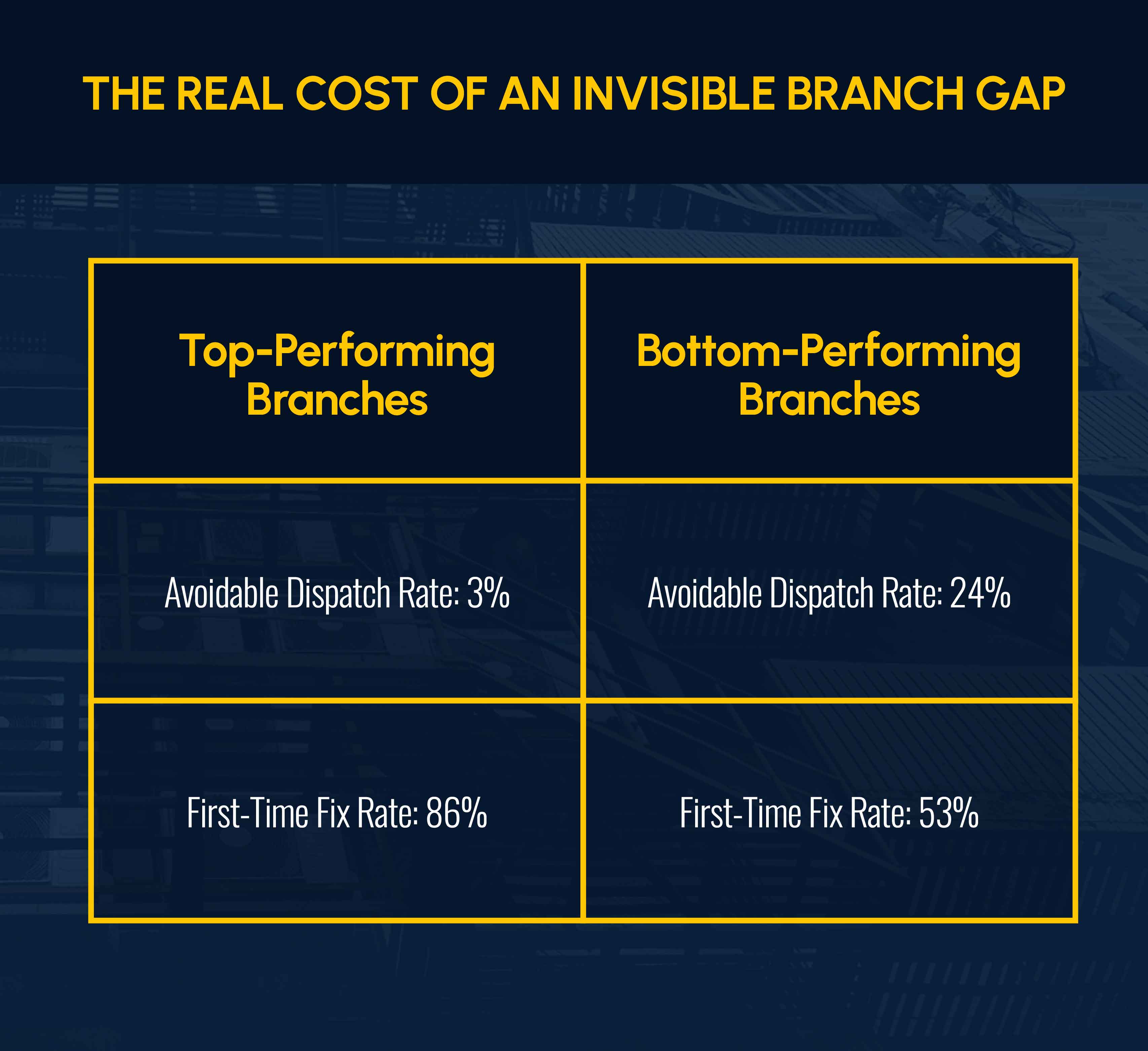
Aquant's 2025 Field Service Benchmark Report found top performers run an avoidable dispatch rate around 3%, versus 24% for the bottom quintile. The same gap shows up in first-time fix rate: Top performers clock at 86%, versus 53% at the bottom. The more branches you have, the bigger that gap gets.
Related: See how to optimize HVAC scheduling and dispatching, especially once you have multiple locations.
5. Build One Technician Training, Safety and Performance System
The technician shortage is already squeezing the HVAC industry, and it’s not letting up. The U.S. Bureau of Labor Statistics projects roughly 40,100 openings a year for HVAC technicians through 2034, and every HVAC company near you is fishing in the same shrinking pool. Without a consistent training program, multi-branch operators are at a disadvantage. Word travels fast about which shops develop people and which churn through them.
Onboarding, safety certifications, and skills progression should be the same across every branch and tied to a shared standard like ANSI/ACCA Quality Installation guidelines rather than the senior tech’s preference. If a technician transfers branches or covers a shift during a surge, they should already know how that branch runs a call.
Build the training system once at headquarters, then require every branch to run it identically instead of letting each location invent its own version.
6. Manage Inventory, Purchasing, Fleet and Equipment as One Network
HVAC inventory doesn’t sit in one place. It's split across a central warehouse, service trucks, jobsites, and whatever's in the van from last week's pickup. This is true at a single location and multiplies with additional branches unless you have one network for purchasing, inventory, and fleet.
Here’s what happens without a single network: A technician responds to an emergency same-day install and realizes they need a replacement condenser. But it’s on a shelf 18 miles away at a sister branch, and the company’s separate systems can’t find it. Instead, the office places a rush order at nearly double the standard cost, and the customer waits two extra days for a repair that should have taken one.
Here’s what to do: Centralize the inventory record, including the item name, quantity, which truck or warehouse it's sitting in, reorder point, and cost. Make it visible to every branch and every dispatcher. The same logic covers trucks and major equipment. You’re wasting money if a cargo van sits idle at one branch while another branch pays for a rental during a surge. It’s the same problem as a stranded compressor does, just on wheels.
When you have shared supplier catalogs and vendor pricing across branches, you also have better purchasing terms than any single location could negotiate alone.
Related: Review HVAC inventory management best practices for the mobile tracking and cycle-count habits that keep inventory accurate once multiple branches pull from the same shelves.
7. Run Every HVAC Branch From One Data Source and Performance Scorecard
Every branch manager should open the same dashboard every morning and see the same numbers defined the same way: revenue, technician utilization, first-time fix rate, callback rate, customer satisfaction, and average ticket size per branch and rolled up.
This applies to status, too: When a job is considered "closed" should be the same regardless of location.
Run weekly cross-branch reviews and recognize whichever branch improved the most that week, not just whichever branch already sits on top. A struggling branch that closes a 10-point gap in callback rate deserves attention, especially if a strong branch is treading water at last quarter's numbers.
Generate financials both by branch and combined, then decide whether each location runs its own P&L or rolls into a consolidated set of books. Sloppy financial tracking is one of the fastest ways to stall HVAC business growth, and guessing wrong on that structure means redoing your chart of accounts while multiple branches are already live.
Related: These HVAC business KPIs break down which numbers predict branch health, even before your P&L reveals the problem.
A Rollout Plan for a New or Acquired HVAC Branch
Opening a branch and integrating an acquisition aren't identical, but they collapse into the same three-stage timeline once the lease is signed or the deal closes. Here's what needs to happen at each stage, whether you're building from empty concrete or absorbing a company that already runs things its own way.
| Stage | What the business should complete |
|---|---|
| Before launch or integration | Finalize the document of what headquarters controls versus branches. Hire and train two supervisors: one lead, one backup. Confirm 6 to 12 months of operating capital beyond what the branch needs to break even. Set up the new branch's Google Business Profile and local listings before opening day. Load the branch into the shared scheduling, inventory, and reporting system before a single job is booked. |
| Launch and first 30 days | Run every job through the standardized life cycle with no shortcuts. Hold daily check-ins with the branch leader. Track avoidable dispatch rate and first-time fix rate from week one, even on a thin schedule. Resolve pricing or process conflicts, especially with an acquired team, in writing. |
| Days 31 to 90 | Move to weekly cross-branch performance reviews. Judge the new branch against a 20%–30% discount on mature-branch numbers, not a location that's been running for years. Fold the branch into the same monthly financial roll-up as every other location. Document what breaks, and fix the playbook before the next branch opens. |
Give Every HVAC Branch One Operational View With Simpro®
Everything in this playbook is the operational core Simpro was built for, including shared dispatch, one inventory record, branch-level and consolidated financials, and standardized job workflows.
Simpro's Multi-Company setup runs every branch, division, or separate legal entity from one build. Headquarters gets a single source of truth for jobs, inventory, and financials, no matter how the business operates, while each branch manager still gets a workspace scoped to their own operation.
You decide what's shared and what stays entity-specific. Customer contacts, supplier catalogs, and inventory can flow across every branch, while financials, employees, and job records stay locked to the entity that owns them. Reports generate by branch, by entity, or rolled up across the group, so you're not exporting spreadsheets and reconciling them by hand every Friday.
Buchanan & Hall, a 25-employee commercial refrigeration, HVAC, geothermal, and residential HVAC contractor, used to run quoting, materials, and job tracking on disconnected systems. Now, they run it all from one build.
Simpro Lightning adds an AI layer on top that optimizes scheduling, workforce management, and materials optimization. Close the branch-to-branch performance gap before it shows up as a callback rate or a missed same-day job.
Simpro supports more than 250,000 users and 24,000+ businesses worldwide, many of them running exactly this kind of multi-branch or multi-trade operation.
Related: Find out how a connected HVAC operating platform does for a growing HVAC group beyond the scheduling basics.
Build a Multi-Branch HVAC Business That Increases Profit, Not Management Overhead
Right now, you're probably running the math on whether branch two or branch five is worth the headache. Use that as a signal: The tools and instincts that worked for a single location can’t support multiple locations.
Scaling a successful HVAC business cleanly has less to do with branch count and more to do with whether a manager three states away can pull the same numbers and work from the same inventory as the flagship shop without a phone call to headquarters.
Simpro gives every branch, division, or entity one operational view, from dispatch to inventory to the financials that show which locations make money and which ones just look busy. Schedule a demo today.


 Back to top