
Your stockroom says you have 20 capacitors. Your tech at the jobsite reports only four. The job stops because the tech has to drive to the supply house. That's an hour and a half of lost billable time.
That example shows how HVAC inventory management can fail your business on any given job. The industry average for inventory accuracy is only 63% for companies relying on manual processes. That means nearly 40% of your parts are miscounted, mislocated, or don't exist. Each one is a potential stockout, a failed first-time fix, or an underbilled job.
This guide covers 10 HVAC inventory management best practices, including how to classify and reorder parts, how to connect your warehouse and vans, and how to link inventory data to your job costs.
What Is HVAC Inventory Management?
HVAC inventory management represents the systems and processes used to track, replenish, and allocate parts and materials. Knowing how to manage HVAC inventory requires end-to-end tracking, spanning warehouses, service vans, jobsites, and supplier relationships.
Proper inventory control for HVAC companies has multiple knock-on effects. You maintain high first-time fix rates (FTFR). You reduce costs from over-ordering, emergency buys, and shrinkage. Job costs reflect what was actually consumed. Done poorly, problems compound. HVAC businesses can lose tens of thousands of dollars every year because of inventory inefficiencies.
What makes it hard is the scale. A midsized HVAC operation might carry thousands of stock-keeping units (SKUs) across warehouses, vans, and jobsites. Add in fluctuating seasonal demand and the constant movement of parts from location to location, and HVAC inventory optimization suddenly seems daunting.
10 HVAC Inventory Management Best Practices for Better Control
These best practices reflect what companies running the tightest HVAC operations actually do, rather than generic operations advice.
1. Treat Every Service Van as a Mobile Warehouse
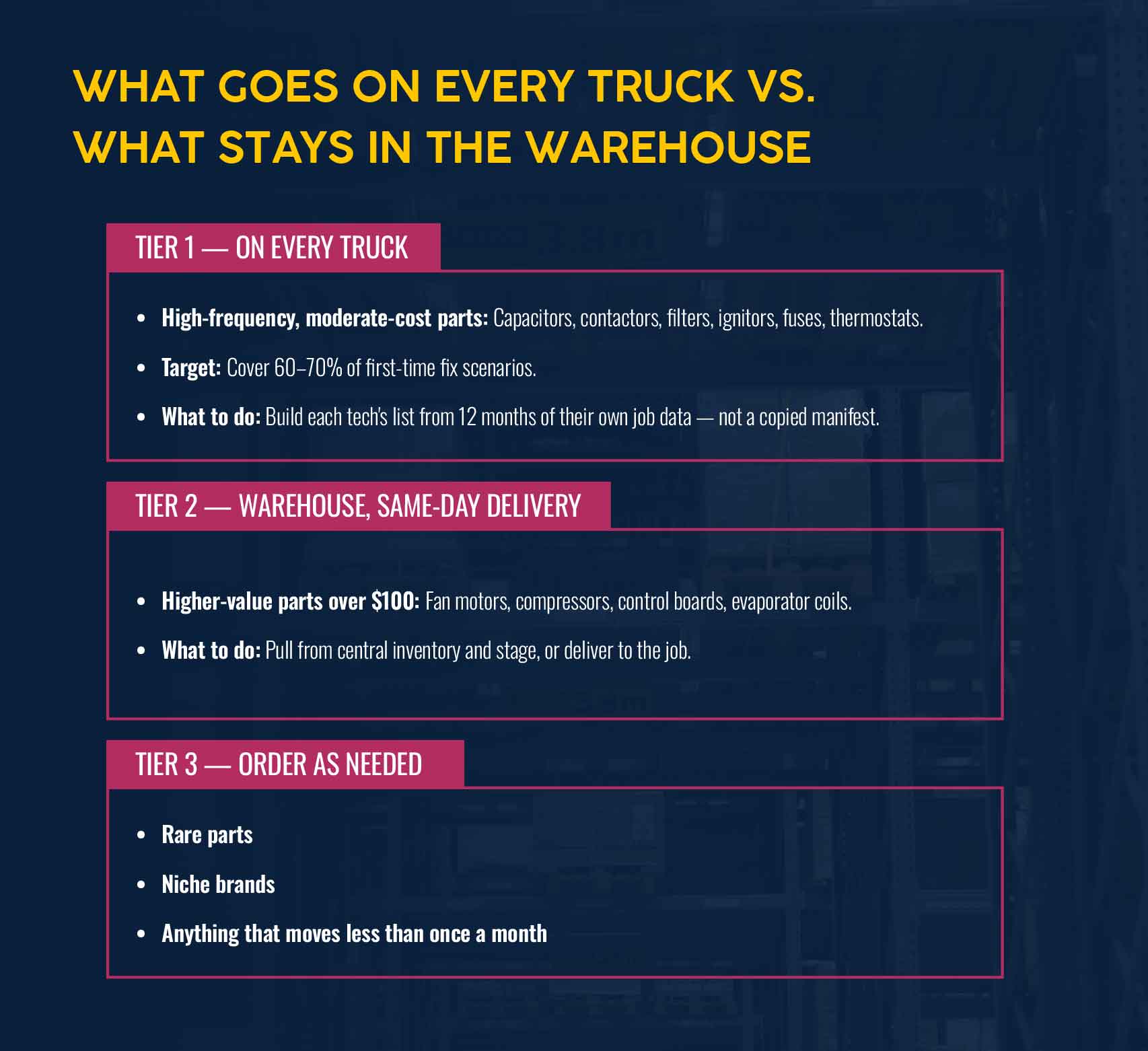
The vans in your fleet are individual inventory locations and should be treated like warehouses. Otherwise, you're running two inventory systems with no reliable data link between them.
Give each van a named storage location in your inventory system. Every part loaded into that van counts as a transfer, and every part used on a job is a deduction. Without this structure, van stock becomes a black hole.
Top HVAC companies analyze 12 months of parts usage per technician to build individualized van stock lists, rather than identical manifests for every truck. A residential tech servicing 15-year-old split systems in one neighborhood needs a different configuration than a commercial tech running rooftop units in three office parks.
The operational fix: Set up named storage devices for each van. Track transfers from warehouse to van as transactions, deduct parts when assigned to a job, and auto-generate replenishment pick lists from weekly van audits.
2. Create a Standardized HVAC Inventory List
A surprising number of HVAC companies manage parts by institutional memory, operating a de facto catalogue based on whoever placed the last order.
A standardized HVAC inventory list lays the foundation for everything downstream: reorder points, cycle counts, job costing, and van replenishment. Start by assigning every part a unique SKU, bin location, unit of measure, primary supplier, and cost
Build your list in tiers that reflect how parts move:
- Consumables: capacitors, contactors, fuses
- Replacement components: fan motors, gas valves, control boards
- Major assemblies: compressors, coils
Each tier requires different tracking rigor and counting schedules.
The operational fix: Audit your catalogue. Remove duplicates, add bin locations for everything, and confirm a primary supplier for each SKU.
3. Categorize Inventory by Part Type, Usage, and Value
Not all parts deserve equal management attention. Only 10–20% of your SKUs account for 70–80% of total inventory value. Managing a dual-run capacitor the same way you manage a compressor leads to overstocking cheap parts and understocking expensive ones.
ABC classification is the standard framework for HVAC inventory optimization:
| Class | SKU Share | Inventory Value | Examples | Management Approach |
|---|---|---|---|---|
| A: Critical | ~15% | ~75% | Compressors, condenser coils, control boards, evaporator coils | Weekly cycle counts, tight reorder points, demand forecasting |
| B: Important | ~30% | ~20% | Fan motors, gas valves, TXV valves, ignitors, contactors | Biweekly counts, min/max par levels, seasonal triggers |
| C: Routine | ~50% | ~5% | Capacitors, fuses, wire nuts, drain tablets, filters | Quarterly counts, two-bin or visual kanban |
Recalculate your classifications quarterly. A part that's A-tier in summer may drop to B-tier by November.
4. Set Par Levels and Reorder Points for Critical Parts
Guessing when to reorder is how you end up with six weeks of backordered thermostatic expansion valve (TXV). Reorder points for HVAC parts should be calculated per SKU using real-life consumption data:
Reorder point = (Average daily demand × supplier lead time) + safety stock
Threshold-based reordering reduces stockout incidents because it's automatic and removes the need for humans to remember and take action.
Here's an example: A 40/5 MFD dual-run capacitor averages 3.2 units of daily demand, a 5-day supplier lead time, and 8 units of safety stock. That means its reorder point should be 24. When stock drops to that level, a purchase order (PO) goes out.
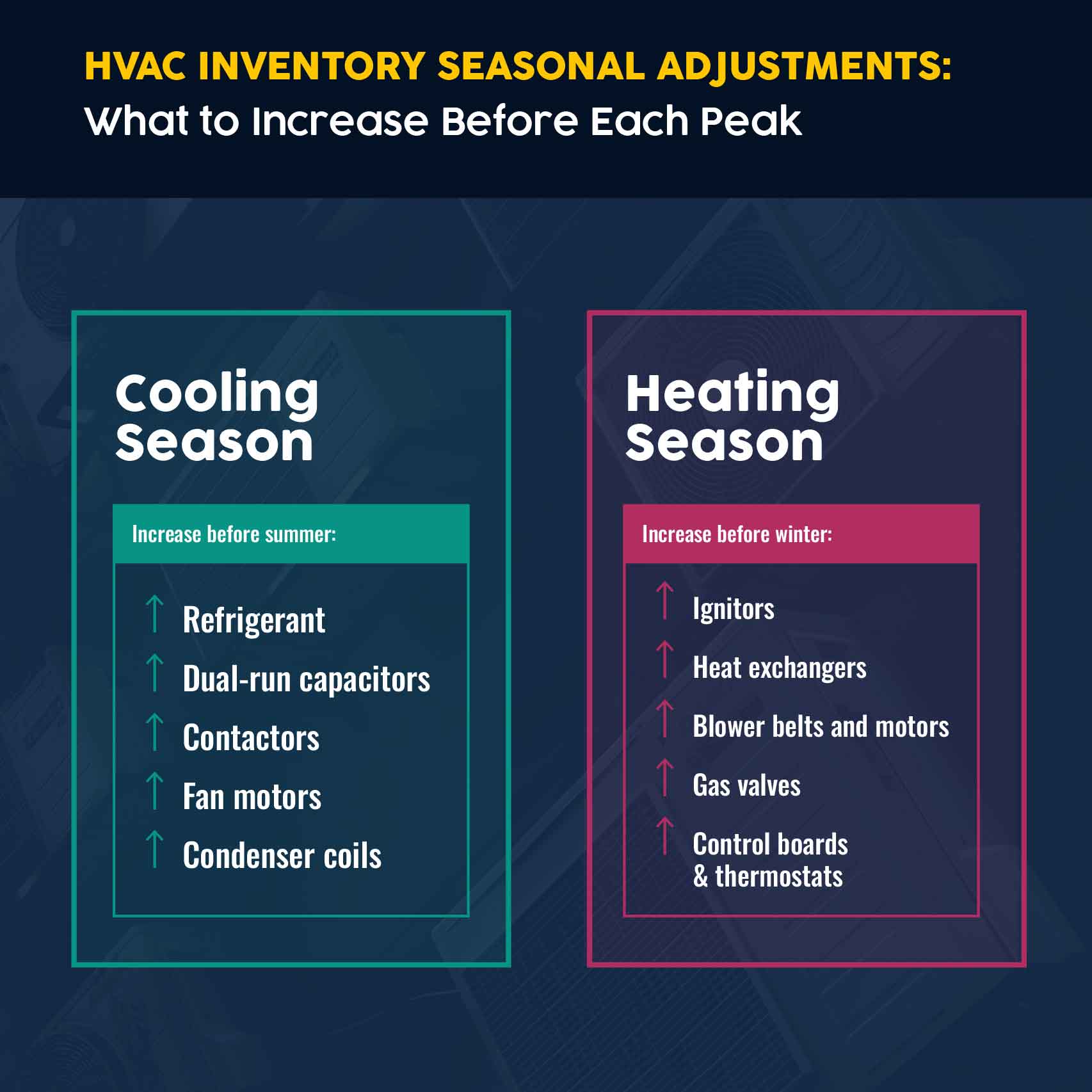
Seasonal adjustment is non-negotiable. Before summer, increase refrigerant, contactors, and capacitor stock. Before heating season, increase ignitors, heat exchangers, and blower belts. Failure to adjust January's min/max levels will create summer stockouts. Fortunately, your job history contains the data you need.
The operational fix: For your top 20 A-item SKUs, calculate a reorder point using the above formula. Set those thresholds in your inventory system this week.

5. Track Part Usage from the Field in Real Time
Manual tracking means that accuracy degrades within days. If technicians fill in paper logs at the end of the day or skip logging altogether, your inventory data becomes unreliable even faster. By month-end, it's fiction.
Barcode scanning can reduce warehouse inventory errors to near-zero compared with manual methods. Implementation is simple: Make scanning faster than not scanning. Every bin gets a barcode label. Technicians scan when loading vans and using parts, and the job number automatically links to the work order.
This simple habit maintains inventory accuracy and keeps job costs honest. You can't know what a job actually costs if you don't know which materials were used.
The operational fix: Require technicians to document all parts usage against a job number at the point of use. Enforcing such discipline produces more reliable data and makes your reporting dashboard actually useful.
Related: How to track HVAC inventory with field service software.
6. Connect Inventory to Work Orders, Estimates, and Invoices
Most HVAC companies track parts reasonably well. They just don't connect that tracking to estimates, work orders, and invoices. Parts get used on jobs but never make it onto the invoice. Estimates include materials at catalog price, not the actual purchase cost. Each job's gross margin looks healthy until you reconcile the materials and find a bunch of unbilled items.
Connecting inventory to work orders closes that loop. When a technician pulls a part from a storage location and assigns it to a job, that transaction should simultaneously update inventory, post to the job cost, and flag the item for billing.
First-in, first-out (FIFO) costing makes this more accurate. The purchase price posts to the job, not a blended average, giving you real-time gross margin by job, not an approximation.
Related: Protect revenue and margins with AI.
7. Run Regular Cycle Counts and Truck Audits
Even the best annual physical inventory can shut down operations for a day or two, with error rates as high as 33% for the worst performers, according to CAPS Research data. Continuous cycle counting achieves 97–99% accuracy, is faster, and doesn't disrupt your operations.
The schedule mirrors your ABC classification:
- A items: Count weekly, verify at least monthly.
- B items: Count biweekly, verify at least quarterly.
- C items: Count monthly, verify at least twice a year.
"We count our inventory almost every day as opposed to waiting till the end of the month, quarter, or year," said Johan Miranda, operations manager at Century A/C Supply in the Houston area.
Get inventory accuracy above 95% before optimizing reorder points or par levels. Everything else depends on the counts being right.
The operational fix: Pull your last physical count accuracy rate. Below 90% is a systemic failure, not a staffing problem. Implement weekly cycle counts for your top 20 SKUs. Set a 30-day target to get 95%+ accuracy on those items.
8. Forecast Seasonal Demand Using Historical Job Data
It's summer, and you're short on contactors, same as last year. What prepared companies do differently is run usage reports before placing Q2 orders.
Analyze 12+ months of service history to build demand-based reorder quantities by SKU and by season. Cooling season brings spikes for refrigerant, capacitors, and contactors. Heating season sees higher demand for ignitors, heat exchangers, and blower belts. The data is already in your work orders.
Seasonal HVAC inventory optimization also frees up working capital. Companies running quarterly usage analysis can identify notable inventory reductions without affecting service capability.
The operational fix: Before each season, pull a trailing 90-day usage report for your top 50 parts and compare against current stock levels. Then, adjust min/max thresholds. It's a two-hour exercise that prevents six weeks of summer stockouts.
Related: How to grow an HVAC business.
9. Manage Suppliers, Purchase Orders, Returns, and Warranty Parts in One Process
When POs, warranty tracking, and supplier pricing live in separate management systems (or worse, in spreadsheets and email), errors compound at every handoff.
High-priority parts require even more care. Maintain active relationships with at least two suppliers, and track their performance systematically. That means on-time delivery rate, order fill rate, and invoice accuracy.
Address performance issues before they create stockouts. Being willing to change suppliers amid poor service levels is accountability, not disloyalty. For high-volume consumables, consider vendor-managed inventory programs, where suppliers monitor usage and maintain stock at agreed-upon levels. Doing so can reduce carrying costs and administrative overhead.
The operational fix: Start tracking on-time delivery rate and order fill rate for your top three suppliers. You need that data before you can have a meaningful conversation about pricing or performance.
10. Review HVAC Inventory KPIs to Find Margin Leaks
Without tracking metrics, your HVAC inventory management efforts won't reveal problems until they become expensive. Review these HVAC inventory recommendations for core monthly metrics to benchmark against:
| Metric | Target | Warning Threshold |
|---|---|---|
| Inventory Accuracy | ≥97.5% | Below 90% = systemic failure |
| Inventory Turnover | 4–6× annually | Below 3× = overstocking; above 8× = stockout risk |
| Stockout Rate | <2% | Track by SKU |
| Dead Stock % | <5% of total value | Above 10% = trapped capital |
| First-Time Fix Rate | ≥88% | Below 72% = van stocking misaligned |
| Parts-Run Frequency | Track per tech | Rising trend = reorder points wrong |
Every HVAC warehouse has zero-movement inventory. But when dead stock surpasses 10% of total inventory value, that's capital tied up in parts that will never move at full price. Run a 12-month no-movement report whenever you're trying to improve inventory. Everything on that list is a candidate for supplier return, transfer, discount sale, or write-off.
Customer service quality in field operations starts by stocking trucks based on actual usage data. Top service companies achieve 82–92% first-time fix rates, and HVAC companies need to match that. For a services company running 100 calls per week, improving FTFR from 70% to 85% can save roughly $200,000 annually.
Related: The top 26 HVAC KPIs to know about in your business.
How HVAC Inventory Management Software Helps Companies Stay in Control
Growing HVAC businesses know when manual processes stop scaling. Spreadsheets can't keep up when inventory spans a central warehouse, five service vans, and two active jobsites. That's when you need an inventory management system built for field operations.
Field service management software that's purpose-built for trades can handle the full inventory workflow from one system: Tracking stock across every location in real time, alerting when parts hit reorder thresholds, generating POs from the warehouse or the field, and connecting every job-used part to the work order and invoice.
Simpro® is built for commercial trade contractors, handling service-based and project-based inventory from a single platform. Stock is organized by storage device: your main warehouse, each van assigned to a technician, and specific jobsites. Every transfer is a tracked transaction. When a technician assigns a part to a job, the inventory count updates, the job cost posts, and the part is flagged for billing. No separate steps or disconnects.
Simpro's stock management runs on FIFO costing, so the actual price posts to the job rather than a blended average. The barcoding portal runs cycle counts by tablet scan. Minimum-stock-level alerts trigger at reorder thresholds automatically, and POs can be created from the desktop or in the field via mobile app.
For HVAC operations using an HVAC maintenance checklist to drive preventive maintenance revenue, parts pre-staged for a scheduled PM call are deducted from stock automatically when the job closes, with no manual adjustment.
More than 24,000 businesses trust Simpro to run their trade operations, with users reporting up to a 30% increase in productivity from tighter workflows across scheduling, inventory, and invoicing.
Quick HVAC Inventory Management Best Practices Checklist
Use this to identify where your current system has gaps:
- [ ] Every service van has its own named storage location in your inventory system.
- [ ] You have a standardized parts catalog with SKUs, bin locations, and primary suppliers assigned.
- [ ] Parts are classified by ABC tier with different counting schedules per class.
- [ ] Reorder points are set using consumption data, not estimates.
- [ ] Technicians log part usage against job numbers at point of use.
- [ ] Parts are assigned to jobs post automatically to job cost and flagged for billing.
- [ ] Cycle counts run weekly for A items, biweekly for B items.
- [ ] Seasonal min/max adjustments happen quarterly and before each peak period.
- [ ] You track on-time delivery and fill rate for your key suppliers.
- [ ] Each month, you review inventory accuracy, turnover, stockout rate, and FTFR.
How many boxes did you check? Less than seven means your HVAC inventory has identifiable gaps with real costs, including shrinkage, failed first-time fixes, and underbilled jobs.
Control HVAC Inventory And Keep Jobs Moving With Simpro
Every extra parts run has a cost of $150–$300 in fuel and lost labor. A fleet of eight trucks averaging one parts run every three days generates $9,600–$19,200 in monthly losses that don't show up on the P&L.
Effective inventory management separates the HVAC companies growing past $3 million from those that plateau. These leaders ensure everything is documented, classified, counted, connected to the work order, and benchmarked against real numbers. They prevent repeat visits and unhappy customers. And it's what HVAC marketing strategies require: an operation that can deliver on what it sells.
Simpro's field service platform gives you the tools to get HVAC inventory under control and keep it there — across warehouses, vans, and every job your crew runs.
Schedule a demo to see why Simpro is the best HVAC inventory software to manage stock across locations, connect parts usage to job costs, and stop losing margin to inventory gaps.


 Back to top