
Your second branch was supposed to double your revenue. But it also doubled your phone calls, your spreadsheets, and the number of things that can go wrong before you find out about them.
That's the real story behind managing a multi-branch electrical business. Adding a location multiplies every gap in your systems. The estimate that used to live in your head now needs to live somewhere your branch manager two towns over can find it. The pricing that felt consistent because you set every quote yourself now varies by whoever's writing it that day. The electrical contracting business that ran fine on instinct at one location starts leaking margin the moment a second one opens.
None of that means expansion was the wrong call. As your business grows from a small electrical operation into a multi-location one, some growing pains are simply the cost of getting bigger. Firm size in the trade is already moving in that direction. According to a recent National Electrical Contractors Association industry profile, more than half of electrical contractors are still small operations with fewer than 10 employees, but the number of firms with 10 or more employees is climbing while the smallest shops shrink in share. Revenue growth is concentrating in larger, multi-crew operations, not spreading evenly across every one-truck outfit. Growth is happening. The question is whether it's happening with a plan or by accident.
This piece breaks down how to scale an electrical business to multiple locations without losing the operational control that made the first branch profitable. Whether you're opening your second location, running three branches that feel like three different companies, or bolting an acquired business onto your existing one, the same eight systems apply.
Is Your Electrical Business Ready to Open Another Location?
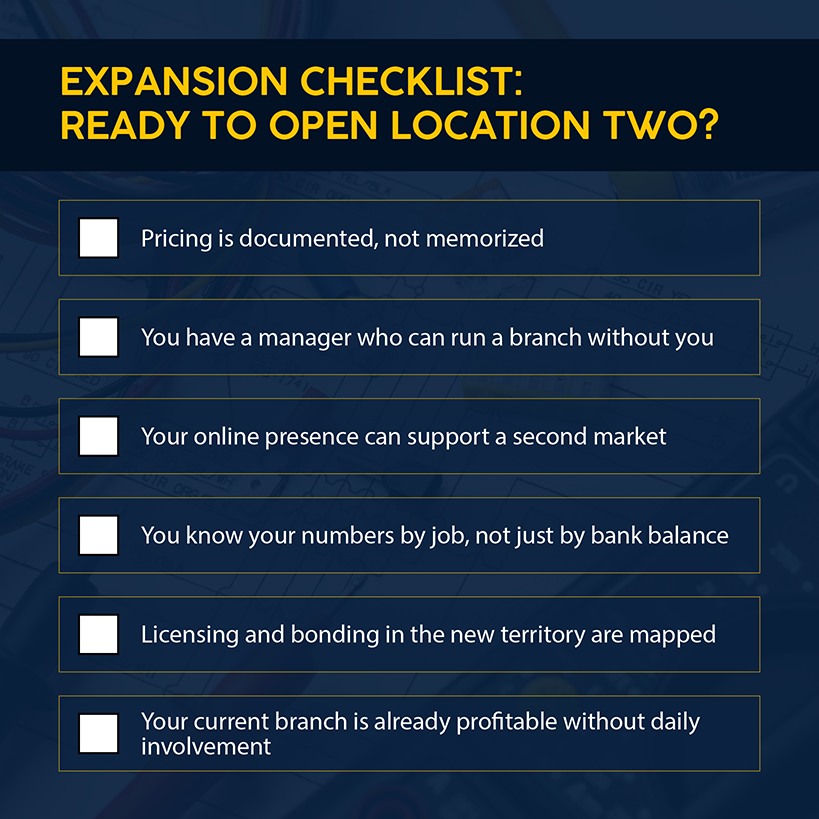
Before you sign a lease or take over a new crew, run through this checklist. Answering "not really" to more than one or two of these means fix the gap before you open the doors.
- Your pricing is documented, not memorized. If estimating lives in one estimator's head, a second location will produce two different price books by accident.
- You have a manager who can run a branch without you in the building. Someone who can make hiring, scheduling, and customer calls without a daily check-in.
- Your online presence and reputation can support a second market. A new territory means new potential customers and potential clients who've never heard of you. Your online presence, social media activity, and review volume need to exist there before the trucks do, not after. Know your unique selling point in that market before a competitor does.
- You know your numbers by job, not just by bank balance. If you can't say which service calls or project types are actually profitable, a second location doubles the mystery.
- Licensing and bonding requirements in the new territory are mapped, not assumed. Electrical licensing varies by state and jurisdiction, and assuming your current license travels with you is a common, expensive mistake.
- Your current branch is already profitable without your daily involvement. Expansion doesn't fix a location that only works because you're standing in it.
If most of those are true, you're ready to think about systems, not survival.
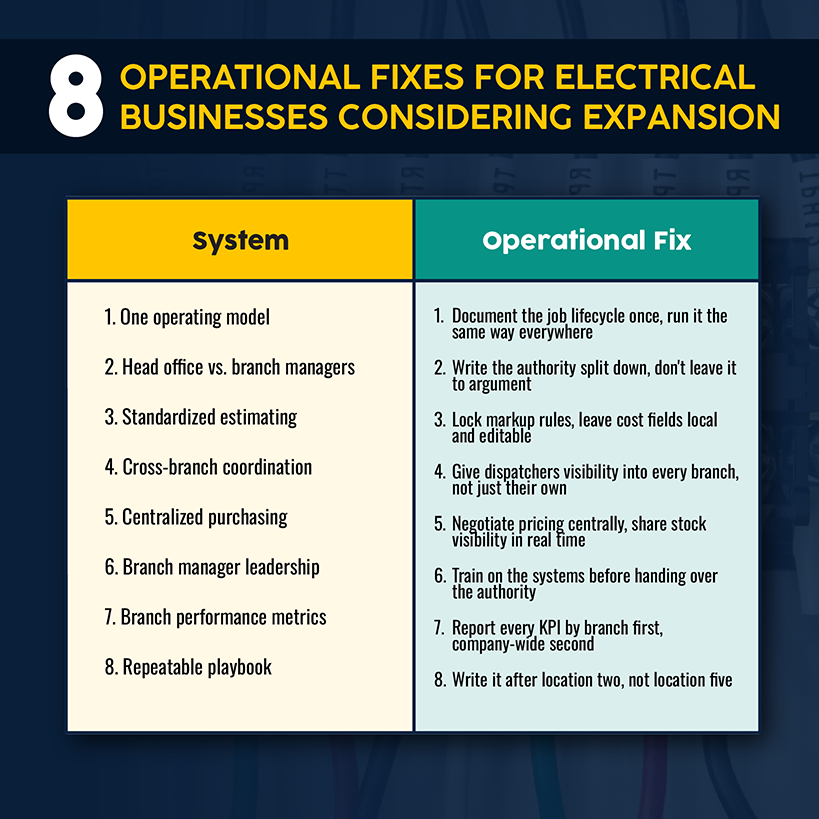
8 Systems for Managing Multiple Electrical Branches
Running a multi-location electrical contracting business well comes down to deciding in advance what has to be identical across every branch and what's allowed to flex. Get that split right and growth compounds. Get it wrong, and every new location becomes a new version of the same problems.
1. Create One Operating Model for Every Branch
The fastest way to lose control of a second location is to let it build its own way of doing things: its own quoting habits, its own version of a service ticket, its own definition of "done." This may feel efficient in the moment. It becomes expensive six months in when you're running the same electrical contracting business as three unrelated companies that happen to share a logo.
Every branch should run the same intake process, the same job workflow, and the same customer communication standard, even if the market, crew size, or mix of electrical services looks different. That doesn't mean rigid. A commercial-heavy branch and a residential-heavy branch will look different day to day. It means the sequence a job moves through from lead to invoice doesn't change depending on which branch picked up the phone. A customer with an electrical system problem should get the same high-quality response no matter who answers.
Businesses running disconnected field service workflows across locations tend to discover the gaps the hard way, usually through a customer complaint that reveals two branches were never actually doing the same thing.
The operational fix: Document the job lifecycle once, from first contact to final invoice, and require every branch to run it in the same system, not just follow it in spirit.
Related: DC Electrical grew from 2 to 60+ employees and expanded into three related businesses by putting them all on one operating model instead of three separate ones.
2. Define What Head Office Controls and What Branch Managers Own
Centralizing everything creates bottlenecks. Decentralizing everything creates chaos. Businesses that scale well draw a clear, written line between the two.
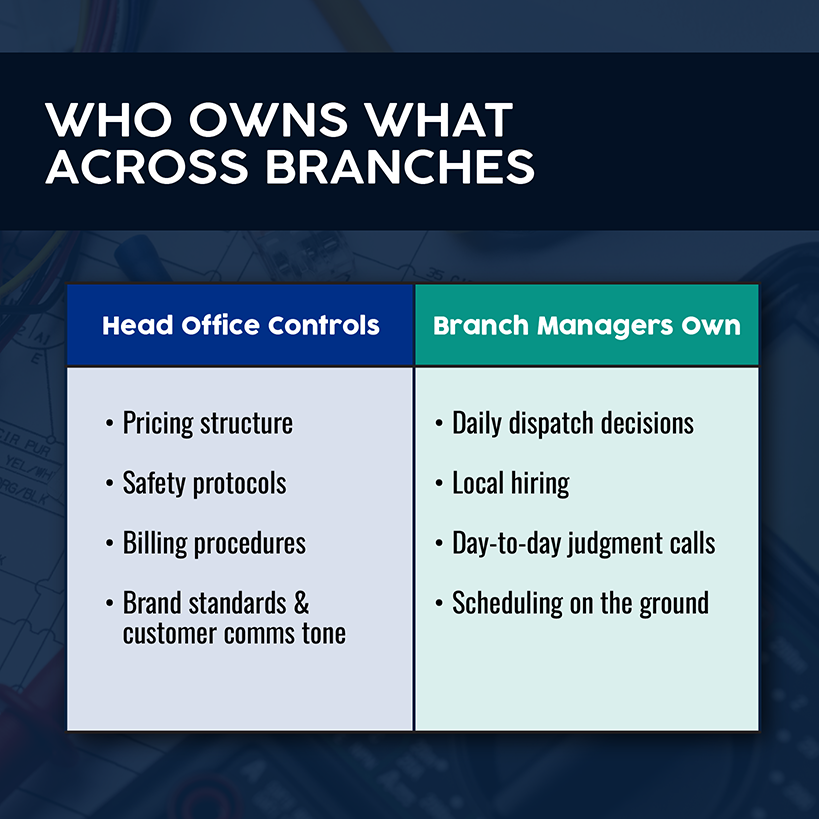
The head office should own things that keep a customer's experience the same whether they call your original branch or the one that opened last quarter, including:
- Brand standards, including customer communication tone, service guarantees, and how you ask customers to leave reviews
- Pricing structure
- Billing procedures
- Safety protocols
Give branch managers real authority over daily dispatch decisions, local hiring, and the day-to-day judgment calls no policy document can fully anticipate.
The operational fix: Write the split down. If a branch manager and head office disagree about who owns a decision, the document settles it, not whoever argues longer.
3. Standardize Estimating Without Ignoring Local Costs
Estimating is where multi-branch inconsistency shows up first and does the most damage. One branch quotes a service panel upgrade at a healthy margin. Another branch, working off the same job type but a different estimator's gut feel, quotes it $400 lower, and now you've got two different reputations for the same electrical services under one company name.
The fix isn't forcing every branch to charge identical prices regardless of market. Material costs, labor rates, and permit fees genuinely differ by region. The fix is standardizing the estimating process itself: the same markup logic, the same labor time assumptions, the same underlying template, while allowing local cost inputs to flex within it. That's how you standardize electrical estimating without pretending every market costs the same to operate in.
Estimating software that locks the markup rules in place while leaving cost fields open for local editing makes that the default, instead of something every estimator has to remember to apply correctly.
The operational fix: Build one estimating template with locked-in markup rules and local, editable cost fields, not one price list you're constantly overriding by hand.
4. Coordinate Electricians, Vehicles and Work Across Locations
Siloed branches mean siloed crews, and in a trade already short on licensed talent, that's an expensive way to run things.
The U.S. Bureau of Labor Statistics projects electrician employment will grow 9 percent from 2024 to 2034, with roughly 81,000 openings a year, in an occupation that already supports about 818,700 jobs nationally. That growth is good news for the industry and a genuine staffing challenge for anyone trying to keep multiple branches fully crewed.
Treating each location's electricians as a separate, fixed pool wastes capacity you don't have to waste. When one branch is buried in service calls, and another has a slow week, shifting a technician or vehicle across the line, even temporarily, is often the difference between hitting a deadline and explaining a delay.
That only works if a dispatcher can see every technician's location, licensing, and availability across branches on one screen, not just their own branch's calendar.
The operational fix: Build cross-branch visibility into scheduling so a dispatcher at any location can see technician availability company-wide, not just at their own branch.
5. Centralize Purchasing While Maintaining Branch-Level Inventory Visibility
Two branches buying the same conduit, breakers, and fixtures from two different suppliers, at two different prices, with no visibility into what the other has on a shelf, is one of the quieter ways multi-location electrical contractors bleed margin. It doesn't show up as one big loss. It shows up as dozens of small ones, every week, that never get flagged because no one's looking at purchasing across the whole business.
Centralizing purchasing negotiations while keeping inventory visibility at the branch level solves both problems. You get the volume pricing that comes from buying as one company, and branch managers still know exactly what's on their shelves, ideally what's on a nearby branch's shelves too, so a shortage on one job doesn't automatically mean an emergency supplier run. This kind of visibility is also where AI-supported inventory tracking is starting to change the math, flagging shortages before a crew is standing at a job site without the part they need.
The operational fix: Negotiate supplier pricing centrally, but give every branch manager real-time visibility into stock across all locations.
Related: Keece Electrical Services runs branches across five cities on one platform, standardizing purchasing alongside quoting and job-level profit tracking so no location is buying or stocking in isolation.
6. Build Branch Managers Who Can Lead Without Creating Separate Companies
A branch manager's job is to run daily operations with the authority to make calls without waiting on you. However, this role still needs to operate as a part of a single electrical contracting business rather than a satellite version of it. That narrows the skill set more than you might think. The best field electricians aren't automatically the best branch leaders. Promoting your strongest technician into a management role without support tends to leave you with a struggling manager and one fewer great electrician.
Good branch leadership means owning local scheduling, customer service, hiring, and project management on the ground, while staying inside the pricing, safety, and reporting standards set at the company level. The managers who do this well treat those standards as guardrails, not obstacles, because they've seen what happens to the branch that skips them.
The operational fix: Train branch managers on the systems before you hand them the authority, not the other way around.
7. Compare Every Branch Using the Same Performance Metrics
You can't manage what you can't compare, and you can't compare what isn't measured the same way. If one branch calculates technician utilization one way and another calculates it differently, "we're doing better this quarter" is an opinion, not a fact.
Every branch should track the same core numbers, including job profitability, technician utilization, first-time fix rate, and customer satisfaction, calculated the same way every time. This is also where blended, company-wide numbers can quietly hide a problem. A healthy overall margin can mask one branch dragging the average down while another carries it. Tracking electrical business KPIs at the branch level, not just the company level, tells you where to spend your attention.
That only holds up if every branch is pulling those numbers from the same reporting system. A shared dashboard makes the comparison automatic. A pile of separate spreadsheets makes it a monthly reconciliation project nobody has time for.
The operational fix: Report every KPI by branch first, company-wide second, never the other way around.
Related: Enhanced Electrical scaled from 8 to 21 field technicians without adding office staff, crediting job-level P&L visibility for materially better bid accuracy.
8. Create a Repeatable Playbook for Opening or Acquiring Branches
Whether you're opening a new location from scratch or absorbing an electrical business you just acquired, the same mistake tends to happen: treating expansion as a one-off project instead of a repeatable process. Every new branch gets its own improvised setup and its own slow crawl toward matching how the rest of the company runs.
A written playbook covering software setup, hiring standards, local licensing and bonding requirements, pricing templates, and a 90-day integration timeline turns "opening a branch" from a scramble into a checklist. That matters even more with an acquisition, where you're not just opening a location but merging an existing team, an existing set of habits, and often an existing set of electrical contracts into your way of doing things.
The operational fix: Write the playbook after your second location, not your fifth. You'll have real lessons to put in it, and you'll need it sooner than you think.
A 90-Day Plan for Improving Multi-Branch Electrical Operations
If your branches are already open and already inconsistent, don't try to fix everything at once. A staged approach works better than a company-wide overhaul announced on a Monday.
- Days 1 to 30: Audit and baseline. Pull current performance from every branch using identical KPI definitions. Identify which branch is actually your best-run location, not your highest-revenue one, and treat it as your working template.
- Days 31 to 60: Lock in hard standards. Roll out standardized pricing logic, safety checklists, and billing procedures across every branch as non-negotiable, company-wide rules rather than location-specific suggestions.
- Days 61 to 90: Launch shared visibility. Give every branch manager the same dashboard, the same KPI scorecard, and a recurring cross-branch review. Recognize the most-improved branch as well as the top performer. Improvement is what tells you the system is working.
Use One Source of Operational Data Across Every Branch
Every system above depends on the same underlying requirement: your branches need to run on shared data, not five parallel versions of the truth. Separate spreadsheets, separate software tools, and separate customer databases per location don't just create extra admin work, they create separate businesses that happen to share your name.
Consolidating onto one connected operating platform means a customer's history follows their account, not their branch, so any technician at any location sees the full picture of who they're working for. It means job costing, inventory, and scheduling data flow into one place instead of getting reconciled by hand at month-end. And it means AI-supported tools, flagging a dispatch conflict, surfacing an inventory shortage, catching a margin slip before it becomes a pattern, actually have enough consistent data across branches to be useful instead of working off a partial picture at each location.
The businesses making this shift aren't doing it for the dashboards. They're doing it to protect electrical business margins that get harder to see, and easier to lose, the more locations you're running at once.
Scale Your Multi-Branch Electrical Business With Confidence
Right now, you're probably running your branches on shared instinct, a few key people holding the whole thing together, and enough manual checking to catch problems before customers do. That works for a while. It's not a long-term system. It's the setup that breaks first when a third or fourth location gets added.
Simpro® exists for electrical contractors trying to run their business successfully across more than one location, built specifically for the trades rather than adapted from generic small-business software. Contractors using Simpro to standardize operations across branches have reported revenue growth as high as 25%, driven less by working harder at each location and more by finally being able to see, compare, and manage all of them the same way.
If you're ready to run every branch on the same operating model instead of managing five versions of the same business, schedule a demo.


 Back to top