
Most HVAC business owners don’t have a demand problem. Leads come in, service calls get booked, and revenue keeps climbing, but they still feel like they can’t step away for even a moment. That’s an operations problem, not a market problem.
Knowing how to run a successful HVAC business in 2026 means more than showing up and doing good work. It means managing the numbers behind every job, building systems that don’t depend on you, and creating a consistent customer experience that every technician can deliver on every job.
This guide isn’t for people looking for an HVAC business plan. Rather, it’s for operators and leaders who are already successful but want to improve their day-to-day management.
Why Most HVAC Businesses Struggle to Run Efficiently
Most heating and air conditioning contractors in the United States never reach $1 million in annual revenue. The barrier usually isn’t a lack of potential customers or skilled labor. It’s the absence of documented processes, job-level cost visibility, and systems that let the business run without the owner micromanaging.
Operational excellence not only drives revenue. It’s the difference between profitability and struggling to stay in business. According to ACCA’s financial benchmarking data, the median net profit margin for HVAC contractors is 5.8%, while the top quartile averages 13.2%. For a $2 million HVAC company, that’s a potential profit gap of $148,000 — and closing it doesn’t require new revenue, new customers, or more trucks.
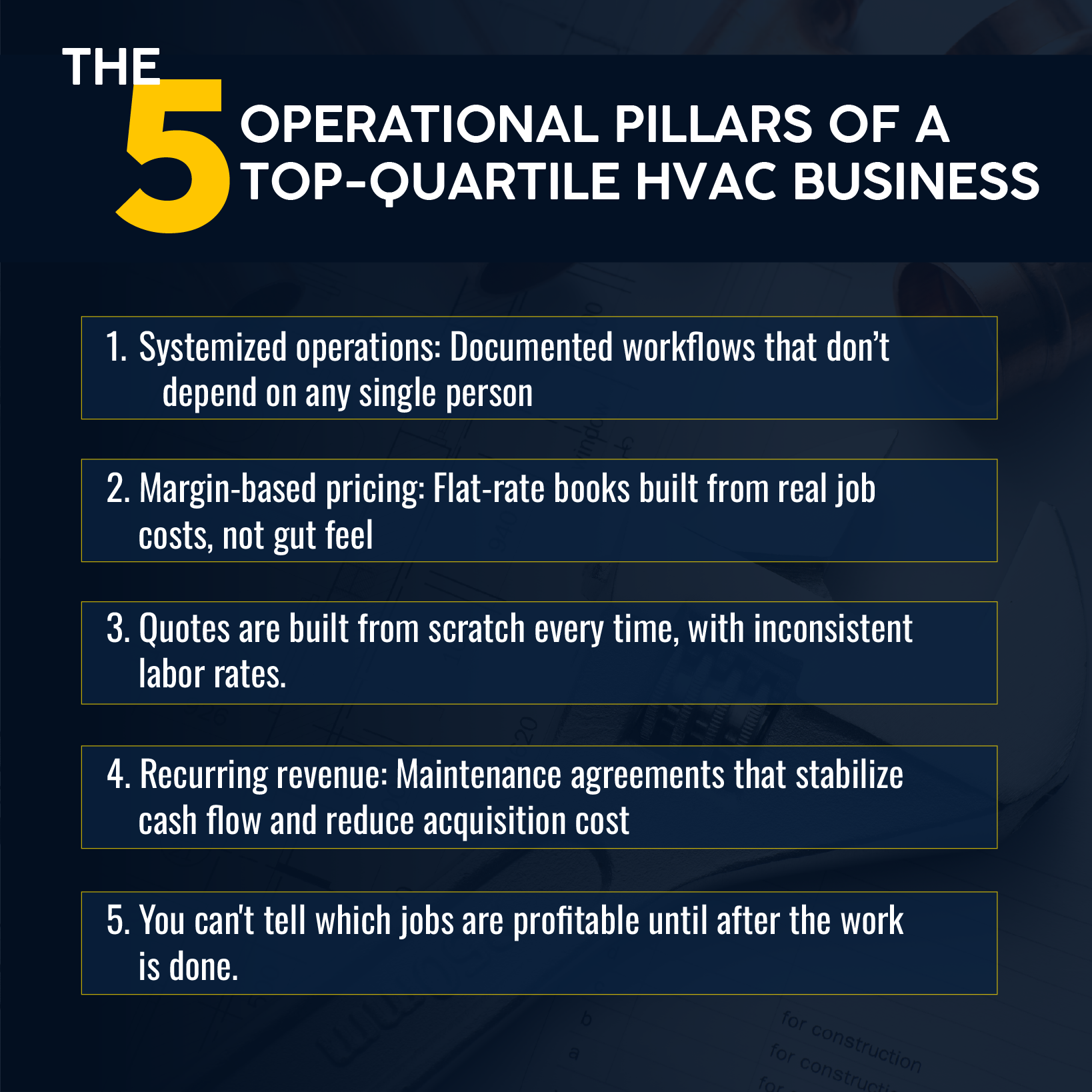
The HVAC management tips below explain how to run a more efficient, profitable, and controlled operation.
Related: Find out how to grow an HVAC business that’s sustainable.
10 HVAC Business Management Tips to Run a More Profitable Operation
Well-run HVAC companies can function without the owner’s constant presence. That’s because they’ve hired the right people and documented everything operational, including pricing, dispatch, tech workflows, and customer retention.
Here are 10 best practices for running an HVAC business that stands on its own.
1. Standardize Your Job Workflow From Quote to Invoice
The HVAC companies that scale most efficiently treat business operations like a process: Every step is the same, every time. Each HVAC service call should follow the same sequence, from how the call is booked to how the tech is briefed, from job documentation on HVAC systems and equipment to same-day invoicing.
Consistent workflows mean your office knows what to expect. New hires follow the process instead of guessing. Customers get the same great experience every time, rather than it being based on which tech shows up.
A simple way to standardize your workflows is with one-page checklist for each job type. To get started, pick your five most common job types. Document the workflow that your best technicians already use. Write it down, and make it the standard.
The payoff goes beyond consistency. You can onboard a new tech in days instead of weeks. Process failures are caught before they become customer complaints. Handoffs go smoothly, without requiring the owner to be the relay.
Standardization is the prerequisite for every other operational improvement on this list.
2. Stop Managing Jobs Manually
Paper job cards, whiteboard schedules, and phone tag between technicians and the office create information gaps that cost real money. When a tech calls back to confirm a part number or drives to the supply house because the truck is missing key equipment or materials, that’s billable time you can’t get back.
HVAC companies that replace manual coordination with software for HVAC business have reported up to 30% productivity increases, 63% reduction in admin time, and more than 20 hours per week saved on scheduling and paperwork.
Manual job management also means more handoffs — and every one of those creates the opportunity for mistakes or miscommunication. Top-performing HVAC contractors use technology so they aren’t confirming appointment details the morning of, relaying job notes between the office and the field, or chasing down technician timesheets on Friday.
Each of those delays creates friction that compounds across the fleet. At five trucks, each running two handoffs per job per day, you’re absorbing 50+ unnecessary communication events daily. Any one of them can cascade into a delayed invoice, a missed follow-up, or a customer who never got a call-ahead.
3. Improve Dispatching and Scheduling Efficiency
Dispatch is the single biggest lever on revenue per truck. Top-performing residential HVAC companies generate $380,000+ per truck annually, while the median is $310,000. What separates the best from the rest? It’s usually not market demand. It’s how efficiently jobs are assigned and routed.
Efficient routing means your techs waste less time driving and spend more time completing jobs. And that means they can handle more jobs per day. Let’s say you operate a six-truck fleet averaging 3.2 completed jobs per day. The difference between averaging 3.2 completed jobs per day and 4.0 jobs per day is approximately $420,000 in annual revenue. Same trucks, same technicians, same overhead.
Solving for underutilization starts by adopting GPS-assisted scheduling that routes the closest qualified technician and matches against job type. Then, be deliberate about how you route calls. System replacements go to your strongest closers, while routine calls go to newer techs. Companies that manage job mix intentionally consistently outperform those dispatching by proximity alone.
4. Track the Right HVAC Business Metrics
Every HVAC business owner tracks total revenue. Fewer track gross margin by service type, overhead ratio, revenue per HVAC technician, and average ticket. Those are the numbers that tell you whether the business is actually healthy.
Here are benchmarks to compare yourself against:
| Metric | Needs Work | Strong | Top Performers |
|---|---|---|---|
| Gross Profit Margin | Below 35% | 45–55% | Above 55% |
| Net Profit Margin | Below 5% | 8–13% | Above 13% |
| Overhead Ratio | Above 40% | 25–32% | Below 25% |
| Labor Cost (% of revenue) | Above 35% | 22–28% | Below 22% |
| Maintenance Agreement Revenue | Below 5% | 15–25% | Above 25% |
Source: CEO Finance Academy
One warning: Blended margin numbers can hide what’s actually working. If your overall gross margin looks healthy, but you’re mixing high-margin service calls with low-margin new construction, you might be prioritizing the wrong jobs. Track HVAC metrics by service type, not just in aggregate.
5. Price Jobs Based on Margins, Not Your Competitors
Pricing based on what competitors charge is one of the most costly mistakes in the HVAC industry. Other companies’ rates reflect their cost structure, not yours. If a competitor is underpriced, matching them means you're losing money at scale — you just don't know it yet.
Build pricing from the bottom up: calculate every cost burden, add your target profit margin, and set prices accordingly.
For residential service work, a well-run flat-rate shop can reach 50–55% gross margin on service. Knowing that, you can set pricing that protects your net margin while accounting for overhead and other costs.
Related: Are you pricing HVAC jobs effectively?
6. Build a Strong Communication Loop Between the Field and Office
When information lives in a technician’s head or a paper job card, the home office operates on assumptions and outdated information. The best-run HVAC businesses use technology to connect the field and office, giving technicians instant access to job details, customer history, and parts availability from their phones. Techs document work, capture signatures, and generate invoices on-site. The office sees job status in real time.
Field service companies spend up to 13 hours each week on administrative tasks that could be automated. John Williams Heating Services used mobile tools to grow from seven to 27 employees without proportionally scaling office headcount.
The downstream impact goes beyond admin savings. When a customer calls to ask about their job status, your office can answer without having to track down the technician. When a tech finishes a job early, dispatch can reassign immediately. And that tech is prepared for the next job because they can access equipment notes from a previous visit.
Across a fleet running 20–30 jobs per day, these efficiencies add up.
7. Get Control of Inventory Before It Delays Jobs
Parts runs are one of the most expensive hidden costs in HVAC operations. According to a financial analysis presented by ACCA, rolling an HVAC truck costs $84.40 per hour — and every unplanned supply house trip consumes roughly an hour of paid technician time while generating zero revenue. At five parts runs per month, per truck, that’s losing nearly $22,000 in lost productivity every year.
The solution? Real-time inventory tracking across trucks and warehouses. Implement software that tracks HVAC equipment and materials from purchase order through assignment to a specific job or quote, whether it’s a service call or a full-on replacement. Implement real-time inventory logging for field staff, including low-stock alerts across multiple trucks or warehouses.
8. Turn One-Off Jobs Into Repeat Business
Maintenance agreements are one of the best ways to earn predictable, recurring revenue for your business, all while improving the customer experience and reducing time and money spent on marketing.
Only 42% of HVAC customers come back for a second job, but that rises to 89% with a maintenance plan. HVAC software that includes preventative maintenance management ensures your techs bring up recurring agreements on the job site, not after the fact. Every plan you convert is a customer who doesn't have to be won over again next year.
Blue Flame Heating Solutions moved from paper-based forms and contracts to a digital repository, including a maintenance planner that offers even better pipeline visibility for the 28,000+ jobs Blue Flame completes each year.
Related: Walk customers through this HVAC maintenance checklist during your next call.
9. Hire and Retain Skilled HVAC Technicians
The HVAC industry faces a shortage of 110,000 technicians. And this problem will likely get worse, as the Bureau of Labor Statistics estimate 8% job growth through 2034. Your business can’t afford turnover when it’s already so difficult to find qualified talent.
HVAC business owners might understand the cost of high turnover, but are you tracking the costs? Every time you need to replace a technician, there are costs associated with recruiting, onboarding, and initial underperformance — not to mention jobs lost because you didn’t have enough staff.
Consider implementing a five-level career progression framework (apprentice through master technician), with defined compensation milestones. This structure can reduce turnover and accelerate productivity. As part of that career journey, provide ongoing training to keep employees current on technical skills, cut callback rates, and protect your first-time fix rate and customer satisfaction scores.
10. Reduce Admin Work With Automation
Admin time isn’t free. Every hour spent on HVAC invoicing, payment reminders, maintenance agreement renewals, and appointment confirmations is an hour not spent on customer calls or dispatch.
Field service management (FSM) software helps HVAC businesses speed up their invoice collection through digital invoicing and on-site payment capture. TEAMWired reduced time spent on invoicing by 90%, with payment times shrinking by 50%.
For a $2 million HVAC business with a 45-day average collection window, moving to 30-day collection frees two weeks of operating cash, which matters when 40% of HVAC contractors cite cash flow management as their top challenge.
BWE Engineering halved its job-to-invoice time after moving from paperwork to digital workflows. Faster customer payments led directly to better cash flow positioning, which is crucial when the median small business only has 27 days of cash reserves, according to JPMorganChase.
Related: Learn more about the HVAC marketing strategies that complement operational improvements.
What Tools Help You Manage an HVAC Business More Efficiently
HVAC business management requires deep visibility into operations and the ability to simultaneously coordinate many jobs and people. Businesses running $1 million+ in revenue soon realize they can’t do that with manual processes alone.
Simpro® field service management (FSM) software is designed for trade businesses like yours. It’s purpose-built for HVAC contractors, with tools for HVAC CRM and customer management, GPS-assisted dispatch, job costing, real-time inventory, automated invoicing, maintenance plan management, and business intelligence reporting. More than 24,000 trade businesses use Simpro to manage jobs, technicians, inventory, and cash flow in one platform.
Simpro customers report 25% revenue increases, 63% reductions in admin time, and profit increases exceeding $100,000. For HVAC business owners evaluating tools, the right question isn’t which software has the most features. It’s whether the platform is designed for key trade workflows — including maintenance agreement management, multi-truck dispatch, and job-level cost tracking.
Simpro handles service work and project-based jobs from the same system. A residential service call and a multiphase commercial install share the same reporting layer, the same dispatch infrastructure, and the same job-costing framework.
Run a Better HVAC Business Without the Chaos
Knowing how to run a successful HVAC business is more than just revenue. If you’re putting out fires every day, the problem isn’t your technicians or your target market. It’s likely some combination of insufficient job-level costing, manual dispatching, and pricing that isn’t calculated from actual overhead.
Audit your day-to-day operations. How are you doing on each of the 10 operational priorities covered above? Note any areas where you’re falling short, then make a plan to close the gap.
Start small. For example, standardize one job type this week. Pull jobs-per-day by technician for the last 30 days. Analyze parts runs across your fleet for the last month. Each of those is a 30-minute exercise that tells you exactly where your operation is leaking and which fix will have the biggest immediate impact on margin.
Simpro gives HVAC business owners the infrastructure to close those gaps without rebuilding every process from scratch. Schedule a demo to see what that looks like for your business.


 Back to top