
A service call gets logged at 7:14 a.m., and by 7:20, the dispatcher is juggling three trucks, two no-shows, and a customer asking why nobody's called back yet. That's exactly the kind of morning that’s preventable with the best use cases for AI in field service.
If you work in HVAC, electrical, or plumbing, you’ve seen this daily scramble play out on whiteboards, with paper tickets, and the senior tech trying to remember what happened the last time something broke down.
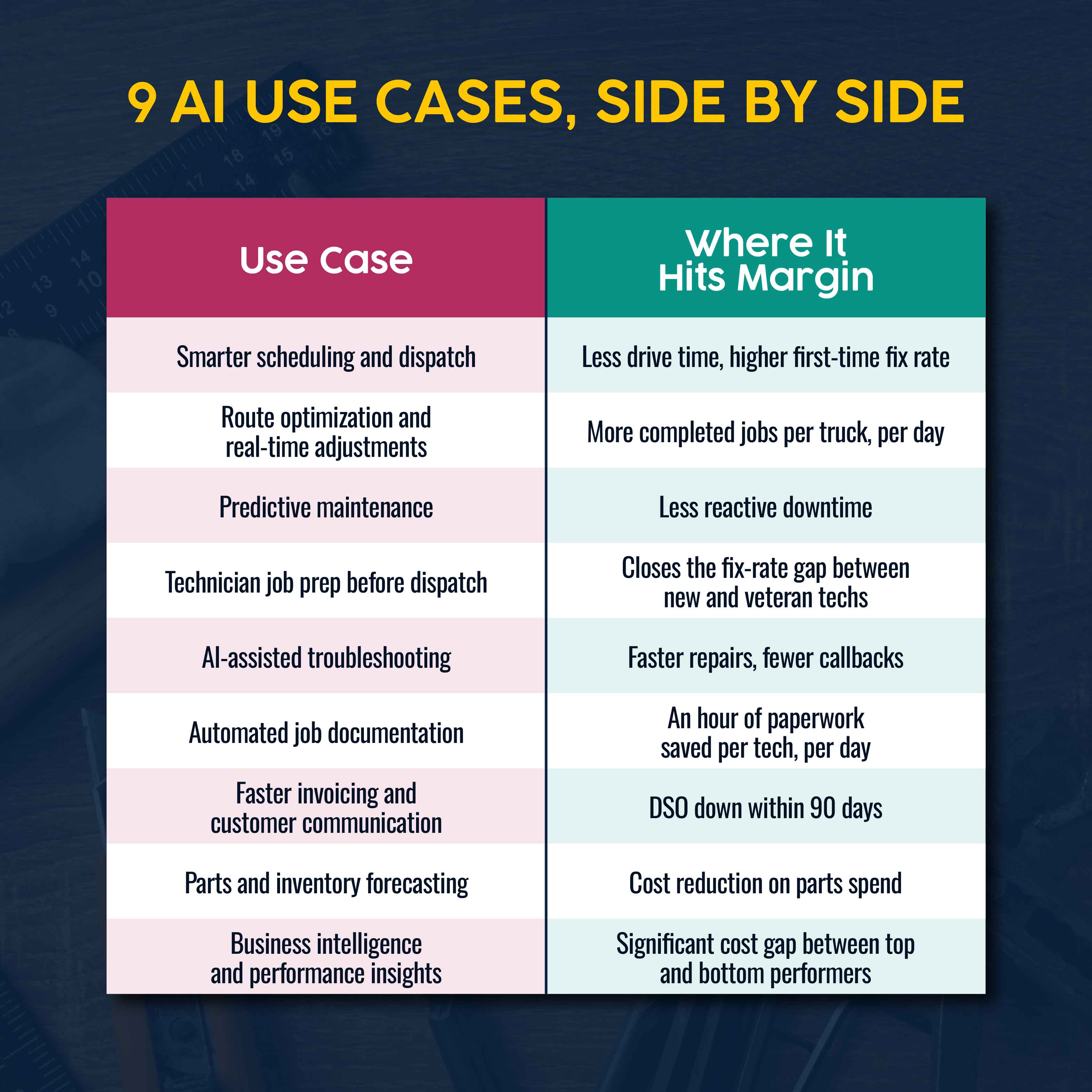
This rundown covers nine of the top use cases for AI in field service, including job types, dollar figures, and team sizes best suited for each one. Each idea attaches to a specific point where jobs lose money and time: dispatch, diagnostics, documentation, invoicing, parts, and reporting.
AI Works Best When It Supports the Full Field Service Job Life Cycle
Most software pitches treat artificial intelligence (AI) like a single feature bolted onto an existing system: a chatbot here, a suggested time slot there. That's not what improves your margin. Field service teams seeing real returns are applying AI across the entire job cycle, from the first call to the final invoice.
Here’s the difference between comprehensive AI in field service management and adding a single feature to your existing workflows:
- The gains compound into more consistent service delivery.
- Better scheduling means techs show up prepared
- Better diagnostics means fewer callbacks.
- The cash from faster invoicing funds the next job.
The use cases below are organized in chronological order, from the first decision on a job (who goes where) to the last one (what it actually cost you).
9 High-Impact AI Use Cases in Field Service
Some of these use cases are already standard in shops your size. Others are still a year or two from full industry adoption. Find out where each one lives in the job life cycle and what it typically delivers.
1. Smarter Scheduling and Dispatch
AI scheduling tools consider the technician’s location, skill set and drive time, as well as parts availability and job value. Then they build (and rebuild) the day's dispatch board automatically. When a job runs long or a tech calls in sick, the AI system proposes a reschedule instead of leaving the dispatcher to do so by hand. This is the scheduling problem addressed by the AI Scheduler for field service management in Simpro RAIN.
Field service businesses already recognize this opportunity. The 2025 Simpro Trades Outlook Report found that 52% of owners expected AI-driven automation to optimize scheduling. The ROI quickly appears, as the best-fit technicians arrive at jobs faster and are more likely to solve the problem in one visit.
The operational fix: If your dispatcher is manually reshuffling the board every time a job runs long, solve that first. Every other use case depends on techs being where they're actually supposed to be.
2. Route Optimization and Real-Time Schedule Adjustments
Scheduling decides who goes where. When routing is AI-driven, response times are minimal even when traffic, weather, or an emergency call force schedule changes. This kind of routing carries the highest long-term ROI of any use case on this list, mostly because most shops optimize for mileage instead of completed jobs per truck, per day.
When you add AI-driven route optimization, you’re able to respond faster with AI recommendations rather than waiting for a dispatcher to get around to it. The ROI includes higher dispatch capacity, more completed jobs with the same fleet, and less planning time.
The operational fix: Implement this fix to see small but compounding gains. For a five-truck operation, completing just one extra job per truck per day works out to roughly $27,500 in additional monthly revenue on a $250 average ticket.
3. Predictive Maintenance for Assets and Equipment
Dispatch and routing get technicians to the job. Predictive maintenance helps them flag potential equipment failures long before they occur — saving an emergency call and bolstering your reputation with the customer. AI-driven systems use predictive analytics and machine learning, along with IoT sensor data, usage patterns, and service history, to flag assets before they fail, not after.
The numbers back up why predictive maintenance is among the top emerging use cases in AI-powered field services. The U.S. Department of Energy estimates that predictive maintenance saves 8–12% over fixed-schedule preventive programs and up to 40% over reactive maintenance. McKinsey, meanwhile, suggests that predictive programs can extend equipment life by 20–40% while reducing unplanned downtime by 30–50%.
Across the industry, 14% of truck rolls aren’t necessary, according to Aquant. Predictive data can prevent most of them.
The operational fix: Before you sell predictive maintenance as a customer-facing service plan, use it internally. Flag the 10 assets with the highest failure rates across your customer base and build service reminders around actual usage data, rather than calendar-based alerts.
4. Technician Job Prep Before Dispatch
Predictive maintenance flags the job. But that doesn’t mean the tech shows up with all the information they need. You solve that through pre-dispatch briefing tools that surface the full job history, customer notes, site-access details, and parts availability.
It sounds like a small thing, but it’s not. A failed first visit adds an average of two additional visits and 14 days to resolution, according to Aquant.
The gap between prepared and unprepared crews is stark: Top-performing field service organizations have an 86% first-time fix rate, while poor performers are at 53%. One easy way to boost your first-time fix rate is by giving techs everything they need before they drive to the job site. When you give techs all the information before they get in the truck, they do better work — and that enhances customer satisfaction.
The operational fix: Give every tech the same pre-job brief a 20-year veteran would build for themselves (equipment history, prior notes, site quirks). That way, even the newest tech gets the benefit of institutional knowledge.
5. Parts and Inventory Forecasting
Your techs not only need the right information, they also need a truck that’s stocked with the right parts for the job. AI-driven parts forecasting looks at job history and site-specific patterns to predict what each truck needs, reducing both the stockouts that cause a second trip and the overstock that ties up working capital in your warehouse.
Already, 45% of field service operations use AI for inventory and asset management, according to a Field Service Insights report, and 34% plan to add AI capabilities in the next year.
The operational fix: AI can also detect patterns in your parts and inventory setup, such as inconsistent supplier pricing, overordering certain components, or missed volume discount thresholds. Improving materials spend by even a few percentage points adds up for a contractor running hundreds of jobs each year.
6. AI-Assisted Troubleshooting in the Field
Even the best pre-job brief can’t predict on-the-job surprises. Once a tech is on-site, AI-assisted diagnostics can guide troubleshooting using equipment history and known failure patterns, along with visual inspection of the unit.
AI-assisted troubleshooting is different from relying on a paper manual or a forum search because it accounts for the asset in front of the tech’s face, not a general model.
Field service organizations using AI-powered diagnostic tools report 39% faster repair times and a 21% improvement in repair accuracy.
The operational fix: Explore all the ways AI can help in the field. For example, remote diagnostics and visual-inspection tools — including photo capture, video collaboration, and equipment data-plate scanning — are increasingly helping technicians be even more prepared, no matter what they encounter at the job site.
7. Automated Job Documentation
After the tech finishes their work, there’s still the task of writing down what happened and turning it into an invoice. This is where many field service businesses suffer delays, as technicians can’t write up reports until they’re back at the office, and sometimes not same-day.
AI-powered voice-to-notes tools let field technicians describe what they did and what they used, converting all that information into structured job documentation automatically. No one needs to type, much less stay late to finish paperwork.
With JobScribe by Simpro®, technicians can reduce admin work by 30-60 minutes per day, which adds up fast across a full crew.
The operational fix: If your techs are filling out job notes from memory at 6 p.m. after a 10-hour day, the documentation is getting worse with every hour that passes between the job and the write-up. Capture job info at the point of work for speed and accuracy.
8. Faster Invoicing and Post-Job Customer Communication
Clean documentation feeds the next bottleneck directly: Getting paid for the job. Traditional field service invoicing loses 15-30 days between job completion and payment, largely because the invoice doesn't get built until someone's back at the office.
Automating the invoice process is an attractive way to keep customers, prevent disputes, and speed up payments. The Simpro JobBrief agent automatically generates a professional post-job summary for every customer, reducing disputes by 25–35% and accelerating payment by 15–20 days.
A $2 million revenue company that reduces its DSO from 45 to 25 days frees up roughly $110,000 in working capital simply by removing the invoicing lag.
The operational fix: Automate collections before automating lead generation. New jobs don't help your cash position if you’ve got a backlog in accounts receivable.
9. Business Intelligence and Performance Insights
The last stop in the job life cycle is measuring profitability — not just overall, but by job, technician, customer, and service type. That analysis is AI-powered, available in minutes instead of running spreadsheets at month-end.
Natural language reporting tools let an owner or ops manager ask direct, plain-English questions about the business, instead of exporting real-time data into different tabs and sorting through columns.
Convenient reporting is only part of the puzzle. Aquant research finds that the annual cost gap between top- and bottom-performing field service organizations can run as high as $1.8 million.
Business intelligence also protects institutional knowledge. By using AI to capture your top estimators’ pricing and estimating judgment, you can give everyone the ability to produce accurate quotes. That saves money, reduces risk, and prevents inconsistencies that hurt margin.
The operational fix: Don't wait for a retirement notice to find out how much expertise lives in one person's head. If a single estimator, dispatcher, or lead tech could disrupt your operation by leaving, close that gap now, while they're still around to help you close it.
Which AI Use Cases Should Field Service Businesses Prioritize First?
Contractors evaluating AI tend to start by comparing tools, which is a good way to end up with five subscriptions and no idea where the money's going. Start by identifying your most costly problem instead. The top use cases for AI in field service aren't universal, so focus on where your operation is actually bleeding time and margin.
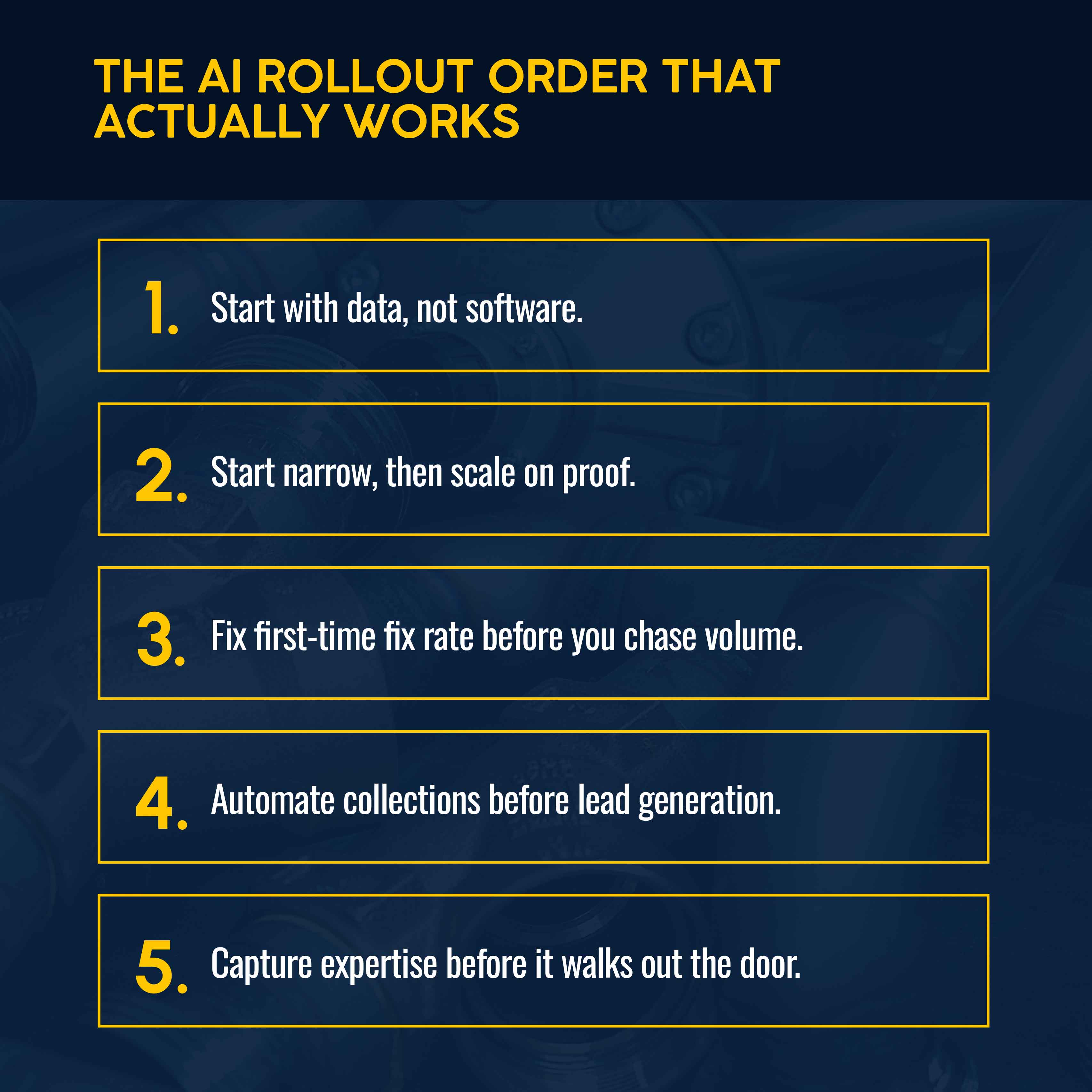
A few sequencing principles hold up across the data:
- Start with data, not software. AI is only as good as your data. Incomplete or fragmented job and asset records will limit your AI ROI. Clean up maintenance records and standardize asset data before going further.
- Start narrow, then scale on proof. Most organizations need 12-18 months to realize measurable value from a new AI use case, and nearly a third need 18–24 months. Pick one problem, one data source, and one measurable outcome, then expand after it's proven.
- Improve first-time fix rate before you chase volume. A failed first visit costs two additional visits and roughly two weeks of resolution time. Don’t increase marketing spend before you solve the operational problem.
- Automate collections before lead generation. With 15–30% of revenue sitting in receivables, AR automation pays back within a billing cycle — as fast as any AI investment use case.
- Capture expertise before it walks out the door. By 2030, more than 2.1 million skilled trades jobs could go unfilled. That’s a business continuity issue. Make sure you capture the knowledge inside the heads of your longest-tenured techs and estimators.
For most contractors running 3+ trucks, you’ll want to start with scheduling and dispatch, followed by invoicing and AR, then predictive maintenance and diagnostics as the data foundation matures. Having AI field service management software that’s built to handle all of it in one system beats stitching together point tools for each stage.
How Simpro Supports AI Across Field Service Workflows
Simpro is used by more than 250,000 professionals across 24,000+ businesses, and its AI capabilities are built into the platform, not bolted on as an afterthought.
Simpro's AI surfaces full job history, customer notes, site details, and parts availability to give techs everything they need before getting in the truck. Once on-site, voice-captured job notes eliminate the end-of-day paperwork pileup and cut billing disputes by up to 40%.
After the visit, an automated post-job customer summary improves the customer experience and reduces disputes by 25-35%, while accelerating payment by 15-20 days and addressing the invoicing lag.
The debate over AI-first vs. AI-powered is real. Most contractors adding AI today are layering it onto legacy field service software that wasn't designed for it. That's a different story from platforms like Simpro that were built from the ground up.
Simpro customers have reported a 25% revenue increase and estimates produced up to 10x faster, numbers that track closely with the quoting and scheduling gains covered throughout this article, because they're coming from the same underlying shift: less time spent on administrative work, more time spent on billable work.
Related: AI field service management platform with Simpro Lightning: See how Simpro ties dispatch, diagnostics, documentation, and invoicing into one connected AI system.
AI in Field Service Is Most Valuable When It Improves the Next Job
If you've already adopted some of these use cases, ask whether they’re in one system or scattered across a bunch of logins. If you’re using separate scheduling apps, invoicing tools, and diagnostic platforms, you’re not getting the ROI you need.
A faster dispatch board doesn't help much if the invoice still takes three weeks to go out. A perfectly diagnosed repair doesn't move margin if the parts aren’t on the truck.
Value compounds only when the tools talk to each other and feed real-life job data into how you schedule, quote, and staff. That's a system that gets sharper with every completed job. If you’re aiming to improve margin, not just efficiency, you need a platform with the full range of field service management capabilities to handle all nine use cases together.
Explore Simpro AI integration for field service management to see how the platform handles the full job life cycle, from the first dispatch to the final invoice.


 Back to top