
Are you considering expanding your plumbing business into the great state of Texas? Or are you an employee seeking a plumbing license to further your career? Texas is known for its booming construction industry, making it a prime location for plumbers to thrive.
However, to legally practice plumbing in Texas, you must obtain and renew a state-issued plumbing license. This will not only ensure that you are qualified and knowledgeable in your trade, but it will also protect you from potential legal issues.
To help you navigate this process, we have compiled a simple guide on how to become a plumber in Texas and renew a Texas plumbing license.
The Nitty Gritty
Discover the different types of plumbers licenses and how to become a plumber in Texas
Learn how to apply for the different types of plumbers licenses
Understand what plumbing work can be done without a license in Texas
Texas Plumbing License Guide: From Apprentice to Master Plumber
A Texas plumbing license is one of four state license types: Tradesman Plumber-Limited, Journeyman Plumber, Master Plumber, and Plumbing Inspector. The TSBPE license guide treats Plumber's Apprentice as a registration and Responsible Master Plumber, or RMP, as a designation.
Key takeaways
- Register as a Plumber's Apprentice before starting work you want counted toward a later license.
- Compare experience, training, exam, and fee requirements before choosing the next credential.
- Treat Master Plumber and Responsible Master Plumber as different statuses with different business responsibilities.
- Keep education, account, and fee records together for each renewal cycle.
- Use the state public search to verify a credential rather than relying on a card, proposal, or verbal claim.

Texas plumbing license requirements at a glance
Requirements depend on the credential, current status, and work you plan to perform. Use the row that matches your present status before choosing the next step. The table separates Apprentice registration, four licenses, and the RMP designation so experience, training, fees, scope, and supervision stay clear. Use it as your first checkpoint.
| Status | Experience and training | Exam | Current base fees | Permitted work and supervision |
|---|---|---|---|---|
| Plumber's Apprentice registration | Be at least 16, register before experience hours begin counting, and complete fingerprinting. | None. | $15 initial registration and $15 renewal. | Learns about and assists with plumbing installation only under a licensed plumber's direct supervision. Review the TSBPE Apprentice requirements. |
| Tradesman Plumber-Limited license | Complete 4,000 hours under licensed plumbers, plus the 24-hour training course or a qualifying U.S. Department of Labor apprenticeship route. | TSBPE Tradesman examination. | $36 exam, $35 initial license, and $35 renewal. | Works on one-family and two-family dwellings under an RMP's supervision. Other structures require direct supervision by a Journeyman or Master Plumber. Review the TSBPE Tradesman requirements. |
| Journeyman Plumber license | Complete 8,000 hours under licensed plumbers, plus the 48-hour training course or a qualifying apprenticeship route. | TSBPE Journeyman examination. | $40 exam, $40 initial license, and $40 renewal. | Performs plumbing under an RMP and directly supervises Apprentices where board rules permit. See the TSBPE Journeyman requirements. |
| Master Plumber license | Hold a Texas Journeyman license for two years, or one year after completing an approved Department of Labor apprenticeship. TSBPE also lists out-of-state eligibility routes. | TSBPE approval, then a Pearson VUE exam. | $25 TSBPE processing, $128.50 Pearson VUE exam, $75 initial license, and $75 renewal. | Performs plumbing under an RMP's supervision and directly supervises an Apprentice or Tradesman on qualifying work. Consult the TSBPE Master requirements. |
| Plumbing Inspector license | Meet the education and 500-hour plumbing training or experience route, or another listed license or professional route. | TSBPE Inspector examination. | $55 for the exam, $55 on initial issuance, and $55 for renewal. | Inspects for a political subdivision and follows the role's affiliation and conflict restrictions. Check the TSBPE Inspector requirements. |
| Responsible Master Plumber designation | Hold a current Texas Master license in good standing and maintain at least $300,000 in commercial liability insurance. | No separate exam listed by TSBPE. | $225 initial designation and $300 renewal. | Takes responsibility for plumbing work offered and performed through the named business, cannot also hold an Inspector license, and serves one company at a time. See the current TSBPE RMP requirements. |
Treat each listed charge as a separate action. Before paying, compare your experience verification and training route with the credential page. Keep booking, approval, fee, and issuance confirmations separate to identify the completed step.
How to become a plumber in Texas
To become a plumber in Texas, most candidates move from Apprentice registration to Tradesman Plumber-Limited, Journeyman Plumber, and Master Plumber. Confirm each transition through the TSBPE credential hub. RMP is optional and business-specific, while Inspector follows separate eligibility rules. Use this section for sequence, records, and decisions, while the table carries the numbers, legal scope, and supervision details.
Before choosing a step, answer four questions: Which status appears in the public record? Which table row matches the evidence already held? Which duties and supervision shape the next role? Does the objective stop at a personal license or extend to company responsibility?
Write one sentence for each answer, then select the action matching all four. Add an expected decision date and one contact for unresolved questions. Pause the application whenever an answer depends on a missing record, unclear job duty, or unconfirmed supervision plan.
1. Register as a Plumber's Apprentice
Ask the prospective employer who directs daily work, who confirms experience, and who takes over after a supervisor change. Discuss the types of assignments available and the schedule for checking accumulated experience. Choose the role only after those answers align with the Apprentice row and your learning goal. Keep one agreed progress review on the calendar instead of rebuilding the conversation at the end of employment.
2. Qualify for Tradesman Plumber-Limited
Compare planned assignments with the work and supervision column in the Tradesman row. Discuss the result with the employer responsible for assigning work, then weigh the near-term role against continued progress toward Journeyman. Relate the credential target to actual duties, supervisor availability, and the jobs expected next. Leave the earliest possible examination date out of the decision until those practical factors align.
3. Progress to Journeyman Plumber
Review employer verification, course evidence, current status, and the role planned after licensing as one Journeyman decision set. Resolve contradictions before paying for the next action. Compare the complete set with the Journeyman row, not with an informal hour total or a coworker's path. Then identify the first job responsibility expected after licensing and confirm that the application goal matches it.
4. Become a Master Plumber
Match the record to one Master eligibility route, then decide what the license changes about the role you intend to take. Compare technical leadership, supervision, and future company plans as separate objectives. Keep board approval, examination, and license issuance apart from the later RMP decision. Set the immediate objective first, and evaluate business responsibility only after the Master path and intended role align.
5. Add RMP only when the business role requires it
Treat this as a business decision, not as an automatic promotion after Master. Identify who owns the company decision, what documentation is missing, and whether the timing fits the work already planned. Settle that business question before choosing the next step.
6. Treat Plumbing Inspector as a separate track
For inspection work, start from the Inspector row instead of the Apprentice-to-Master sequence. Compare the public-entity role, your background, and any outside professional interests with the application materials.
Name the duties sought and the organization tied to them. Continue with the inspection route only when those details form a clear objective. Otherwise, return to the credential path matching the work planned.
How to apply through the Texas State Board of Plumbing Examiners
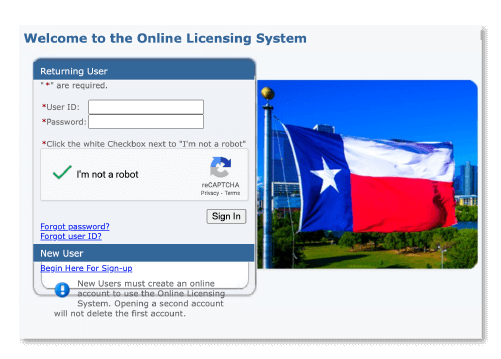
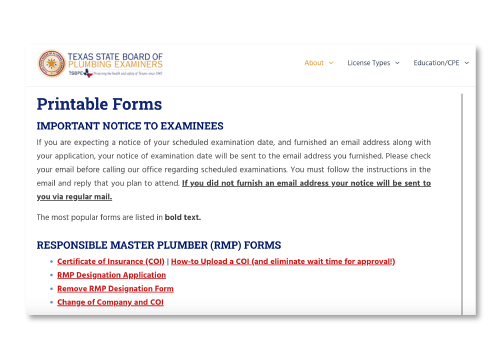
Apply through TSBPE by matching one action to the credential you need. The Online Licensing System instructions cover account setup, common applications, charges, and renewals. The forms index covers paper and specialized routes.
Save each confirmation. Keep the work simple: one credential, one packet, one saved receipt.
Before opening the account, write the exact credential action at the top of the working page. Under it, list the evidence already available, the item still missing, the fee stage expected next, and the public status that will confirm completion. Use that short decision frame throughout the submission.
For a standard online application:
- Create an account with an email address you control
- Add every license or registration you currently hold to the account
- Select the application action for the credential you want
- Upload the requested identity, background, experience, and training documents
- Pay the charge shown for that action and save the receipt
- Follow the approval notice for exam scheduling
- After passing, complete any separate initial-license charge or issuance step
Use consistent filenames for every upload and receipt. Include the credential, document type, employer or provider, and completion date in each name. Don't rely on memory.
Check the evidence once before submission
Check the final packet against three questions. Does every item support the chosen credential action? Do employer, course, and identity records use consistent applicant details? Does each uploaded file match the version you intended to send?
Remove duplicates and old drafts, open every final attachment, and save the submitted packet with its confirmation. Keep later correction requests beside the replacement sent in response.
When a printable route fits, download a fresh form rather than reusing a saved copy.
Before uploading, compare names, employment dates, credential numbers, and course information across the packet. Label files by document type and date. Save the final submitted version, not the blank form, and add later correspondence to the same folder.
Texas plumbing license renewal and continuing education
Texas plumbing license renewal is annual. The TSBPE license guide says all licensees must complete six hours of continuing professional education to be eligible to renew. The same page says you cannot renew a license, registration, or endorsement after two years of expiration and must reinstate it instead. Plan the year around those checkpoints.
Plan one annual record containing the course completion, account confirmation, fee receipt, and the date you verified the updated public status.
Choose a provider listed through the TSBPE training and education page. Keep the completion record until the account status changes. A course receipt alone does not complete the account transaction.
The online renewal instructions direct users to renew from the highest-ranking license shown in the account. Online fee submission is available during the two-month pre-expiration and 275-day post-expiration window.
Before renewing:
- In the account, confirm the credential type, status, and expiration date.
- Complete the selected course and save the completion record.
- Follow the account action identified in the renewal instructions.
- For an RMP record, compare the saved business and insurance details with the account.
- Save the confirmation, then verify the updated public record.
After submission, save the confirmation and compare it with the public record. If the record remains unchanged, contact TSBPE before scheduling or assigning work based on the transaction.
Moving to Texas with an out-of-state plumbing license
Texas does not provide blanket reciprocity for every out-of-state plumbing license. The TSBPE applications and forms index lists an out-of-state examination request and a reciprocal verification form limited to Arkansas and Louisiana. Your current state title does not automatically determine the Texas level, so identify the Texas credential target before ordering records or scheduling an exam.
Use that target to frame the board conversation: confirm the Texas level under consideration, identify the form route that applies, and ask which issuing-state verification belongs with it. Order records only after those decisions align. Focus on the underlying examination, experience, and training history instead of a similar title.
Prepare a short credential summary before contacting the board. Include the issuing state, credential level, original issue date, current status, examination history, relevant employers, and apprenticeship or training information. Ask which Texas route fits that record and what issuing-authority verification to order.
How to verify a Texas plumbing license
Verify a Texas plumbing license through the official Texas Online Licensing System Public Search. Search by name or license number, then compare the record with the person or business information you received. Confirm credential type, status, expiration date, location, and any displayed company or RMP relationship before relying on it. Save that check with your job file.
Cross-check the credential type, status, person, company name, location, dates, and displayed relationship against the information you received. Record the search date with your contractor, hiring, or assignment notes. When the record is missing or inconsistent, pause the decision and ask TSBPE to clarify it.
What plumbing work can be done without a license in Texas?
Texas allows only narrow unlicensed plumbing exceptions. Section 1301.051 of Texas Occupations Code Chapter 1301 exempts plumbing performed by a property owner in the owner's homestead.
Use this section as a caution flag. Ask the local office about the address before work starts. Put the reply with your project notes.
Before starting owner-performed work, contact the local permitting office for the property address. Ask what permits, plans, inspections, or contractor steps apply, then save the response with the project records.
Build a career after licensing
After the credential work, keep the next move narrow: match the role you want with the evidence you have, then keep business growth decisions in a separate plan. The licensing path gets simpler when you separate learning, employment, and company planning into different records. Keep each record short and easy to update.
Build the learning side of that plan with these plumbing training and licensing resources. When your focus moves from personal licensing to company operations, use this practical guide to grow a plumbing business, backed by plumbing field service software that keeps day-to-day operations organized.
Frequently asked questions
Does Texas recognize plumbing licenses from other states?
Texas recognizes only limited out-of-state routes, not every plumbing license automatically. The TSBPE applications and forms index provides an out-of-state examination request and a reciprocal verification form limited to Arkansas and Louisiana. Applicants need to match their record to a Texas license level and complete the route the board requires.
What is the difference between a Master Plumber and a Responsible Master Plumber?
A Master Plumber is a Texas license level. An RMP designation adds business responsibility to an eligible Master license. The TSBPE RMP requirements require good standing and at least $300,000 in commercial liability insurance, limit an RMP to one company, and prohibit simultaneously holding a Plumbing Inspector license.
How do I verify a Texas plumbing license?
Verify a Texas plumbing license through the state's Online Licensing System Public Search. Search by name or license number, then compare the credential type, status, expiration date, location, and any displayed company or RMP relationship. Match multiple fields before relying on the record for hiring, contracting, or regulated work.
Which agency regulates plumbers in Texas?
The Texas State Board of Plumbing Examiners regulates statewide plumber licenses and Apprentice registrations. The TSBPE license guide identifies the credentials, while the board administers applications, examinations, renewals, continuing education, enforcement, and rules. Its license hub also separates credentials from registrations and designations.


 Back to top