
TL;DR
- Lapses trace back to six process failures, from an unowned expiry date and missed visits to pricing that drifted from current costs.
- Keep every agreement, expiry date, and renewal owner in one system, and start commercial renewals 60 to 90 days out.
- Review visit history and margin before the customer hears from you, then send a service summary with the offer.
- Reprice scope and terms to current costs, make signing a one-step action, and log every renewal to an outcome.
- Track five numbers: renewal rate by count, renewal rate by value, on-time visit completion, agreement gross margin, and revenue beyond the agreement.
When you track why maintenance agreements lapse, the decision often predates the renewal notice by months. A rooftop unit misses its September visit, the facility manager sees dirty filters in November, and your January offer arrives after the decision is already made.
You win or lose a service contract renewal in the year of visits behind the notice and in the 60 to 90 days of lead time before it. Harvard Business Review credits Bain & Company's Frederick Reichheld with the finding that a 5% increase in customer retention raises profits by 25% to 95%. The range is wide, but even the low end makes each preventable lapse expensive.
Six causes show up again and again, and each one is fixable before the notice goes out.
Why Do Maintenance Agreements Lapse?
If you pull the account history on your last ten lapsed agreements and tag each one with the first thing that went wrong, you’ll likely find the same issues.
- Nobody owns the date. Expiration dates live in a spreadsheet, a stack of invoices, and the memory of whoever sold them.
- The customer never saw the value. Visits happened, but nobody showed the customer what the techs inspected or fixed.
- Scope and price drifted. Equipment came and went, and costs climbed while the agreement stayed frozen.
- Visits got missed or came late. A skipped fall tune-up loses the renewal months before the renewal date.
- The renewal became a last-week scramble. It lands on whoever is on site, and that person can't change terms.
- Residential notice rules got skipped. A residential service plan that auto-renews without the disclosures and reminders the law requires risks complaints and cancellations. California's amended Automatic Renewal Law sets those rules for consumer plans in that state.
Residential plans make the math easy to see. Say your plumbing company carries 350 members on $210 annual maintenance plans. That's $73,500 a year in recurring revenue. A 10% lapse takes $7,350 with it, plus whatever repair and emergency work those 35 households would have sent your way. Replacing them costs more than keeping them: the same HBR article puts acquisition at five to 25 times the cost of retention, depending on the study.
Related: Lapsed customers are past customers, and our guide to turning one-time jobs into repeat customers covers the automated follow-up that brings them back.
How to Renew Maintenance Agreements Before They Lapse
Seven steps show how to renew service agreements, and you run them in the same order on every account so the contract renewal process holds up through vacations and peak season.
Keep Every Agreement and Expiration Date in One Place
Build one register for every agreement. Tie each customer to its sites and each site to its covered assets, then attach the term, price, and expiry date, plus the visit schedule and a named renewal owner. For commercial HVAC work, ASHRAE/ACCA Standard 180-2018 calls for an equipment inventory and a documented maintenance plan, so a register that lists every unit already covers part of that. A shared spreadsheet works until two people edit different copies.
In Simpro®, a contract record holds an asset's pricing tiers and service-level agreements in one place, and Maintenance Planner schedules the recurring jobs against it. Surrey Tech Services, a U.K. fire safety and electrical compliance contractor, moved its maintenance contracts out of Word documents and into Simpro’s Maintenance Planner, then tripled its contract value in just over a year.
Related: Our guide to scaling recurring maintenance shows how contracts structured by asset or site generate future maintenance jobs automatically.
Set a Renewal Timeline and Assign an Owner
No industry standard exists for renewal timing, so treat this schedule as a starting point for commercial accounts:
- 90 days out: Review the agreement internally.
- 60 days out: Send the service summary and renewal offer.
- 30 days out: Follow up by phone.
- 14 days out: Escalate unsigned renewals to a manager.
- Expiry: Log the outcome.
Where your state has an auto-renewal law, it sets the renewal reminder schedule for residential plans.
Give every renewal one named person from day 90 until the outcome is logged, with authority to adjust scope and price.
Review the Agreement Before Asking the Customer to Renew
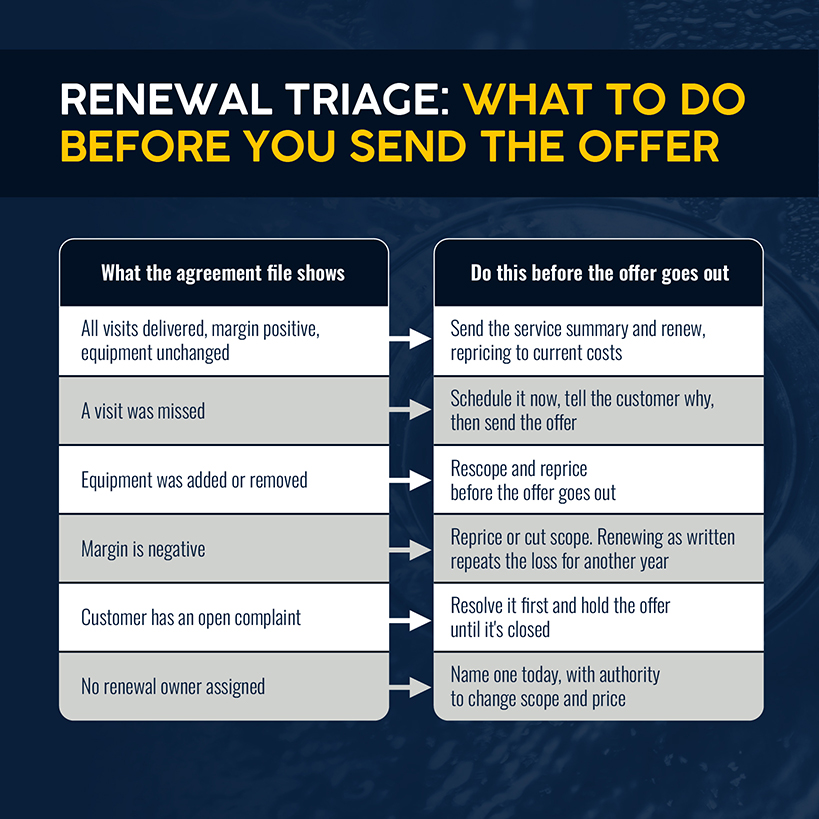
Say your 12-technician shop holds a $6,800 annual agreement on 14 rooftop units, with a spring visit and a fall visit. A September heat wave pulls the crew onto no-cooling calls, the fall visit slips, and nobody reschedules it. The customer will notice the gap before you do unless you check the file first.
Check three things before the customer hears from you: visits completed against visits promised, equipment changes since signing, and the agreement's gross margin. When a visit is short, schedule it now and say so in the renewal conversation. A customer who hears about a missed visit from you first gets an explanation. One who finds out on their own gets a grievance.
The operational fix: Tag every agreement expiring in the next 90 days as clean or short on those three checks, and clear the short ones before any offer goes out.
Related: Our guide to selling HVAC maintenance agreements covers how plan design and cost-based pricing set the visits you promise in the first place.
Show the Customer What the Agreement Delivered
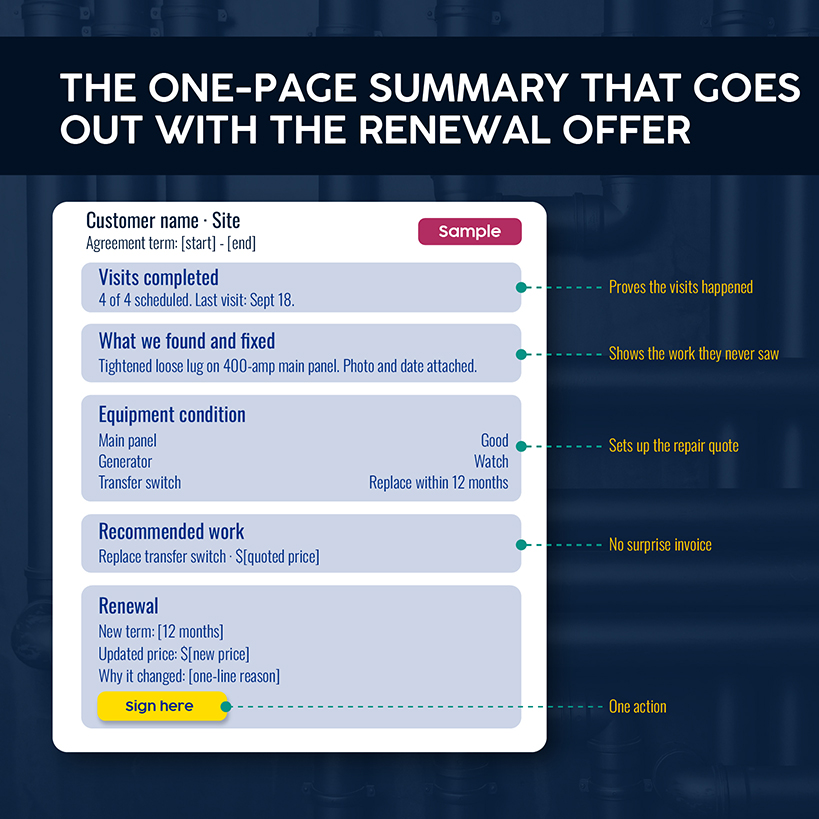
Send a short service summary with the offer. It lists the visits completed and what the techs found and fixed, then closes with equipment condition and recommended work. A quarterly visit that finds and tightens a loose lug on a 400-amp panel belongs in that summary with a date and a photo. Otherwise, the customer would never see that visit.
For fire protection customers, the summary doubles as compliance proof. Sprinkler and alarm inspections follow schedules set by NFPA 25, NFPA 72, and the local fire marshal, and customers need those reports on file for inspectors and insurers. An agreement that delivered every required report on time is one the customer can’t easily replace.
The U.S. Department of Energy's Federal Energy Management Program puts the savings from preventive maintenance at as much as 12% to 18% over a reactive program, and its 2010 guide reports that more than 55% of maintenance in an average facility is still reactive. Aim the number at customers whose sites run mostly on repairs after failure, since planned visits change the most for them. Skip any savings promise for their specific site.
Direct access works too. Virtual Services Group, a U.K. facilities company supporting more than 1,000 locations, gives clients a portal with real-time access to maintenance schedules and compliance records, and saw a 30% drop in client inquiries about maintenance schedules. If your office fields a steady stream of “when is my next visit” calls, a portal can cut them down.
Update Pricing, Scope, and Terms Where Needed
A renewal that repeats last year’s price and scope usually undercharges for this year’s costs and ignores equipment added mid-term. Walk through four questions. What equipment changed? Does visit frequency still match equipment condition? Do the response times you promised still fit how the customer uses the building? What do labor and parts cost now compared with signing?
The first question catches the most drift on security agreements. A customer who added six cameras and a second access-control door mid-term is still paying for the original device count unless the renewal catches it.
Explain every change with its cost basis in plain terms, such as "labor and refrigerant costs rose, and we added two units to your schedule." A bare increase reads as a penalty. For multi-year terms, tie the escalator to a named public index so the adjustment has an outside reference.
Related: Our guide to commercial HVAC maintenance shows how service history sets contract escalators and renewal pricing.
Make It Easy for the Customer to Renew
A customer who has to print, sign, scan, and mail a paper maintenance contract has four chances to set it aside. Send one link that opens the renewal contract with e-signature and a card-on-file option, and make the signature the only action in the offer email. Residential plans can default to automatic renewals once your state's disclosure, reminder, and cancellation rules are met.
Related: Our guide to selling electrical maintenance agreements covers renewal timing and defaulting to auto-renewal with the card on file.
Track Every Renewal Until There Is a Clear Outcome
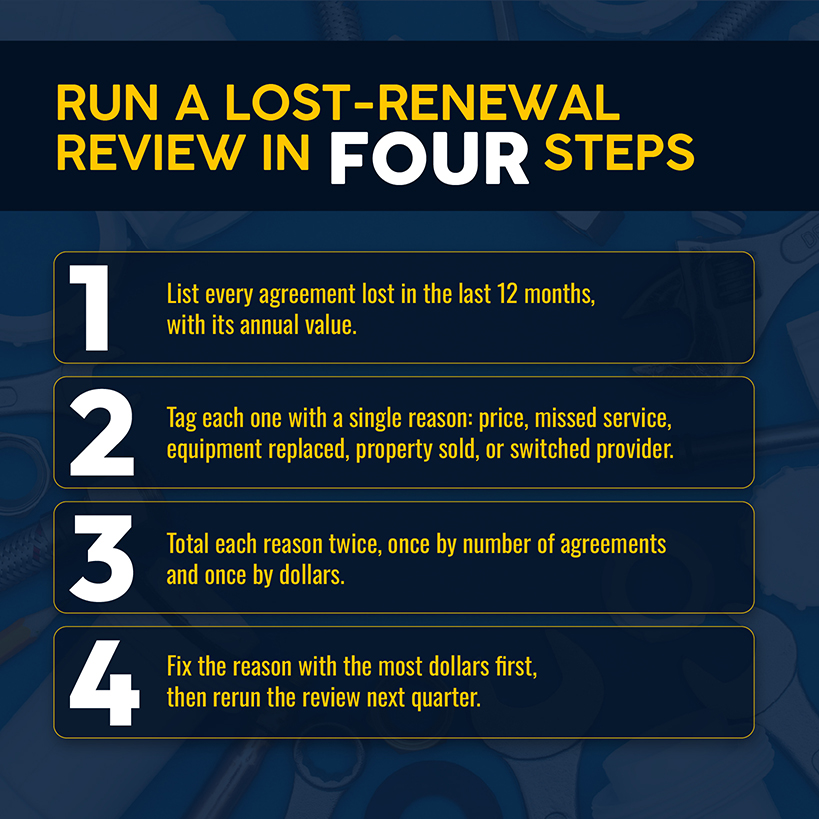
Every renewal ends one of three ways: renewed, renegotiated, or lost with a recorded reason. An agreement still marked "pending" after the contract expires has already lapsed. The record just hasn't caught up. Give each loss one reason from a short list: price, missed service, equipment replaced, property sold, or switched provider. Review the lost list monthly.
Maintenance Planner automates the recurring jobs and the reminders ahead of renewal. Alerts fire when a unit is due, so the office sees a slipping visit before the customer does.
The workflow only pays off on agreements that earned the renewal during the term.
The operational fix: Give every expiring agreement a status and a next action, and run the open list in one weekly meeting until nothing sits at pending.
How to Improve Maintenance Agreement Retention Year-Round
Between signature and expiry, the customer decides whether the agreement is worth keeping, visit by visit.
- Schedule every visit at signing. Generate the full-term calendar the day the agreement is signed. A visit that depends on someone remembering will eventually get missed.
- Report within a day. If you run quarterly electrical inspections on 30 sites, that's 120 visit reports a year. Send each one the next day, while the work is fresh.
- Check in at the halfway point. A five-minute call at month six catches ownership changes and complaints while there's still time to fix them. It also keeps customer relationships warm between invoices.
- Hold the response windows you promised. If the agreement promises a 24-hour callout response, check each callout against it and tell the customer when you miss.
Do that for a year, and the renewal conversation gets short, and a handful of numbers will show whether it did. Proguard Protection Services, a security contractor in Aspen, Colorado, reroutes technicians to emergency calls in real time through Simpro, and grew its client base 6% in its first year on the platform.
How to Measure Maintenance Agreement Retention
Five numbers cover the program without burying the office in reports:
| Metric | What it shows | Warning sign |
|---|---|---|
| Renewal rate by count | Share of expiring agreements that renewed | Holds steady while the value rate drops |
| Renewal rate by value | Share of expiring dollars that renewed | Sits below the count rate |
| On-time visit completion | Visits finished in the scheduled window | Any branch or crew trending down |
| Agreement gross margin | Revenue minus labor, parts, and travel on agreement jobs, as a share of revenue | Negative on agreements that keep renewing |
| Revenue beyond the agreement | Repairs and projects sold to agreement customers | Flat while membership grows |
The first two rows work as a pair. Say 85% of expiring agreements renew by count but only 70% by value. Your larger accounts are leaving, and a blended number hides it. A branch with falling on-time completion will show up in next quarter's lapse list.
Margin tells you which renewals are worth fighting for. An agreement that renews every year at a loss is a retention win that costs money. Reprice it at the next renewal.
Related: Plumbing contractors can pair these numbers with the plan profitability tracking in our guide to selling plumbing maintenance agreements.
Each of those numbers depends on dates, visits, and owners living somewhere your office can see them.
Prevent Renewal Dates From Becoming an Administrative Fire Drill
The agreements that will lapse this season are already on your books. Sort the next 90 days by expiry date and start with any that have no owner, then the ones where a visit slipped or the price hasn't moved in two years.
Simpro keeps the contract, asset, and visit history in one record, so whoever manages contract renewals can see what your crew delivered before they send the offer. It supports more than 250,000 users worldwide. The goal is a stable, profitable book of recurring revenue that renews because the work earned it. Schedule a demo to learn how to get started.
Maintenance Agreement Renewal FAQs
What Is a Service Contract Renewal?
A renewal extends an expiring agreement for a new term, ideally with scope and price updated to match the customer's equipment and what delivery now costs. Without the update, it's a copy of last year's paperwork.
When Should You Start Renewing a Maintenance Agreement?
For commercial accounts, 60 to 90 days before expiration is a workable window, though no industry standard exists. For residential plans, notice timing comes from your state's auto-renewal law where one applies.
Why Do Maintenance Agreements Lapse?
Most lapses trace back to six process failures: nobody owns the expiration date, the customer never sees what the visits delivered, scope and price drift from current costs, visits get missed or run late, the renewal turns into a last-week scramble, or residential auto-renewal rules get skipped. Log a reason for every loss, and the pattern in your book will show up within a year.
Should Maintenance Agreements Auto-Renew?
Auto-renewal cuts lapses caused by missed follow-up when the terms are disclosed clearly and cancellation is easy. On the federal side, the Eighth Circuit vacated the FTC's click-to-cancel rule on July 8, 2025. General unfair and deceptive practices law and state laws still apply, and the FTC reopened rulemaking in March 2026, so a new federal rule is possible.
California's amended law, effective July 1, 2025, covers consumer plans, including residential agreements. It requires express consent, an annual reminder, notice before a price change, and an easy cancellation method. Other states have their own laws. Commercial agreements are generally governed by the contract itself. This is general information, not legal advice, so check your state's rules with counsel before setting a default.
What Is the Difference Between Renewing and Extending a Service Agreement?
An extension adds time to the existing agreement on the existing terms and conditions. That suits a short gap while a renewal gets negotiated. A renewal starts a new term, and that's the moment to update scope and price. The contract's own language controls how each is treated.


 Back to top
