
A $1.2 million rooftop replacement across four office buildings on a corporate campus can look profitable on the estimate and still bleed margin by closeout. The rooftop units land three weeks behind schedule, two crews sit idle waiting on the electrical rough-in, a change order for additional curb adapters never makes it onto a pay application, and $90,000 in retainage nobody was tracking stays locked up long after the job is done. Commercial HVAC project management is the discipline that decides whether the margin you quoted is the margin you keep.
The gap between those two numbers rarely comes from one big mistake. It comes from a hundred small ones such as a late submittal, an unlogged change, or a percent-complete figure guessed instead of verified. This commercial HVAC project management guide breaks the work of managing large HVAC installation projects into nine steps, from the estimate handoff through commissioning and handover, and shows where each step either protects your margin or quietly gives it away.
9 Steps for Managing Large Commercial HVAC Installation Projects
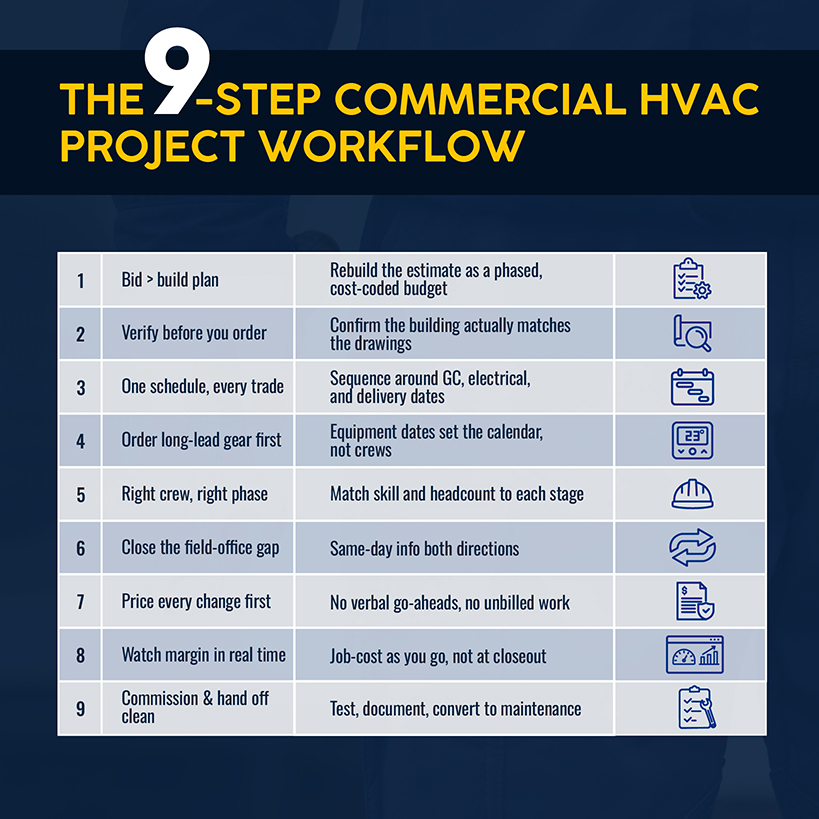
Knowing how to manage commercial HVAC projects at scale isn't about working harder in the field. Whether you carry the title of HVAC project manager or just inherited the job on top of everything else, the work is controlling the decisions that happen before and around the install, like the budget, the schedule, the procurement, the billing.
Here are nine practical, commercial HVAC project management tips. Each step maps to a specific place money leaks out of large jobs, and you can use them to dial in your HVAC projects today.
1. Turn the Approved Estimate Into a Clear Project Plan
The estimate got you the job. It won't run the job. A winning bid is a pricing document; a project plan is an operating document, and the handoff between them is where most large installs start to drift towards unprofitability.
Rebuild the estimate into a job-cost budget organized by phase and cost code with equipment, labor, materials, subcontractors, and overhead broken out separately so you can watch each one against actuals later. Lock down the scope in writing, including what you are not doing: temporary heat, cutting and patching, roof structural work, electrical beyond your disconnect.
On a job this size, undocumented exclusions turn into unpaid work fast, and estimating errors alone account for roughly 32% of construction cost overruns. If your estimate wasn't built on solid load calculations and itemized takeoffs to begin with, that's a separate problem. Start with the fundamentals of how to estimate HVAC jobs accurately before you plan around a number you can't trust.
The operational fix: Convert the accepted estimate into a phased, cost-coded budget on day one, and treat that budget as the baseline every future actual gets measured against.
2. Confirm the Design, Site Conditions, and Installation Requirements
With a plan in place, the next risk is discovering the building doesn't match the drawings. On a retrofit especially, the as-builts are optimistic fiction until someone verifies them.
Walk the site before you order anything. A commercial HVAC system carries design intent beyond raw tonnage (the ventilation rates and energy-efficient performance targets that drive the building owner's operating costs), so confirm the installed design still delivers what was specified.
Then confirm structural capacity for rooftop equipment, roof access and rigging paths for a 12-ton unit, existing duct routing, electrical service, and clearances the drawings assume, but the commercial building may not have.
Pull the mechanical, electrical, and general contractor plans side by side and run a constructability review to catch conflicts like the VRF refrigerant lines routed through a beam or the AHU that won't fit through the only door to the mechanical room. In one study of large-scale projects, design changes accounted for 56.5% of cost overruns. Every conflict you find at a desk costs a fraction of what it costs after the crew is on site with the wrong equipment.
The operational fix: Complete a documented site verification and constructability review before procurement, and get any design discrepancies resolved in writing with the engineer of record.
3. Build One Coordinated Project Schedule
Design confirmed, you can build a schedule that reflects the building instead of the bid. A large commercial install doesn't run on your calendar alone. It runs on the general contractor's, the electrician's, and the equipment manufacturer's calendars as well.
Build a single schedule with real milestones: submittal approval, equipment delivery, rough-in, set, ductwork, controls, startup, and commissioning. Map the dependencies between trades so your crew isn't scheduled to set units before the structural steel or the roof curbs are ready. Sequence around the other trades rather than assuming they'll sequence around you. Coordination gaps are a top reason field crews stand idle.
One shared schedule everyone can see beats four separate versions that only reconcile at the next site meeting.
The operational fix: Maintain one live master schedule tied to trade dependencies and equipment dates. Update it the day something moves, not at the weekly meeting.
4. Secure Long-Lead Equipment and Materials Early
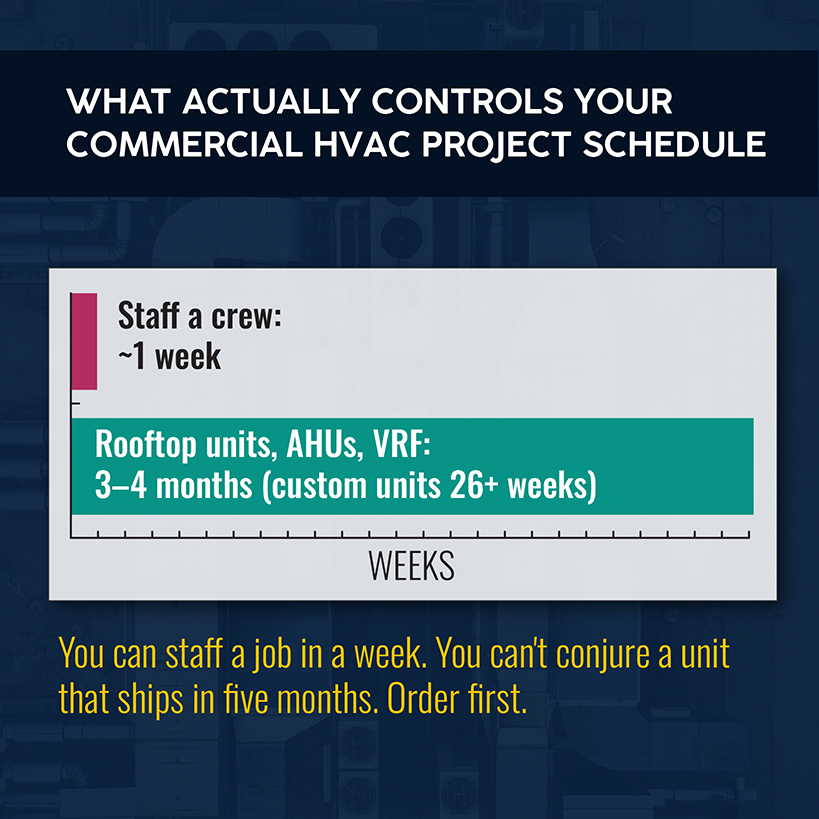
Here's the constraint that reorders everything else: on commercial HVAC work, equipment lead time, not crew availability, usually controls the calendar. You can staff a job in a week. You cannot conjure a rooftop unit that ships in five months.
Standard rooftop units often ship within days to two weeks, but once a unit is out of stock or requires special-order features, delivery windows commonly stretch to 12 to 16 weeks, with some contractors reporting waits of several months for less commonly stocked equipment. So the moment the design and load calculations are confirmed, get submittals approved and place equipment orders as soon as the contract ink is fully dry if your terms allow.
Track stored materials, deposits, and delivery dates against the schedule, and build a contingency window for the components most likely to slip, like VFDs or custom coils. Getting this right depends on disciplined HVAC inventory management best practices so committed materials, deposits, and delivery windows are all visible in one place instead of scattered across purchase orders and email.
The operational fix: Treat equipment procurement as the critical path, place long-lead orders at design confirmation, and track every delivery date against the master schedule.
5. Assign Crews, Supervisors, and Subcontractors Around Project Phases
With equipment on order, attention turns to the people who install it. Large jobs move through phases with very different labor needs, and staffing them as one undifferentiated block wastes the scarcest resource you have.
Match crew size and skill to each phase: a rigging day needs different people than a controls commissioning week. Name a lead supervisor accountable for the site, and schedule subcontractors (electrical, controls, and crane) around your set dates so nobody shows up to a job site that isn't ready for them. This discipline matters more every year: the U.S. Department of Education projects up to 2.1 million skilled trades jobs could go unfilled by 2030, and more than one in five construction workers is already over 55. You win by getting more output from the crew you have, which starts with tight HVAC dispatching and scheduling that puts the right technician on the right phase instead of the closest available body.
Note too that once a subcontractor is scheduled, that labor becomes a committed cost.
The operational fix: Staff each project phase to its actual skill and headcount needs, assign a single accountable supervisor, and lock subcontractor dates to your milestones.
6. Keep the Office, Field, Client, and Project Partners Aligned
A staffed job still fails if information doesn't move. On a multi-month commercial install, the distance between the field and the office is where details go to die.
Field crews need current drawings, RFIs, and change directives; the office needs daily progress, labor hours, photos, and material usage flowing back the same day, not at Friday's paperwork dump. The client and general contractor need status they can trust without a phone call.
Construction professionals lose roughly 35% of their time to non-productive work like hunting for information and reconciling conflicting versions. That's close to two full days a week of everyone losing time and money (including your workers). Every hour a foreman spends re-sending a drawing or clarifying a spec is an hour not spent installing.
Capturing field documentation like labor logs, site photos, and completed work as it happens keeps everyone working from the same picture and builds the paper trail you'll need when a change order or a payment gets disputed.
The operational fix: Standardize one channel for field-to-office updates and capture progress, hours, and photos daily so status is always current, not reconstructed.
7. Control Changes Before They Reduce the Project Margin
Alignment holds right up until the first change, and on a job this size, changes are guaranteed. The question is whether each one gets priced and approved or absorbed into your margin by default.
If you take one thing away from this guide, keep a formal change order log separate from your billed contract value.
When the owner asks for two additional VAV boxes or the GC's rework forces $18,000 of duct rerouting, price it, get written approval, and only then schedule the work and add it to the contract.
Two rules protect you here: never perform changed work on a verbal go-ahead, and never fold a pending change order into your billed totals before it's formally approved.
Unapproved changes are the most common margin killer on large installs, because the labor and material go out the door in real time while the paperwork and the payment lag weeks behind, if they come at all.
The operational fix: Log every change, price it, and secure written approval before the crew touches it. No exceptions for "small" items or requests.
8. Track Progress, Costs, and Forecast Margin Throughout Delivery
With changes under control, the discipline that ties the whole job together is knowing your real margin while you can still do something about it. Job costing at closeout is an autopsy. Job costing mid-project is a steering wheel.
Track actual labor, materials, equipment, and committed subcontractor costs against your phased budget continuously, so a crew running 40 hours over on rough-in shows up now, not at final reconciliation.
Tie this to your billing. Most commercial projects over $500,000 require AIA-style G702/G703 progress billing which includes a Schedule of Values, percent-complete claims, and retainage of typically 5-10% withheld each period.
Reconcile every percent-complete figure against actual field data before it goes on a pay application; a phase billed at 80% when the field shows 60% is a dispute waiting to delay your payment. Done manually, this billing cycle alone eats an average of two to three full days per project per month, which is time and margin both. Watch for over- and under-billing against earned value so you always know whether a job is ahead of its costs or quietly financing itself.
The operational fix: Run real-time job costing against the budget, reconcile percent-complete to field data before every pay application, and track retainage as its own line so you know exactly what's outstanding.
9. Complete Quality Checks, Commissioning, and a Professional Handover
The install is done, but the job isn't, and the last 5% is where reputation and recurring revenue are made or lost. A rushed handover turns a clean project into a callback list.
Run testing, adjusting, and balancing, work the punch list to zero, and commission the system to verify system performance against the design spec. Especially the energy consumption, indoor air quality, and comfort targets the owner signed off on.
A heating, ventilation, and air-conditioning system that tests clean on paper but was never properly balanced generates callbacks within a season and erodes customer satisfaction.
Deliver a real closeout package with O&M manuals, as-builts, warranty documentation, equipment serial numbers, and startup reports the client's facilities team can actually use.
Then close the loop that most contractors leave open: convert the completed install into a preventive maintenance agreement that builds service histories for every unit from day one.
PM contracts typically carry 50–60% gross margin versus roughly 24% on competitively bid installs — reflected in Comfort Systems USA's and Limbach's SEC-filed commercial mechanical margins of 24.1% and 24.5% respectively — renew at 93%+ year over year, and generate $2 to $3 of pull-through repair and replacement revenue for every $1 of contract value, per MSCA's 2025 Benchmark Survey. You already know this HVAC equipment better than anyone; walking away from the long-term service relationship hands that revenue to someone else.
The operational fix: Treat commissioning and closeout as a defined project phase with its own checklist, and present a maintenance agreement at handover while the install is still fresh.
Commercial HVAC Project Management Metrics Worth Monitoring
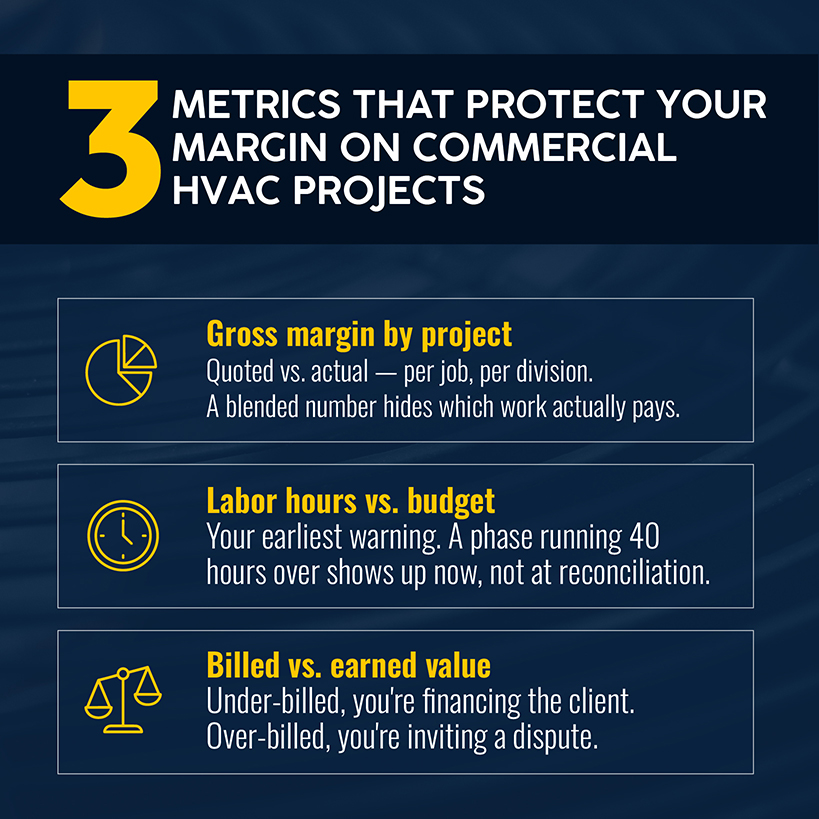
Running the nine steps well produces data. The point of that data is to tell you which jobs are actually making money and which ones just look busy. A few numbers separate the projects protecting your business over the long term from the ones quietly draining it.
One warning first: a single blended company margin hides more than it reveals. If new construction is running at 12% and your service and retrofit work is running at 40%, the blended figure tells you nothing about which division to grow and which to fix.
Track margin by project and by division, not just at the top line. For a deeper cut on the ratios that matter, see the HVAC KPIs that protect project margins.
| Metric | What to track | Diagnostic frame |
|---|---|---|
| Gross margin by project | Actual vs. estimated margin, per job and per division | Below your quoted margin means the estimate, the field, or the change process is leaking; the variance tells you which |
| Labor hours vs. budget | Actual hours by phase against the estimate | Over budget mid-phase is a signal to intervene now, not a closeout surprise |
| Schedule variance | Milestone dates actual vs. planned | Slippage early compounds; a late set date pushes every trade behind it |
| Billed vs. earned value | Percent billed against percent complete | Under-billed means you're financing the client; over-billed invites a dispute |
| Change order margin | Approved CO value and its margin | Low or negative CO margin means you're giving away scope you should be pricing |
| Retainage outstanding | Total withheld across active jobs | Large balances signal cash tied up in closeouts that need to be pushed |
| PM conversion rate | Installs converted to maintenance agreements | Below 35-50% means you're leaving recurring, high-margin revenue on the table |
These metrics only work if they're current. A margin report built from last month's data tells you where you were, not where you're heading, which is why the contractors who catch problems early are usually the ones watching these numbers in real time.
How Connected Project Management Improves Commercial HVAC Delivery
The nine steps and the metrics behind them share one requirement: the estimate, the schedule, procurement, field data, job costing, and billing all have to talk to each other. When they live in separate spreadsheets and inboxes, the seams between them are exactly where margin leaks: the change that never got billed, the percent-complete figure nobody verified, the equipment order that slipped without anyone noticing until the crew showed up.
Connecting those pieces in one system is where Simpro® can help. Not all HVAC software is built for commercial project work. Much of it was designed for one-off service calls and stretched to cover jobs it was never meant to run.
Simpro is field service and project management software built specifically for commercial trade contractors. Its estimating carries live supplier pricing straight into a phased job budget; scheduling and dispatch coordinate large crews and subcontractors around project phases; progress claims generate percent-complete billing and track retainage in line with your contract terms; and project-level reporting tracks work-in-progress, labor productivity, and material spend against budget in real time. It can help you stick to pretty much every best-practice we discussed in this guide, with far less hassle than doing it all by hand and memory.
Because it's one platform, the change order logged in the field flows to the budget and the next pay application without anyone re-keying it.
Simpro serves more than 24,000 businesses and over 250,000 users, and customers report a 25% increase in revenue, 10x faster estimates, and a 30% increase in productivity. Contractors have added roughly 20% more field staff without adding admin headcount, which is exactly what a growth-stage shop needs when skilled labor is scarce, and every new hire is hard to find.
You can see how trade businesses have put this to work across their own projects in Simpro's customer case studies.
Build a Repeatable Commercial HVAC Project Management Process
Most contractors don't lose money on large jobs because they don't know how to install HVAC. They lose it because every project runs a little differently. The best result any single well-run job can give you is a good outcome you can't reliably repeat.
If your commercial jobs are still run across spreadsheets or disconnected systems, the process is only as reliable as the person holding it together in their head.
See how Simpro connects estimating, scheduling, procurement, job costing, and progress billing into one system built for commercial trade work. Schedule a demo.


 Back to top