
If you’re wondering how to price electrical jobs without leaving money on the table, this guide gives you a clear, repeatable method. You’ll learn how to break down every quote. From job scope and materials to labor, overhead, and profit. Plus, discover the best pricing models, benchmarks, and tools to help you quote faster and more accurately. By the end, you’ll have a framework that builds trust with clients and keeps every project profitable.
Why Accurate Pricing is Critical for Electrical Contractors
Research from ELECTRI International found that inaccurate estimating and frequent change orders can reduce project margins by as much as 15–20%. It’s a clear reminder that structured, transparent pricing is essential for protecting profit and building client trust.
Price too high and you lose the job. Price too low and you win the work, but lose profitability.
When your pricing is accurate:
- Your cash flow stays healthy. You’re not waiting on the next deposit to cover the last job’s materials.
- You protect your margin. Every cost, from fuel to admin hours, is accounted for, so you’re not silently losing money.
- You build credibility. Clients trust consistent, transparent quotes that explain what’s included and why.
- You make smarter decisions. When you can compare estimated versus actual costs, you can adjust quickly and quote sharper next time.
If you're unsure what competitive rates look like for apprentices, tradespeople, or senior electricians, take a look at our guide to electrician salaries. It breaks down what electricians across Australia are earning and can help you set rates that support both your business and your team.
Now let's break down exactly how to build that pricing structure, step by step.
8 Steps to Price Electrical Jobs Accurately
Accurate pricing is one of the most valuable skills an electrician can master. It safeguards your bottom line, earns client trust, and prevents costly surprises. The following eight steps will guide you through a structured process to quote every job with accuracy and confidence.
1. Understand the Job Scope First
Before putting a price on anything, make sure you fully understand what the client wants and what you’re working with.
Purpose and deliverables
Being specific avoids misunderstandings and ensures your price covers exactly what’s required.
Technical documentation
Review all drawings, takeoffs, and client-supplied materials. This helps you catch potential design clashes or missing details early, before they turn into unplanned costs.
Site conditions
Visit the site to assess access, ceiling heights, and the condition of existing wiring. Tight spaces or live environments often add time you can’t see on paper.
Regulatory and compliance requirements
Identify any permits, testing, or certification you’ll need. Pricing them upfront ensures full compliance without eating into your margin.
Dependencies
Check for coordination with other trades and delivery schedules. Delays or poor timing can lead to wasted hours on site.
Assumptions and exclusions
Be clear about what’s not included, such as asbestos removal or plastering.
Risks and contingencies
Note potential risks like fragile ceilings, night work, or restricted access.
2. Calculate Material Costs
Material prices shift constantly, so basing your quote on accurate, current data is key. In Australia, industry analysis from IBISWorld notes that supply chain pressures and inflation have driven up material and equipment costs across the construction and electrical sectors, putting contractors under margin pressure.
Bill of materials
List everything. Cables, fittings, fixings, and consumables. A complete materials list ensures no surprises halfway through the job.
Supplier pricing
Use up-to-date supplier catalogs or price books. This avoids quoting based on outdated pricing that could erode your margin.
Waste and overage
Allow a small buffer (around 5–10%) for cut-offs, breakages, or last-minute changes. This keeps you covered when real-world conditions don’t match ideal plans.
Logistics and delivery
Include delivery charges, small-order fees, or handling costs. They might seem minor but add up quickly, especially across multiple jobs.
Standard assemblies
For repeat work, group materials into standard units (like “double socket install”). It saves time quoting and ensures consistency from job to job.
Markup and warranty
Apply a markup that reflects the admin and warranty obligations of supplying materials. This ensures the price covers effort as well as parts.
3. Estimate Labor Costs
Labor is usually your biggest expense and must be considered when thinking about how to price electrical jobs.
Task breakdown
Split the job into stages: first fix, second fix, testing, and handover. Estimating each phase separately helps you spot where time might blow out.
Standard times
Base your time estimates on real data or experience. Recording hours on past jobs gives you a reliable reference for future quotes.
Access and conditions
Factor in obstacles like ceiling height, cramped spaces, or other trades.
Supervision and apprentices
Include time spent managing apprentices or junior staff. It’s productive time that still costs you money, even if their hourly rate is lower.
Travel, setup, and testing
Account for non-productive hours like travel, setup, and certification. Including these ensures your hourly rate reflects your actual time commitment.
Charge-out rate
Your charge-out rate should cover wages, insurance, vehicles, tools, and overheads. Getting this number right guarantees your time is genuinely profitable.
4. Include Overhead Costs
Overheads are the hidden costs of running your business. Forget them and you’re working for free.
Business expenses
Include everything from insurance and vehicles to software, phones, and marketing.
Recovery method
Decide how to recover these costs, either as an hourly rate built into labour or a percentage added to total costs. The key is consistency across every job.
Regular review
Check your overheads at least quarterly. Rising costs (like fuel or software) can quickly eat into profit if your pricing doesn’t adjust.
5. Set Your Profit Margin
Setting a clear, intentional margin helps your business grow and weather slow periods.
Target margin
Decide the level of profit you want based on the job type. Routine service work might sit around 20–30%, while complex projects or emergency call-outs may warrant more.
Contingency
Include a small buffer for unplanned costs like extra materials or delays. This ensures surprises don’t come out of your profit.
Margin vs markup
Know the difference. Confusing these two costs you money.
- Markup = Profit added on top of your costs
Example: If a job costs you £1,000 and you add a 25% markup, you charge £1,250 (£250 profit) - Margin = Profit as a percentage of your final price
Example: If you want a 20% margin on a £1,250 job, your profit is £250, and your costs must be £1,000
To calculate the price, you need to achieve your target margin:
Price = Cost ÷ (1 - Margin %)
If your costs are £1,000 and you want a 20% margin:
£1,000 ÷ 0.80 = £1,250
Understanding both ensures you price consistently and actually hit your profit targets.
Value mindset
You’re selling expertise, compliance, and reliability. Setting the right margin reflects that value and keeps your business sustainable.
6. Choose the Right Pricing Model
Choosing the right pricing model significantly affects consistency, client satisfaction, and long-term profitability. Structured pricing approaches, such as per-point or flat-rate systems, are widely recognized as effective ways to maintain consistent margins while providing clients with predictable, transparent quotes.
Estimating software makes this process more reliable. For instance, Simpro’s estimating software gives you access to live material and labor data, instantly tracking how changes affect your profit margins. Using tools like this helps standardize pricing, ensure accuracy, and build stronger client confidence in every quote.
Here are the main pricing models electricians use and when to apply each one:
Time and materials (T&M)
Best for uncertain or investigative work where the scope might change. It keeps pricing flexible and ensures you’re paid for all time spent.
Flat-rate or per-point pricing
Ideal for standard tasks like socket installs or downlights. It rewards efficiency and helps clients understand costs upfront. Many electricians discussing pricing on Reddit highlight that a per-point system ensures consistency and rewards skill, especially on repetitive jobs.
As one electrician put it: “Price per point. You win some and lose some … hourly rate should only be for fault finding with a minimum charge.” Reddit. This approach ensures you’re compensated fairly for productivity while giving clients predictable pricing they can trust.
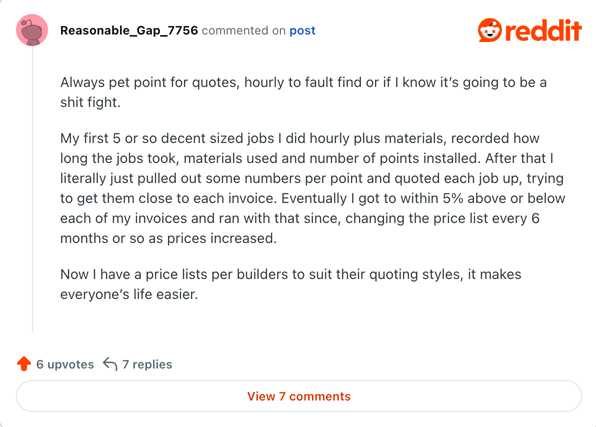
Fixed or lump-sum pricing
Suited to clearly defined projects with drawings and deadlines. It offers clients cost certainty but requires thorough preparation.
Tiered options
Offer 'Good / Better / Best' packages to help clients choose based on quality, budget, or turnaround.
Example: Kitchen Rewire Package
- Good ($1,800): Standard sockets and switches, builder-grade downlights, 2-week completion
- Better ($2,400): Brushed steel sockets, dimmable LED downlights, under-cabinet lighting, 1-week completion
- Best ($3,200): Premium designer switches, smart dimmable lighting, USB charging points, dedicated appliance circuits, 3-day priority completion
This approach often increases your average project value by clearly mentioning what’s included in each tier.
Read Simpro’s blog on “Good Better Best Pricing” that discusses tiered pricing models in a trades environment.
Maintenance plans
Ongoing testing or inspection contracts help create steady income and build long-term client relationships. These recurring services can include emergency lighting tests, safety inspections, or equipment maintenance agreements.
By offering them, you establish consistent cash flow and repeat business opportunities. For more inspiration on building recurring revenue, check out this guide on revenue ideas for electricians.
7. Benchmark Against Competitors and Industry Rates
Benchmarking your rates helps you stay competitive and ensures you’re pricing your skills appropriately. Insights from Simpro’s 2025 Trades Outlook Report suggest trade businesses that regularly review and adjust their pricing in response to market trends are better positioned to protect cash flow and maintain healthy margins.
Research local averages
Benchmarks help you sense-check your charge-out rates and minimums. Rates vary by region and job type, but recent public sources indicate:
- UK: Typical electrician hourly charges often fall around £40–£70+, depending on location and complexity. London can be higher, with some guides listing £50–£60 as common, and up to £100 for emergency work. Checkatrade
- Recent training and trade guides also cite ranges and an average near £44/hr, acknowledging wide variation by experience and call-out conditions. Logic4training
- US: Many sources quote $50–$130/hr, often with a $100–$200 service-call or first-hour fee. Home Advisor
- Australia: Expect A$80–$100/hr with typical service fees A$80–$130 depending on location and job nature. hipages.com.au
Adjust for location and expertise
Your rates should reflect your costs, skill level, and regional market. Urban or specialist work usually commands a premium.
Review regularly
Reassess your benchmarks every few months. Inflation and material price rises can quickly make old rates unprofitable.
Balance competitiveness and value
Don’t just aim to be the cheapest, aim to offer clear value. Professional service and reliable workmanship justify fair rates.
8. Present the Estimate Professionally
Presentation can be the deciding factor in whether a client accepts your quote. A clear, well-structured estimate builds confidence and shows you’re serious about your work.
Scope summary
Start with a brief description of what’s included and what the end result will look like. It reassures clients you’ve understood their needs.
Breakdown of costs
Show a simple separation of materials, labor, and options. When clients see transparency, they’re less likely to challenge your pricing.
Terms and inclusions
List payment terms, validity periods, and exclusions. It avoids disputes later and sets clear expectations from the start.
Options and upgrades
Offer tiered packages or alternate fittings where relevant. This gives clients flexibility while helping you upsell higher-value work.
Professional presentation
Use branded templates, consistent formatting, and easy-to-read language. A clean, well-presented quote reflects your professionalism and can make you stand out from competitors.
Avoid These Common Pricing Mistakes
- Missing a minimum charge for small jobs. Many electricians discussing pricing on Reddit have highlighted that small tasks without a call‑out or minimum fee can quickly become unprofitable. One Redditor summed it up well: “Hourly rate should only be for fault finding with a minimum charge.” Reddit
- Forgetting certification time and documentation. Testing, forms, and client handover take real hours.
- Underestimating access and making good. Old plasterboard, tiled ceilings, or heritage sites add time.
- Failing to price risk. Unknown faults, out-of-hours work, high ceilings, or asbestos checks merit allowances or a higher margin.
- Overlooking supplier fees and freight. Delivery charges, handling fees, and material waste erode margins fast. One electrician shared: "I just spent £600+ on materials, and what the customer will actually be using is closer to £250”. Reddit. This highlights how failing to account for handling and overage can quickly erode your margins.

- Confusing markup with margin. Use the correct formula to hit profit goals.
- Working from stale price books. Update catalogs and assemblies regularly.
- Leaving no pathway for change orders. Failing to outline how additional work will be handled can lead to awkward conversations. Make it clear upfront that extra work increases the cost. One Redditor explained that being upfront with customers that changes will affect the cost of a job is an important step. Reddit.

- Not tracking actuals. Without a post-job review, you cannot improve your estimates or identify where you’re losing money.
How Electrical Estimating Software Can Help
Understanding how to price electrical jobs is one of the toughest parts of running an electrical business, and even the best electricians can lose profit without realizing it. The right estimating software can change that. Simpro is purpose-built for field service and project work, designed to simplify estimating, quoting, and job management for electrical contractors. With Simpro’s electrical contractor software, you can:
- Complete digital takeoffs directly from plans and automatically populate your bill of materials.
- Build quotes faster using assemblies and reusable templates for sockets, lighting points, consumer units, EV chargers, and more.
- Keep pricing accurate with live supplier catalogs and automatic price updates.
- Apply rules-based markups and margins by job type to ensure consistency and profitability.
- Present Good/Better/Best quotes with photos, inclusions, and terms your clients can easily understand.
- Compare estimated versus actual hours with built-in schedule and time capture tools.
- Manage change orders clearly to protect against unapproved variations.
- Convert accepted quotes into jobs, raise purchase orders, and track work in progress seamlessly.
- Produce testing certificates and store them alongside job records for full compliance.

“
Simpro has given us full financial visibility, faster quoting, and streamlined operations. Our project managers can now handle 50% more work, and we're seeing 10 to 15% higher profit margins on project delivery.
Pricing for Profit and Trust
When someone hires you, they're investing in peace of mind. They expect safe work, punctual service, and ongoing support if issues arise. Demonstrate that level of professionalism, and clients will understand your pricing.
Best practices
- Explain the value clearly: Help clients understand what they’re paying for - safer installations, better energy efficiency or longer warranties.
- Offer choice: Present options so customers feel in control. It also gives you the chance to upsell quality and service.
- Be transparent: Outline what’s included, what’s not, and how you’ll handle surprises. Transparency reduces disputes and builds trust.
- Keep your promises: Deliver on your timelines, communicate delays early, and document every change.
- Review and refine: After every job, compare your estimate to the actual cost and hours. Update your rates to improve accuracy next time.
Building a profitable and trustworthy quoting process takes time, but it’s something you can systemize. Start by defining your scope clearly, using standard assemblies, and recovering your overheads properly. Set your profit margin intentionally, choose the pricing model that fits the job, and always benchmark your rates against real data.
Remember, the right tools can make this process faster and more reliable.

Ready to take your electrical business to the next level?
Book a free demo today and see how Simpro's electricians software helps you quote faster, price smarter, and stay on top of every job from estimate to invoice.


 Back to top