
Knowing how to estimate commercial HVAC jobs accurately is the difference between winning profitable work and eroding margin. This is true whether you're bidding on a new build, a large retrofit, or a multi-site mechanical contract.
This guide walks through the complete process for how to bid / estimate commercial HVAC jobs on commercial and construction projects. It covers reviewing specifications and conducting site surveys, through load calculations, quantity takeoffs, cost formulation, and final proposal presentation. If you're looking for guidance on how to set your prices and profit margins, this guide works hand-in-hand with our dedicated article on how to price HVAC jobs.
Step 1: Qualify the Project and Analyze Specifications
Commercial HVAC estimating begins long before numbers enter a spreadsheet. Successful bids start with disciplined qualification and a precise understanding of the scope of work, compliance obligations, and contractual risk.
Review Division Specifications and Mechanical Drawings
Before a single number goes into your estimate, you need to understand the legal and technical constraints of the project. Commercial construction projects are governed by the CSI MasterFormat specification system. As an estimator who knows how to bid HVAC jobs, two divisions dominate your workload:
- Division 01 — General Requirements: contractor qualifications, safety standards, bonding and insurance requirements, warranties, submittal procedures, and scheduling obligations. Missing a single Division 01 requirement can disqualify your bid entirely.
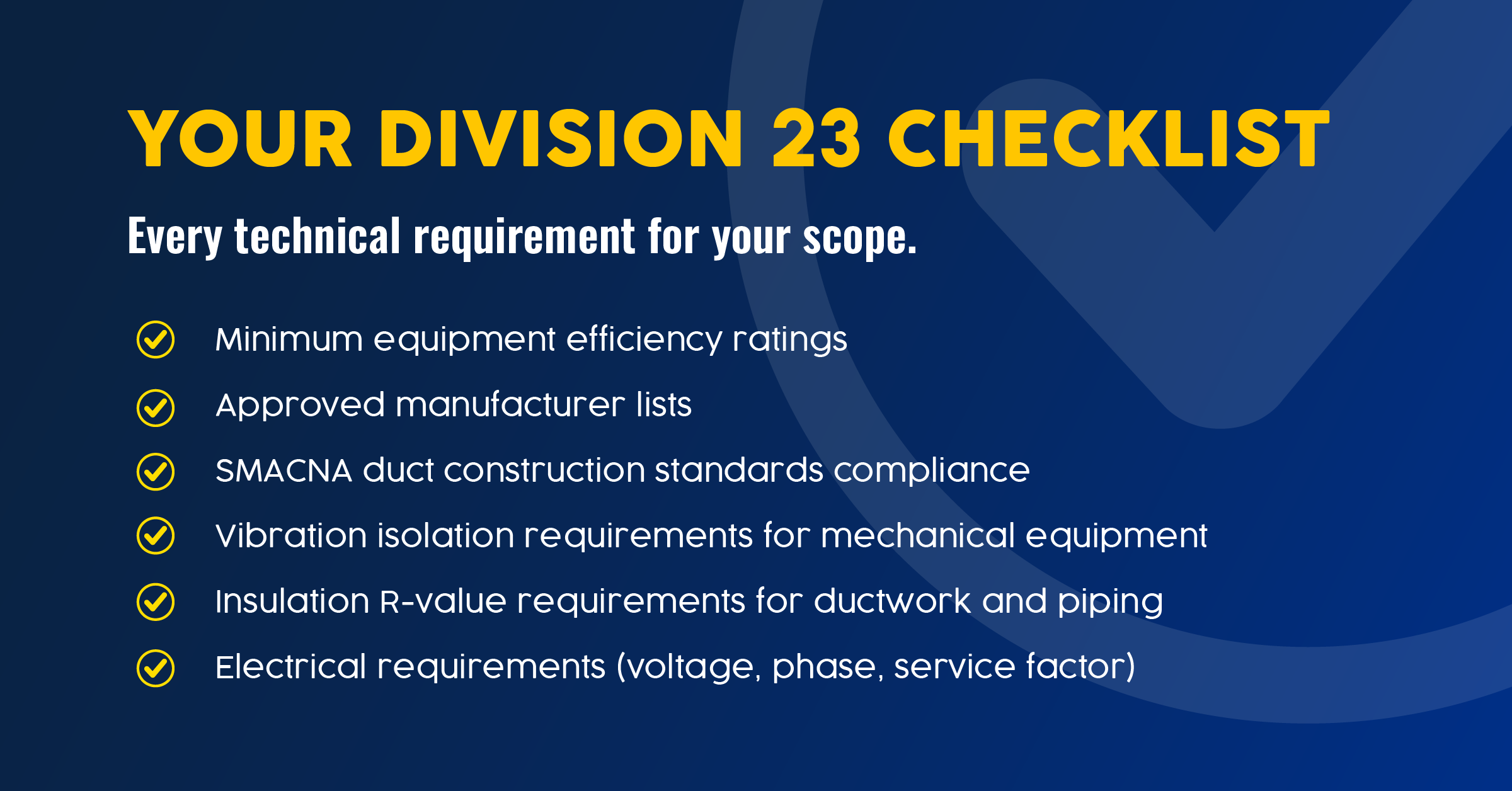
- Division 23 — HVAC: every technical requirement for your scope.
- Minimum equipment efficiency ratings
- Approved manufacturer lists
- SMACNA duct construction standards compliance
- Vibration isolation requirements for mechanical equipment
- Insulation R-value requirements for ductwork and piping
- Electrical requirements (voltage, phase, service factor)
The SMACNA HVAC Duct Construction Standards (4th Edition, 2020) categorize ductwork by pressure classification:
- Low-pressure (up to 2 in. water gauge)
- Medium-pressure (2–6 in. w.g.)
- High-pressure (6–10 in. w.g.)
Each has specific material thickness, reinforcement, sealing, and airtightness testing requirements.
Many building codes directly reference SMACNA standards, making compliance mandatory.
Cross-reference blueprints with architectural drawings and the HVAC equipment schedule to verify ceiling heights, duct sizes, and line-set routing. If you identify layout inconsistencies, clearance violations, or conflicts between mechanical and architectural drawings, submit a Request for Information (RFI) immediately.
An RFI should:
- Reference the exact plan sheet or specification section with the discrepancy.
- Include supporting documentation (marked-up drawings or field photos.
- Set a clear deadline for response to prevent schedule delays
- Be written concisely.
ℹ️ Look out for: reviewing mechanical drawings without validating them against historical profitability. A mechanically sound bid can still be financially unviable if similar past specifications consistently underperformed.
Before transitioning to Simpro, Buchanan & Hall, a commercial refrigeration and HVAC contractor, recognized this gap firsthand:
"In our old system, we had no connectivity between the quote and the job. We also didn't have background information to pull from. You could grab an old quote in the system, but you had no idea how well you did on the job."
After transitioning to Simpro, a connected system linking historical job data directly to estimating, they centralized operations for 10,000 pieces of inventory and 4,500 customers. Estimators now use the Copy Quote or Copy Job function to generate a financially validated baseline and review actual vs. estimated margins in the Breakdown Table before committing to a new bid.
Conduct the Site Survey and Infrastructure Assessment
Specifications define intent, but site conditions define reality. A thorough site survey reduces change orders, protects schedule integrity, and strengthens bid accuracy.
A standard HVAC site survey involves:
- Initial assessment: Gather information about the existing system's age, type, capacity, and known issues.
- Visual inspection: Examine ductwork, vents, filters, and coils for wear, corrosion, or blockages.
- Airflow testing: Use airflow meters and pressure gauges to measure velocity and pressure drop.
- Thermal imaging: Deploy thermal imaging cameras to detect heat loss hotspots.
- Electrical capacity evaluation: Assess panel ratings and confirm service adequacy.
Document ductwork viability, available electrical capacity, structural conditions affecting equipment placement, insulation levels, and demolition or retrofitting needs. Structural constraints requiring custom fabrication routinely erode margins when missed at the survey stage.
ℹ️ Look out for: relying on paper-based surveys that delay field-to-office data transfer. When infrastructure constraints are not digitized immediately, quoting is delayed, and critical details can be omitted from the scope.
Solv, a boiler, HVAC, and plumbing contractor, addressed this with a mobile-first approach:
"All the information for the customer and job requirements is there in the app along with the map tool."
Simpro Mobile allows field teams to capture site conditions, photos, and notes directly on their devices, syncing instantly to the cloud so estimating can begin without delay.
Step 2: Execute Precise Load Calculations and System Sizing
Load calculations determine system performance, long-term operating efficiency, and client satisfaction. Precision at this stage protects both project outcomes and your reputation.
Calculate Envelope and Internal Loads
Load calculations are the mathematical foundation of HVAC system sizing. For commercial projects, ACCA Manual N is the authoritative standard.
Load calculations evaluate three categories:
- Envelope loads: Heat transfer through walls, roof, windows, and doors
- Internal loads: Heat generated by occupants, lighting, and equipment
- Ventilation loads: Heat and moisture from outside air intake
Use local ASHRAE weather station design conditions:
- 1% peak cooling design day
- 99% heating design day
ℹ️ Look out for: performing load calculations in isolated systems that require manual re-entry into estimating platforms. Duplicate data entry introduces errors and delays proposal generation.
Simpro supports CSV import from engineering software directly into the digital catalogue or quote, reducing manual duplication and preserving data integrity.
Determine Ventilation and Outside Air Requirements
ASHRAE Standard 62.1 defines minimum ventilation rates and humidity control requirements for commercial buildings.
Key design parameters to include:
- Demand Control Ventilation (DCV): CO₂ sensors accurate within ±75 ppm
- 0.4% peak dehumidification design day modeling
- Building pressurization strategies
ℹ️ Look out for: managing asset compliance across fragmented spreadsheets. Without centralized asset tracking, estimators cannot reliably maintain compliance records required for larger commercial contracts.
Blue Flame Heating Solutions digitized asset tracking through Simpro’s Asset Builder, centralizing specifications and compliance data across 24,000 sites.
Select and Size the HVAC Equipment
HVAC capacity is measured in tons (1 ton = 12,000 BTU/hour).
Avoid these pitfalls:
- Oversizing and short cycling
- Over-reliance on rule-of-thumb sizing
- Failure to match SHR to building type
ℹ️ Look out for: quoting equipment without digital connectivity to procurement workflows. When accepted quotes don’t convert directly into material orders, manual purchasing increases risk and delays.
In Simpro, converting a quote to a job automatically pushes materials into the Required stock tab, enabling procurement to act immediately.
Step 3: Perform the Quantity Takeoff
A disciplined quantity takeoff protects both cost accuracy and installation productivity. Standardization and repeatability are essential at scale.
Transfer primary machinery item-by-item directly from the mechanical plan's equipment schedule to a master takeoff log. This establishes your highest-cost line items before you begin measuring peripheral and distribution materials. The standard is 400 CFM per ton for air conditioning. Use this benchmark when cross-checking equipment schedule quantities against your calculated loads.
ℹ️ Look out for: manually recreating fittings and material lists from scratch for every bid. Pre-built assemblies accelerate estimating and improve consistency.
Simpro’s Take Off Templates and Pre-Builds bundle materials and labor units into structured digital templates, enabling rapid adjustments without sacrificing detail.
See how Simpro's job estimation and costing tools work in practice.
Step 4: Formulate Cost Estimation and Pricing
Accurate HVAC estimating requires full cost visibility, not just direct materials and wages. Growth-minded field service leaders calculate true burdened cost before applying margin.
Calculate Fully Burdened Labor Costs
Base wage is only the starting point.
ℹ️ Fully Burdened Rate \= Base Wage × (1 + Burden Rate %)
Typical burden rates range from 40–50%.
ℹ️ Look out for: calculating burden against paid hours instead of billable hours. Utilization rates significantly affect the true productive cost per hour.
Simpro’s Schedule Rates apply employment costs and overhead directly to mobile timesheet data, saving time and hassle by providing real-time visibility into actual labor cost performance.
Aggregate Direct Materials, Equipment, Rentals, and Subcontractor Costs
Compile current supplier pricing for equipment, ductwork, sheet metal, copper, and refrigerant before finalizing any commercial HVAC estimate. Request updated quotes from multiple suppliers using exact model numbers and verified takeoff dimensions. Commodity volatility in sheet metal and copper can compress margins quickly when pricing assumptions are outdated.
Material cost discipline matters. According to RSMeans, the following best practices protect both accuracy and profitability:
-
When estimating boilers, confirm whether manufacturer capacity ratings are based on output or input. Misinterpreting this distinction is a common and expensive estimating error.
-
Always include insulation for pipe, boiler, and duct (wrap and liner). Insulation is frequently omitted in early drafts, yet it directly affects compliance, performance, and cost recovery.
-
Verify correct pressure rating and connection type (thread, weld, flange) for all mechanical components to prevent downstream scope gaps.
-
Clarify responsibility for the temperature control system early. Controls are often excluded under the assumption they fall within the electrical scope, creating avoidable exposure at the contract stage.
-
Equipment rental pricing typically follows a predictable structure: weekly rates average approximately one-third of monthly rates, and daily rates are roughly one-third of weekly rates. Common HVAC project rentals include cranes, scissor lifts, duct jacks, and man lifts. Remember that operator wages are not included in rental pricing and must be calculated separately to reflect the true project cost.
-
For complex commercial projects, incorporate subcontractor costs for custom fabrication, controls installation, and required testing and balancing (TAB). TAB is a critical compliance and commissioning component on commercial HVAC projects and one of the most frequently missed line items in early-stage estimates.
Successful HVAC contractors don’t leave their estimates to chance. When every line item (from equipment specs to sub-fees) is double-checked and tied to a firm quote, profits and margins are more predictable and accurate. When they're not, there is loss.
ℹ️ Look out for: manually transferring material data between HVAC estimating software and accounting systems. Uninvoiced materials directly impact margin accuracy.
Simpro integrates supplier invoices directly against purchase orders and exports transactions to accounting platforms such as QuickBooks or Xero.
Apply Overhead, Contingencies, Allowances, and Profit Margins
ℹ️ Final Price = Total Job Cost × (1 + Overhead % + Profit Margin %)
Commercial HVAC profit margins typically range 10–18%.
ℹ️ Look out for: applying target profit margins without validating them against actual post-job performance data.
Simpro’s Breakdown Table and Project Overview Financial View align estimated and actual costs in real time, enabling active margin management before invoicing.
Step 5: Develop and Present the Proposal
A commercial HVAC proposal is both a sales document and a contractual safeguard. Clarity, structure, and transparency reduce disputes and reinforce credibility.
A comprehensive bid should include:
- Cover page with company branding and contact information
- Executive summary: concise overview of the project and its commercial benefits for the client
- Scope of work: detailed description of proposed HVAC work with explicit inclusions AND exclusions
- Equipment specifications: exact model numbers, efficiency ratings, and warranties
- Cost estimate: transparent, itemized breakdown for equipment, installation, labor rate, and additional HVAC services
- Project timeline with milestones
- Warranty and service agreements: post-installation coverage details
- Terms and conditions: payment schedules, legal requirements, insurance
- Maintenance schedule: required upkeep and frequency
- Testimonials and case studies: past successes to establish credibility
For each pricing model, understand which contract structure the project calls for:
| Pricing Model | Description | Best For |
|---|---|---|
| Lump Sum | Fixed price for the entire project; contractor absorbs overruns | Most common for commercial HVAC; requires most accurate estimating |
| Time & Materials | Variable cost based on actual hours + materials + markup | Renovations, retrofits, exploratory work with uncertain scope |
| Unit Pricing | Flat price per completed work item (e.g., per linear foot of duct) | Repetitive work items with variable quantities |
| Flat-Rate | One fixed rate per service including time and materials | Residential service calls and repairs |
Consider presenting Good-Better-Best tiered options, a proven strategy for expanding ticket sizes and empowering customer choice. Each tier should include a distinct scope, corresponding project timeline, specific pricing, and maintenance schedule requirements.
See our complete guide to building winning Good-Better-Best HVAC proposals.
ℹ️ Look out for: manually formatting complex commercial proposals. Automated quoting structures increase proposal speed and consistency.
Simpro’s Form Builder uses dynamic fields and conditional logic to convert finalized estimates into structured, professional proposals efficiently.
Step 6: Track Metrics and Continuously Improve Your Estimating
The most successful field service organizations treat every completed job as data for refining the next bid.
Key benchmarks*:
-
Overall win rate: ~25%
-
Hard competitive bids: 10–20%
-
Design-build: 25–50%
*Key benchmarks calculated based on industry averages
ℹ️ Look out for: disconnected quotes and job performance data. Without historical visibility, estimators cannot calibrate margin assumptions accurately.
Simpro connects the full job lifecycle, from quote to completion, enabling detailed WIP reporting, margin tracking, and win/loss analysis.
Build an Estimating Process That Gets Better With Every Bid
Learning how to estimate HVAC jobs accurately and how to bid confidently is a structured process supported by technical rigor, disciplined review, and connected operational data.
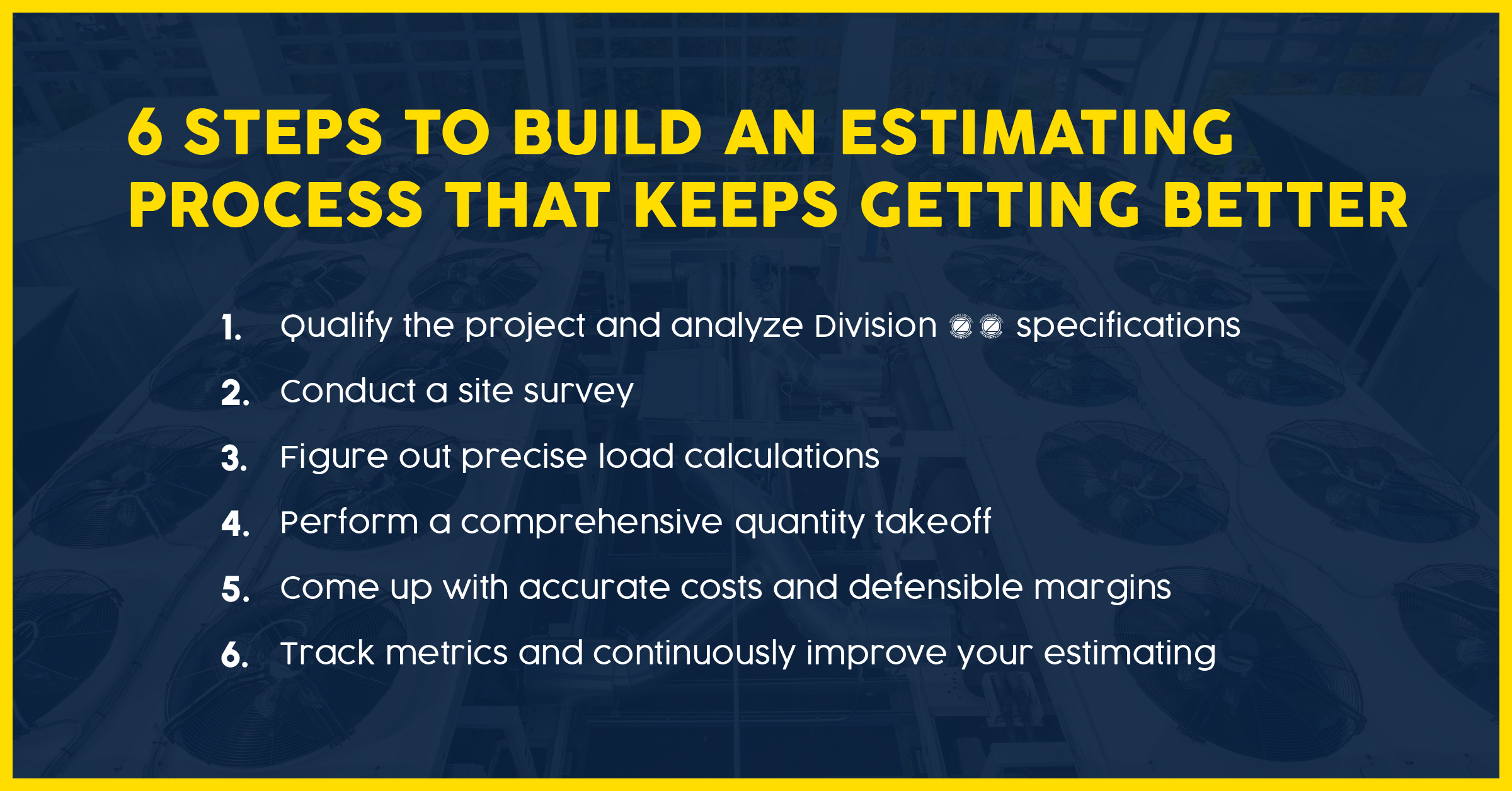
Here are six steps that will give you an excellent foundation:
- Qualify the project and analyze Division 23 specifications
- Conduct a site survey
- Figure out precise load calculations
- Perform a comprehensive quantity takeoff
- Come up with accurate costs and defensible margins
- Track metrics and continuously improve your estimating
Simpro supports HVAC businesses with a connected platform that unifies estimating, field execution, procurement, and financial reporting. We aim to help growth-minded field service leaders build a more disciplined, data-informed HVAC bidding process.
Ready to explore how it works in practice? Discover how Simpro supports HVAC estimating and project management workflows.


 Back to top