
These are good times for electrical contractors. And the trends in electrical industry growth directly reflect today's technological advancements. AI investment is fueling data center growth. Electrical vehicle (EV) infrastructure keeps expanding. Grid modernization is racing to keep up. The U.S. electrical industry is on track to generate $347.5 billion in revenue in 2026, fueled by a 4.8% compound annual growth rate (CAGR) over the past five years.
If you're an electrical contractor, this growth is as much of a stress test as a business opportunity. Chasing every new revenue stream simultaneously can break your business. As demand accelerates, you need to focus on how you'll get the work done without bleeding margin. Every opportunity lands differently depending on how tight your scheduling, costing, and materials tracking actually are.
This article breaks down 10 trends reshaping the electrical industry this year, what each means for your business, and how to apply each to your operations.
What's Changing in the Electrical Industry in 2026?
The big picture: Demand is surging from multiple directions, but skilled labor is at a premium, and supply chains remain constrained. The electrical industry is also experiencing a structural shift in types of electrical work toward higher-complexity, higher-voltage, higher-margin work in data centers, energy systems, and smart infrastructure. That's good news for revenue potential, but not so much for businesses still running operations on spreadsheets and group texts.
There are more than 250,000 electrical contracting businesses in the U.S., and most generate less than $2 million annually. The profit margin gap between average performers (4–8% net margins) and top-quartile firms (8–12%) is about your operations, not technical excellence. Understanding the electrical trends driving 2026 is the first step. Building the systems to capitalize on them is the toughest part.
10 Electrical Industry Trends Contractors Should Watch in 2026
Here's what's moving the needle this year and what it means for how you run your business.
1. Rising Demand for Data Center and AI Infrastructure Work
AI-driven demand is already here and continues to grow. Data center construction spending in April 2026 reached a seasonally adjusted annual rate of $50.7 billion, up 28.1% from a year earlier. Perhaps most importantly, data centers are driving almost all growth in the broader nonresidential sector.
For electrical contractors in the right markets, this is a once-in-a-generation opportunity. High-voltage, complex project work demands precise job costing, tight scheduling, and multi-phase billing. Contractors that can accurately price data center infrastructure — and track costs through completion — have an advantage over their less prepared competitors.
The operational fix: Before chasing data center contracts, build your job costing infrastructure. You need to know your actual cost per phase — not just the estimate — before billing milestones hit. Electrical job management software platforms designed for exactly this: managing the full quote-to-invoice cycle on complex, multi-stage commercial projects where estimating variance kills your margin.
2. Electrification Is Expanding the Scope of Electrical Projects
Electrification continues to be a major trend in the electrical industry. The push toward EVs, electric HVAC, and all-electric buildings means electrical systems are absorbing more of the load previously handled by gas infrastructure. This expands the scope of virtually every project type — from new construction to renovation to service calls.
For residential service teams, this means panel upgrades and heavy-up work are becoming standard items. A homeowner adding a heat pump, EV charger, and solar battery storage in one renovation cycle can represent $15,000–$25,000 in electrical work alone.
The expanding scope of electrical work also pushes contractors into deeper conversations about energy efficiency, clean energy integration, and sustainable energy systems.
The operational fix: Build tiered service packages around electrification upgrades. Good/better/best pricing works here, as it creates upsell opportunities and establishes a clear value proposition. When a customer calls for a panel upgrade, your team should be able to upsell a full electrification assessment — all before leaving the job site.
3. EV Charging Infrastructure Remains a Revenue Opportunity
EV chargers are one of the highest-potential service lines in the electrical industry. While demand has moderated in the past couple of years, that still equates to thousands of new EV charger installs each quarter.
The install side is straightforward for most licensed electricians. The revenue side is where it gets interesting. Contractors positioning themselves as full-service providers of EV charging infrastructure can see average tickets of $10,000+ for bundled battery, solar, and EV charger packages. Commercial charging infrastructure projects, particularly for multi-family properties and fleet operators, are driving even larger contracts.
What's more complex is managing the inventory, meeting certification requirements, and the scheduling variability that comes with running EV work alongside traditional service calls. This work requires different materials, job durations, and billing structures.
The operational fix: Track EV charger installation as a distinct job type so you can measure its standalone margin rather than as part of blended margin. If you run this revenue line through the same informal process as a panel swap, you're flying blind on profitability.
4. Grid Modernization and Energy Reliability Are Creating New Service Needs
Smart grid investment is accelerating across the U.S., driven by federal infrastructure funding and utility-side pressure to handle variable renewable energy inputs. For electrical contractors, this translates into demand for smart grid integration work: backup power systems, automatic transfer switches, grid-tied battery installations, and advanced metering infrastructure.
Power systems reliability has become a business continuity issue for commercial and industrial clients. On the installation side, facilities managers are asking contractors for generators, uninterruptible power supply (UPS) systems, and fault-detection upgrades. Post-install maintenance contracts on backup power systems create predictable cash flow and act as a buffer during slow periods.
Because high-voltage systems and smart grid components can be complex, contractors can create technical differentiation by investing in certifications and tooling.
The operational fix: Use your job-history data to identify commercial clients with backup power systems that are aging or unserviced. A targeted outreach campaign, tied to a maintenance contract offer, is one of the highest-ROI marketing moves available to an electrical business.
5. Renewable Energy and Battery Storage Projects Are Becoming More Integrated
Solar and battery storage projects in 2026 are more likely to be integrated into a single project scope than quoted as separate service lines. Solar remained the top source of new grid capacity in 2025, with 490 gigawatts expected to be added over the next decade.
For electrical contractors, the business model is shifting. Homeowners and commercial clients now want coordinated installations as a package, including solar panels, battery storage, EV chargers, and updated power systems. That's good for average ticket value but requires tight project planning, materials coordination across renewable energy sources, and careful scheduling and sequencing of work.
Contractors in solar-adjacent markets have a distinct opportunity if they can build genuine competency in battery storage integration, as they can capture work from traditional solar installers that lack an electrical license.
The operational fix: Build inventory tracking for battery and solar components that's separate from standard electrical materials. Lead times are different, storage requirements are different, and job planning timelines are longer.
6. Labor Shortages Are Pushing Contractors to Improve Productivity
This one isn't new, but the numbers keep getting harder to ignore. Employment of electricians is projected to grow 9% from 2024 to 2034, with approximately 81,000 openings projected each year. Meanwhile, nearly 30% of union electricians are at or near retirement age, meaning that the electrical workforce could shrink over the next few years even as demand increases.
Not only is hiring difficult, but labor costs are rising. Fully burdened labor cost for a journeyman runs 40–55% above base wages when you factor in payroll taxes, workers' comp, benefits, and vehicles. The best move for most contractors? Squeezing more billable output from your existing team.
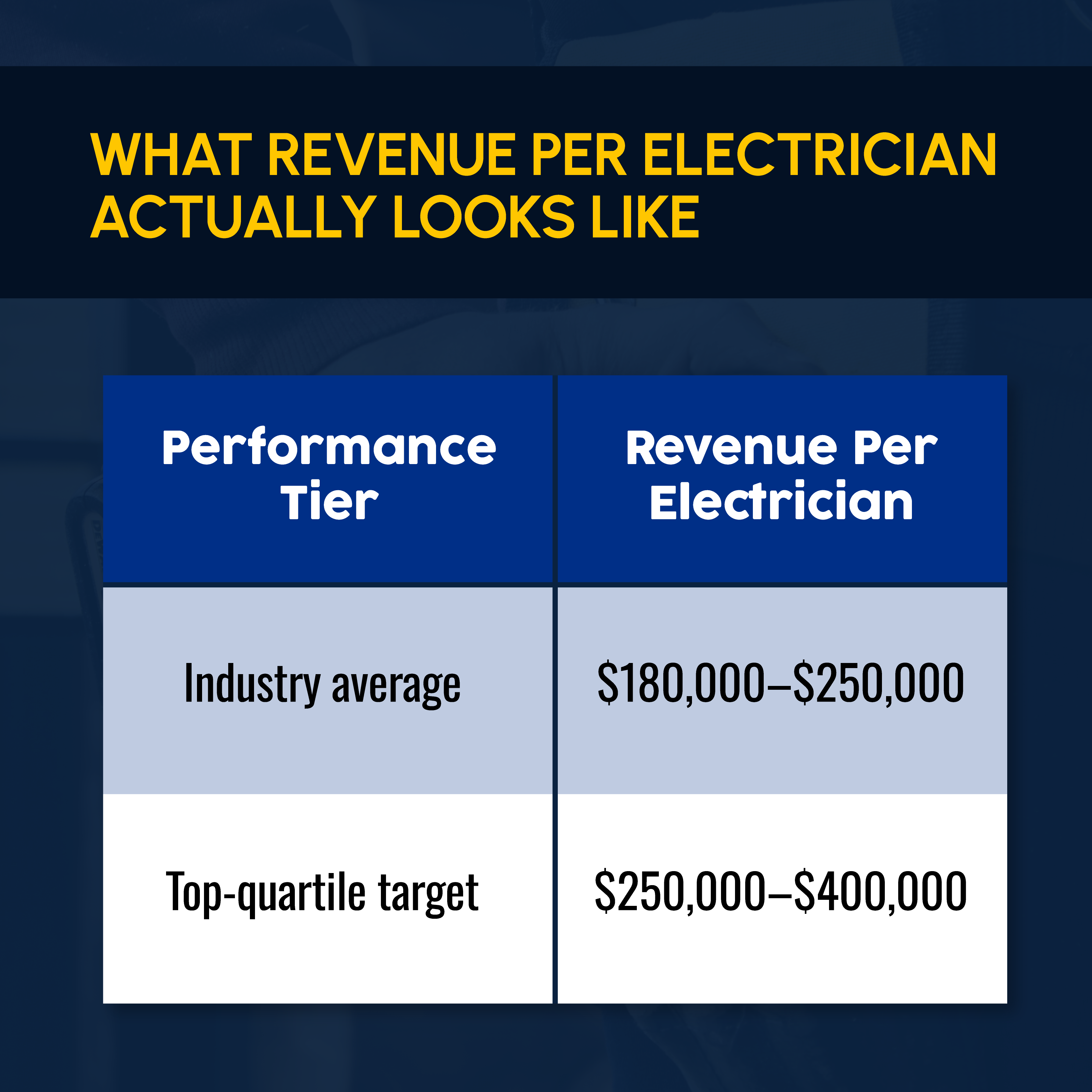
Revenue per electrician benchmarks tell you where you stand:
- Industry average: $180,000–$250,000 per journeyman per year
- Aim for: $250,000–$400,000 If you're not tracking this number, you don't know whether your productivity problem is about pricing, dispatch, or marketing volume.
The operational fix: Run a billable utilization audit for your team. Top-quartile targets are 65–75%. Anything below 60% means time is leaking somewhere: excessive drive time, administrative work, or scheduling gaps. Real-time job-status tracking and route optimization can recover those hours.
7. Supply Chain and Equipment Delays Are Affecting Project Timelines
Switchgear lead times that used to run weeks now run months. Supplies of transformers, panels, and certain smart grid components remain constrained. For contractors running project-based work, this is a margin issue. Miscalculated lead times push out billing milestones, extend project durations, and tie up crews on incomplete jobs.
Smaller contractors get hit hardest because they lack the purchasing volume to secure priority allocation from distributors. Managing this challenge requires better materials planning during the estimating stage — not just knowing what you need, but when it will be available and building that into your project schedule.
Electrical work that touches high-voltage systems or requires specialized equipment for smart city infrastructure or industrial applications is especially vulnerable to delays. A missed transformer delivery on a data center project doesn't just slow you down; it can also trigger penalty clauses.
The operational fix: Build lead time buffers into your estimates and project schedules as standard practice, not an afterthought. Your estimating tool should flag specialty materials and prompt for lead time verification before a quote is finalized.
8. AI and Automation Are Moving Into Electrical Business Operations
AI adoption in field service management is moving from novelty to necessity. The operational use cases are concrete:
- AI-powered scheduling that accounts for technician skills, real-time availability, and job location
- Automated follow-up on unsold estimates
- Predictive job costing based on historical data The business case isn't complicated. Labor is your single largest cost, and you're in control of billable output from your team. AI scheduling tools, automated estimate follow-up, and predictive job costing don't replace electricians. They eliminate the administrative drag that keeps good electricians from doing more billable work each day.
The argument for protecting revenue and margins with AI is simple: Electrical contractors that adopt operational AI tools now will have a structural cost advantage within two years over those who don't.
The operational fix: Start with the highest-friction part of your operation — likely scheduling, invoicing, or estimate follow-up. Automate one process before adding more. Complexity doesn't scale: One well-implemented automation outperforms five half-built workflows every time.
9. Smart Buildings and Connected Systems Are Increasing Technical Complexity
Smart home and smart city infrastructure are raising the technical bar for electrical work. Building-automation systems, integrated lighting controls, connected HVAC interfaces, EV-ready wiring in new construction, and advanced metering all require electrical work that goes beyond the standard service call.
Residential smart home installations have become a meaningful revenue category, as well. Homeowners retrofitting older homes with connected systems generate consistent service work, including troubleshooting, upgrade installs, and integration calls. While individual smart home tickets are smaller than commercial projects, recurrence is higher.
The technical complexity highlights certification and training requirements. Contractors that upskill technicians in building automation and smart city electrical systems will compete for work that commodity operators can't touch.
The operational fix: Track smart home and connected systems work as a distinct service category. If you're doing this work but lumping it into general residential service, you don't know its margin contribution or whether it's worth prioritizing.
10. Electrical Contractors Are Using Data to Protect Margins
The most important electrical industry trend for 2026 isn't technical but financial. The gap between 5% and 12% net margins in the electrical industry is rarely about technical skill or market access. It's usually about visibility. Top-quartile operators can track job-level profitability, revenue per technician, billable utilization, and estimate-to-actual variance in real time. Most contractors don't — or can't.
The average electrical business tracks revenue. Fewer track gross margin by job type. Fewer still measure the variance between what they estimated and what the job actually cost. These variances are where margin disappears.
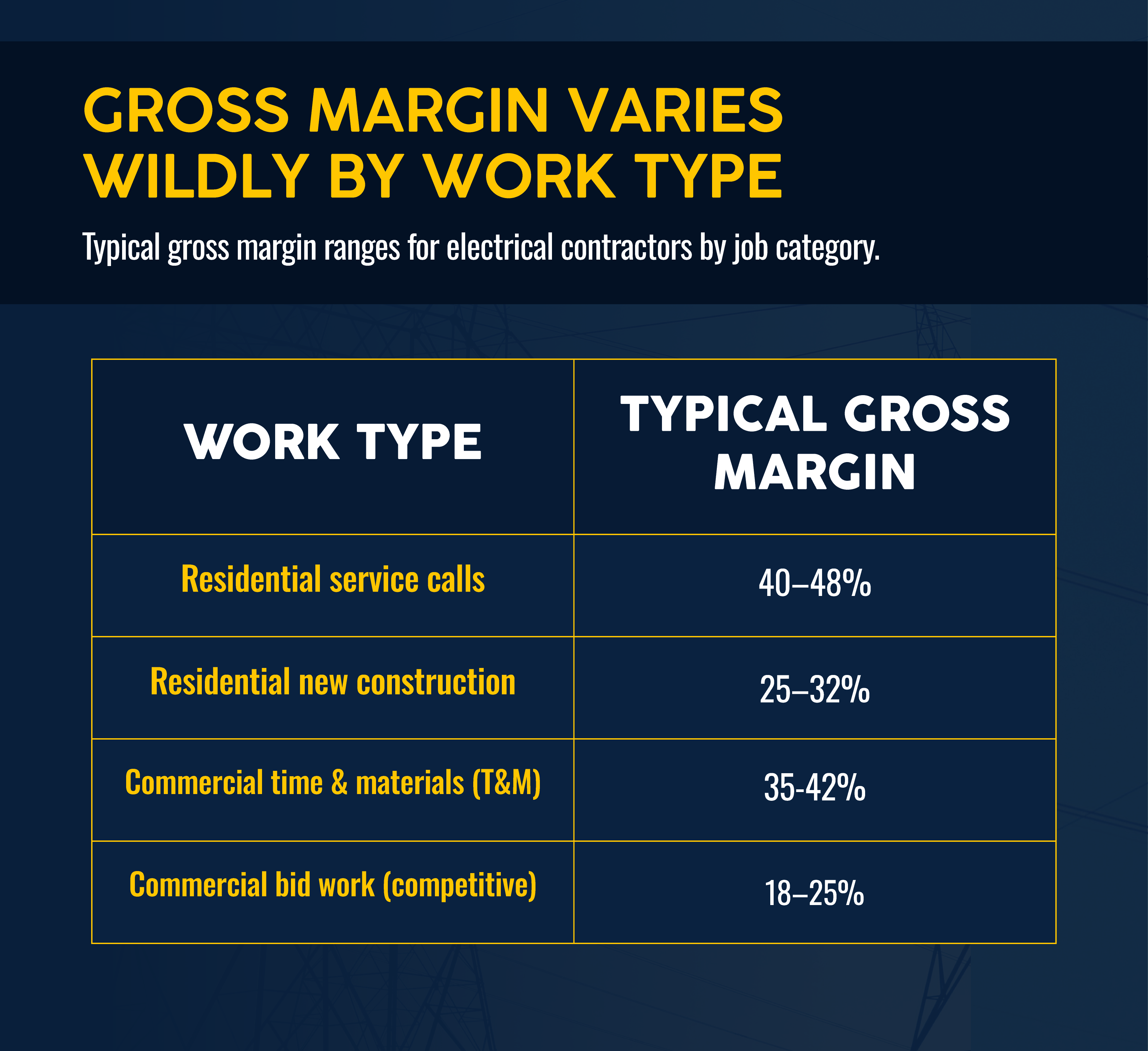
Service work carries 45–55% gross margins. Competitive commercial bid work runs 18–25%. If you don't know your revenue mix, you can't optimize it. If you can't optimize your revenue mix, you're leaving several margin points on the table.
The operational fix: Pull a job-level profitability report by work type for the last 90 days. If your software can't produce that report, that's the first problem to solve.
Related: Check out our electrical business profit guide to learn how to get data out of people's heads and into a system.
How Electrical Contractors Can Prepare for 2026's Trends
Across all 10 trends, a pattern emerges: The constraint isn't market opportunity but operational capacity. You can't profitably add EV charging to your service mix without formal materials tracking. You can't compete for data center work without job costing discipline. You can't protect margin on smart building projects without real-time visibility into actual per-job costs for labor and materials.
To run a successful electrical business in 2026, these operational priorities cut across every trend on this list:
- Job costing discipline. Know your actual cost per job, per work type, per technician — not just at the end of the quarter or year, but in real time.
- Scheduling and dispatch efficiency. Revenue per truck per day should target 3–4 calls minimum to justify fleet overhead. Below that, and you have a dispatch problem.
- Revenue mix visibility. If you can't see your margin by work type, you can't make informed decisions about what to grow and what to stop doing. The right electrical marketing strategies will help you reach customers in new service categories. But your business has to be able to execute on that demand.
Manage Electrical Industry Growth With Simpro®
The electrical industry trends shaping 2026 all point in the same direction: more complexity, more specialty work, and more operational load. The contractors who outperform have systems that can handle complexity without adding headcount.
Simpro® is built for electrical contractors who run break-fix service, planned maintenance, and project work simultaneously — and need to see each group's profitability without accessing three different systems. Over 24,000 businesses use Simpro to manage quoting, scheduling, dispatching, inventory, and job costing in a single platform. Customers report 25% revenue increases and 10x faster estimates after adopting the platform.
Whether you're a five-person residential team building out an EV charging service line or a 30-person commercial operation bidding on data center infrastructure work, the operational question is the same: Do you know where you're making money?
Schedule a demo to see what that visibility looks like in practice.


 Back to top