
Quick Answer: Agentic AI for electrical companies means software that acts autonomously across multi-step tasks — answering calls, prepping technicians, drafting quotes, chasing overdue invoices — rather than following a fixed script like a chatbot or basic automation. It matters now because the electrical workforce could shrink up to 14% by 2030 even as demand keeps climbing, according to Simpro's 2026 electrical industry statistics. AI agents like Simpro Lightning's JobReady, JobScribe, and JobBrief handle estimating, dispatch prep, compliance documentation, and customer follow-up, freeing licensed electricians for the code-compliance and safety-critical decisions AI shouldn't make alone.
An AI agent electrical deployment can cover a lot of work for small contractors: Answering calls while your crew is on a ladder pulling wire, drafting quotes your estimator hasn't gotten to, and chasing the invoice that's 45 days past due.
None of this is theoretical, and the labor math is part of why it matters now. Electrical industry statistics suggest the electrical workforce could shrink up to 14% by 2030 while demand keeps climbing. You're not going to hire your way out of that gap. You have to get more done with the crew you've got.
To get more out of your current staff, you need software that acts on information rather than just storing it. Electrical contractors need to understand the difference between an agent, a chatbot, and basic automation, the eight ways agentic AI already shows up in electrical work, and when you should keep tasks for yourself.
AI Agent vs. Automation vs. Chatbot: What Electrical Business Owners Need to Know
Understanding agentic AI for electrical business owners starts with knowing the vocabulary. If you don’t get the differences between “chatbot” and “automation,” you’ll make bad buying decisions that cost you money but don’t help your business.
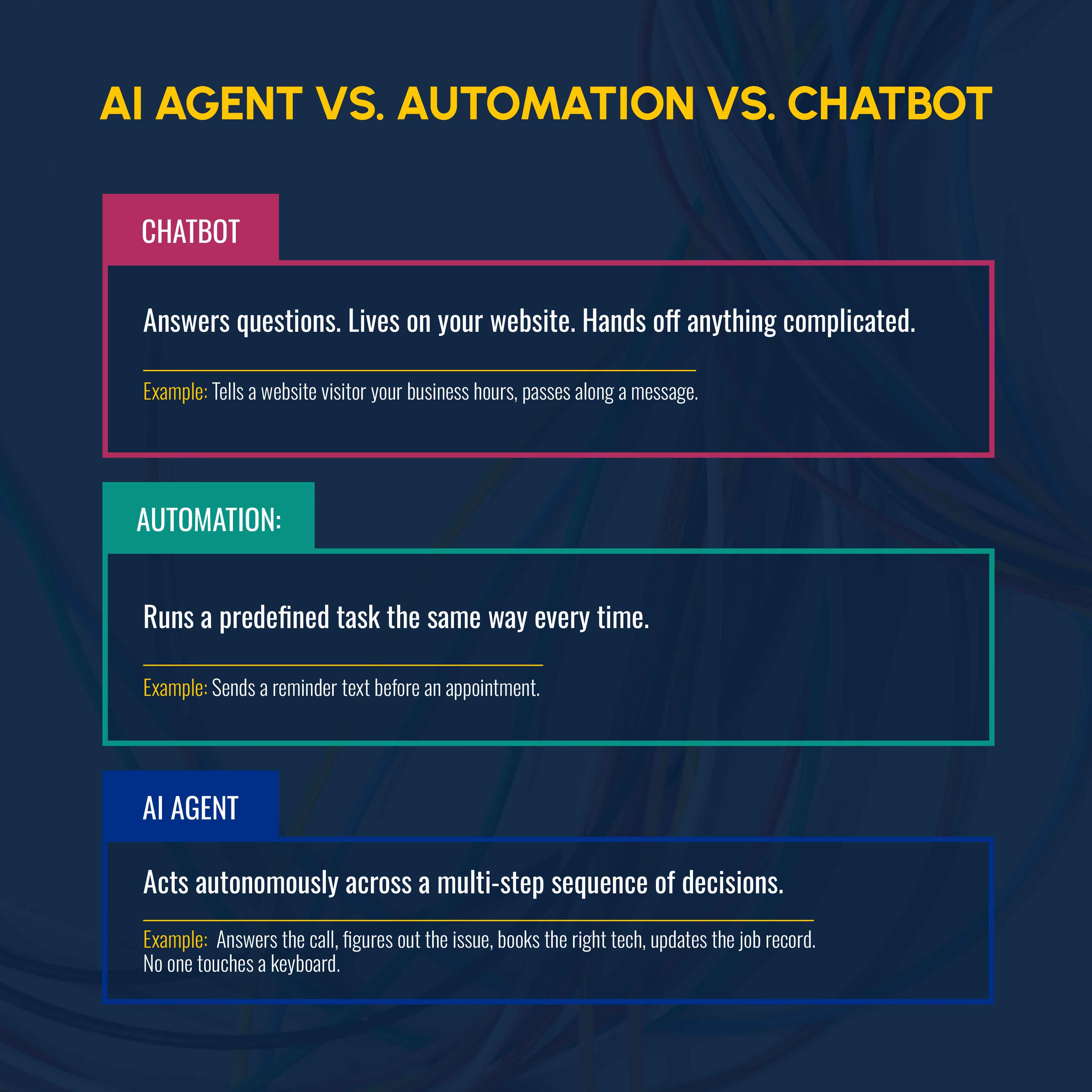
Chatbots: A chatbot answers questions. It lives on your website, responds to questions like "do you install EV chargers?" with a canned reply, and hands off anything more complicated. Basic automation is built to automate repetitive tasks, like sending a reminder text 24 hours before an appointment or routing a form submission to an email inbox. Chatbots are useful and consistent, but rigid.
AI agents: Agents can act autonomously across a multi-step sequence of decisions, not just one. When someone calls about a breaker that keeps tripping, the agent can determine from the caller’s description whether this is a tripped breaker or a full panel failure. The agent then books the right technician for the job and updates the job record, all without human intervention. Behind AI agents are large language models (LLMs) reasoning through each step with minimal human input.
Generative AI: This is yet another form of artificial intelligence. It’s useful for creating content, marketing collateral, or a job posting, but it doesn't independently take action on your business systems.
The value of agentic AI for electrical business owners starts with a simple fact: Many shops don't have a dedicated dispatcher, estimator, and office manager. One person, or a small team, is doing all of this work and more between service calls.
Nearly 70% of trade business owners say AI will determine whether they can keep up with demand, according to the Simpro® Trades Outlook Report. But many of these businesses already have too many software systems with no idea how to consolidate or integrate them. That gap is your opportunity.
8 Ways Agentic AI Can Support Electrical Companies
Each of these tactics corresponds to a bottleneck inside growing electrical businesses.
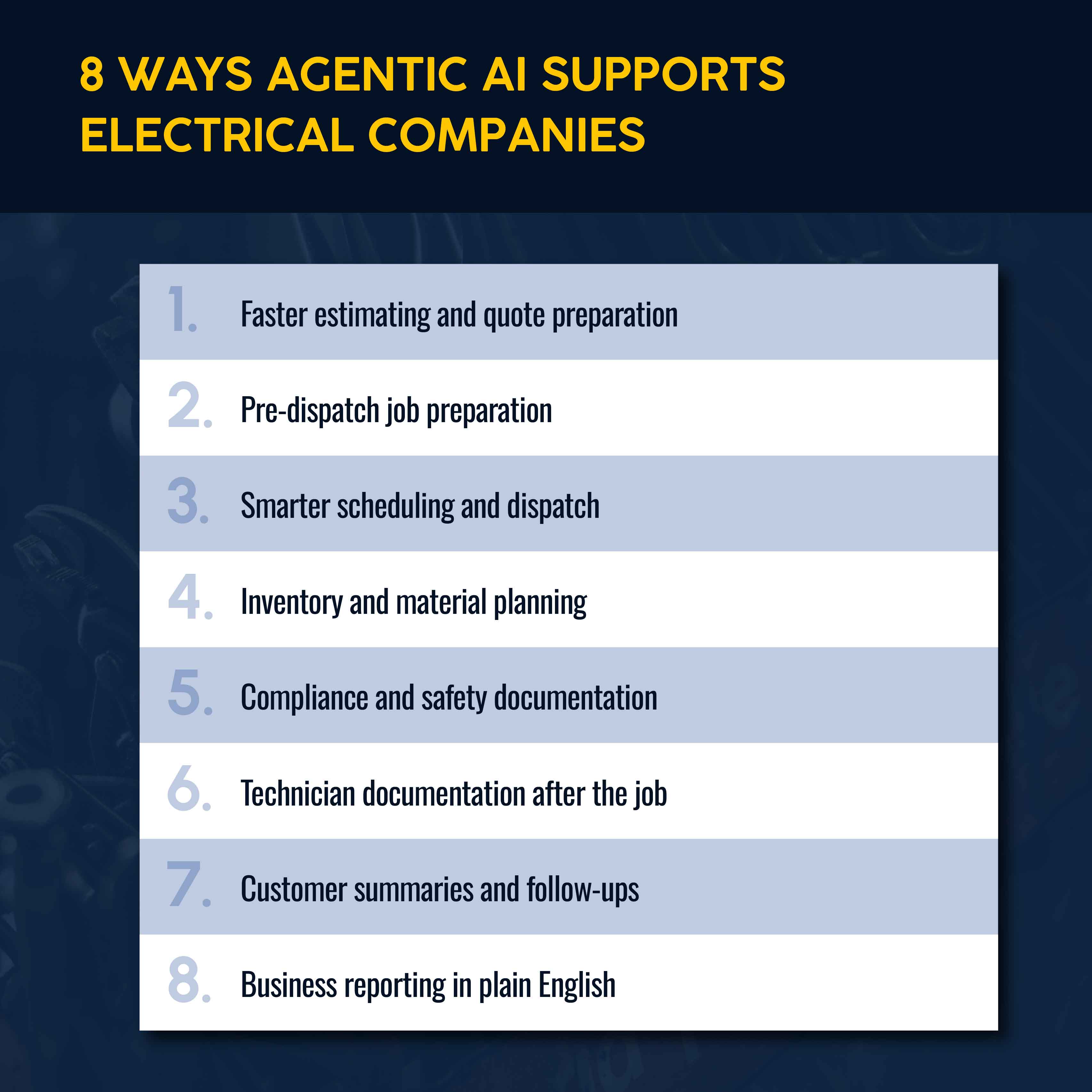
1. Faster Estimating and Quote Preparation
Building commercial tenant-improvement bids used to be time-consuming. But with the right software, it can quickly be constructed from job-walk photos and voice notes, with pricing pulled straight from your electrical price book instead of retyped line by line.
Simpro uses its own estimating tools, including Simpro Takeoffs, with symbol recognition and plan markup to turn a blueprint into a structured quote automatically. Companies have reported up to 10x faster estimates compared with manual methods.
The operational fix: Route every repeatable job type (panel upgrades, EV charger installs, service calls) through a templated, AI-assisted quote builder. Reserve manual estimating for jobs that truly need a custom bid.
Speed matters when you’re bidding. For EV charger install requests, a same-day quote wins more work than sending it two days later — after the homeowner has already called two other electricians.
2. Pre-Dispatch Job Preparation
When technicians aren’t prepared for a job, routine service calls can turn into costly return visits. An AI agent can pull job history, customer notes, site-access details, and the parts needed before the technician leaves the shop.
Simpro Lightning's JobReady agent compiles everything a tech needs ahead of dispatch, with the goal of moving first-time fix rates from the 75% industry average to 90% or higher.
The operational fix: Build a pre-dispatch checklist into your job records so the agent has something to pull from. Garbage in, garbage out applies here as much as anywhere.
3. Smarter Scheduling and Dispatch
Manual dispatch boards work fine with two trucks. They start breaking down around truck five or six, when you're simultaneously juggling technician location, certifications, parts already on the vehicle, and customer priority. Agentic tools can handle complex, multi-variable dispatch decisions and adjust in real time when a job runs long or an emergency call comes in.
The operational fix: Start by giving the agent your constraints (certifications, service radius, truck stock). A dispatch agent working from incomplete data will make confident-but-wrong decisions, and you won’t know the difference until it’s too late.
If each technician recovers even one extra billable hour a day at a $125 shop rate, that's compounding revenue throughout the year.
4. Inventory and Material Planning
When jobs stall mid-install because of material shortages, the cost is much more than the time delay. You need to factor in the second trip, idle labor utilization, and the customer's patience. Agentic AI can watch job pipelines and flag material needs before a crew winds up at a supply house, waiting for a will-call order.
The operational fix: Tie your material planning to your quote-to-job pipeline instead of running it as a separate spreadsheet. The earlier the agent sees a job, the earlier it can flag what's needed.
Consider a commercial rough-in that stalls for two days waiting on a breaker order. On a five-person crew billing out around $600 an hour combined, two idle days is close to $9,600 in stalled labor, on top of any jobs you had to push back to cover the delay.
5. Compliance and Safety Documentation
Electrical work requires more documentation than most other trades, including permit tracking, load calculations, panel schedules, and jurisdiction-specific inspection sign-offs.
Simpro's Digital Forms use conditional logic to build mobile-friendly, government-compliant documentation on the spot. AI-Guided Forms for field service management belongs in the same field-documentation workflow when a technician needs a structured path through required details. Simpro Lightning’s JobScribe automatically captures compliance notes and other crucial details automatically, saving time down the road.
The operational fix: Build compliance checks into the job close-out step, not as a separate audit weeks later when the paperwork is harder to track down. Fixing a missing certificate on the same day the job wraps takes five minutes. The same problem found during a customer dispute three months later is a much bigger problem.
6. Technician Documentation After the Job
Post-job paperwork eats 30 to 60 minutes a day per technician. That time isn't billable, and it keeps techs from tackling the next job. Simpro Lightning's JobScribe agent converts a technician's spoken notes into a structured job record in real time. Simpro's launch data points to up to 40% fewer billing disputes as a result of tighter documentation.
The operational fix: Train technicians to narrate as they work, not just at the end of the job. Real-time capture beats trying to reconstruct a job from memory at 5 p.m.
7. Customer Summaries and Follow-Ups
When customers don’t understand what work was performed or how the invoice is structured, you quickly have a customer service problem, as they call back with questions or dispute the bill. Simpro Lightning's JobBrief agent generates a professional, plain-language summary automatically at job close. This reduces disputes by 25%–35% and speeds up payment by 15–20 days.
The operational fix: Send the summary before the invoice, not after. Providing context reduces friction on the payment that follows.
8. Business Reporting in Plain English
Most electrical business owners don't want a dashboard. They want to know, "What's our margin on commercial jobs this quarter?" without building a report or waiting on a data analyst. Simpro Lightning includes JustAsk, a conversational business intelligence layer that answers plain-English questions about revenue, technician utilization, and accounts receivable aging.
The operational fix: Ask the questions you'd normally corner your bookkeeper with at month-end. Do so frequently; if you're only pulling reports once a quarter, you're letting problems linger for weeks.
Related: Protecting revenue and margins with AI starts with understanding how blended numbers hide which parts of your business are actually working.
Where Electrical Business Owners Should Keep Human Control
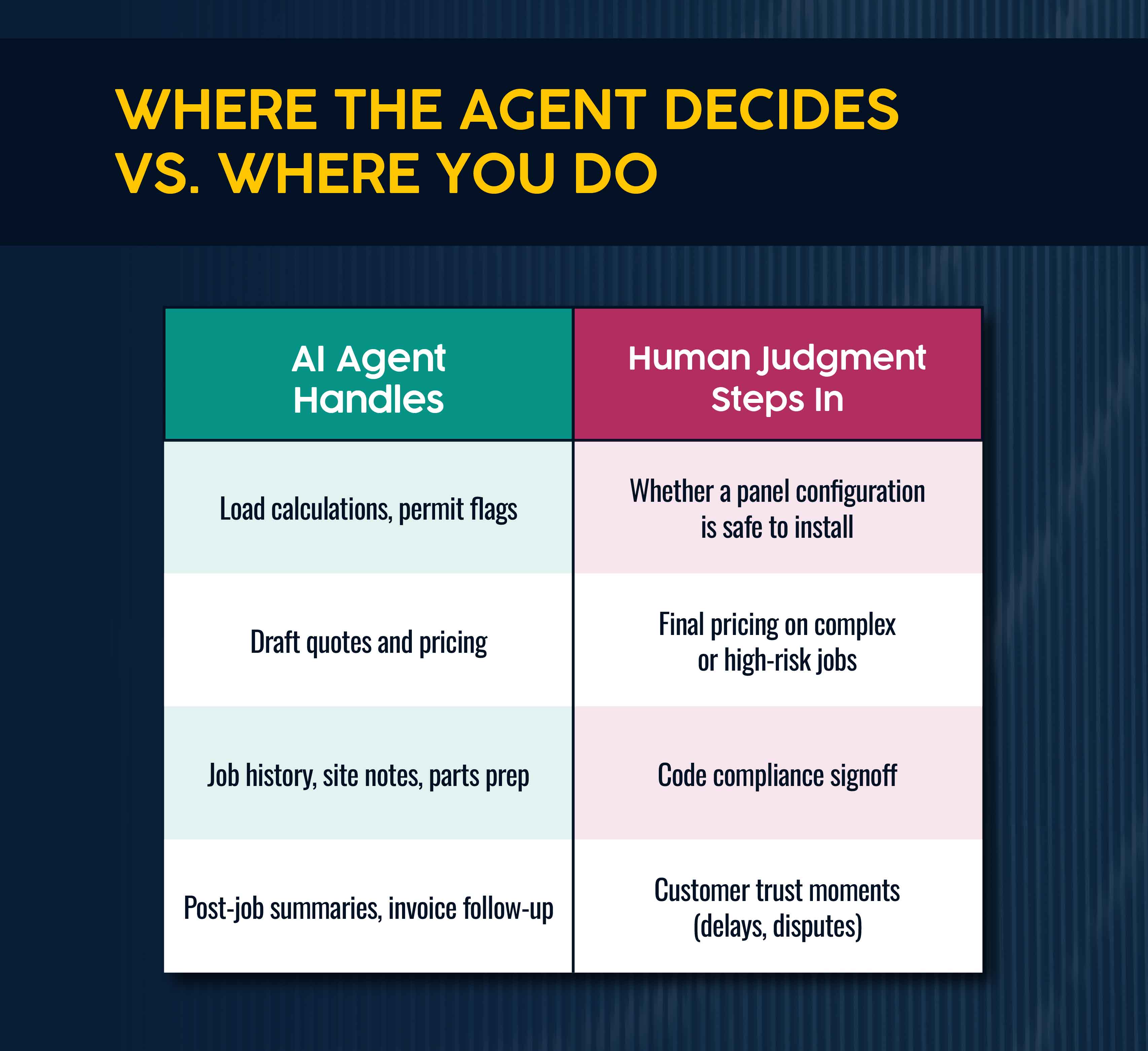
Agentic AI takes the initiative, but only inside rules you set. Human oversight must be built into the moments that matter most, and especially in a licensed trade.
Only licensed electricians should handle code compliance and safety-critical judgment calls. AI can organize load calculations and flag a permit requirement, but you don’t want an agent deciding whether a panel configuration is safe to install.
Pricing on complex or high-risk jobs requires human review before sending to the customer, even when the draft quote is 80% of the way there. Customer service still requires the human touch — whether it’s walking someone through the costs of a rewire or explaining a delay.
The businesses benefiting most from agentic AI use it to automate administrative work and free up licensed and experienced people for the decisions that actually require them.
There's a liability angle here, too. Your insurance, license, and reputation are on the line for every job. Set the agent up to draft, flag, and prepare next steps, but keep a licensed person as the last check before finalizing anything involving code compliance, safety, or a customer-facing price. Contractors that skip that step transfer risk from the field to the office, where it's harder to catch until after it becomes a problem.
Use Simpro AI to Cut Admin Across the Job Life Cycle
Lightning AI agents for field service management put AI at the foundation instead of as an add-on feature. At the center is Cooper, the operating layer enabling AI agents across your business. Cooper functions less like a chatbot and more like a digital business partner — surfacing problems before they escalate, streamlining team communication, and learning how your business operates.
Related: Compare AI platforms for electrical business, including an integrated AI operating layer versus bolting AI onto disparate systems.
Lightning sits on top of electrical-specific tools Simpro has offered for years, including:
- Simpro Data Feed, which automates job and quote creation from incoming emails
- Maintenance Planner for scheduling preventative work on customer assets
- Simtrac for real-time data on where your fleet is at any moment.
Simpro is built for the trades, not retrofitted from a generic small-business tool or a bloated set of enterprise systems. That’s the difference between software that understands what a panel schedule is and software that has to be taught every time.
Electrical Infrastructure Services reported a £250,000 sales uplift after six months with Simpro. Customers across the platform report revenue increases of 25% on average.
Lightning launched with four agents (FieldReady, JobReady, JobScribe, and JobBrief), part of a broader set of agentic AI systems working across a shared data model, with more than 20 additional specialist agents on the public roadmap and new ones releasing monthly. That shared data model is essential: When dispatch and documentation agents work off separate systems, they re-create the same coordination problems you had before AI. Agents that share one operating layer solve this problem.
Leading electrical contractors are using AI to clear admin work that eats into margins while giving crews more time for billable work. Simpro's mission is to double contractor profitability, not just save you an hour here and there.
If you're ready to see what that looks like for your business, schedule a demo.


 Back to top