
Somewhere between the missed call at 7:45 a.m., the quote that's still not out the door, and the tech typing notes in his truck at 9 p.m., you've probably thought: I should be doing something with AI. What you haven't gotten is a straight answer on what any of it actually does inside a business like yours.
This beginner's guide to adopting AI for electrical business skips the jargon and the hype. You know artificial intelligence is coming for the trades one way or another. You just don't have time to sort out what it means for your business.
You built a successful electrical business because you know electrical work cold and run a tight operation. This guide is meant to help you make sense of AI and point a few tools at problems you already know you have.
Start With the Workflows Slowing Down Your Electrical Business
Before you touch a single tool, it helps to know what these terms mean, since "AI" is doing a lot of work as a catch-all:
- Artificial intelligence (AI) is software that understands a request and acts on it, rather than just following a fixed set of rules.
- Generative AI creates something new from what you give it, like drafting a summary or building a report.
- Machine learning is software that improves at a task by studying patterns in your data, like which jobs tend to need a callback.
None of these replace your own judgment or a master electrician's expertise. They handle the repetitive, data-heavy work so that your judgment and human intelligence can be used where they matter.
Data from Simpro® shows the average electrical technician loses 30–60 minutes a day to paperwork alone — across a five-person crew, that's real billable time. Four places that overhead costs you:
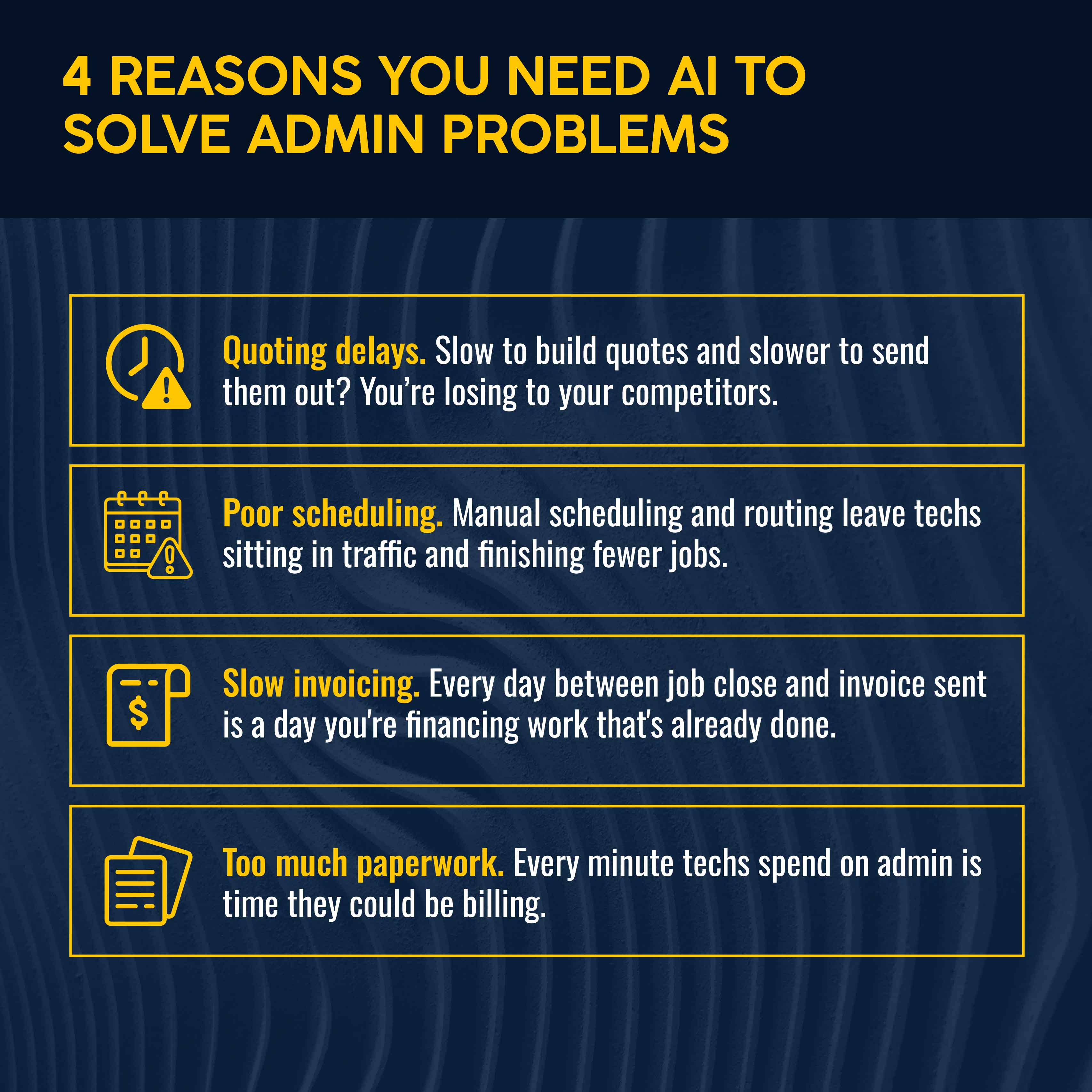
- Quoting delays cost jobs. A quote that takes 30 minutes to build, then sits another day, loses bids to contractors who respond same-day.
- Scheduling burns drive time. Poor routing means techs drive more and complete fewer jobs. For a five-tech crew at $95/hour, that's $475–$950 in daily capacity sitting in traffic.
- Slow invoicing stretches your cash cycle. Every day between job close and invoice sent is a day you're financing work that's already done.
- Paperwork compounds everything. Hours a week on admin unrelated to electrical work adds up to a part-time position's worth of lost capacity.
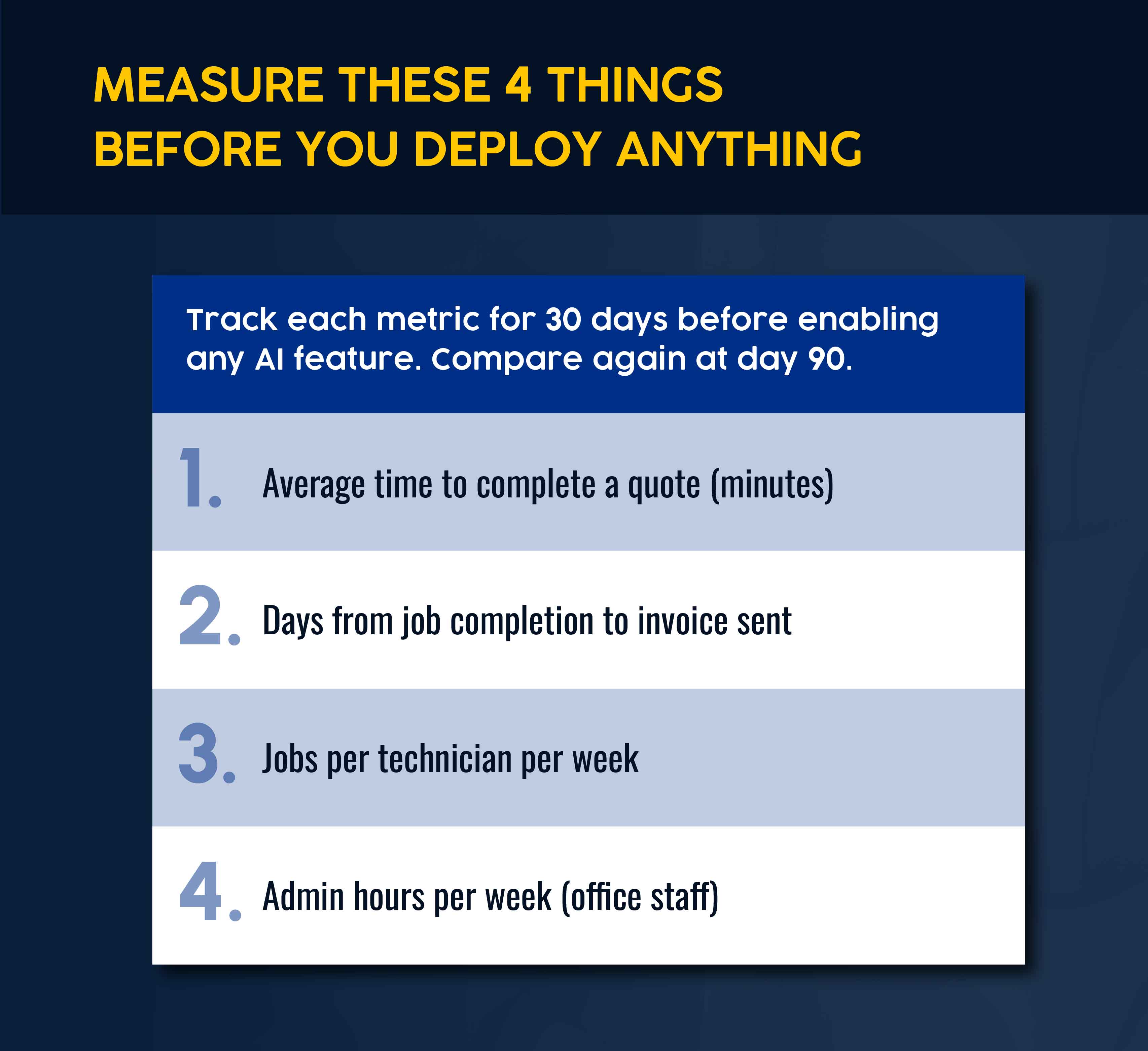
Track your baseline before adopting any AI tools: average quote time, days from job completion to invoice sent, jobs per technician per week, and admin hours per week. Thirty days tells you where to start; 60–90 gives you a real benchmark.
AI Use Cases Electrical Contractors Should Prioritize First
Sequence matters as much as which tools you pick. Start with admin. Field operations can wait.
"Take each thing up one at a time," says Kristin Larson, CEO of Southwest Industrial Electric. "Make sure that your team knows that this is a process...and make sure that [everyone] is using it correctly."
Administrative workflows show returns in weeks, not quarters. Here's what to tackle, in order.
Customer Communication and Missed Call Follow-Ups
The average home services business misses 45% of phone calls. Each unanswered call represents roughly $250 to $1,200 in lost potential revenue, depending on job type.
How AI helps you: An AI voice agent answers your business line when nobody's free to pick up. It talks with the caller in plain language, figures out what they need, and either books the appointment or texts your dispatcher a summary. Automated SMS follow-up does the same for calls that hit voicemail, texting back within seconds instead of hours.
What changes day to day: Right now, a missed call is a missed lead unless someone remembers to call back before the customer tries a competitor. With this running, that call gets answered or texted immediately, day or night.
What setup looks like: You connect the tool to your existing phone number and calendar. No new hardware, no new number to learn.
The operational fix: Enable automated call capture and lead follow-up first. It's the lowest-friction item on this list, takes hours to set up, and you'll see results the same week.
Estimating, Takeoffs, and Quote Preparation
A three-technician residential shop can spend 12 hours a week on quoting alone. AI tools cut that by handling the repetitive math automatically — the person building the quote reviews a draft instead of starting from blank.
How AI helps you: For commercial work, AI estimating tools calculate loads from NEC requirements — connected load, demand load, breaker and conductor sizing — from the plans you upload. You're reviewing a calculation the software already ran, not typing formulas into a spreadsheet.
What changes day to day: The estimator still owns the bid. What used to take an hour of manual calculation now takes minutes of review, which means quotes go out same-day instead of next-day.
What setup looks like: You upload the plans (PDF, CAD file, or photos) into the estimating tool, either a module in your FSM platform or a connected app synced to it. It's matched against your existing price book and labor rates. Commercial jobs get a one-time review of NEC settings before you trust it on a live bid.
The operational fix: If your average quote turnaround is longer than 24 hours, start here — faster quotes close at roughly twice the rate. South Island Electrical used Simpro to cut manual quoting and invoicing, fueling a 35% rise in net margin. "We knew there were inefficiencies, but without data, we couldn't make decisions with confidence," said founder Damon Stewart.
Related: Find out how electrical contractors are protecting revenue and margins with AI in 2026.
Scheduling, Dispatch, and Route Planning
More than half of trades business owners expect AI to enable smart scheduling — matching the right tech to the job instead of relying on gut feeling.
How AI helps you: An AI-powered dispatch tool matches electricians to jobs based on license class, certifications (arc flash, high voltage), location, and prior experience with specific equipment.
What changes day to day: Your dispatcher still makes the call — the tool surfaces the right options in real time instead of them memorizing certifications. If a hospital transfer switch fails, the software flags the nearest qualified tech instead of someone working a roster by hand. This is where AI Scheduler for field service management in Simpro RAIN fits the dispatch workflow.
What setup looks like: You build technician profiles once — license class, certifications, equipment experience, service area — in your FSM platform. The tool matches against that profile every time a job comes in, which is why this comes after quoting and communications: it needs job history already in the system.
The operational fix: Make this phase two. AI dispatch is only as reliable as the data feeding it.
Job Preparation Before Dispatch
When techs show up without context — no equipment history, no prior notes — first-time fix rates drop, and the return trip comes out of your margin. The average first-time fix rate is about 75% without AI briefing tools; AI can push that past 90%.
How AI helps you: Software pulls information about what happened last time and which parts were used so techs know what to expect before they leave for the job.
What changes day to day: Instead of walking in cold, techs walk in with the same context a 20-year office veteran would have handed them.
What setup looks like: It's a feature you switch on inside your FSM platform, pulling from job history and customer notes already there. The tech gets the briefing automatically on their device. The only real work is making sure techs log notes consistently, so there's something to pull from.
The operational fix: A natural next step once quoting and dispatch data are already flowing, not a new habit to build from scratch.
Field Notes, Safety Documentation, and Service Reports
The pattern is familiar: the tech finishes a job, spends half an hour in the truck typing incomplete notes, and the invoice doesn't go out until the next day, if not later.
How AI helps you: Generative AI job capture: the tech talks through the job out loud, and the software builds the report — photos, meter readings, code references, parts used. Nothing's written from scratch; it's turning what the tech already knows into a document.
What changes day to day: Techs talk instead of type. Simpro's JobScribe agent, part of the AI intelligence layer for field service management, eliminates 30 to 60 minutes of daily paperwork per technician and cuts billing disputes by up to 40%.
What setup looks like: Techs use the voice capture feature on the phone or tablet they already carry — no new device. There's a short adjustment period as they get used to narrating a job out loud, but nothing to configure beyond turning the feature on. Most shops run a quick walkthrough rather than formal training.
The operational fix: This is a no-brainer. Voice capture has the lowest resistance to adoption of any AI tool in field service for a reason.
Invoicing, Payment Follow-Ups, and Customer Summaries
Billing disputes erode customer trust and delay payment. That's what happens when customers get an incomplete summary days after the job's done.
How AI helps you: AI-generated content documenting what was done, which parts were used, and what the charges reflect is built the moment a job closes. Simpro's JobBrief agent reduces billing disputes by 25–35% and speeds payment by 15 to 20 days.
What changes day to day: The invoice goes out the same day the job closes, not the next morning, because the report was already built on-site.
What setup looks like: You set the summary format and reminder cadence once inside your invoicing settings. After that, it runs automatically every time a job closes. No per-invoice setup required.
The operational fix: Pair this with field capture. The invoice is only as fast as the report feeding it.
Business Reporting and Operational Visibility
After AI is running across quoting, scheduling, field notes, and invoicing, you start working with real data — job margin by technician, utilization trends, billing cycle length — without building spreadsheets by hand.
How AI helps you: AI can spot patterns in your own job history that would take you weeks to find on your own.
What changes day to day: You get insights you never had before. In Simpro's 2025 Trades Outlook Report, the survey of more than 600 trade businesses found that 70% use their FSM for data centralization, and 94% have realized major productivity gains.
What setup looks like: If quoting, dispatch, field notes, and invoicing already run through the platform, there's nothing to build separately because dashboards populate from existing data. The only decision is which KPIs to surface first: margin by technician, utilization, billing cycle length.
The operational fix: Reporting AI needs consistent upstream data. Get field capture running first. The dashboard is only as useful as what feeds it.
Standalone AI Tools vs. AI Built Into Your Field Service Management Software
When you decide to move forward, the question is where AI lives. Is it standalone apps? Or tools built into the platform you're already using?
The case for embedded comes down to data. A standalone scheduling tool that doesn't pull from your job history works with half the picture; a quoting tool that doesn't talk to dispatch recreates the handoffs you're trying to avoid.
Training and integration complexity are the most common barriers to AI adoption. When AI is native to your FSM platform, both shrink to one onboarding process and one support line.
Before buying a separate product, audit the FSM platform you already have. Most modern platforms ship AI tools for scheduling, dispatch, and customer service as part of the base product.
Related: Find out what to look for in AI platforms for electrical businesses.
An AI Adoption Checklist for Electrical Businesses
You don't need to do all of this in month one. Three phases over 90 days get real traction — and going slower is a perfectly reasonable way to keep your team from feeling steamrolled.
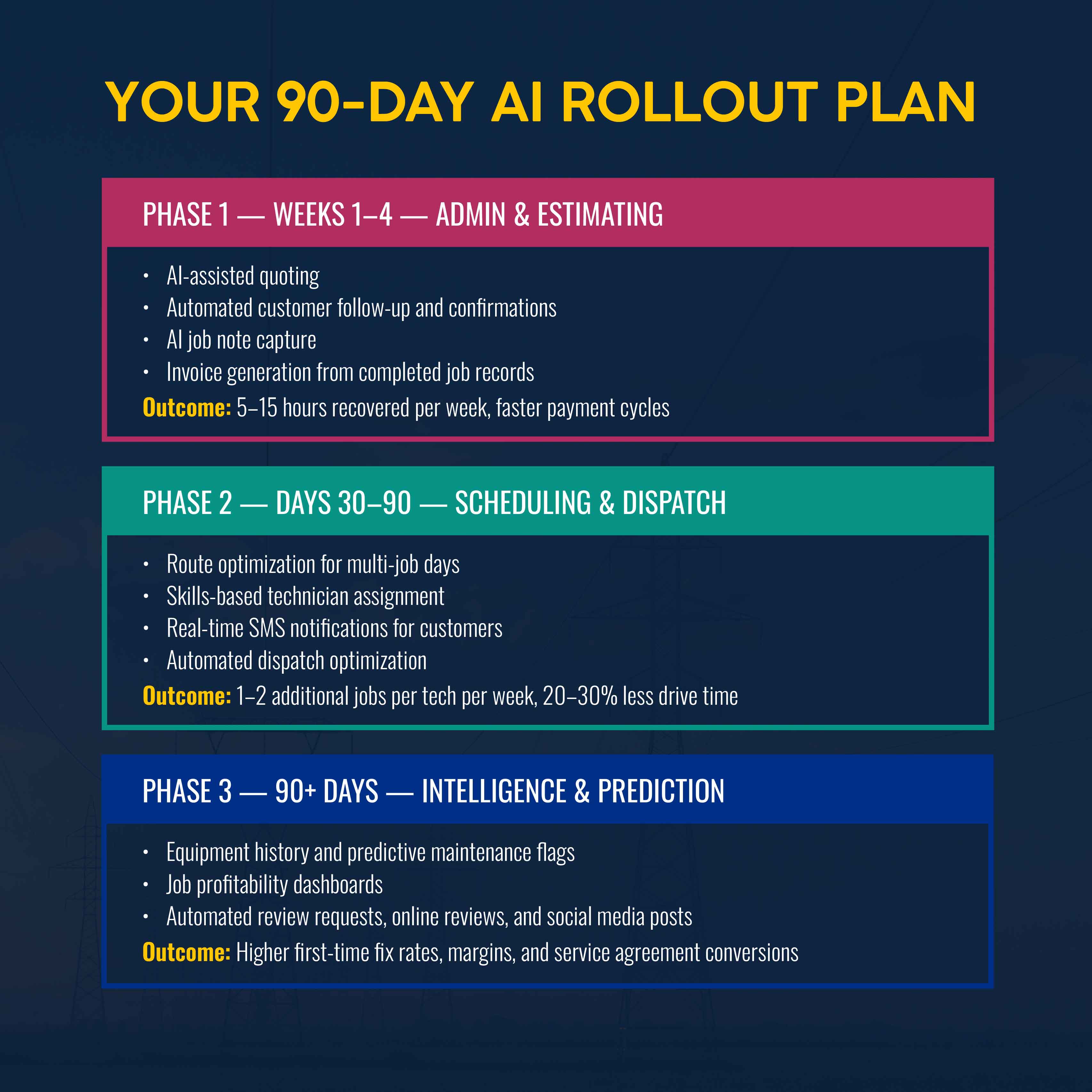
Phase 1: Admin and Estimating (Weeks 1–4)
- Enable AI-assisted quoting in your FSM platform.
- Set up automated customer follow-up and appointment confirmation sequences.
- Automate invoice generation from completed job records.
- Enable AI job note capture, if available.
Expected outcomes: 5–15 hours recovered per week, plus faster payment cycles.
Phase 2: Scheduling and Dispatch (Days 30–90)
- Activate automated scheduling and dispatch optimization.
- Enable route optimization for multi-job days.
- Set up real-time SMS notifications for customers.
- Use skills-based assignments to match technicians to job types.
Expected outcomes: 1–2 additional jobs per technician per week, 20–30% reduction in drive time.
Phase 3: Intelligence and Prediction (90+ Days)
- Enable equipment history tracking and predictive maintenance flags.
- Use performance dashboards to track job profitability in real time.
- Add AI customer communication for post-job summaries, online reviews, and social media posts.
Expected outcomes: improved first-time fix rates, service agreement conversions, and margins.
Common pitfalls:
| Pitfall | How to Avoid It |
|---|---|
| Too many tools at once | Start with one workflow and go deep before expanding. |
| No baseline measurement | Track three KPIs for 30 days before deploying any feature. |
| Standalone tools instead of embedded | Audit your current FSM for built-in AI features. |
| Skipping training | Designate an AI champion per location who learns first and trains the rest. |
| Expecting instant results | Initial time savings show up in 2–3 weeks; full ROI typically lands 4–6 months in. |
Getting Started With Simpro AI in Your Electrical Business
Simpro serves more than 24,000 trade businesses, purpose-built for electrical, plumbing, HVAC, and security operations. In May 2026, Simpro launched Lightning, the largest single product release in company history — an AI-native operating platform built around a central AI system called Cooper.
The platform's AI agents include:
| AI Agent | What It Does | Outcome |
|---|---|---|
| FieldReady | Trains technicians on company workflows, data, and standards | Onboarding drops from 12–16 weeks to days. |
| JobReady | Briefs every tech before dispatch: job history, customer notes, site details, parts | First-time fix rate goes from 75% to 90%+. |
| JobScribe | Captures jobs in the technician's own voice and builds the complete service report | Eliminates 30–60 min/day of paperwork per tech; billing disputes decline up to 40%. |
| JobBrief | Auto-generates post-job customer summaries | Reduces disputes by 25–35%; accelerates payment by 15–20 days. |
More than 20 additional specialist agents are on the public roadmap, covering customer service, procurement, and workforce management.
Getting started with AI as an electrical business owner will help you grow your business. Simpro data shows 69% of trade business owners see AI's biggest impact in optimizing workflows. The average business runs five separate software systems, and nearly a third have no strategy for connecting them.
You don't have to figure this out alone, or all at once. Simpro AI integration for field service management gives electrical contractors a purpose-built AI system for every workflow, from first estimate to final payment, so a small business owner can easily put AI to work and get value quickly.
Schedule a demo to see what Lightning can do in your shop.


 Back to top