
You’re booked out weeks ahead. The crew is solid. Revenue looks fine.
But margins are thin, invoices are late, and you’re still the person holding everything together. You have an operations problem, not a growth problem.
Running a successful electrical business past $1 million in revenue requires evolving from a skilled electrician to a business operator. Your biggest challenges become about systems, pricing discipline, cash flow controls, and team structure.
This guide offers 12 best practices for running an electrical business, including NECA benchmarks that ensure you’re working with real numbers, not guesses.
What Makes a Successful Electrical Business Today?
The U.S. electrical services market was valued at $163.9 billion in 2024 and is projected to reach $294.6 billion by 2034. There’s plenty of electrical work in this growing industry.
Where some contractors struggle is in running the business efficiently. Median net profit margin for electrical contractors is 5–6%, with top-quartile companies at 10–12%, according to NECA data. The difference isn’t just market dynamics or luck. It’s explained by job-mix decisions, overhead discipline, and billable utilization.
12 Electrical Management Tips to Run a Profitable Business
Whether you have a successful operation or are still creating your business plan, these tips can help you understand what really goes into electrical industry success.
1. Build Systems, Not Just Skills
You can’t scale a business that depends on your presence and expertise for everything. You need documented processes and standard operating procedures (SOPs) for core workflows, quoting, dispatch, job completion, and invoicing. Make sure your employees can execute these tasks without asking you how.
The operational fix: Pick your three most common job types and write a one-page SOP that includes a quoting template, materials checklist, field steps, and invoice trigger. Use these to onboard your next hire.
2. Get Job Scheduling Under Control
If your service electricians are running fewer than 3–4 calls per day per truck, you likely suffer from drive-time inefficiency, scheduling gaps, or insufficient job volume. Each missed call or delay represents revenue — and margin — left on the table.
For service-focused electrical businesses looking to protect margin, the benchmark range is $250,000 to $400,000 per year per technician. If your journeymen are generating $200,000, you might have a utilization gap.
The operational fix: Every week, track calls on a per-truck basis. If the number is low, identify whether the constraint is marketing volume, drive time, or job-duration mismatches, and address the root cause specifically.
3. Track Job Costs and Profit Margins
Blended profit-and-loss (P\&L) statements can obscure which parts of the businesses are profitable or not. If you run a mix of residential service, commercial time and materials (T\&M), and competitive bid work, the overall margin reveals very little. You need margin by job type.
NECA gross margin benchmarks by work type:
| Metric | Industry Avg | Top Quartile |
|---|---|---|
| Net profit margin | 4–8% | 8–12% |
| Gross margin: residential service | 40–48% | 48–55% |
| Gross margin: commercial T&M | 35–42% | 42–50% |
| Gross margin: commercial bid | 18–25% | 25–32% |
| Revenue per technician | $130K–$200K | $200K–$300K |
| Overhead | 28–35% | 20–28% |
| Billable utilization | 55–65% | 65–75% |
Source: NECA Financial Performance Report, via Steph's Books
For example, residential service (40–55+% gross margin) vastly outperforms competitive bid work (18–32+%). Contractors targeting 15%+ net margins should keep bid work below 25–30% of total revenue.
It’s not enough to track job cost and profit margin. You need systems that monitor these figures in real time, not just after the job is invoiced. On a $200,000 project, a 20% labor overrun is $40,000 in margin erosion. Across 20 projects, that’s $800,000 in lost margin — all preventable with real-time job costing rather than end-of-month reconciliation.
The operational fix: Pull your last 12 months of jobs, and calculate gross margin by work category. If commercial bid work is dragging your blended margin below 35%, set a goal of shifting 10–15% of that revenue toward service or T&M work.
Related: See our guide on electrical business profit margin for a deeper breakdown of where electrical contractors lose money.
4. Improve Cash Flow With Faster Invoicing
Commercial general contractors (GCs) routinely enforce net-60 or net-90 payment terms, with 5–10% retainage held until project completion. If commercial and new construction exceed 20–25% of your revenue, the cash requirements jump sharply. You may be profitable on paper and still miss payroll because the money is sitting in accounts receivable.
Every day between job completion and invoice adds unnecessary delay in growing your business. Same-day invoicing reduces debtor days without touching pricing or payment terms.
The operational fix: Every completed job gets an invoice sent within 24 hours. Assign one person to own the trigger. Track days-to-invoice as a weekly KPI. For commercial work, push back on payment terms. Moving from net 60 to net 45 on $50,000/month of materials spend preserves $25,000 in your operating account.
5. Hire For Reliability, Not Just Technical Skill
The electrical industry’s workforce could shrink by 14% by 2030 because of retirements and an aging population, even as demand grows. The labor shortage is structural, meaning you can’t wait for a vacancy to start recruiting.
Keep candidate pipelines active year-round. Partner with local trade schools to stay top of mind with new graduates. Tap your existing team members: A referral bonus of $1,500+ can attract high-quality candidates at little cost.
The operational fix: Define clear skill milestones and promotion criteria for each level, from apprentice to journeyman to foreman. Employees who see a defined path stay longer, and retention is far cheaper than hiring anew.
6. Standardize Your Quoting And Pricing
Some electrical businesses have no trouble getting electrical leads, only to falter when it comes to quoting and pricing. Inconsistency here is a surefire way for electrical contracting businesses to leak margin. When two estimators quote the same job differently, the average ticket value drops, and you lose jobs you should win while winning jobs you shouldn’t.
Flat-rate pricing for residential service work consistently produces 15–25% higher gross margins than equivalent T\&M work. The model converts technician efficiency into margin, removes pricing friction with customers, and reduces disputes. Reserve T\&M for commercial projects where the scope isn’t defined.
The operational fix: Build standardized quote templates for your 10 most common job types, including panel upgrades, EV charger installs, and residential service calls. Make sure every estimator uses them. Review quote conversion rates monthly by job type. If conversion is below 80% on residential service work, investigate whether the issue is pricing, speed, or follow-up cadence.
7. Use Electrical Business Management Software
At $1 million+ in revenue, the operational gaps that were once tolerable become bottlenecks. Quoting takes too long. Job costing happens at month’s end. Invoices are delayed because technicians have to drive back to the office first.
Cloud-based electrical software connects scheduling, quoting, job costing, inventory, and invoicing in a single system, allowing office and field staff alike to access the same information in real time.
The business impact is measurable: TEAMwired reduced quote time from two hours to 30 minutes after implementing a connected field service management (FSM) platform. Surrey Tech Services cut admin time by the equivalent of two full-time positions, all while growing contracts 2x–3x.
The operational fix: Before evaluating software, audit where quoting slows down, where cash flow gets stuck, and where you lose visibility into field activity. Match the platform to your specific gaps, not the longest feature list.
8. Stay on Top of Compliance and Safety
Safety standards are essential to your business reputation and financial health. A serious job-site injury leads to workers’ compensation claims, investigation by the Occupational Safety and Health Administration, and less credibility with GCs who refer ongoing commercial work.
Safety training should be continuous. Hold regular toolbox talks, update equipment standards, and train staff on protocols for high-risk tasks like panel work, trenching, and working near live electrical systems. Technology can help: Digital forms with conditional logic make it practical to capture and store compliance documentation on every job.
The operational fix: Build safety checklists into your job workflow so compliance documentation is captured in real time, not reconstructed after the fact. Track near-miss incidents as leading indicators of risk, not just recordable injuries.
9. Manage Inventory and Materials Efficiently
Materials can represent 25–45% of revenue on some job types. Too much inventory ties up cash. Too little inventory delays jobs because of stockouts. And when materials leave trucks without a job code, they vanish from your cost sheets.
The operational fix: Track electrical equipment and materials from purchase order through assignment to a specific job or quote, whether it’s a service call or a full electrical installs project. Implement real-time inventory logging for field staff. Run a monthly variance report comparing materials purchased to materials billed.
10. Invest in Local Marketing That Actually Works
Word of mouth is a powerful driver of business, but it’s passive. Local marketing ensures you are actively finding new customers inside your service area. Start by prioritizing marketing channels that convert existing customers to repeat buyers, as that’s often easier and less costly. Search engine optimization (SEO), for example, builds visibility for service-area searches over time, and at a lower ongoing cost than paid ads.
Most marketing strategies for electricians prioritize, in order, Google Business Profile, review volume, local SEO, paid search.
The operational fix: Build a referral program with adjacent trades as the core of your marketing strategy. Word of mouth from a trusted professional reaches potential customers who are already pre-qualified by the recommender. Formal referral relationships with an HVAC contractor, GC, and real estate agent can generate consistent job volume at near-zero acquisition cost.
11. Build Strong Customer Relationships
Transactional customers cost more to serve than recurring ones. Every time you acquire a new customer from scratch, you pay an acquisition cost, invest dispatch time, and carry all the risk of a first interaction going poorly.
The operational fix: Segment your existing customer list. Identify your top 20 customers by revenue over the last three years and contact each one about a service agreement. Converting five of them to annual contracts at $2,000 each is $10,000 in recurring revenue, all without a single cold call.
12. Monitor Business Performance With Real Data
Every electrical business should track these key performance indicators (KPIs): revenue per electrician, billable utilization, gross margin by job type, overhead as a percentage of revenue, and days to invoice.
Growing an electrical business requires tracking metrics each week. They’ll reveal where margin is leaking, long before the shortfall affects your bank account.
Use these NECA-sourced overhead benchmarks to calibrate your own numbers:
| Category | Healthy Range | Danger Zone |
|---|---|---|
| Office salaries (admin, dispatch, estimating) | 6–10% of revenue | Above 12% |
| Rent/facilities | 2–4% | Above 5% |
| Vehicle/fleet costs | 3–5% | Above 7% |
| Insurance (GL, umbrella, E&O) | 2–4% | Above 5% |
| Marketing & business development | 1–3% (or 5–8% for growth) | Above 12% without revenue gain |
| Software & technology | 1–2% | Above 3% |
| Total overhead | 20–28% | Above 35% |
Source: NECA; Steph's Books; Profitability Partners
The operational fix: Build a one-page weekly dashboard with these five metrics. It’s this simple: Know your numbers, catch problems early, and fix the biggest leak first.
Common Mistakes Electrical Businesses Make (and How to Avoid Them)
Knowing what excellence looks like in electrical contracting also means knowing which behaviors hurt your business. They include:
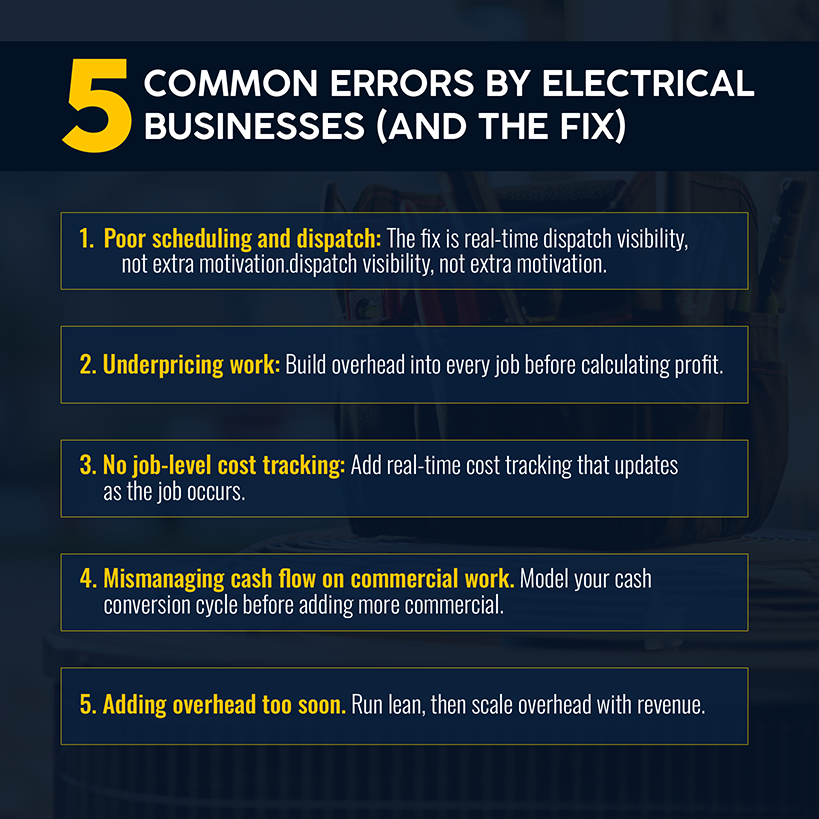
- Inefficient scheduling and dispatch. Service electricians averaging fewer than three calls per day represent a utilization gap that compounds immediately. The fix is real-time dispatch visibility, not extra motivation.
- Underpricing work. Pricing from memory, skipping overhead allocation, and quoting noncompetitive bid rates on service work all erode margin silently. Build overhead into every job before calculating profit.
- No job-level cost tracking. If you find out a job lost money after sending the invoice, you aren’t job costing. You need real-time cost tracking against estimates as the job occurs.
- Mismanaging cash flow on commercial work. Net-60 and net-90 terms, plus retainage on growing commercial revenue, can make a profitable business cash-insolvent. Model your cash conversion cycle before adding more commercial.
- Adding overhead ahead of revenue. Adding $5,000/month in overhead before the revenue base justifies it creates $60,000/year of drag. Run lean, then scale overhead with revenue.
How Electrical Business Management Software Helps You Scale
The problem isn’t knowledge. It’s that manual processes create failure points at every stage: inconsistent quotes built in spreadsheets, paper job cards instead of digital and mobile-first, and cost overruns that surface too late.
Look for a software platform that connects all your needs in one platform, along with the latest technology. Electrical contractors increasingly protect margins and revenue with AI, including smarter scheduling and dispatch, better estimating, and automated communications with prospects and customers.
Running a Successful Electrical Business Comes Down to Control
The electrical services market is growing. The constraint is operational control: the ability to see where margin is going, move work through the system efficiently, and build recurring revenue that doesn’t require finding a new customer every month.
Simpro® connects quoting, scheduling, dispatch, job costing, inventory, and invoicing in one system for more than 24,000 trade businesses. The platform covers the full life cycle, from lead capture through final invoice, in a single workflow.
Is your electrical business ready to grow but held back by manual processes? Schedule a demo to see how Simpro helps electrical contractors build the systems that unlock growth.


 Back to top