
TL;DR
- A maintenance SLA sets how fast you respond, arrive and fix by priority of call, when preventive maintenance gets done, and what you owe when you miss.
- Define priorities by what the failure does. GSA's emergency, urgent and routine tiers make a ready template.
- Write separate targets for response, on-site arrival and resolution, and spell out when the clock starts and stops.
- Price each tier against the technicians you actually have on shift.
- Track every open job against its deadline and escalate before it passes.
Service level agreements (SLAs) in commercial maintenance contracts often boil down to one sentence from the bid: "Contractor responds to urgent calls within three hours." Then a rooftop unit trips offline at a grocery store on a Saturday, and your on-call tech is 90 minutes out on another customer's job. Nobody on either side can say when the three hours started.
That call was lost at the bid when someone wrote "three hours" without saying when the clock starts or what the extra staffing costs are.
The U.S. General Services Administration (GSA) spells out emergency, urgent and routine priority levels for the contractors who maintain federal buildings. Writing them down didn’t guarantee much. In 2024, GSA’s own Inspector General found that building maintenance contractors weren’t complying with their contracts, citing poor performance and ineffective oversight. Borrow the priority levels, add the seven other terms a maintenance contract needs, and set up the tracking before the first call comes in. A three-hour promise nobody can watch counting down is a penalty clause waiting for a Saturday.
What Is an SLA in a Commercial Maintenance Contract?
A service level agreement (SLA) is the part of a commercial maintenance contract that commits you to response and resolution times, plus an arrival time for each call priority. It also sets a preventive maintenance schedule and defines remedies for missed commitments. The scope and price sections describe what you do. The SLA sets the performance standards for speed and reliability.
Customers want one because a facilities manager answers to someone, and a number gives that manager something to hold up when service delivery slips. Disputes over maintenance-contract SLAs often trace back to a word like "prompt" that nobody turned into hours.
Commercial accounts make getting it wrong more expensive. A restaurant that loses its walk-in cooler overnight loses the inventory, and the property manager who hired you hears about it before you do.
Related: Seven steps for qualifying, pricing and proposing commercial maintenance contracts cover the work that comes before an SLA.
What Should an SLA for a Maintenance Contract Include?
The eight key components follow roughly the order a call moves through, from the phone ringing to the invoice going out. Skip one and a customer's procurement team or your own dispatcher fills the gap, usually at the worst moment.
Define the Maintenance Services Covered
List the service expected at each site and on each asset. "HVAC maintenance" is a category. "Quarterly service on 14 rooftop units and two chillers across four stores" is a scope you can staff and price. Name the exclusions too, such as refrigerant recovery, tenant-caused damage and equipment you've already flagged as past its service life.
If you keep an asset register, point the SLA at it. Every asset on that list then inherits a priority level and a PM plan, and anything off the list becomes a quote instead of a free call.
Related: Nine steps for choosing customers, scoping and pricing electrical maintenance agreements include pairing each visit frequency with a response-time commitment.
Create Clear Service Priority Levels
Define each level by what the failure does, then attach examples. GSA’s contracts draw the lines this way. An emergency covers service requests where the failure puts people or property in immediate danger, such as a broken water pipe, a stalled elevator with passengers inside or a gas leak. Urgent work covers failures that interrupt operations, such as a dead circuit or an extreme-temperature complaint. Routine work disrupts nobody.
Three or four levels is plenty. Add a fifth, and your dispatcher spends the 7 a.m. rush arguing with the customer about where a call belongs. Settle who classifies the call, too. If the customer's front desk picks the level, expect every call to arrive as an emergency.
Set Response, Attendance, and Resolution Targets
Response, attendance and resolution run on three different clocks. Response is when someone acknowledges the call and has a plan. Attendance is when a tech is on site. Resolution is when the problem is fixed or made safe. A contract that gives one number for "response" leaves the customer assuming a tech is in the building and leaves you assuming a callback.
Then define the clock itself. It starts when you log the call, and the contract should say who logs it. It pauses while you wait on site access, a customer approval or a part on order. It stops when the problem is resolved or made safe. Say whether the clock runs on business hours or continuous time, too. A 2024 GSA Inspector General audit found two contractors and a GSA contracting officer’s representative reading a 24-hour routine deadline as three 8-hour working days, when GSA meant 24 continuous hours.
Define Service Hours and Coverage
State which business hours the standard targets cover and what changes outside them. The Bureau of Labor Statistics notes that HVAC technicians may work evening or weekend shifts and be on call for emergencies, so after-hours coverage means somebody's weekend is already spoken for.
Write after-hours terms as their own clause. An emergency at 2 a.m. can carry a longer on-site target than one at 10 a.m., but it should still leave a paper trail, such as a written account of costs and the plan for a permanent fix by the next business morning. Spell out how after-hours calls are billed, and who pays for the overtime your on-call tech just earned.
Include Preventive Maintenance Commitments
Reactive calls get the attention, but the PM schedule is the part of the contract you control. List the tasks, the frequency and the completion window, for example, "within 7 days of the scheduled date." That window is an illustration.
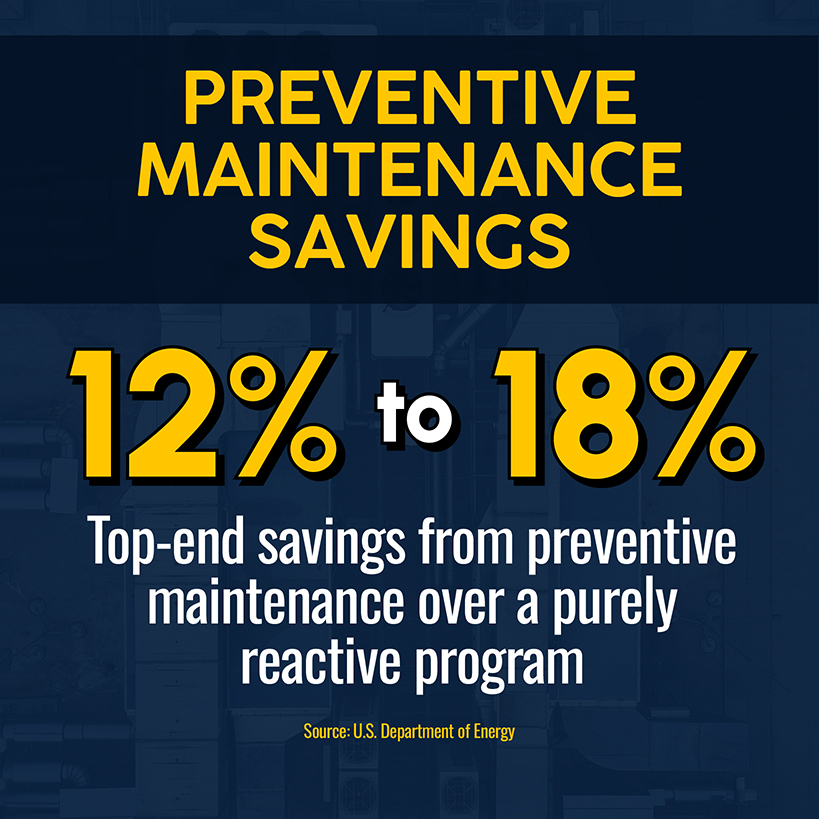
The U.S. Department of Energy's FEMP O&M guide defines preventive maintenance as actions performed on a time- or machine-run-based schedule. It cites studies showing savings of as much as 12% to 18% over a purely reactive program. If your crew skips PM visits whenever reactive calls spike, you hand back the savings the customer thinks they paid for. The renewal conversation starts there.
Establish Performance Metrics and Reporting
Pick four numbers and report SLA performance monthly or quarterly: SLA compliance by priority, PM completion rate, first-time fix rate and repeat calls. Add uptime percentages when the contract covers refrigeration or chiller plants. Break SLA metrics out by priority, because a blended figure hides the weak tier. A 96% overall score can sit on top of emergency calls at 80%, and the customer will find that tier on their own if you don't.
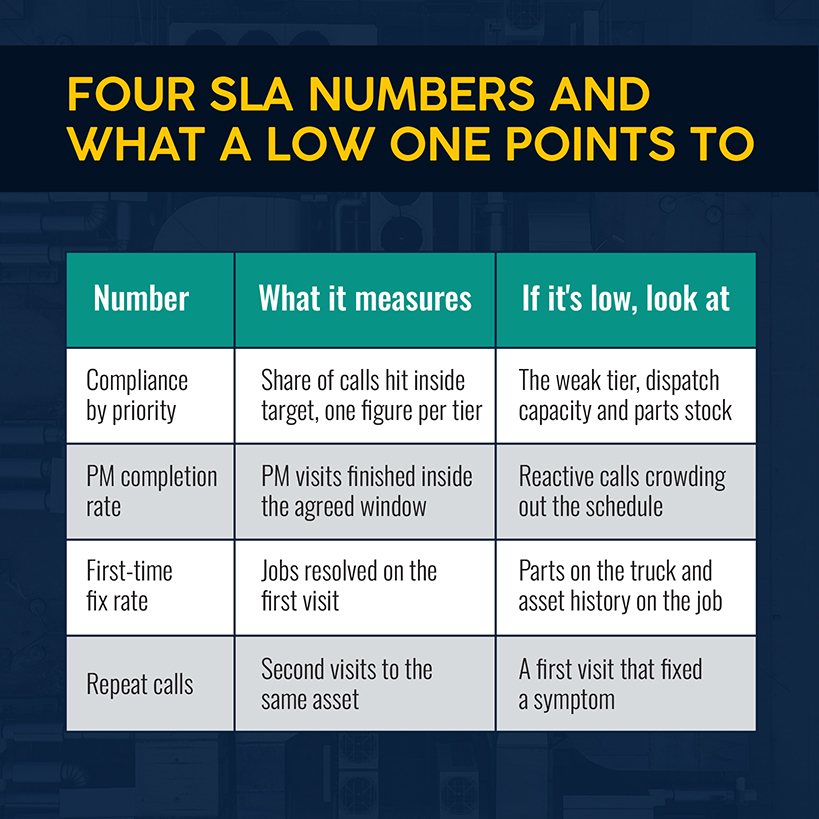
Repeat calls are the first place to look for service quality problems. A second visit to the same asset usually means the first one fixed a symptom. Track it by asset and technician team so the pattern shows up as a training or parts problem before it becomes a customer complaint.
Set Escalation Rules for At-Risk Jobs
Map the escalation paths before a job breaches, including who gets notified and when. For example, the dispatcher gets an alert at 50% of the target time, the service manager at 75%, and the contract owner phones the customer at 100% before the customer phones you.
Written escalation also gives the customer a named person to call, which protects customer satisfaction on the day a job runs late. It gives your team permission to pull a tech off a lower-priority job without waiting for someone to approve it.
Specify What Happens When an SLA Is Missed
Remedies come in three forms: service credits, fee deductions and a cure period for repeat misses. Pick one and cap it. A credit that scales with misses, such as 2% of the monthly fee per missed emergency up to 10%, keeps a bad week from erasing a quarter's margin. On a $15,000 monthly fee, that's $300 per miss with a $1,500 cap. Both rates are illustrations.
Write the exclusions in the same clause: force majeure, parts lead times you flagged in advance and customer-denied site access. A locked mechanical room shouldn't keep your clock running. Build in a written extension request for routine calls you can’t finish on time, too. The customer hears about the delay from you before they notice it themselves.
Related: Commercial property managers who vet a plumbing maintenance agreement want a documented scope, response guarantees and pricing they can put in a budget.
With the terms set, the question becomes what they look like at each priority.
Maintenance SLA Examples for Different Service Priorities
GSA’s contracts are the clearest public model for priority tiers, but the audited contracts don’t set a number for every tier. These maintenance SLA examples pair the federal baselines with illustrative targets you can adapt. Treat the numbers as a starting point to price against your own staffing, not a standard.
| Priority | Trade examples | Federal contract baseline | Illustrative contract target |
|---|---|---|---|
| Emergency | Gas leak, burst pipe, sprinkler system impairment, walk-in cooler failure | Failure that puts people or property in immediate danger; response time set by each contract | Acknowledge in 15 minutes, on site in 2 hours, made safe in 4 hours |
| After-hours emergency | The same failures outside core hours | Not specified | Acknowledge in 15 minutes, on site in 3 hours, written report by 10 a.m. the next business day |
| Urgent | Rooftop unit down in summer, dead circuit, fire alarm panel in trouble, access-control door that won’t lock | Response expected within 1 hour | Acknowledge in 30 minutes, on site in 4 hours, resolved within 1 business day |
| Routine | Dripping fixture, flickering lighting, one camera offline | Completed within 24 continuous hours in most audited contracts | Acknowledge within 1 business day, resolved within 5 business days |
| Preventive | Scheduled PM visit | Completed in the month scheduled | Completed within 7 days of the scheduled date |
Even federal contracts leave holes. The GSA audit found one contract that never said how quickly urgent work had to be completed, and it recommended that GSA spell out routine completion times in contract language. Your contract and your dispatch board fill those holes, so price each tier against the staffing it needs. A one-hour urgent response across a 40-mile service area means a tech parked near the middle, and that tech costs money whether the phone rings or not.
Once the tiers have numbers, the work shifts from writing them to meeting them.
How to Manage SLAs in Field Service Operations
Managing SLAs in field service starts the day the contract is signed. A promise only holds if the people dispatching against it can see it.
- Load the SLA into your records. Assign every asset a priority level and PM plan, so the dispatcher sees the commitment when the call comes in.
- Put a deadline on every job. The tech and the dispatcher should both know the target time and whether the clock is running or paused.
- Escalate on the clock. Alerts fire at the thresholds you wrote into the contract, before the deadline passes.
- Report monthly. Send the performance data by priority, with the cause of every miss attached.
- Hold regular reviews. Meet the customer quarterly, then reset targets or price at renewal based on a year of actual performance.
Simpro® covers the preventive side directly. The Maintenance Planner add-on lets you assign multiple service levels and the testing frequency to each asset, and it alerts you when an asset is due for maintenance or fails testing. On the reactive side, scheduling and dispatch can send the closest available qualified technician, and automatic reminders and notifications go to customers and staff. None of that replaces writing the clock rules down.
Related: Seven areas of work, from dispatch to reporting, can run on field service automation, including service reminders for recurring maintenance.
Tracking shows when a job is running late. The reasons sit upstream of the truck.
Why Commercial Maintenance Businesses Miss SLA Targets
Misses get built in at the signing table or the dispatch board, long before a technician is involved. They trace back to six places:
- The SLA was sold without checking dispatch capacity, coverage area or after-hours staffing.
- There's no shared view of which open jobs are close to breach.
- Parts for contracted equipment aren't stocked, so every repair takes a second trip.
- Techs arrive without the asset history or the site access instructions.
- PM visits slip when reactive work spikes, and nothing escalates the slippage.
- The clock rules were never defined, so every late job turns into a dispute.
Capacity misses are the easiest to picture. Say you run 12 technicians and sell a 2-hour on-site target on a $180,000-a-year contract covering 18 retail stores across 60 miles. You staff it with the same two on-call techs you had before. The first week, two simultaneous emergencies put you in breach on one of them, and no dispatcher could have fixed that. The sale did it.
PM slippage compounds the problem. When the schedule gets tight, reactive work takes the slot first, so the PM visits that would have prevented next month's emergency slide to next month.
Related: Growing a book of recurring maintenance contracts without missed visits takes planning tools built for asset-based work across many sites.
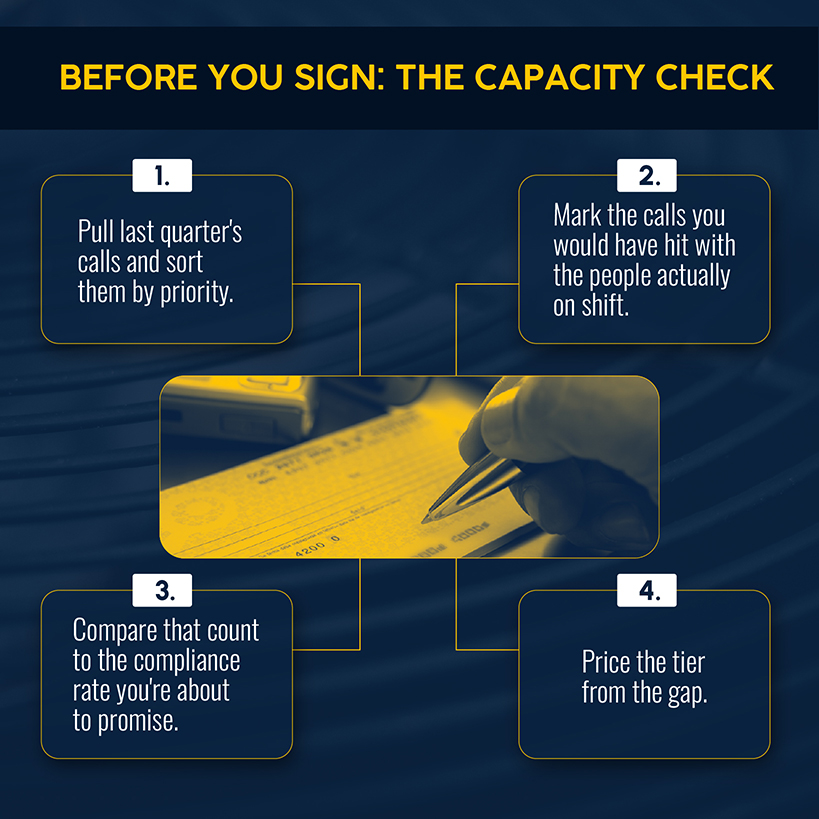
The operational fix: before you sign the next SLA, pull last quarter's calls by priority and count how many you would have hit with the people actually on shift. Price the tier from that number, and add a technician to the quote if the number comes up short.
Manage Commercial Maintenance Contracts and Service Commitments With Simpro
You probably already know which account is closest to a breach. The harder part is knowing before the customer calls. Simpro is field service management software with more than 250,000 users. Its reports list every recurring job due in a date range, so you can staff the PM work before reactive calls crowd it out.
Proguard Protection Services, a security contractor in Aspen, Colorado, uses Simpro with Simtrac fleet tracking to see which technician is closest to a call and whether that tech’s van holds the parts the job needs. Schedule changes reach technicians immediately, so the team can pull someone off a job and send them to an emergency. In its first year on Simpro, Proguard grew sales 14% and its client base 6%.
If you want your next commercial maintenance contract to hold its margin when reactive calls spike, bring your toughest SLA and schedule a demo.


 Back to top
