
Running a plumbing business above $1 million in annual revenue means inventory isn't just a margin problem as much as a logistics problem. Every fitting pulled from a van without being logged, every emergency hardware run because a tech left the warehouse under-stocked, every job closed out without the materials bill hitting the invoice. Those gaps compound fast.
The best plumbing inventory management software closes that loop. This guide covers seven platforms that plumbing companies rely on to track parts, tools, and materials across trucks, warehouses, and job sites. We’re sharing what each platform does well and where it falls short. Whether you're looking for the best plumbing inventory management apps for a small crew or full-service asset management software for a larger operation, the right choice depends on how your business is built and where the gaps are.
Best Plumbing Inventory Management Software at a Glance
| Tool | Best for | Pricing |
|---|---|---|
| Simpro® | Midsize and large plumbing contractors managing service, projects, and multi-location ops | Priced for your workflow |
| BuildOps | Commercial plumbing contractors with large field teams | Custom |
| Housecall Pro | Small residential plumbing businesses (1–10 techs) | From $59/mo |
| Sortly | Small teams needing simple, visual inventory tracking | Free limited plan; paid from $24/mo |
| Zoho Inventory | Plumbing distributors or warehouse-heavy operations | Free limited plan; paid from $29/mo |
| Jobber | Residential service businesses managing quotes and jobs | From $49/mo |
| Workiz | Mixed-trade SMBs managing plumbing, HVAC, and electrical | From $225/mo |
7 Best Plumbing Inventory & Asset Management Software
Here’s a fuller look at the best plumbing asset management software options. One thing to keep in mind: Some tools in this list are field service management software platforms with native inventory built in. Others are standalone inventory apps.
The best plumbing asset management apps handle one piece of the puzzle well — tracking what you own and where it is. The FSM platforms connect parts usage to work orders, estimates, and accounting in real time. Finding the right fit for your plumbing operation depends on your needs and goals.
1. Simpro®
Best for: Midsize and large plumbing contractors ($1 million–$50 million+ revenue) running service jobs, multi-phase projects, service agreements, and multi-location operations.
Materials are one of the biggest costs for plumbing contractors, second only to labor. Managing materials spending is only possible when every part gets tracked, billed, and reconciled. Doing so requires a system where inventory isn't a separate module, but rather a layer built into the job workflow.
Simpro is purpose-built field service management (FSM) software for trade businesses, and inventory is one area where that shows. It doesn't bolt inventory onto a customer relationship management (CRM) system and call it done. The platform builds stock management into the operational workflow, from estimate to invoice.
As Kiely Plumbing found after implementing Simpro, estimate creation time dropped by 10x, admin work fell by 63%, and revenue rose by 35%, all without adding headcount. The platform gave the business real-time visibility into what was on each truck, in the warehouse, and tied to open jobs, all from one place.
Foster Plumbing found value in the real-time job costing, both during COVID-era volatility and the subsequent years of pricing escalations. “It helped us move fast, quote accurately, and make decisions with confidence,” says former CEO Amy Carnrick.
Key Features
- Real-time stock visibility across warehouses, trucks, and job sites from one dashboard
- Minimum stock level alerts, with automated reorder triggers
- Full stocktake via an online Barcoding Portal with tablet-compatible barcode scanner
- Stock transfers between storage locations and reallocation to jobs before dispatch
- Field staff access to add materials on-site, check stock levels, and post usage post-job, all via Simpro Mobile
- Supplier catalog imports with current pricing
- Side-by-side price comparisons across vendors
- Purchase order creation and management
- Received item tracking
- Direct supplier invoice push to QuickBooks, Xero, or MYOB
- Full audit trail on every stock transaction
- Stock value reports, usage trends, demand forecasting, and materials assigned to jobs not yet invoiced
Where Simpro separates from general-purpose tools is the connection between inventory and job costing. Every part pulled for a plumbing job is tied to that job's cost record. When you close the work order, your materials bill isn't a guess. You can see actual vs. estimated material costs before the invoice goes out, catching any gaps before they hurt your margin.
Simpro customers across the trades report a 30% improvement in field technician productivity and measurable reductions in wasted time on admin and materials reconciliation, which frees office staff to focus on scheduling plumbing jobs rather than chasing paperwork. More than 24,000 businesses and 250,000+ users work in Simpro globally.
Pricing
Custom pricing based on team size and requirements. Designed for teams of 5+. Contact Simpro for a quote tailored to you.
Related: See how plumbing service software from Simpro connects estimating, scheduling, and inventory end to end.
2. BuildOps
Best for: Commercial plumbing contractors managing large field teams and high-volume operations across multiple sites.
BuildOps is purpose-built for commercial trades — the kind of operations where you might have 20 or 50 technicians running across multiple sites. Its inventory module connects to quoting, dispatch, and invoicing, so every material used on a job ties automatically to the right work order. Inventory tracking is visible in real time across all warehouse locations and service trucks.
The platform is designed for commercial project management workflows. It’s less ideal for plumbing businesses primarily running residential service calls. There’s no residential service dispatch workflow, and the platform might be more than such operations require.
Key Features
- Real-time material visibility connected to jobs and work orders
- Inventory tracking across service trucks and warehouse locations
- Job-based material assignment and usage reporting
- Integrated time tracking, CRM, estimating, and mobile app
- Robust reporting on inventory trends and usage patterns
Pricing
Custom. Contact BuildOps for a quote.
3. Housecall Pro
Best for: Small residential plumbing businesses, typically 1–10 technicians, focused on customer communication and booking.
Housecall Pro is strong at covering the customer-facing operations side of a residential plumbing business: online booking, automated communications, payment collection, and basic job management. It stores customer history against job records, which helps with repeat service calls and customer communication.
For more advanced inventory management, Housecall Pro integrates with Ply, a dedicated plumbing inventory platform that adds real-time truck and warehouse stock, barcode scanning, multi-vendor request for quote, and automated purchase-order generation. Housecall Pro doesn’t include a native inventory module with warehouse or truck-level stock tracking. Contractors who need that capability should budget for Ply’s additional cost and setup.
Key Features
- Online booking, automated customer communications, and payment collection
- Customer history stored against job records
- Basic materials list tied to job records
- Integration with Ply for real-time truck and warehouse stock tracking
- Mobile app for field technicians
Pricing
Free trial available. Starts at $59/mo (single user).
4. Sortly
Best for: Small plumbing teams or solo operators who want simple, visual inventory tracking without a full FSM platform.
Sortly takes a visual-first approach to inventory, organizing parts by photos, folders, and tags. Location tracking lets you set up custom folders by warehouse, truck, or job site. Technicians can use barcode and QR code scanning from their smartphone, and the platform works offline — useful when techs are in basements or other areas without reliable cell coverage.
Sortly doesn’t connect to work orders, estimates, or invoicing, and it lacks job-costing capabilities. It tracks inventory in isolation, which covers the basics for a small team but won't tie material use to specific plumbing jobs or flag unbilled materials when a work order closes. Plumbing companies managing multiple service calls per day will likely need a more connected platform as they grow.
Key Features
- Visual, photo-based inventory organization using custom folders and tags
- Smartphone-enabled barcode and QR code scanning
- Custom inventory location folders by warehouse, truck, or job site
- Low-stock alerts with configurable thresholds
- Offline access with automatic sync on reconnect
Pricing
Free limited plan; paid tiers from $24/mo.
5. Zoho Inventory
Best for: Plumbing distributors or warehouse-heavy operations managing significant parts volume without a field service component.
Zoho Inventory handles vendor management, barcode scanning, purchase orders, multi-location tracking, and sales reporting at an accessible price point. It integrates with Zoho's broader business suite, which is useful if you're already using Zoho CRM or Books, and it offers cloud-based access with mobile support.
Zoho Inventory isn’t trade-specific and lacks built-in scheduling, dispatch, and work order management. Plumbing businesses that need to track inventory from purchase order to job to invoice in a single workflow will need a separate FSM platform.
Key Features
- Multi-location warehouse tracking
- Barcode scanning support
- Purchase order and vendor management
- Cloud-based access with mobile support
- Integration with the Zoho suite and select accounting tools
Pricing
Free limited plan; paid tiers start at $29/month.
6. Jobber
Best for: Residential service businesses managing quoting, scheduling, and customer communication for small plumbing crews.
Jobber is a well-known residential field service platform that handles quotes, scheduling, customer communication, and invoicing cleanly. It's particularly popular with small crews managing high-volume residential service calls. Jobber simplifies the customer-facing and admin workflows for businesses that don't yet need deep operational complexity.
For inventory, Jobber supports line-item tracking tied to jobs and integrates with Ply for more advanced materials management. Jobber doesn’t include native multi-location stock tracking, van-level inventory visibility, or job-cost reporting tied to materials usage. Contractors who need those features will require the Ply integration or a separate FSM.
Key Features
- Quoting, scheduling, and invoicing in one platform
- Line-item materials tracking tied to job records
- Customer communication tools, including automated reminders
- Integration with Ply for warehouse and truck-level inventory tracking
- Mobile app for field technicians
Pricing
Plans start at $49/month.
7. Workiz
Best for: Small and midsize plumbing businesses, especially those running multiple trade types from a single platform.
Workiz is a flexible FSM platform that handles scheduling, invoicing, and inventory across multiple trades. For contractors managing plumbing, electrical, and HVAC work from a single dashboard, it offers solid operational breadth without enterprise pricing. Field techs can check stock and request parts through the mobile app. The platform integrates with QuickBooks Online, Stripe, and GPS tracking tools.
Workiz doesn’t include job-cost tracking tied to materials usage, nor does it support multi-phase project workflows. It’s less suited to plumbing businesses managing complex commercial projects or detailed, long-term job-costing analysis.
Key Features
- Real-time inventory tracking across warehouses, offices, and service vehicles
- Low-stock alerts with automated reorder triggers
- Job-based part assignment before dispatch
- Mobile app for field technicians to check stock and request parts
- QuickBooks Online integration and GPS tracking tools
Pricing
From $225/mo (3 users).
Key Features to Look for in Plumbing Inventory Software
Not every tool in this list is built for the same kind of plumbing operation. Before choosing a platform, figure out which features actually matter for how your business runs.
Real-Time Stock Visibility Across Locations
If you can't see what's on each truck and in the warehouse from one screen, you're dispatching blind. Your dispatchers should be able to confirm a van is stocked before sending a tech to a job. Stock verification prevents costly, time-wasting return trips during the job.
Low-Stock Alerts and Reorder Triggers
Behind labor, inventory is the most costly operating expense for most small businesses. Automatic reorder alerts prevent the emergency hardware store runs that inflate material costs and eat into technician time.
Mobile Access for Field Staff
When technicians log materials from the job site rather than at the end of the day, your business will see more accurate inventory data and better productivity. Mobile barcoding yields 99.9% inventory accuracy compared to manual entry. If your field staff can't update stock from a phone, the data will drift.
Integration With Work Orders and Job Costing
This is where most standalone inventory tools fall short. Every part used on a job should link to that job's cost record, not logged in a separate system that doesn’t connect to invoices. Without this link, you're relying on manual reconciliation to understand your plumbing profit margins.
Purchase-Order Management and Supplier Catalog Sync
Plumbing companies waste time when they manually generate purchase orders, call vendors to compare supplier prices, and re-enter invoice data into accounting software. Good inventory software handles this inside the platform with import catalogs, purchase-order generation, tracking of received items, and automatic pushes to accounting.
Accounting Software Integration
If your inventory platform doesn't connect to QuickBooks, Xero, or MYOB, you're doing double entry. Month-end reconciliation becomes a manual audit. For a plumbing business managing 50–200 material purchases a month, that's hours of admin time that shouldn't exist. The right accounting software integration lets your team save time on reconciliation and close the books faster every month.
GPS Tracking and Van-Level Visibility
Knowing what's on each truck before dispatch isn't just an inventory question. It also affects scheduling quality. When your system ties stock levels to specific vehicles, dispatchers can schedule jobs based on what's actually loaded, not what's supposed to be there.
How Inventory Connects to Job Costing and Why It Matters
The average $1 million+ plumbing business nets between 5–12% net profit. Material costs represent 30–50% of total project expenses for residential contractors, according to the National Association of Home Builders. That ratio makes materials tracking one of the highest-leverage areas for margin improvement, yet most inventory conversations treat it as a logistics problem, not a financial one.
Here's what the numbers look like when inventory management breaks down:
- Material costs: This is the biggest controllable cost on most jobs. Without a system that ties parts to work orders, much of it goes untracked and unbilled. With a fleet of technicians running multiple jobs per day, those unlogged pulls add up to significant margin erosion every month and hurt cash flow.
- First-time fix rate: Top performers approach 90%; the industry average for first-time fix rate is around 80%. Each return visit means you’re spending more on labor and fuel, not to mention the lost opportunity costs.
The operational fix isn't just tracking inventory. It's connecting inventory to the rest of the job workflow.
When businesses link every part consumed on a job to that job's cost record, they gain visibility. Before sending the invoice, they can see whether materials came in over budget, whether a tech used expensive fittings where cheaper alternatives were available, and how quoted material costs match up against actual costs. That visibility protects plumbing pricing accuracy over time.
Simpro does all of this natively. Materials added by field techs through Simpro Mobile flow directly into the job record. Received purchase orders trigger an inventory update and get pushed to accounting. When the job closes, the actual vs. estimated cost is visible before the invoice goes out.
Related: Review the best plumbing pricing apps for your business.
Choose the Right Plumbing Inventory Software for Your Business
The right choice for plumbing inventory and asset management software depends on where your business is and where you need it to go.
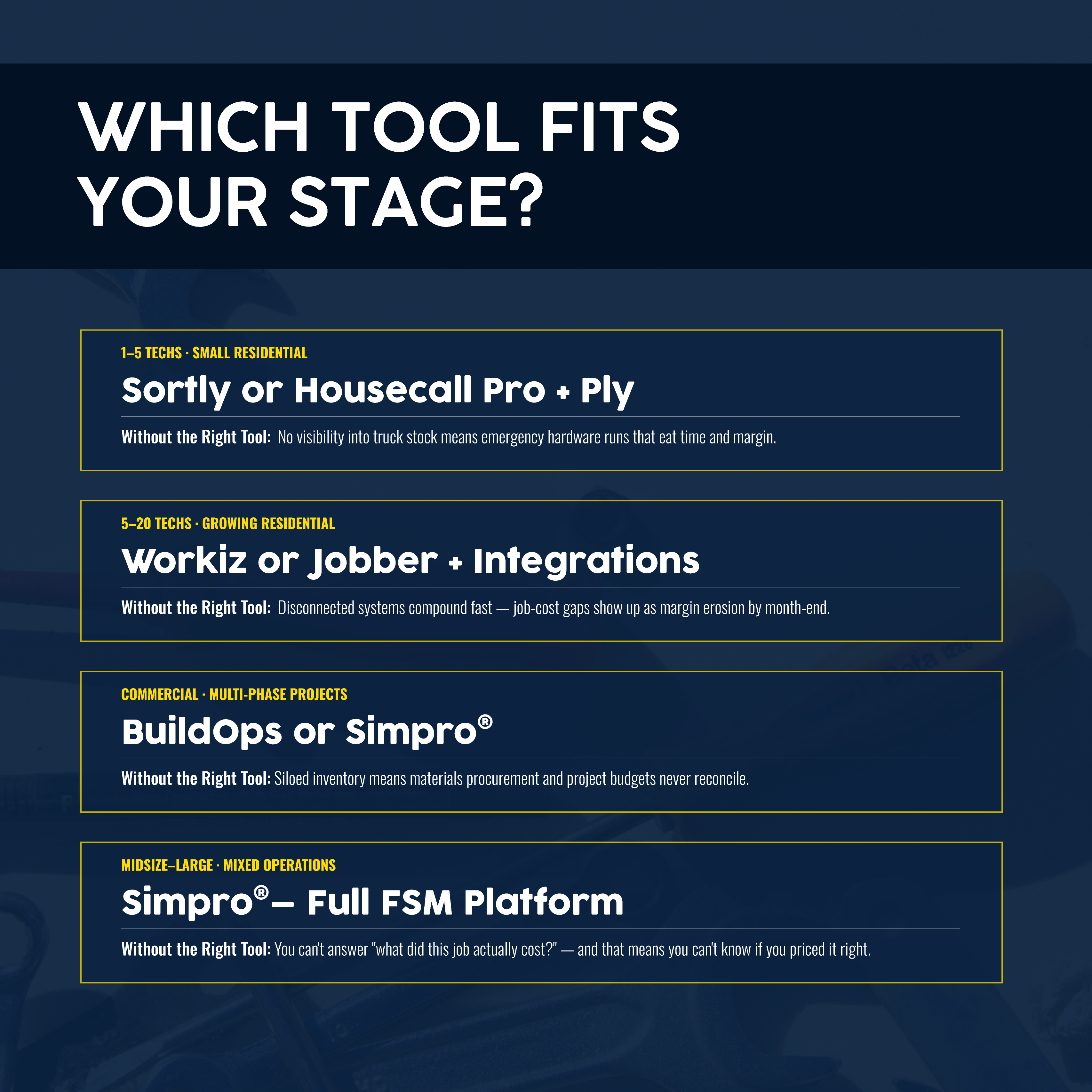
Small residential plumbing operations (1–5 technicians) can benefit from simpler tools like Sortly or Housecall Pro with a Ply integration. The priority at this scale is visibility into what’s on your trucks and what needs to be ordered. Deep job-costing integration matters less when one person can track most of it manually.
Growing residential service businesses (5–20 technicians) need inventory connected to scheduling, work orders, and invoices. Workiz or Jobber with integrations can work, but contractors can hit the ceiling quickly, especially related to job-cost reporting. At this stage, an all-in-one FSM platform starts to pay for itself, because the cost of disconnected systems compounds as volume grows.
Commercial or multi-phase plumbing operations can’t silo inventory management in a standalone tool. They need stock levels tied to project phases, materials procurement connected to project budgets, and purchase orders that flow to accounting without manual re-entry. BuildOps handles commercial scale. Simpro handles both service and project work, a less common combination that matters for contractors running mixed operations.
Midsize and large plumbing businesses focusing on residential, commercial, or both enter a different conversation. Instead of, "What's on the truck?" they’re asking, "What did this job actually cost, and did I price it right?" That's a job-costing question, and they need a platform where inventory is a layer of a broader operational system, not a module or a standalone app.
The global FSM software market is projected to grow from $5.1 billion in 2025 to $9.17 billion by 2030, largely driven by contractors who've realized that manual systems don't scale. With the industry facing a 550,000-plumbing staffing shortfall by 2027, productivity per technician becomes more valuable than ever. Inventory software that connects to dispatch, job costing, and accounting not only saves admin hours; it also makes each tech more effective on every call.
The Closed Loop Most Plumbing Businesses Are Missing
If inventory tracking is happening in one system, scheduling in another, and accounting in a third, you've got three sets of books that never fully reconcile. That cost shows up in unbilled materials, margin erosion on jobs that should have been profitable, and month-end reconciliation that takes days.
The businesses that scale profitably are those that close the loop: Parts purchases flow into the warehouse record, get allocated to a job, are tracked when a tech pulls it from the van, hit the invoice, and post to accounting automatically, with no manual bridge between steps.
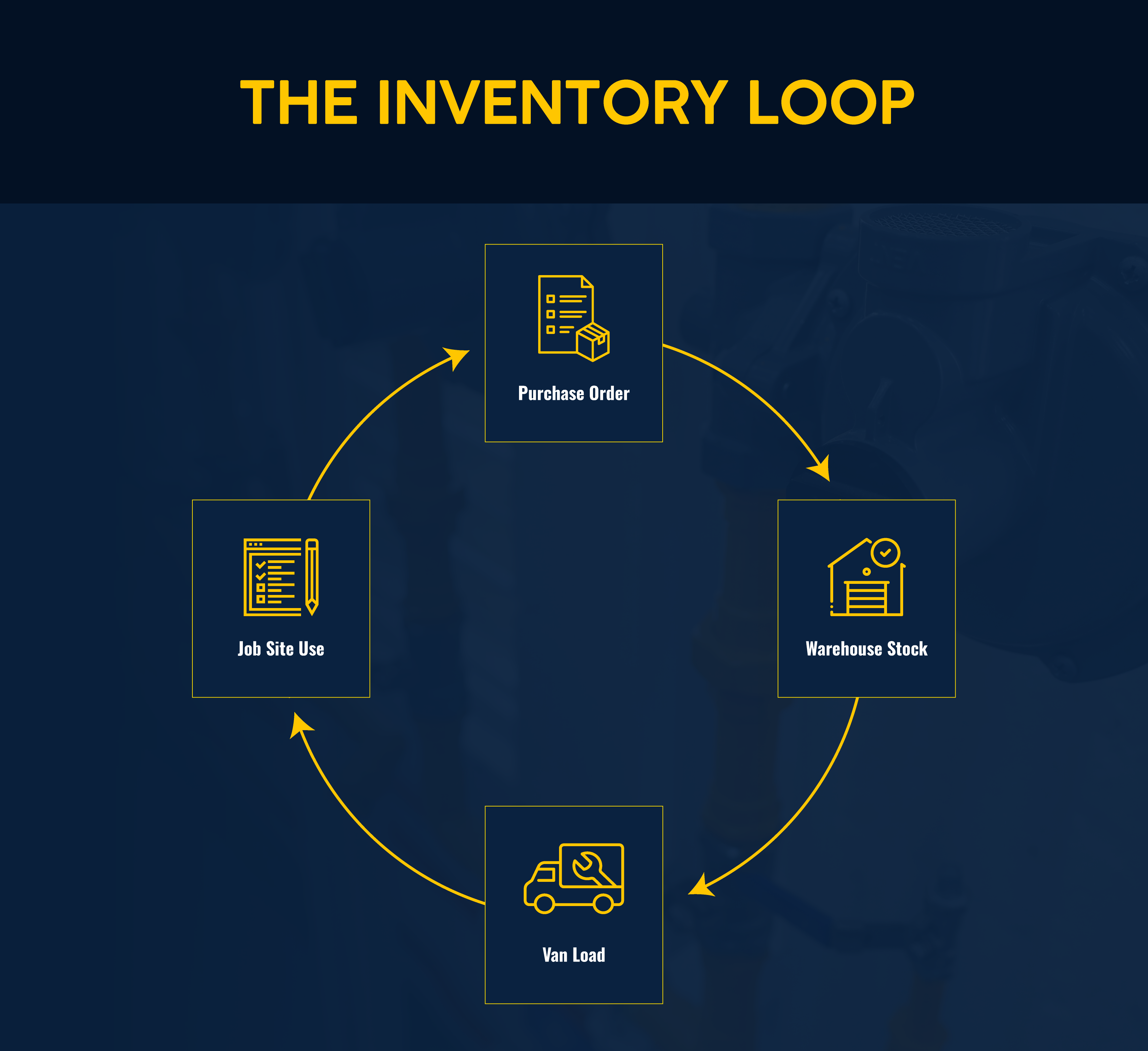
What’s the best plumbing inventory management software for your business? First, you need to decide whether you need an FSM platform, an inventory app, or both. And before committing to any tool on this list, ask this question: Does it close the loop, or does it only give better visibility into one part? The businesses that scale profitably in the long term are running on a single connected system, not a patchwork of tools.
Schedule a demo to see how Simpro connects inventory, estimating, job costing, and accounting in a single platform built for plumbing contractors.


 Back to top