
Building an HVAC price book is one of the most direct ways an HVAC business can influence profit margins.
Most contractors who lose money aren't squandering profit on bad jobs. Rather, they’re making pricing decisions the wrong way, by the wrong people, at the wrong time. A tech quoting a blower motor from memory. A dispatcher pulling prices from a spreadsheet that hasn't been touched in eight months. An owner who doesn't know his loaded labor rate, so he's been undercharging on time-and-materials work for three years.
An HVAC pricing book fixes the part that actually controls margin: Consistent, accurate pricing that every technician uses on every job. This guide covers what belongs in an HVAC service price book, which pricing model fits your business, and how to maintain a book that earns its keep as the business scales.
What Is an HVAC Price Book?
An HVAC pricing book is a structured catalog of every service your business performs, repairs, installations, maintenance, and emergency calls, with a pre-calculated price attached to each. It may break jobs into labor and materials line items, or it may present a single flat rate per task. Either way, the goal is the same: technicians stop quoting from gut feel and start quoting from a system.
That catalog also encodes your cost structure: what it actually costs to deliver each service, overhead included, so every price in the book produces the margin you need rather than the margin you hope for.
How Can a Price Book Help With Profitability?
The median net profit margin for HVAC contractors is 5.8%, but top-quartile shops average 13.2%. The difference is rarely labor productivity. It's pricing discipline.
HVAC profit margins for contractors using flat-rate pricing are roughly 7%, compared to 4% for time-and-materials (T&M) shops — a 3-percentage-point gap that, on $2 million in revenue, is $60,000 in additional take-home. Without a price book, technicians quote different prices for the same job and underprice from memory using round numbers that don't account for overhead. Meanwhile, on-site quoting slows down every call.
Having a price book makes your cost structure explicit, delivers standardized pricing across every technician, and gets customers to a signed approval faster.
Residential vs. Commercial HVAC: Should You Have Separate Price Books?
For businesses doing both residential and commercial work, the answer is almost always yes. Residential HVAC is standardized enough that set pricing works cleanly. A well-organized residential book can cover 80-90% of service calls without requiring quoting judgment.
Commercial work involves asset-specific service pricing, negotiated contract rates, and multi-site accounts with location-specific terms. Trying to run that through a residential price structure creates errors.
Separate books aren't significantly more work, and keep the logic in each one clean.
Flat Rate vs. Time and Materials: Choosing the Right Model for Your HVAC Price Book
The flat-rate vs. T&M question is often framed as either/or. In practice, most mature HVAC businesses use a hybrid.
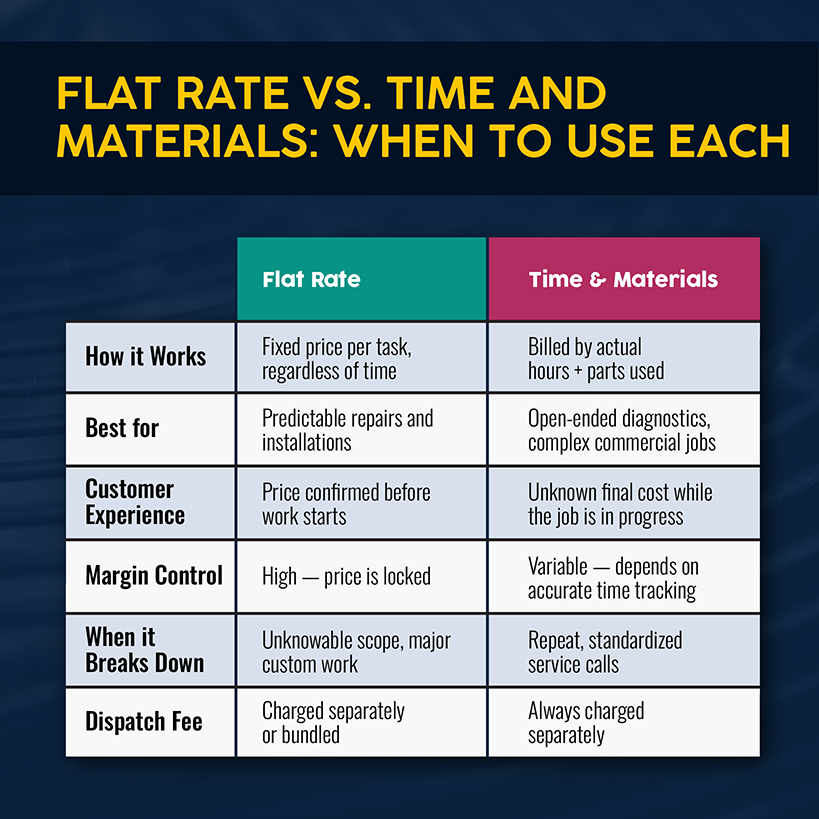
Flat-rate pricing assigns a fixed price per task, regardless of how long it takes. The customer knows the price before you start, you don’t need to argue over how long the job ran, and you capture full margin, even on jobs where your tech is faster than average. For predictable residential service repairs and installations, flat rate is the default.
T&M pricing bills actual hours and materials. It makes sense for open-ended diagnostics, complex commercial systems with unpredictable scope, or any job where you don’t know what's involved until you're inside the equipment. A dispatch fee (sometimes called a service call fee) covers truck roll and diagnosis time. Never absorb that into the repair price — unless your pricing structure explicitly bundles it, which some flat-rate shops do for competitive positioning.
For most residential-focused shops, 75-85% of jobs are predictable enough for flat-rate. The price book should be built around that, with T&M reserved for genuine exceptions. For commercial-heavy shops, the split is different, and the book structure should reflect it.
Related: What are the best plumbing flat-rate pricing apps?
What to Include in Your HVAC Price Book
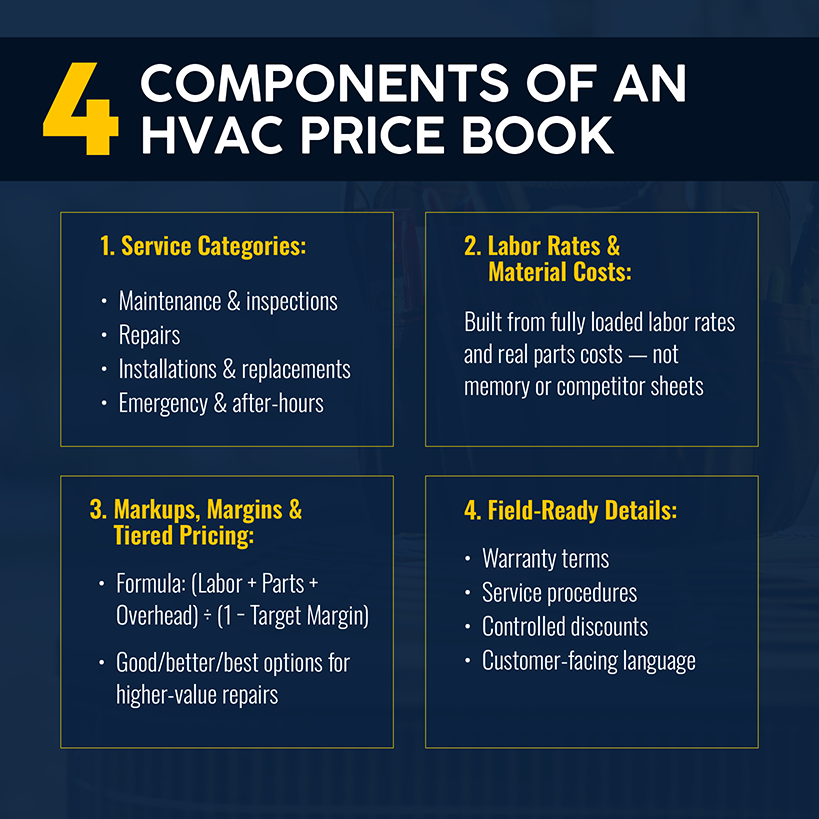
An organized HVAC service price book that works in the field has four components that build on each other. Start with categories, because they determine the structure that everything else lives in.
1. Categorize Your HVAC Services
Service categories are the skeleton of the price book. Get them wrong, and the book becomes unusable in the field. Standard categories for HVAC work:
- Maintenance and inspections: seasonal tune-ups, filter replacements, coil cleaning, preventive checks
- Repairs: component-level repairs by system type (cooling, heating, refrigeration, controls)
- Installations and replacements: equipment replacement, system installation, ductwork
- Emergency and after-hours: same-day response, after-hours surcharges, weekend and holiday rates
Within each category, break services down to the specific task level. "HVAC repair" is not a price book entry. "Condenser fan motor replacement, standard residential" is.
2. Labor Rates, Material Costs: What to Build Them From
The true test for most price books is getting labor and material into your pricing calculations. Every price should come from real cost inputs, not competitor rate sheets or memory.
For labor, you need to calculate the fully loaded labor rate, which includes payroll taxes, benefits, insurance, workers' compensation, and overhead allocation. Residential HVAC labor currently bills at $85-$150/hour and commercial at $110-$190/hour. If your loaded rate isn't informing those numbers, your prices have a problem.
For materials, most successful shops use a 2.5x-3.5x multiplier on parts cost for flat-rate pricing. Parts prices move constantly: HVAC parts and equipment suppliers have repeatedly updated pricing since the beginning of 2025, with some increases reaching 14-25%. A 10-technician shop doing 1,200 jobs per year can lose $12,000-$18,000 annually to pricing lag alone. That's margin leaking on every job, and accurate pricing is the only fix.
3. Apply Markups, Margins, and Tiered Pricing
The flat-rate pricing formula is:
Flat-Rate Price = (Loaded Labor + Parts Cost + Overhead Allocation) ÷ (1 − Target Margin)
Using a simple markup percentage understates true margin. If your target gross margin is 50% and you mark up a $200 part by 50%, you're selling it at $300 — which is a 33% gross margin, not 50%. The division formula gives you the right number.
Tiered pricing (good/better/best)works well on higher-value repairs and replacements. When presented with three choices, most customers select the middle option, which means a well-constructed middle tier effectively moves your average ticket upward without a hard sell.
4. Add Field-Ready Details, Including Service Procedures, Warranties, Discounts, and Value Justification
The field version needs supporting information that helps technicians close jobs. Some of the items that directly affect the customer experience during quote presentation:
- Warranty information. Build warranty terms directly into the relevant line items so your techs know whether a job is covered before they quote it.
- Service procedures. Brief descriptions of what's included in each service give customers context and keep techs consistent.
- Discount and coupon sections. When discounts are built in as formal entries, techs apply them as line items rather than manually overriding prices. A $200 discount applied ad hoc across 300 jobs per year gives away $60,000 in gross profit. Controlled discounting keeps that visible.
- Customer-facing language. Entries should describe what the customer receives, not internal codes. "Evaporator coil replacement, includes refrigerant recharge and leak test" reads differently than "EVAP COIL RPL W/REF."
Building Your Own HVAC Price Book vs. Using Software
Building a price book in a spreadsheet is a reasonable starting point. The problem is maintenance. Every change in parts price means finding affected entries, recalculating, and pushing a new file to the field — with no guarantee that everyone's working from the same version. Cross-referencing margin by service category means pulling from the spreadsheet and matching it against job records that live somewhere else.
At one truck, that's annoying. At eight, it's a structural problem that starts affecting cash flow before it shows up on a P&L.
Simpro® is a field service management (FSM) platform that handles price book management as a native part of the system, connected to quoting, inventory, job costing, and invoicing in a single workflow.
- The catalogue establishes base costs for every part and material in the business. Pricing tiers and markups are applied at the item or group level, so a single update ripples through every affected price automatically.
- Pre-builds bundle labor and materials into a single billable service — the equivalent of a price book line item, but connected to inventory and job records. Standard price pre-builds calculate sell price dynamically from costs, which is ideal for T&M. Flat-rate pre-builds lock in pricing regardless of actual costs, which is best for fixed-price schedules.
- Take-off templates handle large-scale or repeat project estimating for commercial work.
- Supplier catalogue importing links multiple suppliers to a single item and compares live prices and discounts side by side. This is the direct fix for pricing lag — the $12,000–$18,000/year problem most HVAC shops absorb without ever seeing it on a report.
For HVAC businesses that want a faster path to a complete book, Simpro's price book provides a pre-built HVAC catalog with ready-made categories, flat rates, and descriptions. Plus, it includes a built-in labor rate calculator and markup customization, updated regularly to reflect market conditions.
How to Maintain and Roll Out Your HVAC Price Book in the Field
Building the price book gets you started. Keeping it accurate and making sure techs actually use it is where most shops lose ground.
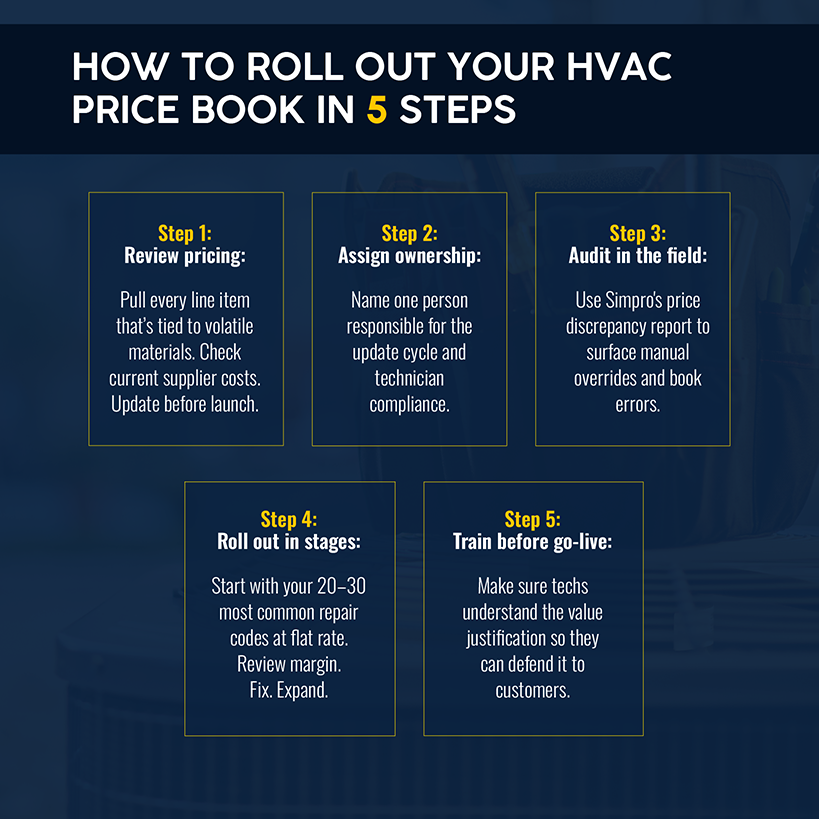
- Review pricing on a regular cycle. Every six months is the minimum; every quarter is better. Pull every line item tied to volatile materials, check current supplier costs, and update accordingly. Simpro's supplier catalogue integration makes that visibility the default; you're confirming what the system surfaces rather than hunting for discrepancies.
- Assign ownership. Someone in the business needs to own the update cycle and technician compliance. Without a named owner, both slip.
- Audit pricing in the field. Simpro's price discrepancies report shows where the price billed on a job didn't match the price book. This surfaces manual overrides and errors in the book itself, providing visibility into discount behavior.
- Roll out in stages. Start with the 20-30 most common repair codes at flat rate while keeping the rest on T\&M. Review close rates and margin, fix what isn't performing, then expand. Launching everything at once will derail your implementation.
- Train before you go live. Techs erode customer confidence when they can't explain why a capacitor replacement costs what it does. Train techs on the value justification so they can be your advocate in the field.
Related: Check out our guide on how to grow HVAC sales.
How to Set HVAC Prices for Small Jobs and Big Jobs
Your approach to pricing HVAC jobs should be the same, whether you're pricing a $109 capacitor swap or a $28,000 commercial rooftop replacement. What changes is the level of detail required and the margin profile you're targeting.
For small jobs, start with the loaded labor cost formula we mentioned earlier:
Flat-Rate Price = (Loaded Labor + Parts Cost + Overhead Allocation) ÷ (1 − Target Margin)
A contactor replacement on a residential condenser might take 45 minutes of labor at $95/hour loaded, with a $35 part at 3x markup and $40 overhead. That works out to $216 before margin. At 40% gross margin, that's $360. The market range of $129-$199 for the same job should raise a question about whether shops in that range are actually making money on it.
Related: Explore the estimating and proposal process with our guide to bidding on HVAC work.
For large jobs, the math is the same, but job-specific costing is worth the extra time. Variable labor hours, project-sourced equipment, and scope risk make flat-rate appropriate only when the scope is truly well-defined. T\&M with a cap handles the rest.
Both types of jobs start with the price book. Get the inputs right, keep the book current, and make sure your customers see a number that reflects what the job actually costs.
Ready to see how Simpro can improve your HVAC price book and protect your margins? Schedule a demo.


 Back to top