
HVAC advertising examples are everywhere online, but most of them aren't worth copying. "Trusted. Local. Family-owned." Every shop in town runs some version of the same message, and when homeowners search for HVAC services, it all blurs together because no one says anything specific.
We’re sharing a better strategy, broken down by channel with actual ad copy, offer structures, and HVAC advertising ideas that generate calls.
You'll see HVAC marketing examples for Google, Facebook, direct mail, and fleet, what seasonal timing looks like in practice, and why maintenance club ads play a different game than repair ads. Throughout, we’ll weave in HVAC marketing strategies that go beyond paid advertising.
What Separates HVAC Ads That Get Calls from Ones That Don't
One principle separates high-performing HVAC ads from the rest: Service-centric copy loses to customer-centric copy.
"We fix AC" is about you. "Sleep comfortably tonight" is about your customer.
Every high-converting HVAC ad shares two things: A specific offer and a comfort or safety hook. Neither alone is enough. When you put them together ("Same-day AC repair, $49 diagnostic fee — sleep in your own bed tonight"), they become something a potential customer actually acts on.
HVAC Advertising Examples: Google Ads
Google is where high-intent HVAC searches land. Someone typing "AC not cooling" at 2 p.m. on a 95-degree day isn't browsing. They need help now.
The Emergency Repair Search Ad
Emergency intent keywords convert at higher rates than general service terms and should get their own ad group with distinct bids.
"Furnace not working," "AC out," "no heat" — these aren't the same as "HVAC tune-up," and bidding on them identically wastes money.
The formula for emergency search ads:
- Headline 1: Pain-first — "AC Out? Same-Day Repair — Dallas"
- Headline 2: Credibility — "Licensed & Insured | 500+ 5-Star Reviews"
- Headline 3: Commitment — "1-Hour Response Guarantee"
- Description: "Our certified techs are on call 24/7. We'll diagnose the problem fast and give you a clear price before we start. No surprise charges."
- CTA: "Call Now" or "Book Online" — not "Learn More"
A homeowner with no AC on a 100-degree day isn't in the consideration phase. They're ready to decide. "Learn More" belongs on a product page, not an emergency repair ad.
Callout extensions that outperform: Same-Day Service | Licensed & Insured | NATE-Certified | BBB A+ Rating | 24/7 Emergency Repair
Google Local Services Ads (LSA)
LSAs deliver the highest return on ad spend of any paid HVAC channel. The Google Guarantee badge instills trust in homeowners even before they read your listing. Plus, you’re listed above standard paid ads in search results, so placement comes down to review count and response time, not just bid.
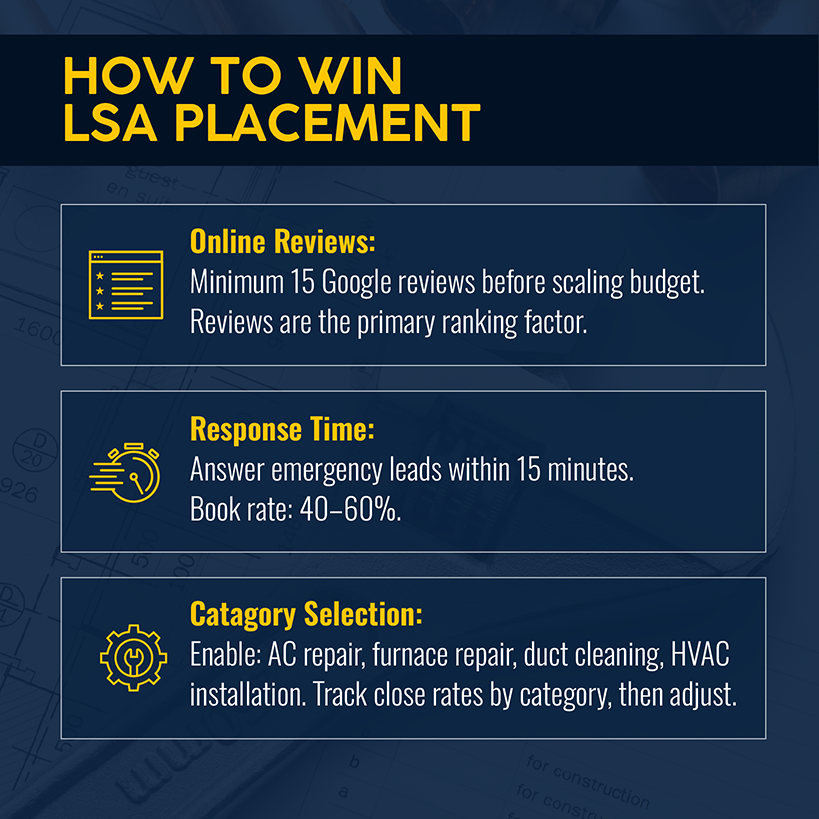
What you can control:
- Online reviews: Get to at least 15 Google reviews before scaling your LSA budget. Online reviews are the primary ranking factor.
- Response time: Emergency leads from LSAs book at a 40–60% rate when answered within 15 minutes. That window is the value proposition.
- Category selection: Enable AC repair, furnace repair, duct cleaning, and HVAC installation. Track which lead types actually close, then adjust bids accordingly.
LSAs charge per lead, not per click. With a new HVAC installation averaging around $5,000, even a $100 cost per lead (CPL) is rational if you're closing at a reasonable rate. Local SEO and LSA are complementary — running both is how HVAC contractors own the top of the page.
For setup details, see the Google Local Services Ads Help Center.
Facebook and Instagram Ad Examples for HVAC
Meta advertising works differently from Google. These homeowners aren't searching. They're scrolling, and your ad has to create a reason to stop before it can create a reason to call.
The Seasonal Tune-Up Offer
The most common mistake with seasonal HVAC Facebook ads is running them when it's already hot outside. By June, every HVAC company in the market is bidding against you. Cost per click (CPC) spikes, CPL balloons, and the math falls apart.
Instead, start running Facebook ads 3–4 weeks before peak season. A late March or early April ad for air conditioning tune-ups catches homeowners in planning mode rather than panic mode.
Example ad copy:
"Summer's coming. Get your AC tuned up for $89 before the rush — [City] homeowners only. Limited slots available this month."
- Format: Single image or short video. Use an offer-led headline.
- Target: Homeowners aged 35–65. Define the service radius.
- Image: A family comfortable at home outperforms equipment photos by roughly 40% — pets and kids in comfort situations do especially well.
The Maintenance Club Recruitment Ad
A repair ad tries to win a job. A maintenance club ad tries to win an existing customer for years. Different goals require different approaches.
Example copy:
"One call a year keeps the breakdowns away. Join our maintenance plan for $X/month — priority scheduling, discounts on repairs, and no diagnostic fees for members."
Offer structures that convert:
- A monthly flat fee that’s low enough to be a nondecision
- An annual membership with the first tune-up as the anchor
- A "first tune-up free" enrollment hook with auto-renewal
Start with your existing customer list via a Facebook custom audience upload, then build lookalike audiences from that base.
Direct Mail and Print Examples for HVAC
HVAC marketing ideas aren’t limited to digital. Direct mail produces numbers that are easy to dismiss until you look at them: 5,000 postcards can generate 2–3 calls per day, and targeted seasonal campaigns have documented ROI above 500%.
The Tune-Up Postcard
Every door direct mail (EDDM) saturates a ZIP code without a mailing list, which makes it useful for contractors building a new service area or filling a slow season. It's one of the more underrated HVAC promotional ideas for shops that want to layer offline reach on top of digital.
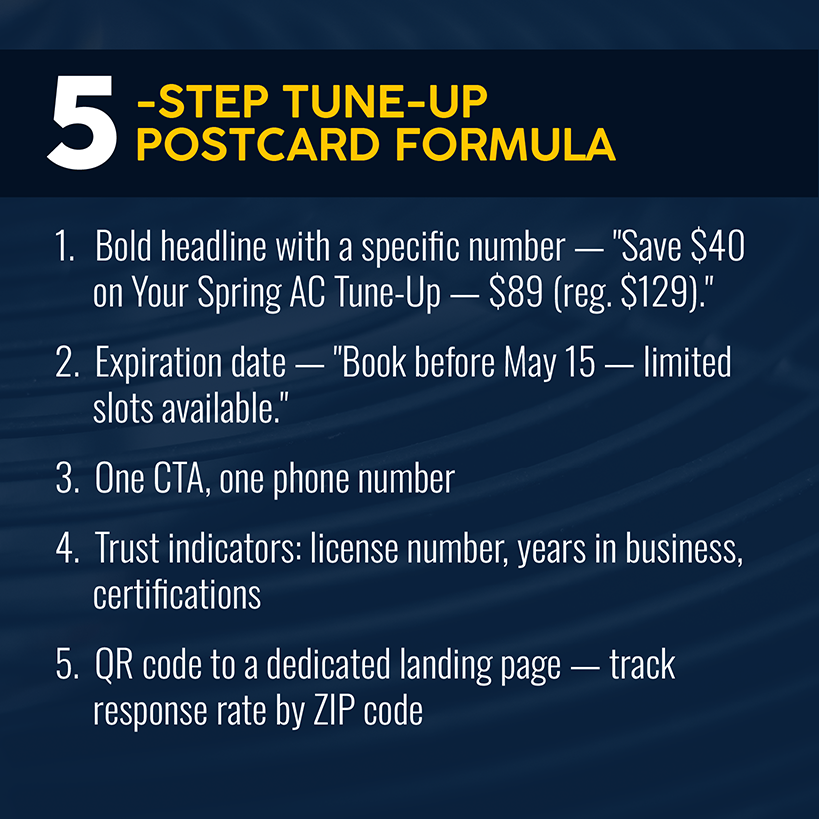
Postcard formula:
- Bold headline with a specific number — "Save $40 on Your Spring AC Tune-Up — $89 (reg. $129)"
- Expiration date — "Book before May 15 — limited slots available."
- One CTA, one phone number
- Trust indicators: license number, years in business, certifications
- QR code to a dedicated landing page so you can track response rate by ZIP code
"Discounted service" isn’t an offer. "$89 tune-up" is. Vague pricing reads as untrustworthy. If your ad doesn’t reveal a firm price, people assume the real number is higher.
The Neighbor Discount Door Hanger
Leave door hangers on 10–15 surrounding homes immediately after completing a job in the neighborhood.
Copy:
"We just finished an HVAC service at [Street/Neighborhood]. Same-day availability this week — [Neighborhood] residents get $50 off their first service. Call before Friday."
This approach combines word of mouth with geography. The social proof is hyperlocal, the availability is real, and the deadline is legitimate. It builds trust the way no paid ad can — it reads like a neighbor's recommendation, not a mail piece.
Happy customers in that neighborhood become your next source of HVAC leads. Pairing this approach with referral programs for existing customers multiplies the effect.
Vehicle Wrap
With 30,000–70,000 impressions per day and a cost under $100/month, amortized over 3–5 years, vehicle wraps have the lowest cost-per-impression of any local format. Use high-contrast color with one URL, and make sure the phone number is readable at 40 mph. Everything else is noise.
Seasonal HVAC Advertising Examples (and When to Run Each)
Timing influences whether your ad spend succeeds.
A useful benchmark is the 20-degree rule: When a forecast shows a 20-degree temperature spike, calls follow. Your ads should already be running before that moment arrives.
| Season | What to Run | When to Start | Offer That Converts |
|---|---|---|---|
| Preseason (March–April) | AC tune-up, inspection, early-bird | 6–8 weeks before peak | Specific price + deadline |
| Peak (June–August) | Emergency repair, same-day availability, 24/7 | Continuously | Speed and availability |
| Offseason (fall) | System replacement, financing, upgrade | October–November | Monthly payment ("from $129/mo") |
| Pre-winter (Sept–Oct) | Furnace tune-up, heating inspection | 6–8 weeks before temps drop | "$89 furnace check before first freeze" |
| Winter peak (Dec–Jan) | Emergency heat, same-day guarantee | Continuously | Service guarantee |
Off-season replacement ads with financing hooks outperform peak-season ads. A homeowner replacing a 15-year-old HVAC system in October is in planning mode. That's where "as low as $129/month" entices. A homeowner in July without air conditioning just wants someone to show up.
Related: 5 Ways to Stay Calm During HVAC Busy Season
Maintenance Club Advertising: The Ads That Build Recurring Revenue
Repair ads win one job. Maintenance club ads win a customer for 5–10 years.
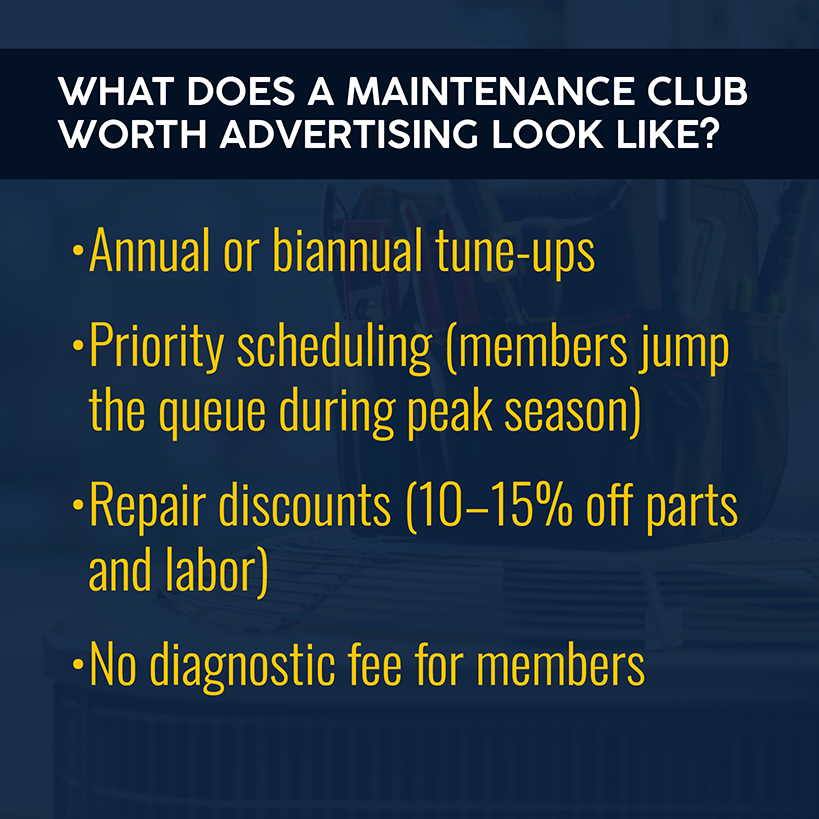
The structure of a maintenance club that’s worth advertising:
- Annual or biannual tune-ups included
- Priority scheduling — members jump the queue during peak season
- Repair discounts (10–15% off parts and labor)
- No diagnostic fee for members
Copy that works:
- Urgency + prevention: "Never get stuck in a heat wave — join our annual maintenance plan."
- Exclusivity: "Members get same-day priority — no waiting when everyone else is calling."
- Ongoing value: "Parts and labor discounts for the life of your membership."
Run these ads to existing customers first via Facebook custom audiences — someone who's already paid you once is the easiest convert. Cold audiences come second.
Shaffer Beacon Mechanical reported a 60% increase in profit margin after building a maintenance plan program.
Related: Simpro® Maintenance Planner handles the operational side at scale: scheduling, reminders, and tracking which members are due for service.
The Ad Worked. Now Don't Blow It.
A lead that came in from a $50 CPL Google ad and didn't get called back for four hours is a $50 lead that went to your competitor. Ad ROI is determined after the lead arrives.
The math is easy to understand: a $40 CPL at 10% close rate is a $400 customer acquisition cost. An $80 CPL at 50% close rate is $160. Your CPL is not your CPA. The gap between them is operations: a slow phone response, next-day-only scheduling, and 48-hour quotes.
Automated notifications save field service time by simplifying booking confirmations and follow-up. When the homeowner gets a job confirmation with technician info and an arrival window, no-shows decline. Meanwhile, online reviews go up, which feeds back into LSA placement.
Simpro for HVAC connects lead management to the operational side: scheduling, dispatch, customer communication. The money you spent on advertising doesn't leak out before the job gets booked.
Interested in learning how to improve HVAC advertising planning and results? Schedule a demo.


 Back to top