
HVAC manufacturers have raised equipment prices roughly 40% since 2020. The refrigerant transition has increased R-454B cylinder costs sixfold since 2021. When a compressor goes on backorder in mid-July, the customer's call goes to you, not the manufacturer.
Your choice of HVAC manufacturers and suppliers, and how you structure those relationships, has real margin consequences once you're past $1 million in revenue.
This guide covers eight major manufacturers and four distributors worth understanding, including the parent-company structures most contractors overlook. Plus, we're sharing how to build manufacturer relationships that deliver better pricing, priority inventory, and support programs that actually pay back.
Top HVAC Manufacturers and Suppliers to Know
The North American market is dominated by six corporations that control more than 150 HVAC brand names across heating and cooling systems, ventilation systems, and commercial equipment — and across every price tier.
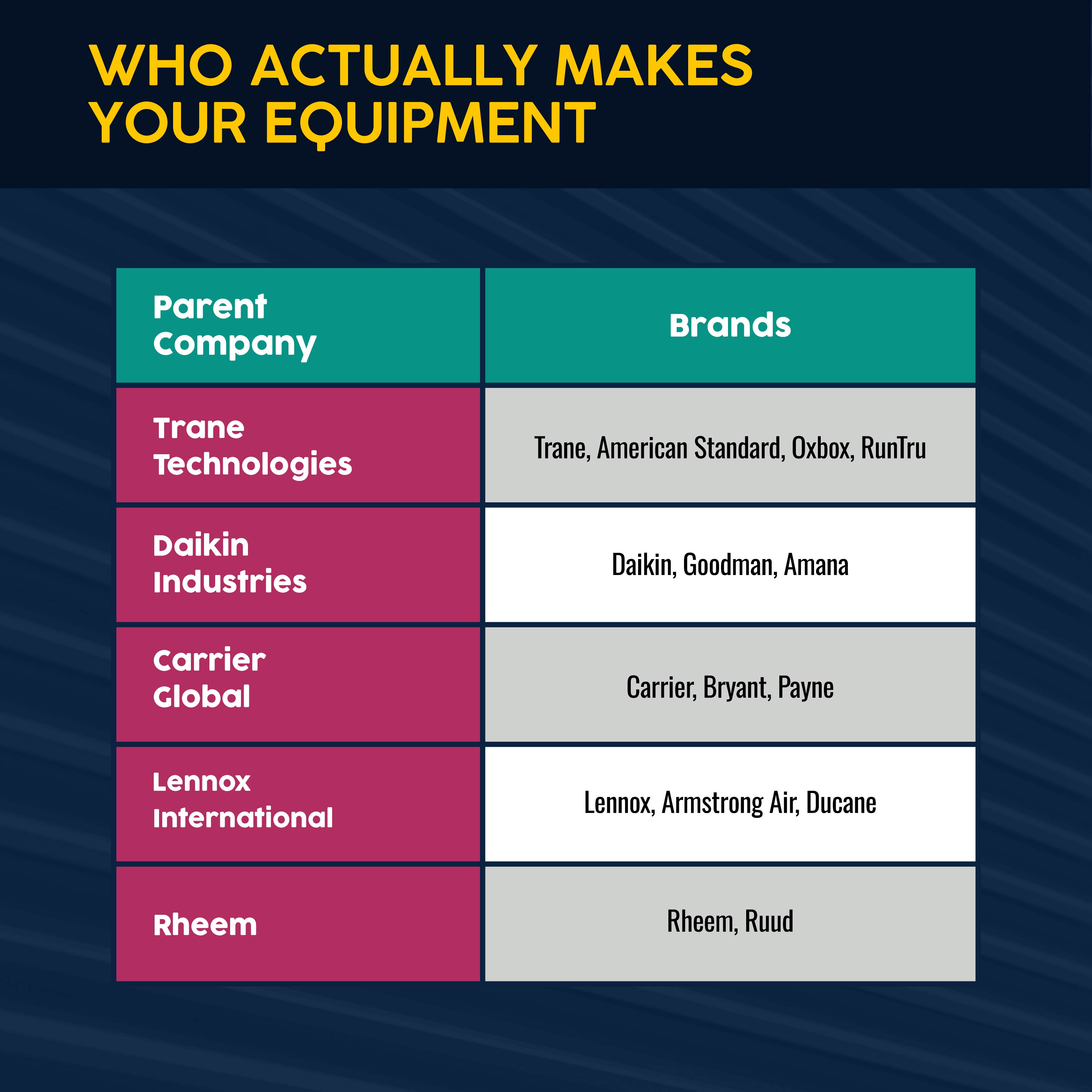
Trane and American Standard both belong to Trane Technologies. Goodman and Amana both come out of Daikin's Waller, Texas, plant. What looks like a choice between competing brands is often simply a pricing-tier decision within the same parent company. The first step to making sound supplier decisions is understanding how most HVAC equipment manufacturers structure their portfolios.
1. Carrier: Best for Broad Residential and Light Commercial Coverage
Carrier Global holds nearly 17% of the North American market and operates three brands that contractors encounter at the counter regularly: Carrier, Bryant, and Payne. All three come from the same manufacturing infrastructure. If you're buying Bryant units from your distributor, you're in Carrier's network at a different price tier.
Carrier's premium brand carries strong consumer recognition in air conditioning and heating, which helps in the residential replacement conversation. The Carrier Enterprise distribution arm manages the contractor relationship at the regional level. This means the representative relationship is more influential in getting access to priority inventory and pricing, versus brand preference.
Best for: Contractors running residential and light commercial work who want a single manufacturer relationship that spans multiple price points.
2. Trane: Best for Durable Systems and Premium Brand Recognition
Trane Technologies leads the North American market at 21% share. The company owns and operates these brands at different price tiers: Trane, American Standard, Oxbox, and RunTru. Trane is the premium option, built on a durability reputation that converts well in the residential replacement market.
The Trane Comfort Specialist dealer program offers marketing support and lead generation in exchange for sales volume and installation quality commitments. For contractors doing high-ticket residential replacement work, the brand name becomes a silent sales tool. Homeowners who've heard "It's Hard to Stop a Trane" for 20 years are already pre-sold on quality.
Best for: Residential replacement contractors that sell on durability and want a manufacturer brand that supports the initial conversation.
3. Lennox: Best for High-Efficiency Residential Systems
Lennox International holds around 8% market share and owns Armstrong Air and Ducane at lower price points. Lennox's positioning is built on high efficiency ratings. The brand tends to show up in markets where utility rebate programs and energy-efficiency credits factor into the customer's decision.
If your residential market skews toward higher-income homeowners, or you're routinely bidding work where rebate processing is part of the proposal, Lennox equipment gives you something to sell beyond installation quality, including indoor air quality products and premium SEER-rated units that qualify for utility rebate programs. The Lennox Premier Dealer program structures the relationship around training, lead referrals, and rebate handling.
Best for: Residential contractors in markets with active utility rebate programs or consistent demand for high-efficiency upgrades.
4. Rheem: Best for HVAC and Water Heating Product Coverage
Rheem Manufacturing is one of the few major manufacturers that remains privately held, with a product line spanning HVAC systems and water heating. For contractors that cross-sell or operate across HVAC and plumbing-adjacent work, that breadth pays off: fewer distributor relationships to manage, consolidated warranty processing, and a single manufacturer training structure.
Rheem's 2024 acquisition of Nortek Global HVAC, now Nordyne, added Nortek-family brands to the portfolio, including Frigidaire and Gibson.
Best for: Contractors serving residential customers who bundle HVAC and water heater replacements, or multi-trade shops looking to consolidate manufacturer touchpoints.
5. Daikin: Best for Heat Pumps, Mini-Splits, and Ductless Systems
Daikin Industries holds 19% of the North American market and manufactures Daikin, Goodman, and Amana systems, all produced at its Waller, Texas, facility. The Daikin brand has emerged as a strong option for ductless, mini-split, and efficiency heat pump installations as demand accelerates. Electric heat pumps have been outselling gas furnaces throughout the 2020s.
Contractors who haven't built ductless expertise are watching that business go elsewhere. Daikin's commercial HVAC lineup, including variable refrigerant flow systems, and residential mini-split portfolio give contractors the range to compete in both segments without adding a second manufacturer relationship.
Best for: Contractors building or expanding a heat pump and ductless installation practice, especially in commercial retrofit.
6. Goodman: Best for Budget-Conscious Residential Jobs
Goodman is Daikin's value-positioned brand. Same parent company, same manufacturing facility, lower retail price point. Goodman air conditioners and furnaces are most commonly used for volume residential replacement work, where installed cost is the primary factor for customers.
The HVAC industry averages roughly 5–12% net margins. A contractor running a $4,500 Goodman install is in a different territory than one running a $14,000 Trane job, but the math works if volume is consistent and procurement is tight. Contractors can carry Goodman as a secondary brand alongside a premium line, quoting the full price range without splitting manufacturer relationships.
Best for: High-volume residential contractors competing on price, or as a secondary brand for price-flexible quoting alongside a premium line.
7. American Standard: Best for Mid-Tier Residential Heating and Cooling
American Standard is Trane Technologies' mid-tier residential brand, in many cases sharing production infrastructure with Trane. American Standard is a step down in price while maintaining the same core manufacturing standards, making it a straightforward second option for contractors within the Trane Technologies dealer network.
For Trane-aligned contractors, American Standard provides pricing flexibility without requiring a separate manufacturer relationship, distributor account, or training program. For jobs with tight budgets, you quote something the deal can support, and that gives the customer a reliable system.
Best for: Trane-network contractors that need a mid-tier residential option for budget-sensitive customers.
8. Mitsubishi Electric: Best for Ductless and Zoned Comfort Systems
Mitsubishi Electric has a specialty in ductless and zoned systems, marketed in the U.S. through a joint venture, Mitsubishi Electric Trane HVAC US. The Mitsubishi Diamond Contractor program is a rigorous manufacturer certification, requiring training and volume commitments in exchange for lead referrals and priority technical support.
The global ductless mini-split market is growing at a compound annual growth rate of 8.3% through 2032. Contractors that complete Mitsubishi's certification process get access to a customer base searching for certified installers in ductless systems, zoned comfort, and building automation, along with direct referrals from the manufacturer's channels. Most dealer programs are built around volume rebates. This one generates leads.
Best for: Contractors specializing in ductless, zoned, or high-end residential comfort systems that want certified installer status as a lead generation channel.
Related: See how service software for your HVAC business increases efficiency and closes gaps.
HVAC Suppliers and Distributors Worth Knowing
Your distributor is who you actually buy from, and that relationship tends to have more day-to-day impact on your business than brand preference. Pricing tiers, credit terms, delivery reliability, and first call on backordered inventory all run through your distributor rep, not a toll-free manufacturer line.
1. Ferguson HVAC Supply: Best for Broad Parts and Equipment Distribution
Ferguson is one of the largest HVAC distributors in North America, carrying equipment and parts from most major manufacturers. For contractors that need sourcing flexibility across brands, Ferguson's breadth and national branch coverage provide a reliable option.
Another strength of Ferguson is parts availability during shortages. When your primary distributor is backordered on a compressor or control board, a nearby Ferguson branch might have it on the shelf. Maintain an active account with Ferguson, even at lower purchase volumes, to give yourself an inexpensive form of insurance against job delays.
Best for: Contractors needing broad parts availability across multiple brands, or a pre-established backup channel when primary suppliers are backordered.
2. Johnstone Supply: Best for Contractor-Focused Wholesale Support
Johnstone Supply is a contractor-focused HVAC wholesale distributor with an emphasis on local rep relationships and contractor support programs. Branches are generally staffed by people who know the equipment, which matters when you're troubleshooting a warranty issue or trying to find a replacement part mid-job.
For contractors building their first formal supplier relationship, Johnstone's scale and local branch culture make it a solid primary distributor for residential-focused operations.
Best for: Contractors building a primary distributor relationship with a supplier that prioritizes contractor support and offers competitive pricing.
3. Carrier Enterprise: Best for Carrier, Bryant, and Payne Equipment Supply
Carrier Enterprise is Carrier Global's dedicated distribution arm, which means you're buying from them whenever you pull Carrier, Bryant, or Payne equipment. Your relationship with Carrier Enterprise's regional rep determines your pricing tier, lead times, and access to promotional programs.
Contractors committing to a Carrier-aligned business will find natural alignment — and returns — by investing in the Carrier Enterprise relationship. That means proactive volume planning, prioritizing rep communication, and formalizing the relationship with a multi-year purchasing plan.
Best for: Contractors building a Carrier-family brand as their primary residential or light commercial equipment line.
4. HVACDirect.com: Best for Online Equipment Sourcing and Price Benchmarking
HVACDirect.com is an online equipment distributor carrying systems from multiple manufacturers. It works as a pricing benchmark and backup source for contractors that need price verification or short-notice sourcing. For day-to-day procurement, the lack of a local rep creates friction when returns or warranty issues arise.
This provider can sit in your workflow by verifying your primary distributor's pricing and sourcing equipment on short notice, especially when local channels are out of stock.
Best for: Price benchmarking and secondary sourcing for established contractors that already have primary distribution relationships.
Related: Learn how to estimate HVAC jobs accurately under margin pressure.
How to Choose the Right HVAC Manufacturers and Suppliers
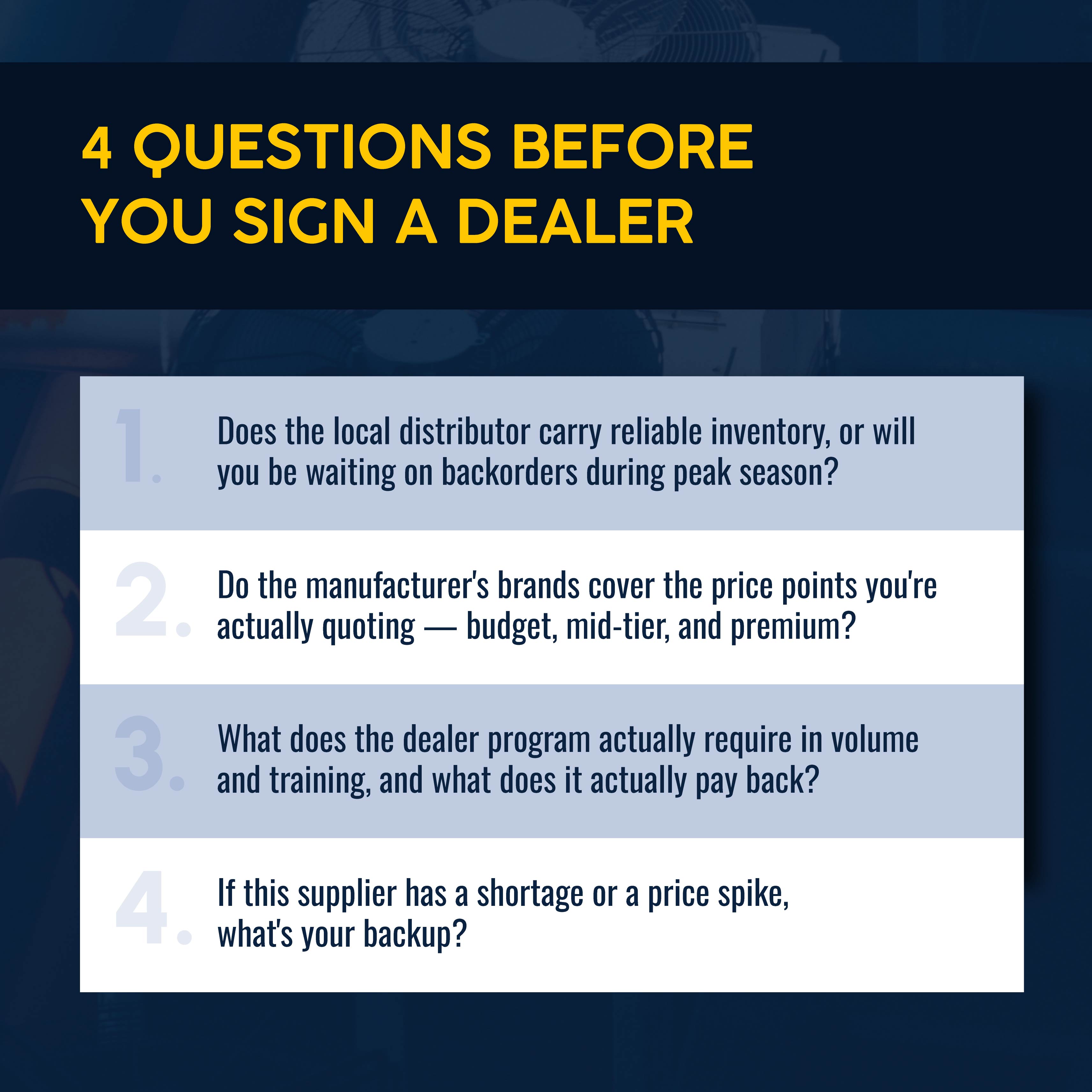
Now that you know the leading HVAC suppliers and manufacturers, the question becomes which relationships are worth building and which are fallbacks when you're stuck. The answer depends on your service mix, typical job price point, local distributor options, and the training and support available through manufacturer dealer programs.
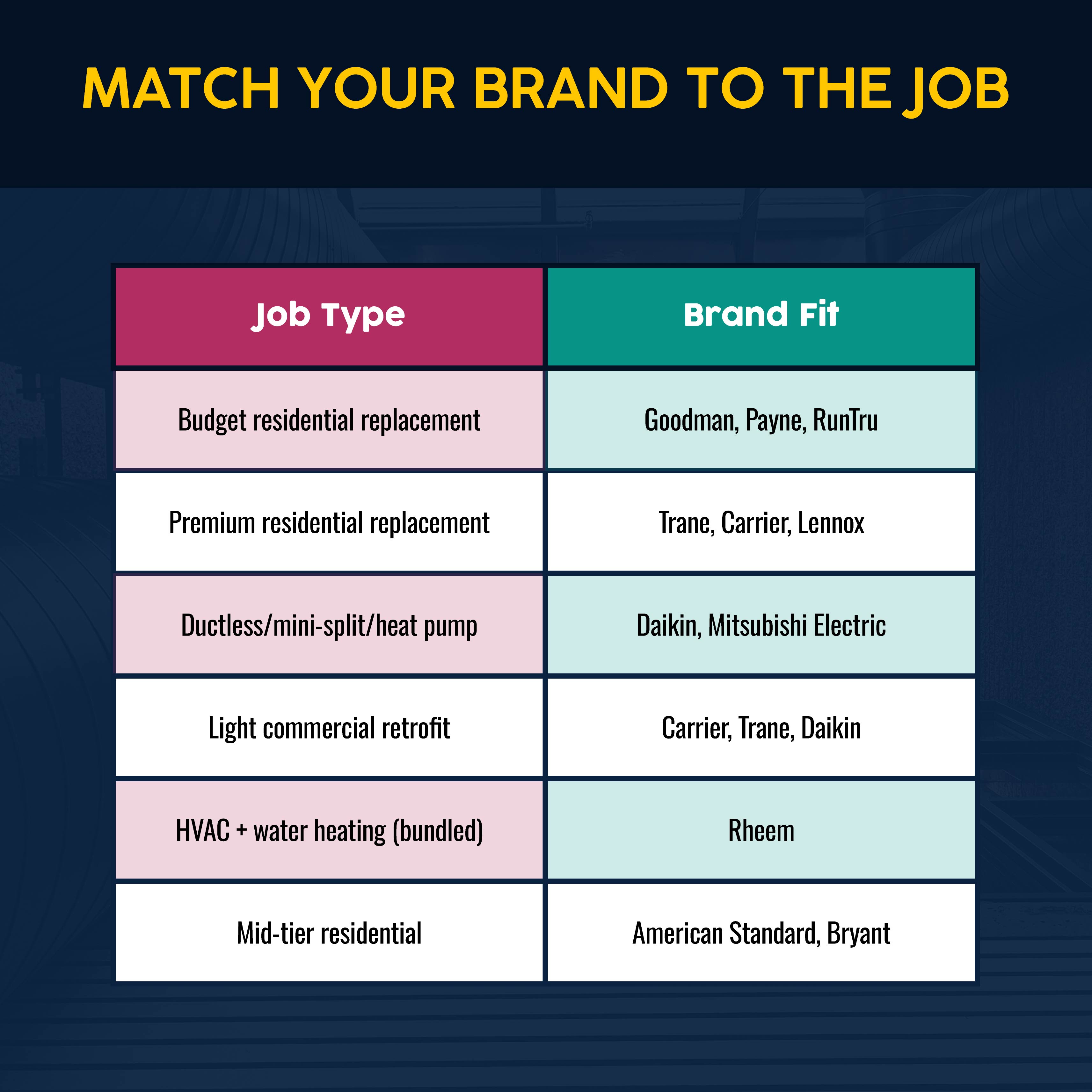
Match the brand to the segment. Contractors with commercial customers and residential installs often carry two brands: a premium name for high-end residential (Trane, Carrier, Lennox) and a cost-competitive option for volume residential or commercial retrofit (Goodman, Payne, RunTru). That coverage lets you quote across price ranges without walking away from jobs or winning business at poor margins.
Understand the OEM structure before negotiating. Choosing between Goodman and Amana means choosing between price tiers from the same original equipment manufacturer (Daikin Industries). When you realize this, you can adjust your volume commitments and loyalty program terms accordingly, all without negotiating against yourself.
Evaluate the distributor, not just the brand. Your distributor controls local inventory availability for air handlers, refrigerant, and everything else, plus pricing tiers, credit terms, and technical support. An engaged rep who alerts you to price increases, energy efficiency product updates, and stock constraints is worth more than a marginal price difference between competing brands. Build that relationship before you need it.
Diversify across at least two primary suppliers. HVAC supply chains face many risks, including tariff uncertainty on components sourced from Mexico, China, and Canada; freight disruptions; and the ongoing A2L refrigerant transition. Qualifying a second supplier means you can pivot without losing jobs, even if your primary channel is backordered.
Related: Our practical guide to how to run a successful HVAC business, including the systems HVAC companies need to run at scale.
How HVAC Contractors Can Manage Suppliers, Inventory, and Jobs More Efficiently
Knowing which manufacturers and suppliers to work with solves the sourcing question. Then, you can focus on managing catalogs from multiple manufacturers, tracking inventory across vans and warehouses, and verifying quotes against current costs rather than prices from a few months ago.
Simpro® is built for exactly this. Contractors can import and sync supplier catalogs directly into the platform and compare vendor pricing side-by-side. This is crucial when equipment prices are volatile, as quotes built from memory or outdated spreadsheets consistently undercharge. A "Price Updated" timestamp on catalog entries shows when pricing last changed, so you're not discovering a margin problem after the job invoices.
Simpro's mobile app lets field techs create purchase orders from the job site and connect them directly to the job record. Every part pulled on-site is tied to a cost, which feeds accurate job-level margin reporting. For contractors managing residential Goodman installs and commercial Trane work, job costing shows which product lines are profitable at your current pricing. You see the true ROI, rather than a blended margin that hides which installs are working and which aren't.
Real-time inventory visibility across vans, warehouses, and job sites means technicians aren't arriving at jobs without parts that sit somewhere else in your operation. The Maintenance Planner add-on supports preventive maintenance agreements and asset tracking. This is an especially useful tool as the A2L transition means HVAC contractors are managing legacy R-410A equipment and new A2L-compliant systems simultaneously.
Simpro helps you build more accurate estimates from the start. If you're working from a standard HVAC bid structure, the platform's catalog-linked quoting tools are faster and more defensible than manual builds.
Related: Get our free HVAC bid template for consistent, professional proposals.
Over 24,000 businesses use Simpro to manage operations across quoting, scheduling, procurement, and job costing. For contractors growing their HVAC business past the point where informal systems work, the platform connects supplier catalog management to job-level cost data so the margin math actually adds up.
Your supplier relationships are probably in better shape than your procurement data. Most contractors know their reps, carry two or three primary brands, and have a rough sense of what equipment costs. The job-level visibility to know which manufacturer relationships are actually profitable, or whether catalog pricing reflects what you're paying today, tends not to exist in any organized form.
When you're ready to accurately estimate HVAC jobs and manage procurement across jobs, seamlessly and in real time, Simpro gives you the platform to do it.
Schedule a demo to see how Simpro works for HVAC contractors building more profitable operations.


 Back to top