
Your phone isn't ringing as much as it should. The jobs are out there, and the U.S. electrical services sector is growing every year. If you’re not seeing this growth, it’s worth asking: Is your electrical business website pulling its weight?
You can’t afford to have a low-performing website. Most consumers say a professional website makes a business more credible, and 62% will avoid businesses without one. Your website is your digital front door, and it’s where many consumers are looking first: Electrical repairs are the No. 2 home services search on Google.
This article shares 12 electrical websites: examples, what each gets right, and best practices you can incorporate into your overall electrical marketing strategy. Whether you're an electrical company building a website from scratch or redesigning an existing site, here's how you build a website that drives business.
What Makes a Good Electrical Business Website?
Before jumping into examples, let's go over the fundamentals. The best electrical business websites must do three things well:
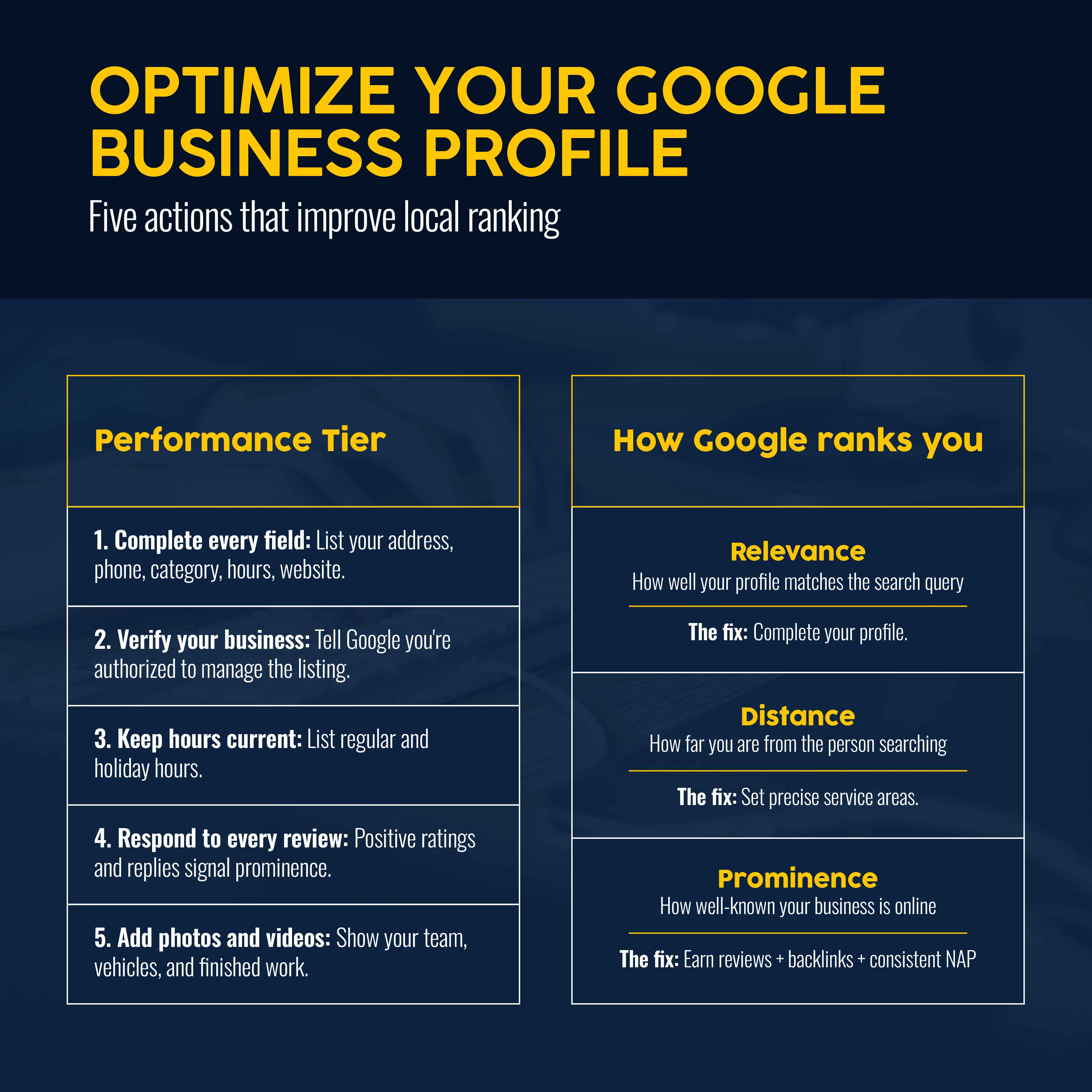
- Get you found. Strong search engine optimization (SEO) attracts customers to local service area pages, keyword-rich service pages, a fully optimized Google Business Profile, and name, address, and phone (NAP) consistency across directories.
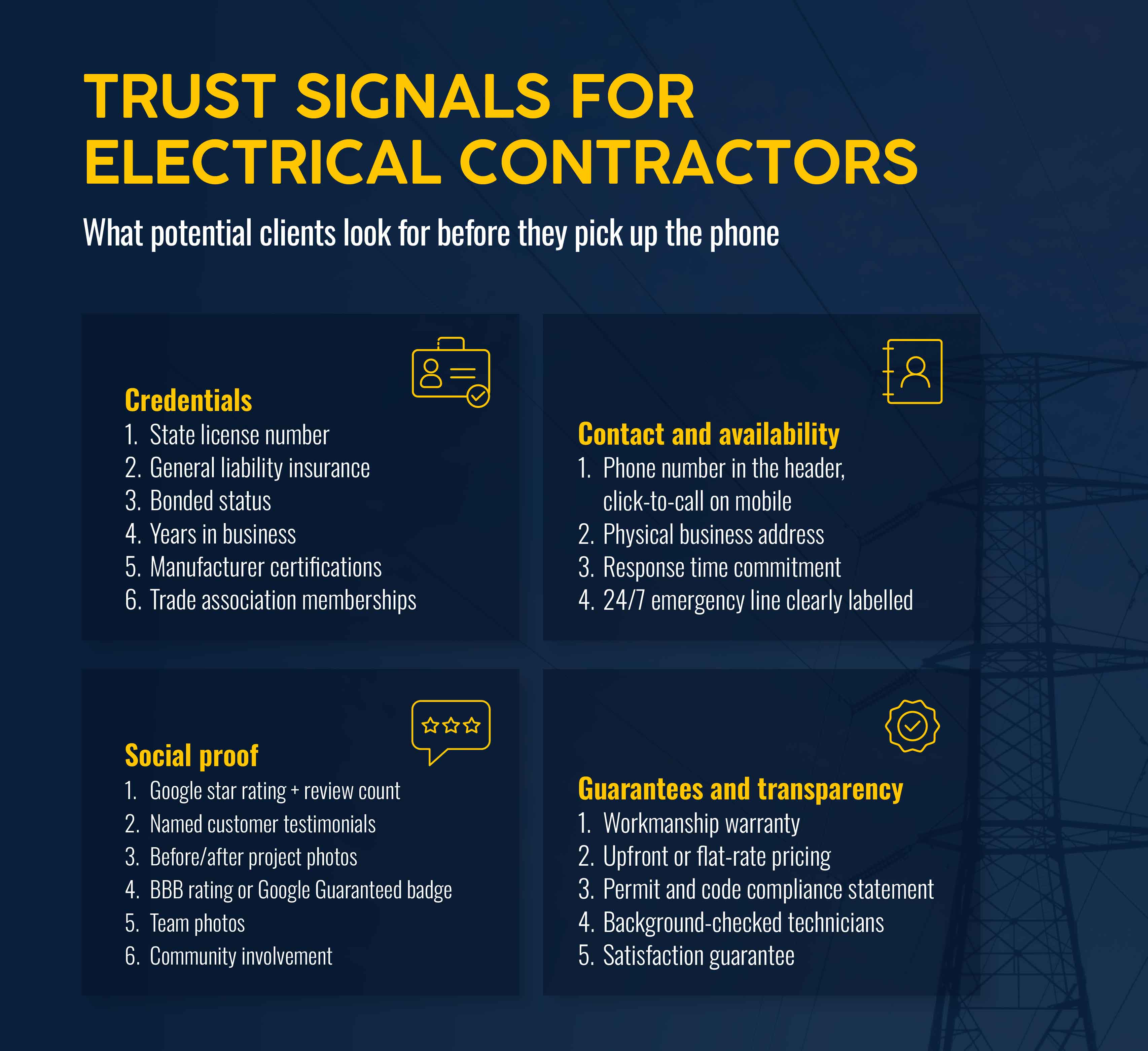
- Turn visitors into customers. Website visitors need an easy, clear path to asking for a quote. Clear calls to action (CTAs), trust signals (licenses, reviews, years of experience), and mobile-friendly design all matter here.
- Create a strong customer experience. From first click to final invoice, deliver a welcoming experience backed by fast response times and professional follow-through.
Here's how you nail every one of these:
- Header with a phone number and quote CTA
- Mobile-first, responsive design that loads in under 3 seconds
- Real service pages (not a generic "Services" page)
- Local service area pages with geographic specificity
- Clear display of licenses, insurance, certifications, and years of experience
- Customer reviews near every decision point
- Real photos: Your team, vehicles, completed projects
- Easy navigation for residential, commercial, and emergency services
- Short, friction-free contact forms
- Frequently asked questions (FAQs) for common concerns
Related: Make those website leads pay off by measuring and improving your electrical business profit margin.
At a Glance: What the Best Electrical Websites Have in Common
Here's the pattern across high-performing electrical contractor websites:
| Website Element | Why It Matters | What to Do |
|---|---|---|
| Clear headline with service + location | Visitors decide in seconds whether they're in the right place. | Name your service and city above the fold. |
| Sticky phone number in header | Phone leads are people ready to buy. | Pin the number so it's visible regardless of screen size. |
| Trust signals above the fold | Many visitors judge credibility by design alone. | Show license number, certifications, star rating, and years in business before scrolling. |
| Dedicated service pages | Each service is a separate ranking opportunity in Google. | Build one page per major service: panel upgrades, EV chargers, emergency, generators, etc. |
| City/service area pages | Local search drives many Google queries. | Build location-specific landing pages for each market you serve. |
| Mobile-optimized layout | Most local electrical searches happen on mobile devices. | Test load speed, CTA tap targets, and click to call on phones. |
| Online booking/quote forms | Customers prefer scheduling via online forms. | Offer at least one digital path to booking beyond the phone. |
| Customer reviews | Most consumers read reviews before hiring a local business. | Embed Google reviews or a testimonials section on key pages. |
12 Electrical Business Website Examples to Learn From
These are real electrical website examples from existing contractors, not software tools or field service platforms. The goal is to analyze what each does well and what you can borrow for your site.
1. High Class Electric: Above-the-Fold Trust Signals
What it does well: High Class Electric doesn't make you scroll to know who they are. License number, years in business, and a phone number are all visible high up on the landing page.
Best practice in action: Trust signals belong above the fold, especially for electrical businesses, where safety and credentials matter to potential clients.
What you can learn: The main headline is a good place to mention your service and location. License number, years of experience, and a clickable phone number should be quickly visible on every screen size.
2. Withrow Electric: Family-Owned Brand Positioning
What it does well: Withrow Electric leans into its family-owned identity. Real photos of team members, a personal "About Us" narrative, and community-focused language differentiate them from faceless competitors. In a market where homeowners invite strangers into their homes, a human connection is a competitive advantage.
Best practice in action: Your brand story is a trust signal. Family ownership, community roots, and the people behind the business aren't just "nice to have." They convert.
What you can learn: Use real photos. Write in first person on your About page. Mention how many years you've been serving the area. These can persuade website visitors to pick up the phone.
3. Mister Sparky: Emergency Service CTAs
What it does well: Mister Sparky knows that much of its traffic arrives mid-crisis. Their site makes emergency service impossible to miss: bold CTA buttons, 24/7 prominently displayed, and click-to-call accessible from every page. The urgency is built into the design.
Best practice in action: Emergency services needs a distinct, visible entry point. Don't make a panicked homeowner hunt for your emergency number.
What you can learn: Treat emergency electrical work like a product line, not a footnote. It deserves its own service page, CTA button in the header, and mention above the fold. Reducing distractions around the CTA increases conversions.
4. Green Electrical: Clean, Simple Website Design
What it does well: Green Electrical resists the urge to cram everything onto one page. White space is used intentionally: it directs the eye to what matters and makes the site feel professional without being overwhelming. Navigation is simple. CTAs are clear.
Best practice in action: A good electrician website design creates clarity. Clean layouts with generous white space make it easier for visitors to find what they need and take action.
What you can learn: If your homepage has five phone numbers, a sliding banner, and a list of every service you've ever performed, simplify. Pick one primary CTA per page. Let the design breathe. This is conversion-focused design.
5. Kollmann Electric: Clear Service Navigation
What it does well: Kollmann Electric structures its navigation around how customers think, not how the business is organized internally. Residential, commercial, and specific product lines are clearly delineated, and each category leads to dedicated service pages.
Best practice in action: Navigation should mirror how customers think about their problem. Clear category structure reduces friction, improves the user experience, and contributes to search engine rankings.
What you can learn: Don't list 30 services on one page. Build hierarchy. If you serve residential and commercial clients, make those separate navigation items, each with dedicated pages. Every service page is a distinct SEO ranking opportunity.
6. Mel Carr Electric: Local Authority and Service Depth
What it does well: Mel Carr Electric doesn't just say they serve the Capitol Region of New York. They prove it with service area pages for specific cities. Blog content references local projects. The site reads like a local, not an outsider.
Best practice in action: Local SEO isn't just about keywords. It's also about demonstrating your community ties.
What you can learn: Build dedicated city or neighborhood pages for each market you work in. Mention neighborhoods, landmarks, and other community context. This is how you compete for "[service] in [city]" searches. A fully optimized Google Business Profile, paired with location-specific landing pages, can increase local search visibility by up to 70%.
7. Casey's Electric: Industrial and Commercial Service Clarity
What it does well: Casey's Electric makes clear that it serves industrial and commercial clients, with distinct sections for each. Companies can immediately find their path. Each segment has its own content, tone, and CTAs.
Best practice in action: If you serve multiple customer types, design for each one separately. Don't force everyone through the same funnel.
What you can learn: Commercial clients want project experience and a quote form built for scale. Industrial clients need to know you can handle the scale of large projects. If your site doesn’t speak to each specifically, you're probably converting neither.
8. NuBlue: Modern Visual Design
What it does well: NuBlue has the color blue in its name, and that’s reflected in every aspect of this electrical contractor’s website design. Notice the clean typography, professional photography, high-contrast CTAs, and a layout that works flawlessly on mobile devices. The design communicates competence at a glance.
Best practice in action: Visual design is a trust signal. Professional photos convey legitimacy and authenticity. A polished site tells potential clients you're serious about your business.
What you can learn: Invest in professional photography. Even one shoot featuring your team, trucks, and finished work makes a measurable difference. Pair that with a clean layout and high-contrast CTA buttons, and you've already separated yourself from most competitors.
9. Edelman Electric: Multi-State Excellence and Promotional Offers
What it does well: Edelman Electric spans Illinois and Wisconsin, but that doesn’t mean it’s not connected to customers and the community. The company shares local reviews, community involvement, promotional offers, and a CTA for the Home Wellness Club maintenance plan. For residential customers, this shows a breadth of service and a depth of commitment.
Best practice in action: Larger electrical businesses can showcase their expertise while still offering promotions. The maintenance plan isn’t a hard sell but a welcome offer into an exclusive club.
What you can learn: If you're targeting residential electrical work, make it welcoming rather than an obligation. Showcase special offers, maintenance plans, and reviews from happy customers.
10. Kolb Electric: Local Service-Area Positioning
What it does well: Kolb Electric makes geography a core part of its identity. Service areas are prominently displayed, and local SEO is dialed in. The site consistently pairs service offerings with location, giving them multiple chances to show up in "[service] near [city]" searches.
Best practice in action: Geographic clarity is one of the highest-ROI moves in electrical contractor SEO. If you're not visible on page 1 for key service areas, you're invisible.
What you can learn: Build dedicated service area pages, not just a list of cities in your footer. Each page should include the city name in the title, services available there, any local context (permits, utility specifics), and a localized CTA.
11. AC Electric: Direct Contact and Quote CTAs
What it does well: AC Electric removes every barrier between a visitor and a conversion. The phone number is a clickable button in the header, repeated in the footer, and embedded in every service page. "Get a Quote" CTAs appear multiple times as visitors scroll.
Best practice in action: Conversion-focused design makes the next step unavoidable without being annoying. Multiple contact methods, visible CTAs, and a short quote form can outperform even the sharpest marketing copy.
What you can learn: Count how many clicks or how many seconds of scrolling before you reach a phone number or form. This is where you’re losing leads. Put your number in every page header, ideally as part of the page template. Consider limiting the quote form to four fields: name, phone, ZIP code, service needed. Additional fields reduce submission rates.
12. Daven Electric: Review Integration and Social Proof
What it does well: Dave Electric knows that many visitors want to know right away whether this company is well-reviewed. Up to, you see Daven’s Google rating and a link to a dedicated customer reviews page. Scroll further, and visitors see the electrical contractor’s credentials, service areas, a live map, and another section featuring handpicked reviews. The reviews are a load-bearing element of the conversion strategy.
Best practice in action: Reviews work hardest near decision points, not just on a separate page. 97% of local consumers look at online reviews before hiring a local business. 85% are encouraged by positive reviews, while negative ones deter 77%.
What you can learn: Embed Google reviews onto your homepage and key service pages. Put a star rating near your primary CTA. Ask customers for reviews within 24–48 hours of job completion. That's when satisfaction is highest and reviews convert at the best rate. Businesses with 40+ Google reviews see significantly higher conversion rates, while 100+ is the threshold for maximum local search visibility.
Electrical Website Best Practices to Follow Before You Redesign
Here's a consolidated checklist drawn from the patterns above. Use it before you hire a web designer or touch a single pixel.
Header and Navigation
- Phone number visible on every page, every device
- Sticky header on mobile with click-to-call button
- Navigation structured by customer type (residential, commercial, emergency), not by your internal org chart
- SSL certificate (HTTPS): no padlock = lost trust and lower Google ranking
Service Pages
- One dedicated page per major service (panel upgrades, EV charger installation, rewiring, emergency, generators, lighting)
- Service + location in page titles for SEO value
- Clear description of the job, what to expect, and a CTA at the top and bottom
- FAQ section per service page targeting common questions
Local SEO and Service Areas
- Dedicated landing pages for each city or region you serve
- Google Business Profile that includes service areas, photo uploads, hours, Q&A section, and review responses
- NAP info consistent across all directories (Yelp, Angi, BBB, Nextdoor)
Trust Signals
- License number, insurance, and certifications visible above the fold on the homepage
- Years of experience
- Customer reviews embedded near CTAs
- Real team photos (not stock)
Conversion Elements
- Primary CTA on every page (call, quote, or book)
- Short quote form with name, phone, service need, ZIP code
- Online booking or scheduling option for customers who prefer digital
- Live chat or SMS option if you have the capacity to respond
Mobile and Performance
- Responsive design that works across all screen sizes
- Pages load in under 3 seconds, verified by Google PageSpeed Insights
- Buttons large enough to tap on a phone
- Compressed images to speed up load times
Related: Learn how to improve revenue and margin with AI.
Turn Website Leads Into Booked Electrical Jobs
If you want your electrical business website to bring in new customers, you also need a well-run operation that can respond to inbound calls. That's where electrical contractor software comes in.
Growing electrical businesses use software like Simpro® to close the gap between website leads and dispatched jobs. Contact form submissions can route directly into Simpro, auto-creating a job, triggering a scheduling workflow, and kicking off automated follow-up. No manual data entry, no dropped leads. The customer portal lets clients accept quotes and book service online, turning your website into a two-way operational interface, not just a brochure.
If you’re a successful electrical business looking to get to the next level, you need a high-performing website and a field service platform that helps you scale without adding back-office headcount. The right infrastructure matters when you’re trying to convert leads into booked jobs, track margins before invoices go out, and empower your technicians in the field — all on one platform. Your website makes you visible; your tech stack makes sure every job is profitable.
Ready to see how Simpro fits into your growth stack? Schedule a demo.


 Back to top