
Commercial HVAC manufacturers and suppliers offer contractors more options than most sourcing strategies account for. You might have a Trane dealer agreement from a few years back, a Daikin distributor account opened for one job, and a few regional reps who check in during the slow season.
Those relationships deserve a harder look. The refrigerant transition, supply chain volatility, and equipment market shifts since 2022 have changed what good sourcing looks like. It’s time to ask whether your existing partnerships are still right for the work you're running.
This guide covers the top commercial HVAC manufacturers and suppliers that contractors encounter in North American commercial work. We share what each is built for, where they're strongest, and how to build a sourcing strategy for commercial jobs that holds up.
What's the Difference Between a Commercial HVAC Manufacturer, Supplier, and Distributor?
The terms get blurred constantly, and that costs contractors money when it creates confusion about who handles what.
- Manufacturers design and produce equipment. Trane, Carrier, Daikin, and Johnson Controls make the physical systems, such as rooftop units, chillers, variable refrigerant flow (VRF) systems, and air handlers. Most don't sell directly to contractors. They sell through authorized distributors and, in some cases, factory rep firms.
- Distributors are the intermediaries. They buy in volume from manufacturers and sell to contractors at wholesale prices. Your distributor relationship determines your pricing tier, parts availability, and access to technical support. On commercial work where a parts lead time can halt a job or breach a service contract, that relationship matters more than the name on the equipment.
- Suppliers are the broadest category, covering a wide range of distributors, rep firms, and specialty parts vendors. In practice, most contractors use "commercial HVAC suppliers" to mean their distributor network, which is close enough. The operational bottom line: You have a relationship with a manufacturer when you hold dealer certification. You have a relationship with a supplier when you have a wholesale account. Most of the day-to-day work runs through the distributor.
Related: How to estimate HVAC jobs, including the bid elements specific to commercial work.
How to Choose the Right Commercial HVAC Manufacturer or Supplier
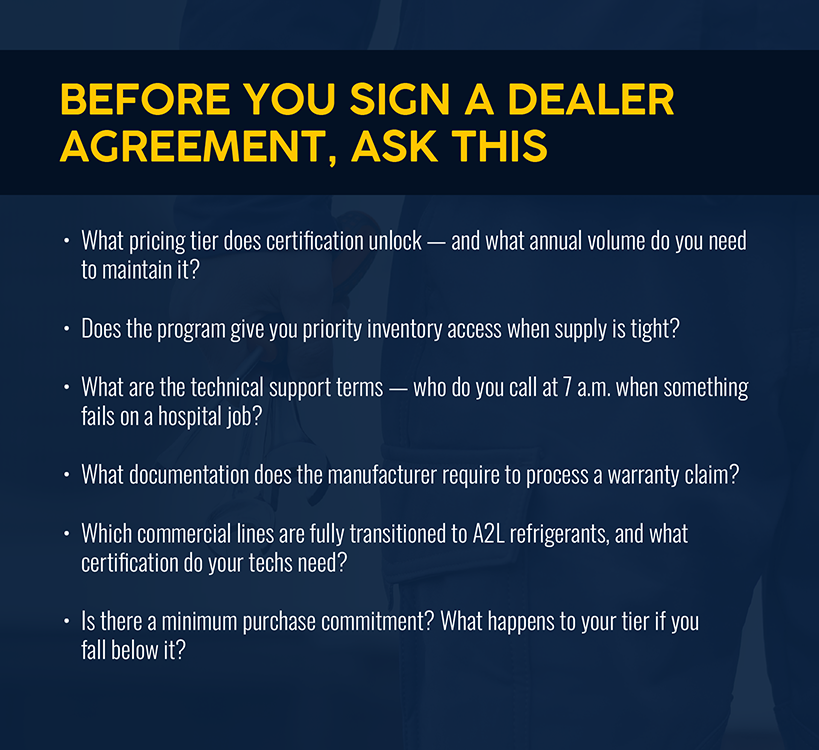
Before committing account volume to any manufacturer platform or distributor relationship, evaluate four things.
Dealer program and certification requirements. Major commercial manufacturers run authorized dealer programs with pricing tiers, warranty benefits, and priority inventory access. Getting certified takes time and sometimes requires volume commitments. The payoff is access to preferred stock and technical support, which is worth pursuing before peak demand hits.
Parts availability and lead times. On a commercial service contract covering a hospital or data center, equipment downtime means penalty exposure and client friction. Know your distributor's actual stock position on the lines you run most. A distributor quoting a three-week lead time on a commonly needed compressor is a liability you absorb every time you bid a contract with response-time guarantees.
Refrigerant transition status. As of January 1, 2025, new R-410A equipment is no longer manufactured. Any commercial work you're bidding now uses the A2L refrigerants R-454B or R-32. Confirm which manufacturer lines are fully transitioned and that your installers have A2L-compatible tools and current certification before specifying equipment. R-454B pricing has moved substantially since the transition; build that into material costs.
Warranty documentation requirements. Manufacturer warranties on commercial HVAC systems require documented proof of qualified maintenance. Before establishing a manufacturer partnership, understand their claim submission process: what technician sign-off is required, what service records they want, and how claims are filed. Most missed warranty claims come down to documentation, not workmanship. The maintenance got done; the paperwork didn't.
With those criteria in place, here's a working reference to the manufacturers and suppliers you're most likely to encounter.
Related: Standardize and upgrade your bidding with this free HVAC bid template.
Top Commercial HVAC Manufacturers and Suppliers to Know
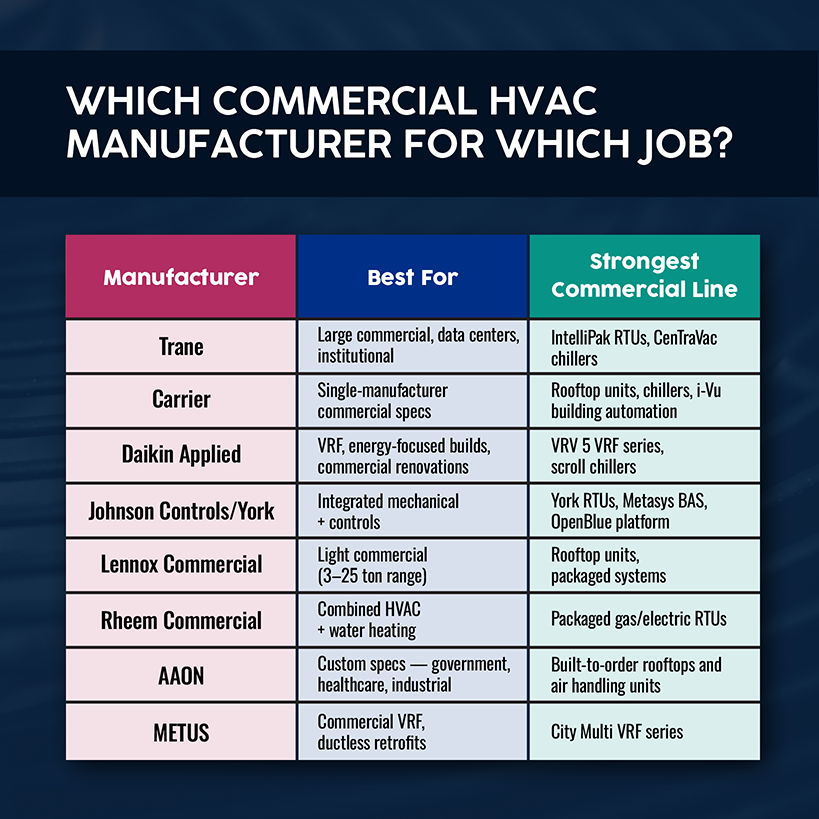
The eight manufacturers and four distributors below represent the primary players for commercial contracting work in North America. This is a contractor-facing breakdown of who does what and where each fits in your sourcing strategy. It’s not a manufacturer directory.
1. Carrier: Best for Broad Commercial HVAC Product Coverage
Carrier has one of the widest product ranges in the North American commercial HVAC market, with rooftop units, chillers, fan coils, split systems, and building automation under one manufacturer relationship. On jobs where the general contractor (GC) or building owner wants a single-manufacturer spec, Carrier has the product depth.
The i-Vu building automation platform differentiates Carrier on smart building projects. The Carrier Abound platform is gaining adoption on enterprise accounts where connected building performance is part of the contract. The full line includes Energy Star-certified options, which matter for jobs with green building or sustainability requirements.
Carrier is worth the dealer certification investment, in particular, for contractors prioritizing range over specialization in a first commercial manufacturer relationship.
2. Trane: Best for Large Commercial and Building Performance Projects
Trane leads the North American HVAC equipment market at roughly 22% share, built primarily on large commercial work. The IntelliPak rooftop unit series runs from 20 to 150 tons of capacity, covering most institutional, data center, and large office building specs. The CenTraVac centrifugal chiller line is a standard specification when energy performance is a contractual requirement.
The Symbio controls platform matters increasingly for jobs that include building automation integration in the bid. If your commercial pipeline includes hospital systems, university campuses, or data centers (where Trane is most heavily specified), dealer certification is worth the investment. The installed base follows.
3. Daikin Applied: Best for VRF, Chillers, and Energy-Efficient Commercial Systems
Daikin is the world's largest HVAC manufacturer by revenue, and its commercial applied division focuses on the more complex end of the product range: VRF systems, centrifugal and scroll chillers, and engineered air-handling units. The VRV 5 commercial VRF series offers energy-efficient performance across multi-zone commercial applications.
Daikin VRF is a strong competitive spec, particularly for commercial renovations where running new ductwork is impractical, as well as mixed-use developments that require zone-level control. For contractors targeting energy-conscious commercial clients, such as facilities managers running energy budgets or LEED-certified builds, you should understand Daikin's inverter technology and efficiency ratings, among other specifications.
4. Johnson Controls/York: Best for Integrated HVAC Equipment and Building Controls
Johnson Controls operates in building automation and HVAC manufacturing, making it a natural fit for complex commercial jobs where mechanical and controls are bid together. The York product line covers rooftop units (RTUs), chillers, fan coils, packaged equipment, and ventilation systems. Metasys BAS and the OpenBlue AI platform are widely deployed in hospitals, government buildings, and institutional facilities.
For contractors working on institutional accounts that already run Johnson Controls building infrastructure, York equipment specs naturally. Contractors that build competency in Metasys integration gain an edge in healthcare and government segments, where it's already the installed standard.
5. Lennox Commercial: Best for Light Commercial Rooftop Units and Packaged Systems
Lennox focuses on high-efficiency light commercial equipment: rooftop units, packaged systems, and split systems for retail, small office, and multi-family work. On jobs ranging from 3 to 25 tons, Lennox is a competitive option with solid distributor coverage and reasonable parts availability across most major markets.
For contractors at the boundary between residential and light commercial, including strip retail, restaurants, and office buildings under 20,000 square feet, Lennox commercial equipment is a practical first manufacturer relationship. Many units in the commercial line carry Energy Star ratings, which matters on green building specs or tenant improvement projects with efficiency requirements. For heavy commercial or industrial applications, their product line runs thinner.
6. Rheem Commercial: Best for Packaged Commercial HVAC and Water Heating
Rheem's commercial line is strongest where HVAC and water heating overlap, such as commercial water heaters and packaged gas/electric heating and cooling systems. On restaurant, hospitality, and light industrial jobs where a single manufacturer covers both applications, Rheem can simplify warranty management and distributor relationships.
Rheem commercial RTUs run through wholesale distributors and are available through most major supply houses. The gas-fired RTU lineup is a strong fit when efficient heating and cooling capacity are priority specifications. For light commercial work with a combined HVAC and water heat scope, Rheem is a practical single-source option. The product range is limited for large mechanical contracts.
7. AAON: Best for Custom Commercial and Industrial HVAC Equipment
Oklahoma-based AAON builds commercial and industrial HVAC equipment to order. The product line covers RTUs, air handling units, condensing units, and outdoor mechanical rooms, all designed to custom performance specifications rather than catalog-standard configurations. AAON is frequently specified on government, healthcare, education, and industrial projects where indoor air quality standards and engineering requirements exclude off-the-shelf equipment.
The tradeoff is lead time. Custom built-to-order units typically run eight to 12 weeks. Build that into your project schedule, and communicate it to the GC before the job starts, not after missing a milestone. The equipment holds up in the field, but procurement timing is not flexible.
8. Mitsubishi Electric Trane HVAC US (METUS): Best for Commercial VRF and Ductless Systems
METUS is the joint venture between Mitsubishi Electric and Trane Technologies that serves the U.S. commercial market. The City Multi VRF series is backed by Mitsubishi's VRF technology and Trane's domestic distribution network. It's the flagship commercial line and the leading VRF brand on U.S. commercial projects requiring multi-zone ductless configurations.
METUS is the spec to know on commercial renovations where infrastructure limits ducted systems, mixed-use buildings requiring independent zone control, and commercial spaces with energy-efficiency requirements. The Diamond Contractor program provides certified installers with project registration benefits, technical support priority, and warranty backing. If VRF work is part of your commercial pipeline, Diamond certification opens those conversations.
9. HVAC Distributors (HDI): Best for Contractor-Focused Wholesale HVAC Supply
HVAC Distributors is a wholesale distributor with a Mid-Atlantic footprint. It carries commercial lines from Bosch, Mitsubishi, and other manufacturers, as well as OEM parts suppliers. What you get from an established account is contractor pricing, local stock, and job site delivery on the equipment lines they carry.
Regional wholesale distributors typically handle local demand patterns better than national chains, which means better fill rates on commercial parts when supply is tight. Contractors in their footprint should establish a wholesale account before they need it.
10. HTS Engineering: Best for Built-to-Order Commercial and Industrial HVAC Distribution
HTS Engineering functions as both a distributor and a manufacturer's representative, depending on the product line, with a focus on commercial and industrial HVAC. Their differentiation is engineering HVAC solutions: custom-specified equipment for mechanical scopes where standard catalog units don't meet design requirements.
For contractors bidding complex mechanical work, including process cooling, custom air handling, or industrial applications, HTS's technical support and custom sourcing capability is worth a conversation before submitting your spec.
11. Homans Associates: Best for Regional Commercial HVAC Supply and Parts Support
Homans Associates is a Northeast-based commercial HVAC distributor representing multiple commercial equipment manufacturers, including Mitsubishi Electric. Homans’ value is regional: local inventory aligned to Northeast market demand, manufacturer technical support access, and account relationships that reflect regional specification norms.
For contractors working in New England on equipment lines with limited national distributor coverage, Homans is a key relationship to establish. Regional reps tend to have direct access to manufacturer technical support, which national distribution chains can't always match.
12. HVACDirect.com: Best for Online Commercial HVAC Equipment Sourcing
HVACDirect.com is an e-commerce platform for HVAC equipment and supplies, including commercial units from major manufacturers. The use case is narrow but legitimate: standard catalog equipment on smaller commercial jobs where price and delivery logistics are primary, rather than technical support or account relationships.
Use this site for transactional procurement where the spec is already settled. It's not a substitute for a distributor relationship, which you’ll still need for service contracts and large installation projects that depend on availability, technical support, and warranty accountability.
Manufacturer vs. Supplier: Which Should Contractors Work With?
In short, work with manufacturers and suppliers, depending on the purpose. Treating them as interchangeable is where the margin starts slipping.
Manufacturer relationships, specifically authorized dealer programs, matter most on large commercial work where warranty documentation, pricing tiers, and technical support are part of how you win and execute jobs. Trane dealer status helps with data center bids. Daikin VRF certification helps with renovation specs. METUS Diamond certification opens hospital accounts that require documented installer qualification.
Distributor relationships matter in daily operations: parts procurement, job-site delivery, and account pricing on volume commercial work. A strong local distributor relationship has more day-to-day operational impact than most manufacturer programs, as it's the distributor who determines when — or if — your tech receives crucial parts. Commercial customers on service contracts aren't typically patient when it comes to delays.
The contractors that lose margin consistently on commercial work tend to treat procurement as transactional, shopping around by job rather than building long-term supplier relationships with predictable pricing, availability, and support. Account volume creates leverage you can’t get by negotiating every purchase.
Related: How to run a successful HVAC business — operations, margins, and the back-office systems that hold commercial work together.
The Operations Side of Managing Manufacturers, Suppliers, and Jobs
Choosing the right commercial HVAC manufacturers and suppliers is only the first step. What determines profitability is having the operational infrastructure to track what you're using, what it costs, and whether jobs are performing as you priced them.
Consider a commercial job that draws from three manufacturer lines and two distributors. There’s a mix of warranty-covered and non-warranty equipment, a phased billing schedule, and a maintenance contract running alongside installation. The administrative load compounds fast.
Miss a warranty documentation step, and you absorb the repair. Fail to track a parts run, and it disappears from job cost. Schedule a crew on a multi-phase install without building in equipment lead time, and you eat the delay.
Simpro® is service software built for HVAC businesses running commercial work at this level of complexity. Job costing tracks actual labor hours against estimates in real time, so margin erosion shows up while there's still a job to fix it on. Inventory management follows parts across jobs and vehicles with low-stock alerts before shortages reach the field. Digital forms with signature capture produce the documented service records required for commercial manufacturer warranty claims. The Maintenance Planner automates recurring service scheduling so contract revenue doesn't fall through the cracks.
More than 24,000 businesses run their operations on Simpro. The contractors that consistently grow their HVAC business without adding administrative overhead are those whose back office matches the complexity of their commercial work.
If your supplier relationships are solid and your operations aren't keeping up, that's the next thing to fix. Schedule a demo to see how Simpro handles it.


 Back to top