
Finding the best HVAC job management software often starts from a place of urgency. One quarter, you're managing eight technicians on a spreadsheet. The next quarter, you've got 14 techs, 200 open jobs, three service agreements you forgot to invoice, and a dispatch board that's more guesswork than system.
That's when HVAC contractors start taking this search seriously.
The software platforms that get you to $1 million in revenue aren't the ones that get you to $5 million. Two platforms can claim to handle scheduling, mobile functionality, job costing, and accounting integration, yet perform very differently when it counts.
That gap is especially wide in HVAC field service software. A platform that's easy to set up for a three-tech residential operation will hit the wall when you're running 15 technicians across commercial and service work, managing inventory across multiple trucks, and trying to monitor job-specific margin. What matters is how each platform handles complexity, no matter what the marketing copy says.
Signs You’ve Outgrown Your Current HVAC Software
Before evaluating platforms, it's worth knowing whether your problems are grounded in software or processes. Sometimes, it's both. Either way, you need to determine the shortcomings before implementing a new platform.
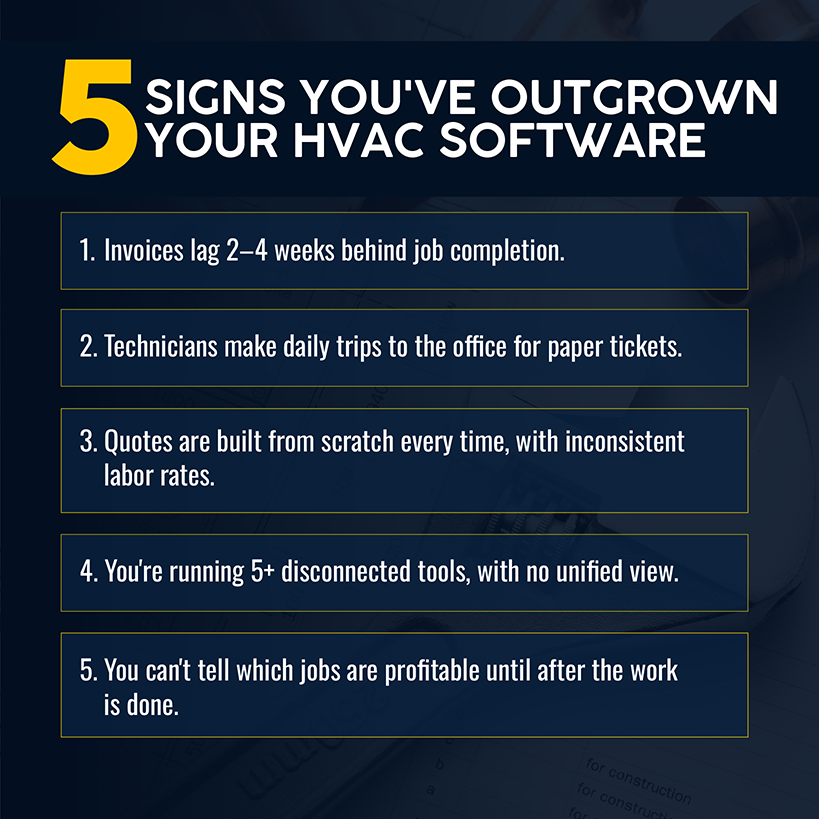
Here are some of the common signs you need new HVAC software:
- Invoicing lags 2–4 weeks behind job completion.
- HVAC technicians make daily trips to the office to pick up paper tickets.
- Quoting is inconsistent because estimates are built from scratch, and labor rates vary by person.
- You're not sure which jobs are actually profitable until after the work is done.
- You're running 5+ disconnected tools (including scheduling, invoicing, accounting, CRM, inventory) without a unified view of the business.
The right software makes a big difference for mid-market contractors. Top-performing shops complete significantly more service calls per technician, per day, than average operations. First-time fix rates are much higher for best-in-class businesses. And even modest improvements in either metric translate directly into recovered revenue per tech.
The platform you choose should close those gaps.
Related: Why HVAC businesses need AI-ready operations.
Best HVAC Job Management Software at a Glance
| Tool | Best For | Pricing Model | Notable Limitation |
|---|---|---|---|
| Simpro® | Mid-market & growth-stage contractors ($1M–$20M), commercial HVAC, multi-crew operations | Priced for your workflow | Implementation complexity; plan for a structured onboarding |
| BuildOps | Commercial HVAC, large project management, multi-site service agreements | Custom quote | Not designed for residential service operations |
| Jobber | Small and midsize businesses under $2M, residential-focused | From $49/mo | Limited job-costing depth; not built for commercial complexity |
| Housecall Pro | Solo to 5-tech residential operations, paper-to-digital transition | From $59/mo | Doesn't support complex job costing or multisite commercial work |
| FieldEdge | QuickBooks-dependent operations, businesses of all sizes | Tiered pricing | Fewer native integrations outside QuickBooks |
| Zoho FSM | Small and midsize businesses wanting CRM-native field service tools | Limited free plan; from $25/user/mo | Requires configuration work; less trade-specific depth out of the box |
| Service Fusion | Growing HVAC businesses (10–50 technicians) scaling headcount without per-user fee increases | Tiered pricing | Less depth in job costing and reporting than enterprise-tier platforms |
1. Simpro
Best for: Mid-market and growth-stage HVAC contractors managing complex workflows across service, projects, and maintenance. In particular, it’s designed for commercial HVAC, multisite operations, and businesses running multiple crews who need real job costing.
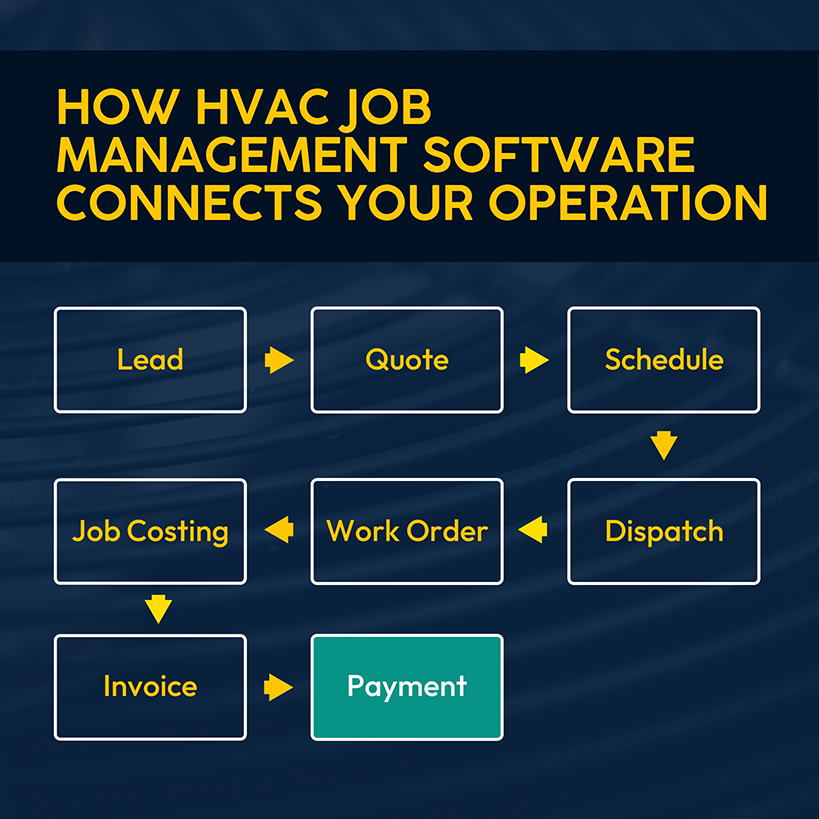
Simpro is a purpose-built, cloud-based field service management platform designed for trade contractors in HVAC, electrical, plumbing, and security. It covers the full job life cycle — lead to invoice — with particular depth in quoting and estimating, job costing, preventative maintenance management, and inventory control. It's the platform built for contractors who've outgrown basic scheduling tools and need a single operational system that scales with them.
Key features:
- End-to-end job management: quoting, scheduling, dispatch, work orders, job costing, invoicing
- Real-time job costing against budget across labor, materials, and subcontractors during the job, not just after the invoice
- Maintenance Planner with asset tracking, pipeline visibility, and recurring invoice automation
- Inventory management with purchase orders, vendor pricing comparison, and low-stock alerts across multiple trucks or warehouses
- Digital Forms with conditional logic for field compliance
- Business reporting: profit/loss by job, work-in-progress reports, technician activity, cash flow forecasting
- GPS fleet tracking (Simtrac add-on)
- Multi-company and multi-location support
- Native accounting sync with QuickBooks, Xero, Sage, and MYOB
- Full feature list
Related: See how Simpro handles HVAC operations end to end.
Pricing: Custom-quoted based on specific workflows. Explore pricing options.
Real-world results: TEAMWired, an electrical and HVAC contractor, cut quoting time from two hours to 30 minutes after implementing Simpro. Invoice generation dropped from 30 days post-job to as few as two days. Office invoicing time fell by 90%. Technicians moved from daily paper ticket pickups to digital dispatch — and completed twice the jobs per day. The company saw 65% revenue growth and doubled its technician team.
2. BuildOps
Best for: Commercial HVAC contractors managing large-scale projects, multisite service agreements, subcontractor coordination, and high-complexity job costing.
BuildOps is purpose-built for commercial HVAC and mechanical contractors (but not residential). Its architecture supports construction-service hybrid workflows, detailed asset tracking, contract-based service agreements, and multisite coordination. If your primary revenue comes from commercial clients with long-term maintenance contracts and complex jobsite logistics, BuildOps is built for you.
Key features:
- Commercial job costing with multiphase project management
- Service agreement and preventive maintenance management
- Subcontractor coordination tools
- Asset tracking across client sites
- Real-time job monitoring and field reporting
Pricing: Contact BuildOps for a quote based on team size and workflow requirements.
Notable limitations: Not designed for residential service operations. If your business is a mix of residential and commercial, BuildOps' architecture may require workarounds for the residential side of the operation.
3. Jobber
Best for: Small and midsize HVAC businesses — those typically under $2 million revenue with 1–10 technicians — that prioritize ease of use, clean client communication, and fast setup.
Jobber is consistently rated as the most user-friendly HVAC management software for smaller business operations. It handles scheduling, invoicing, client communication, and online payments with a clean interface and low training burden. Strong for residential service businesses managing straightforward work orders.
The tradeoff is depth: Jobber doesn't offer real-time job costing, and commercial project management isn't its strong suit. For contractors looking to move off spreadsheets or paper-based systems, it's an accessible starting point that eliminates a significant amount of manual data entry from day-to-day operations.
Related: For guidance on building accurate job quotes before you even pick a platform, see Simpro's guide to bidding HVAC jobs.
Key features:
- Drag-and-drop scheduling
- Client hub portal for online booking and communication
- Automated quote follow-ups and job reminders
- Online payments via Stripe and credit card
- QuickBooks and Stripe integrations
- Mobile technician app
Pricing (individuals): Core: $49/mo. Connect: $129/mo. Grow: $199/mo.
Notable limitations: Doesn’t include real-time actual vs. estimated cost tracking at the job level. As job complexity grows and technician count expands past 10, most Jobber users report needing to switch platforms.
4. Housecall Pro
Best for: Solo to 5-technician residential HVAC businesses making the transition from paper or spreadsheets to a digital platform.
Housecall Pro's mobile-first design, automated customer notifications (job reminders, review requests, satisfaction surveys), and intuitive drag-and-drop scheduler make it accessible with minimal training. Customer communication is handled through automated texts and emails triggered at each job stage, which keeps customer satisfaction high without adding manual work. Technicians manage their day entirely from mobile devices — accepting jobs, updating status, collecting signatures, and processing payments in the field.
It's the right tool for a business that's outgrown text messages and whiteboards. The limitations become visible when jobs get more complex. It’s more residential-focused, and its reporting doesn't provide the margin visibility that growth-stage contractors need.
Related: For a deeper look at HVAC pricing that works before you scale, see Simpro's guide on pricing HVAC jobs.
Key features:
- Drag-and-drop scheduling and mobile dispatch
- Automated customer reminders and follow-up sequences
- Integrated payment processing
- Review management tools
- Basic reporting and job history
Pricing: Basic: $59/mo (1 user). Essentials: $149/mo. Max: $299/mo.
Notable limitations: Doesn’t include inventory management across multiple trucks or warehouses. Weaker on commercial project management.
5. FieldEdge
Best for: HVAC businesses of all sizes with a heavy reliance on QuickBooks and needing best-in-class accounting integration alongside strong field service tools.
FieldEdge's primary competitive advantage is its native, two-way QuickBooks integration, which is considered the strongest in the category. Real-time GPS technician tracking and a solid mobile app round out the core toolset.
For HVAC companies that run accounting through QuickBooks, FieldEdge eliminates the disconnects between the job site and the books that cause billing delays and reconciliation headaches.
Key features:
- Real-time dispatching with GPS fleet tracking
- Native two-way QuickBooks integration (Desktop and Online)
- Service agreement and maintenance contract management
- In-field quoting and customer history
- Comprehensive equipment tracking and service history
Pricing: Tiered pricing, requires a consultation.
Notable limitations: Integration depth outside of QuickBooks is narrower than platforms like Simpro, which also connects natively to Xero, Sage, and MYOB.
Related: Manage your people with Simpro's workforce tools
6. Zoho FSM
Best for: Small and midsize HVAC businesses already using Zoho's customer management relationship (CRM) system. Also good for business suites that want field service tools within a connected ecosystem.
Zoho FSM is part of Zoho's broader business platform, which includes CRM, analytics, a helpdesk, and project management. For contractors already using Zoho's suite, the native integration across those tools is a practical advantage. The field service module covers scheduling, work orders, mobile technician tools, and basic reporting.
The tradeoff is trade-specific depth — Zoho FSM isn't purpose-built for HVAC, so workflows around job costing and inventory management will require configuration and potentially third-party tools.
Key features:
- Scheduling, dispatch, and work order management
- Mobile app for technicians with job details and customer history
- Asset tracking and service history
- Native integration with Zoho CRM and Zoho Analytics
- Basic reporting and customer portal
Pricing: From $25/user/mo. Free trial available, as well as a limited free plan.
Notable limitations: Doesn’t come with trade-specific features such as real-time job costing or pricebooks with labor and materials. Requires configuration to replicate the operational depth available in purpose-built trade platforms.
7. Service Fusion
Best for: Growing HVAC businesses with 10–50 technicians that want a feature-rich platform with flat-rate, unlimited-user pricing.
Service Fusion's primary differentiator is its pricing model. Most FSM platforms charge per user or per technician, which means software costs scale linearly with headcount. Service Fusion charges a flat monthly rate regardless of how many users are on the system — a meaningful advantage for businesses actively adding technicians.
The platform covers the core FSM workflows: scheduling, GPS fleet tracking, invoicing, inventory management, and customer management, plus a built-in VoIP phone system that eliminates a separate communications tool.
Key features:
- Scheduling and dispatching with a drag-and-drop interface
- GPS fleet tracking
- Inventory management
- Integrated VoIP phone system
- Customer portal for self-service booking
- Invoicing and payment processing
- Flat-rate, unlimited-user pricing across all tiers
Pricing: Three tiers; prices aren’t publicly listed but include unlimited users.
Notable limitations: Job costing and reporting depth are lighter than platforms like Simpro or BuildOps. For contractors whose primary need is cost control and margin visibility at the job level, Service Fusion's reporting may not provide enough granularity as operations scale past 30–40 technicians.
Features to Look for in HVAC Job Management Software
Not all field service software is built the same way. The features that matter at five technicians aren't always what matter at 20. Here's how to prioritize based on your business today and where you hope to go.
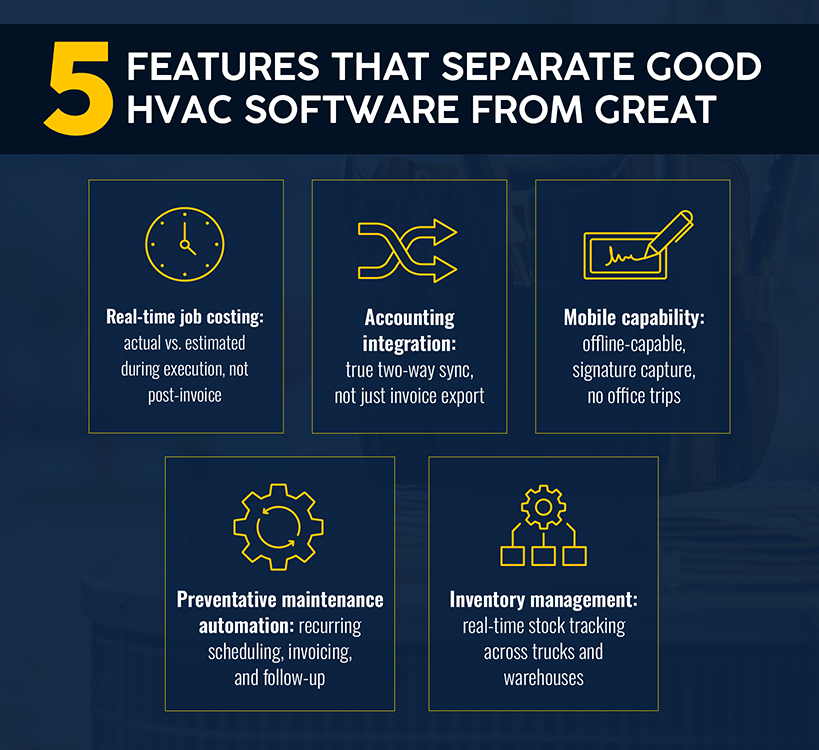
Real-time job costing is the single highest ROI capability for contractors above $1 million in revenue. Knowing labor, materials, and margin per job during the job rather than post-invoice is what enables businesses to price confidently. Look for actual vs. estimated cost tracking that updates as hours are logged and materials are used.
Accounting integration depth matters more than accounting integration count. Most platforms offer QuickBooks integration. Few deliver true two-way sync that handles job-level cost data, payroll, and tax, not just invoice totals. Get specific: Does the integration push job-cost data or just final invoices?
Related: Explore Simpro's job management software features.
Mobile capability is a first-class feature, not an afterthought. If the mobile app requires constant connectivity, can't capture digital signatures, or isn't intuitive enough for field crews to use without training, adoption will fail. Look for an offline-capable mobile app. Test it before you commit.
Preventative maintenance automation determines recurring revenue. Contractors benchmarking at $1 million should be targeting 300+ active service-plan memberships. Managing that volume requires software that can automate scheduling, trigger customer follow-ups, and generate recurring invoices without manual intervention. Otherwise, maintenance agreements become a scheduling headache, and customer service suffers when follow-ups fall through the cracks.
Inventory management across trucks and warehouses is where midsize HVAC operations bleed margin without realizing it. Look for platforms with real-time stock tracking, purchase orders, and low-stock alerts across multiple vehicles and locations. These features prevent the two most expensive outcomes: materials leaving the job without being billed, and technicians visiting a supplier mid-job because the truck wasn't stocked correctly.
Related: Key features to look for in job management software
Choose the Right HVAC Job Management Software
The question facing most contractors isn't, "Which software has the best features?" Rather, they’re asking, “Which platform will still be the right fit in three years, when the team is bigger and the jobs are more complex?"
Entry-level tools get you digitized. Purpose-built platforms get you the data to bid accurately, manage margins in real time, stay organized across dozens of concurrent jobs, build a maintenance revenue base, and know which service lines are worth expanding.
For a broader cross-trade shortlist, use the field service management software comparison guide after you narrow the HVAC-specific requirements.
Real-world results: Blue Flame Heating Solutions, a UK-based HVAC company with 86 employees and £6 million in revenue, uses Simpro to manage over 28,000 jobs per year. Their assessment: "For the first time ever, we've been able to look at the work and see how much it actually cost us, which is massive in terms of profit."
Simpro is purpose-built for trade contractors who've outgrown basic scheduling tools and need an operational platform with genuine depth in job costing, project management, preventative maintenance, and inventory control. Over 24,000 businesses use Simpro to run tighter, more profitable operations.
Schedule a demo to see how Simpro fits your HVAC operation.


 Back to top