
Quick Answer: HVAC companies can use AI to save time, win more work, and grow by applying it to the highest-friction points in the job life cycle: lead capture, scheduling, route optimization, estimating, predictive maintenance, diagnostics, customer follow-up, reporting, and marketing. According to Simpro's 2025 Trades Outlook Report, 69% of trade business owners say AI's biggest impact is in workflow optimization — reducing technician downtime, improving routing, and increasing job completion rates. The fastest ROI typically comes from platform-native AI built into your field service management software, where tools can access real job data rather than generic benchmarks.
HVAC margins sit between 5–12% for most contractors. But that shrinks whenever you have a poorly routed technician, a missed part, or an unnecessary return visit. Every HVAC business wants better workflows, systems, and technologies for organizing techs, parts, and jobs.
And while AI for HVAC has generated considerable noise over the past few years, the focus has largely been on energy efficiency and smart equipment — topics aimed at building owners, rather than contractors.
This article covers nine specific ways that HVAC companies are using AI tools to tighten operations through faster quoting, smarter dispatch, fewer return trips, less paperwork, and cleaner job costing. For each application, you'll see what it looks like in practice and how you can get started.
Why AI HVAC Tools Are Gaining Traction
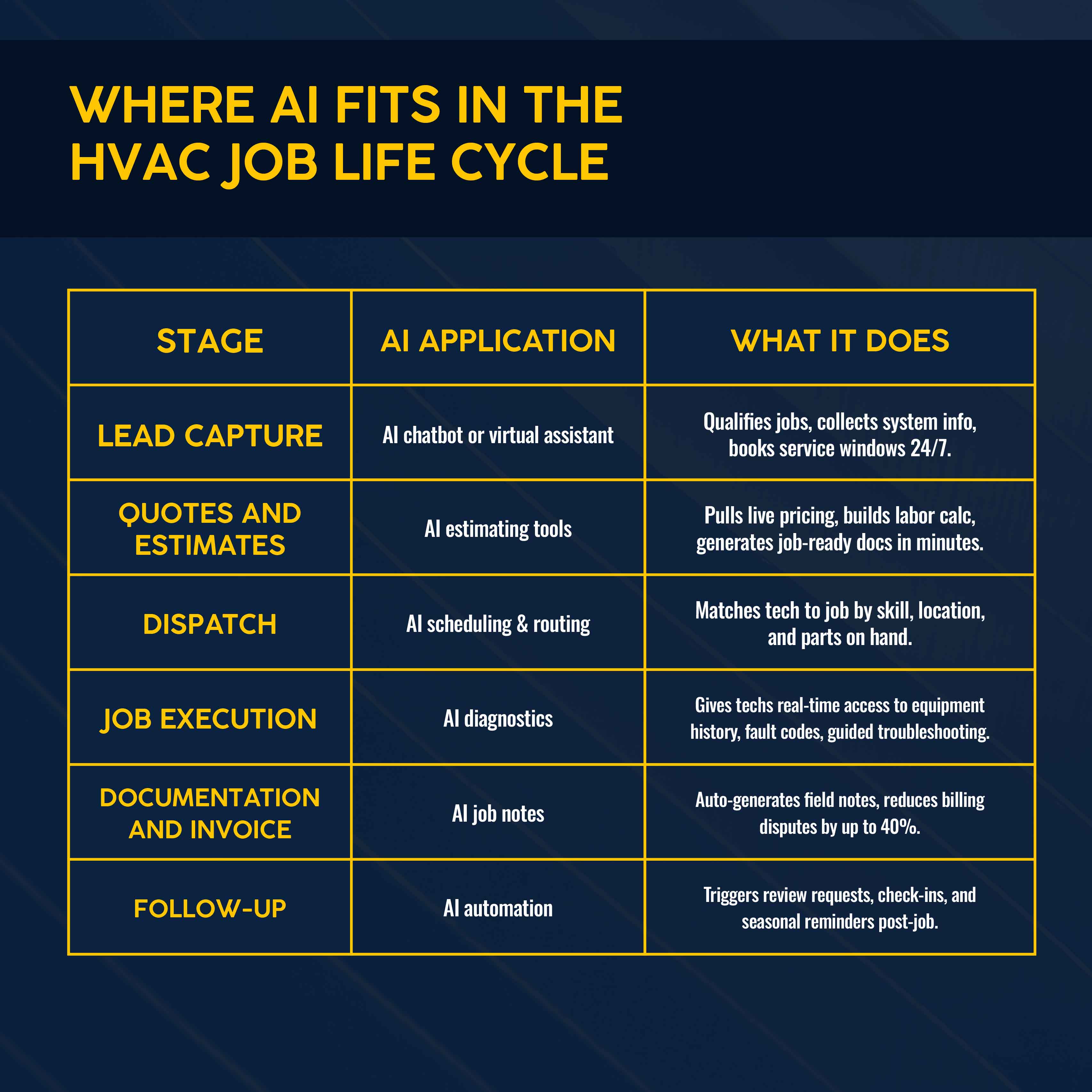
Every stage of the HVAC job life cycle carries friction that costs money. Slow quoting squanders jobs, poorly scheduled technicians lower utilization rates, return visits erode margin, and paper-based documentation creates billing disputes. That's where artificial intelligence (AI) comes in, working alongside humans while compressing time per task and reducing errors that generate rework.
The Simpro® 2025 Trades Outlook Report, surveying nearly 600 trade businesses, found that 69% of owners see AI's most significant impact in workflow optimization: reducing technician downtime, improving routing efficiency, and increasing job completion rates. That said, many businesses have yet to fully take advantage of AI — or integrate all the disconnected tools they're currently juggling. That gap can be your near-term competitive advantage.
Related: Find out why HVAC businesses need AI in their operations.
9 Practical Ways HVAC Companies Can Use AI Tools
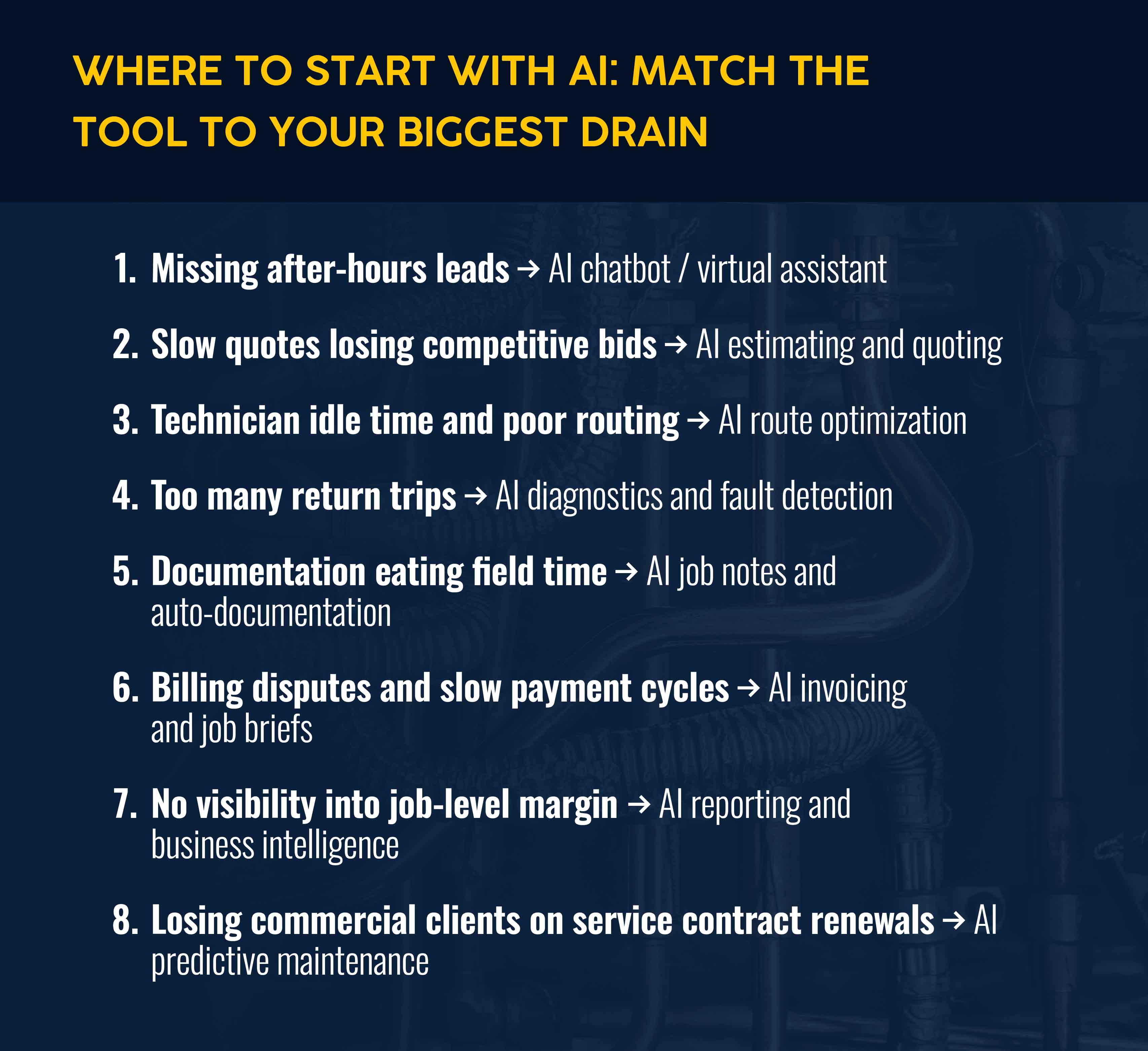
The following AI system examples for HVAC businesses illustrate the highest-friction points in the job life cycle. Most of these examples work with or alongside tools already in use by contractors.
1. Use AI Chatbots and Virtual Assistants to Capture More HVAC Leads
After-hours call volume is a persistent revenue leak. When a homeowner's AC goes down at 9 p.m. Friday, they call your number, but if they get a voicemail, they'll call the next company on Google. AI-powered chatbots can handle initial intake 24/7, qualify the job type, collect critical information, and schedule service windows without a human dispatcher.
For a residential HVAC company running 8–12 technicians, capturing two or three additional missed calls per week can generate $40,000–$90,000 in annual revenue. This revenue is out there, just waiting to be captured.
The operational fix: Deploy a chatbot that collects system type, problem description, and preferred service windows while routing urgent requests to an on-call line. Your customer service representative can review a queue of booked appointments in the morning rather than returning missed calls.
2. Use AI Scheduling and Dispatching to Send the Right Technician to the Right Job
At a certain point, you can't scale a manual dispatch system. At five people, they can match each job's technical requirements to a technician's certifications, location, availability, and parts on hand. For 20 technicians handling 50+ jobs a day, this approach becomes a rapidly compounding problem.
AI-assisted dispatching analyzes those variables simultaneously and recommends the optimal assignment, reducing mismatches without removing dispatcher judgment from the process.
The value isn't automation for its own sake. A dispatcher with better information makes better decisions faster: fewer emergency reassignments, fewer customers waiting past their HVAC service windows, and less time on the phone coordinating with techs.
The operational fix: Use dispatching software with built-in AI recommendations to automate scheduling decisions rather than managing assignments by whiteboard. You'll quickly recover the cost through more accurate job assignments and fewer missed windows.
3. Use AI Route Optimization to Reduce Drive Time and Fuel Costs
Windshield time is unpaid time. HVAC technicians can easily lose 1.5–2.5 hours per day to suboptimal routing, backtracking, traffic delays, and poor job sequencing. AI route optimization works from real-time data — traffic conditions, estimated job duration, parts pickups, and customer service windows — to sequence the day more efficiently.
How can AI route optimization impact your bottom line? Imagine an operation running 10 vans at a total of $5,000 per month in fuel. A 20% reduction in fuel costs from smarter AI routing is $12,000 per year back in the business. And that's not counting the additional jobs — and revenue — that now fit in the schedule.
The operational fix: Route optimization is a powerful tool for HVAC professionals running more than five vehicles. It's becoming non-negotiable for dispatching software to include this capability.
4. Use AI Estimating and Quoting Tools to Speed Up Sales
Manual estimating means your team is pulling catalog prices by hand, building spreadsheets of labor calculations, emailing PDFs, and chasing signatures — all during peak season. And that often means lost business, as the fastest quote that's clean and professional often wins. Slow is expensive.
AI-assisted estimating pulls in materials pricing, labor rates, and job templates automatically, reducing what used to take two hours to under 20 minutes. Customers say Simpro's estimating tools have made quote generation 10x faster, which means you don't need to increase headcount in order to handle more volume. That efficiency matters, whether you're pricing a residential equipment replacement or a multi-unit commercial maintenance contract.
Related: Learn about protecting revenue and margins with AI across the HVAC job life cycle.
The operational fix: Replace spreadsheet estimating with platform-native quoting that uses live pricing data and generates job-ready documents on submission. Speed on the front end directly improves close rate.
5. Use AI Predictive Maintenance to Move Beyond Reactive Repairs
Reactive work is the lowest-margin service category. Emergency dispatch is expensive. Parts availability is uncertain. And customers remember the disruption. AI predictive maintenance uses IoT sensors and machine learning to detect HVAC system degradation — including energy consumption anomalies — before failures occur. That transforms your role from crisis response to scheduled visits.
For contractors managing commercial accounts, you create a recurring revenue model of monthly monitoring fees, proactive parts orders, and planned service visits, along with expensive emergency calls. Already, over 30% of trade businesses say that predictive maintenance capabilities help prevent costly equipment failures and emergency service calls.
For a company managing 12–15 commercial buildings, AI can change the economics of a service contract — and give you a more defensible sales conversation than competing on hourly rate.
The operational fix: Package predictive monitoring as a tiered commercial service offering. Clients pay for uptime outcomes rather than hourly rates, which reframes the pricing conversation from a line-item cost to a performance guarantee.
6. Use AI Fault Detection and Diagnostics to Help Technicians Troubleshoot Faster
First-time fix rates are one of the cleaner indicators of operational efficiency. The lower the percentage, the more return visits you're making, which hurts margin. AI diagnostic tools give technicians real-time access to equipment history, fault code databases, and guided troubleshooting on a mobile device. Time on-site drops, while resolution rates go up.
For a company running 30 jobs per day, improving the first-time fix rate from 75% to 85% eliminates roughly three return trips daily. At $200–$300 in fully loaded cost per return visit, that's $600–$900 per day in recovered margin, or roughly $130,000–$195,000 annualized for a business that size.
The operational fix: Give technicians mobile access to service history, equipment records, and diagnostic guidance before they arrive on-site. An informed tech makes better decisions, fixes problems faster, and comes back less often.
7. Use AI to Automate Customer Follow-Ups, Reviews, and Maintenance Reminders
Retaining existing customers is far less costly than acquiring new ones. AI-automated customer communication — follow-ups, review requests, and seasonal maintenance reminders — keeps your business visible between service calls and drives repeat bookings without adding dispatcher time.
Simpro's 2025 Trades Outlook data found that nearly 80% of trade business owners identify invoicing and cash flow as critical operational priorities. Automated follow-up directly influences those areas. Customers who receive timely maintenance reminders are more likely to book an appointment in advance, rather than waiting until a crisis and enduring a worse experience.
The operational fix: Build automated post-job workflows that trigger after job completion. Initiate a review request within 24 hours, follow-up check-in at two weeks, and seasonal maintenance reminder before peak season. These run without staff involvement and generate bookings that would otherwise fall through the cracks.
8. Use AI Reporting to Understand Job Profitability and Business Performance
Blended margins hide financial problems. A company reporting 12% overall gross margin might look acceptable. But if the commercial maintenance division runs at 19%, and residential replacement comes in at 6%, suddenly that 12% isn't reassuring. Without job-level visibility, margin differential is invisible, which means lower-quality decisions about pricing and staffing.
AI-driven business intelligence automatically surfaces data at three levels: the job, the technician, and the service category. It identifies the highest-margin call types, which technicians have the highest callback rate, and which commercial clients are eroding profitability through excessive rework. The answers are already in your data. AI makes them visible without a manual report build.
The operational fix: Move beyond revenue and gross margin summaries. Track actual vs. estimated cost per job, callback rates by technician, and margin by service line. You'll make different and better decisions once you upgrade your data.
Related: AI in field service management: See how AI-driven reporting changes operational decision-making.
9. Use AI Marketing Tools to Generate Better HVAC Leads
Most HVAC marketing runs on broad targeting and periodic manual optimization: Google Ads adjusted ad hoc, seasonal campaigns built from scratch, lead volume measured in clicks. By contrast, AI marketing tools optimize ad spend in real time, identify demand patterns by season and geography, and generate ad variations at a scale that manual teams can't replicate.
For a $3 million–$5 million HVAC company spending $60,000–$100,000 annually on paid acquisition, a 15–20% improvement in cost-per-lead or lead-to-job conversion rate returns $9,000–$20,000 in efficiency. The key is connecting marketing AI to your job data so the optimization targets booked revenue rather than click volume.
The operational fix: Use AI marketing tools that integrate with your customer relationship management system and job records. You want HVAC leads that become booked jobs and get measured by completed work rather than traffic reports.
What AI HVAC Tools Should Your Business Consider?
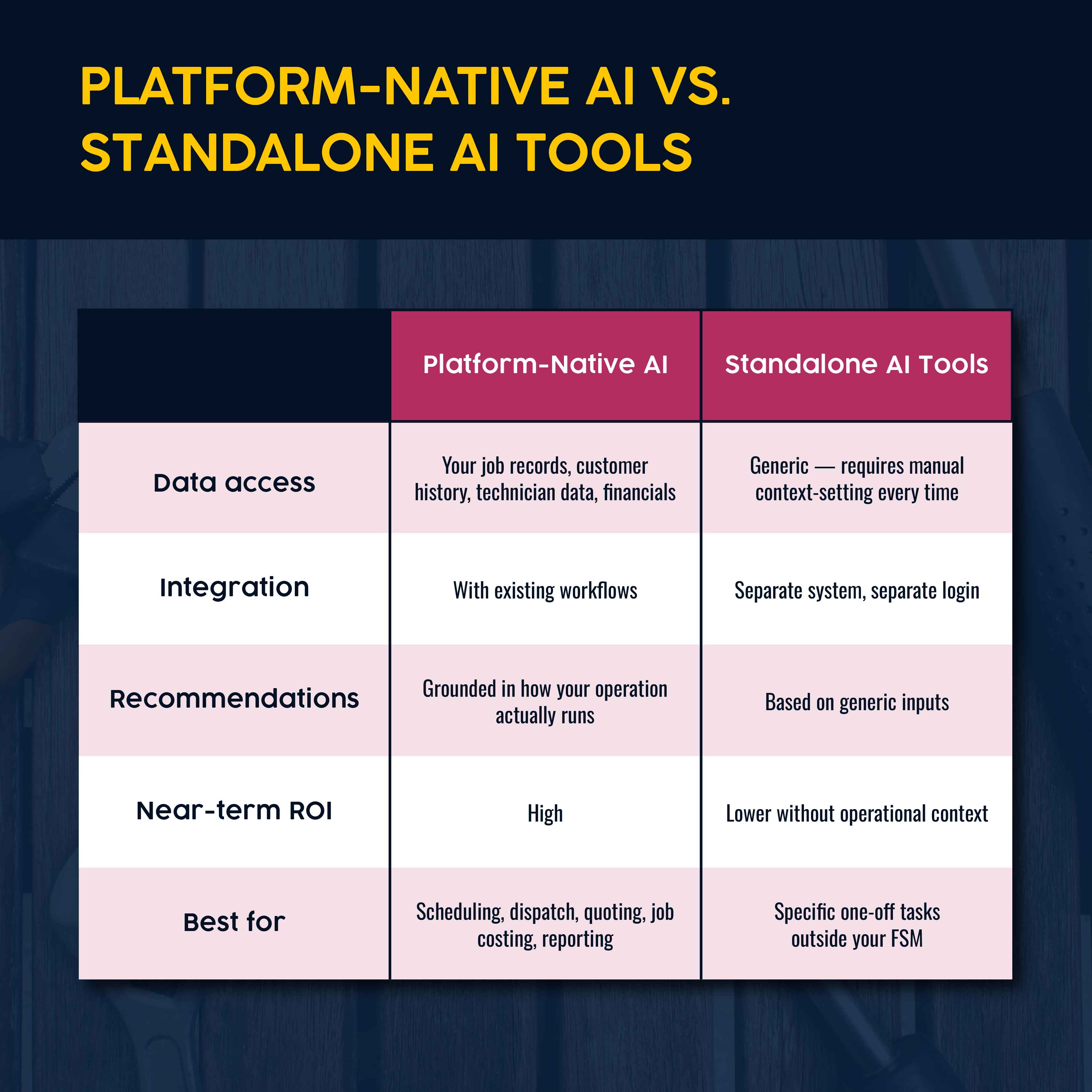
AI tools for the HVAC industry fall into two categories, and the distinction matters for where you invest.
Platform-native AI technology lives inside your field service management (FSM) software. It can access job records, customer history, technician data, and financials, so outputs are based on real-world data, not generic averages. This is the biggest near-term ROI for most growing contractors.
Standalone AI tools include generative writing assistants, standalone chatbots, and marketing automation platforms. They handle specific tasks but don't automatically connect to your operational data. They require manual context-setting and are another system to manage.
Simpro's 2025 Trades Outlook data found that the average trade business manages at least five software systems, and nearly a third have no strategy for integrating the information those systems generate. That fragmentation is the primary obstacle to getting value from AI. Before adding new tools, ask whether your existing systems can share data. AI is only as useful as the information it can access — and the best answer might be exploring AI platforms for HVAC.
How Simpro Helps HVAC Companies Use AI Across Their Operations
Simpro is a purpose-built system designed for field service trade businesses: HVAC, plumbing, electrical, and security. It covers the full job life cycle from quoting through invoicing. More than 24,000 trade businesses and 250,000+ users rely on it to manage scheduling, dispatch, job costing, inventory, and reporting from a single connected platform. Customers report an average 30% productivity increase after implementation.
Prairie HVAC/R used Simpro to move from Excel and paper forms to real-time job costing, preventive maintenance scheduling, and per-job cost tracking. The visibility changed how the company priced and managed work.
Simpro's Lightning platform, launched in 2026, introduced a suite of AI agents built specifically for field service workflows:
- FieldReady cuts technician onboarding from 12–16 weeks to days, which matters for any HVAC company dealing with turnover in a tight labor market.
- JobReady prepares dispatch-ready job packages and can raise first-time fix rates from an industry average of 75% to 90%+.
- JobScribe removes 30–60 minutes of daily documentation per technician and cuts billing disputes by up to 40%.
- JobBrief reduces payment disputes by 25–35% and accelerates payment cycles by 15–20 days.
- Cooper, the platform's AI operating layer, is a business intelligence partner that surfaces issues early, answers operational questions, and learns how your specific business operates.
Start With the HVAC Bottleneck, Then Choose the AI Tool
Your margins can't afford every AI HVAC experiment on the market. The most successful HVAC contractors start with their most costly operational problem and use AI to fix it.
Your starting point could be dispatch efficiency, quoting speed, job documentation, billing disputes, or technician idle time. Pick one to start with. The nine applications shared above are a menu, not a checklist. Tailor your response to what your operation actually needs.
If you're seeking how to use AI to grow an HVAC business at scale, consider your FSM platform. Simpro connects scheduling, quoting, job costing, inventory, and invoicing in one platform, so AI recommendations run on your actual operational data rather than generic benchmarks.
Simpro's Lightning platform is built for exactly this: an AI-first operating system for plumbing, HVAC, electrical, and other trade businesses that connects every workflow from quote to cash in a single system. More than 24,000 businesses use Simpro to run tighter operations, dispatch smarter, and close the margin gaps that manual processes leave open.
Schedule a demo to see what that looks like for a business like yours.


 Back to top