
Most plumbing jobs are won or lost in the proposal stage, long before a technician visits the site. If you’re proposing a vague scope, giving a lump-sum price, and sharing a PDF that doesn't land in the client's inbox, you’ll lose out to competitors who turn in a cleaner, clearer document.
This guide outlines when to choose proposals versus estimates and how to write proposals that address customers’ needs and win bids. Plus, we’re sharing the best plumbing estimate template for your business so you can get approvals, protect your margins, and move the job forward fast.
- Download: Plumbing Estimate Template (PDF)
- Download: Plumbing Estimate Template (Word)
- Download: Estimate Template (Excel)
The rest of this guide will walk you through the additional information needed to turn this estimate template into a professional proposal.
When Should Plumbers Use a Proposal Instead of a Quick Estimate?
Estimates give a client a ballpark figure. Proposals close a job.
For straightforward residential service calls (a leaking fixture, a blocked drain, a water heater swap), you can often give a quote by following a plumbing estimate template. But once a job involves multiple systems, a commercial client, a phased timeline, or a price above $2,500, you need a proper proposal.
Commercial property managers, general contractors (GCs), and facility managers are comparing your bid to two or three others. They're looking at the number, but they're also deciding whether your company is trustworthy and professional.
If your plumbing business is doing more than $1 million in annual revenue, the quality and speed of your proposals directly affect growth. The median contractor converts 73.9% of quotes that reach a clear decision, while the top 25% convert at 81.3%. If you move from below average (60%) to excellent (85%) conversion on $5 million in annual quoting volume, you’ll add $1.25 million in revenue — without increasing your marketing spend.
Making that leap starts with your proposal.
What to Include in a Plumbing Proposal Template
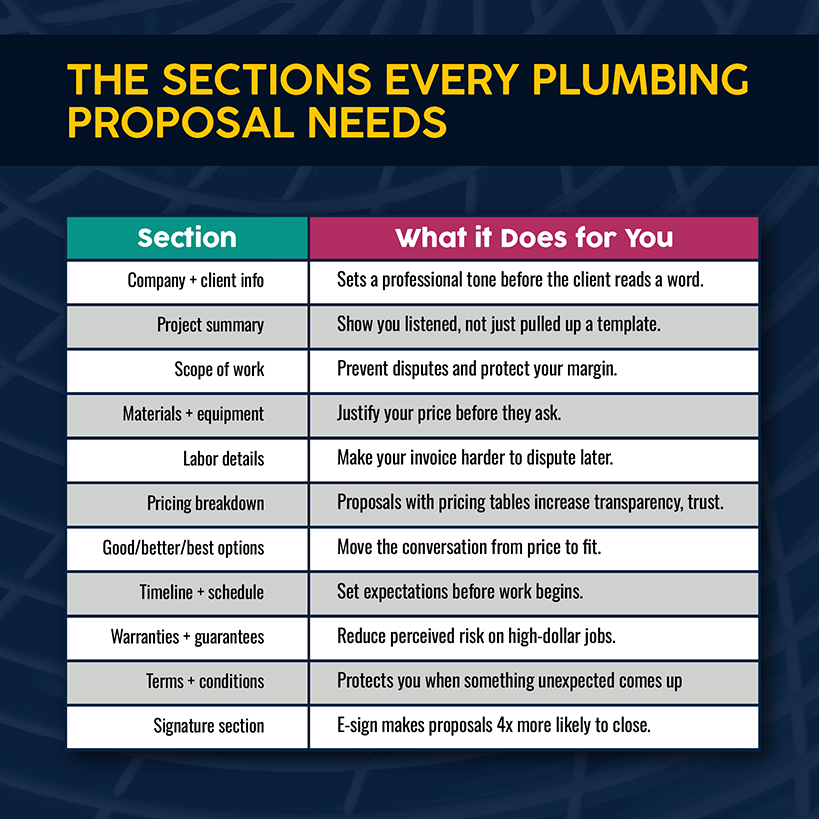
Below is the structure that works. Service proposals should be four to six pages. When bidding commercial plumbing jobs, your proposal can run to 11 pages; beyond that, win rates start to drop.
Company and Client Information
Every proposal opens with a clean header featuring your company name, logo, license number, and insurance information. On the client side, include name, job-site address, and contact information. Add a proposal number, the date of issue, and an expiration date.
The expiration date creates urgency and protects you against accepting a proposal where the pricing no longer makes sense. Set a standard 30-day expiration on residential bids. Adjust for commercial work based on project complexity and your supplier pricing windows.
Project Summary
Your summary offers two to four sentences describing the client's situation: what you observed, what the problem is, and what you're proposing to do about it. Even a brief personalized introduction signals to the client that this proposal was written for their job, not pulled from a file.
Scope of Work
The scope of work is a make-or-break section for residential and commercial proposals. This section should describe exactly what work will be performed, area by area, for the entire job.
For a residential main line replacement, specify:
- The access method (hydro jet vs. mechanical snake vs. excavation)
- The pipe sections being addressed
- How access points will be handled
- Whether the inspection will precede or follow the repair
- What happens if the camera reveals additional damage in a secondary line
For a commercial bathroom rough-in, specify:
- Fixture counts by room
- Supply and drain connection locations
- Pressure-balancing specs
- Carrier and flange specifications
- Coordination requirements with the tile or finish contractor.
Include which permits you're pulling and which inspections you're scheduling. For jobs in jurisdictions with specific code requirements, reference the applicable standard.
Explicit exclusions are just as important as inclusions. State clearly what isn’t in the proposal, such as third-party excavation, electrical connections, equipment provided by the general contractor, or permit fees. On commercial bids, a concealed conditions clause is non-negotiable.
Any pre-existing undocumented infrastructure or conditions discovered during work should constitute a change-order event, not scope creep on your dime.
Materials and Equipment
Detail exactly what materials you’ll be using. Instead of "copper pipe," specify diameter, grade, and fittings type. Instead of listing "water heater," specify the brand, capacity, energy rating, and manufacturer warranty terms. When your scope shows Watts ball valves and type-L copper versus a competitor’s generic terms, a prospect comparing bids will understand why the prices differ.
Labor Details
Make sure to separate materials and labor. Go further by breaking labor down by task when practical. For example, you should create separate line items for drain line removal and replacement, camera inspection, and fixture reinstallation. Specify crew size, any subcontracted work, and how many technicians will be on site for multi-day jobs.
This gives your customers more detail and prevents disputes that can arise when everything is included under "labor."
Pricing Breakdown
Itemized breakdowns build trust, whereas a lump sum creates doubt. Consider a client evaluating a vague $6,800 job versus one with a table showing $1,200 in materials, $3,400 in labor across four tasks, $600 in equipment rental, $180 in permit fees, and $1,420 for overhead and profit. Only one of them understands what they're paying for.
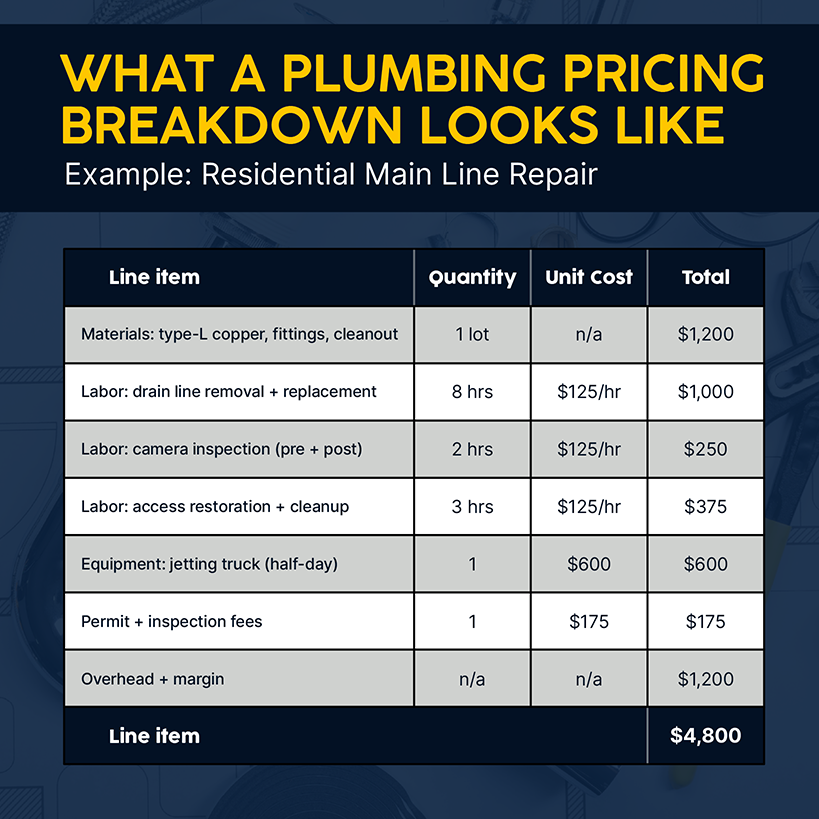
Structure your pricing table with these line categories:
- Materials (itemized by component, with quantities and unit costs)
- Labor (broken down by task or phase)
- Equipment and specialty tools (rental, jetting trucks, camera inspection)
- Subcontractor costs (clearly labeled)
- Permit and inspection fees
- Overhead and margin (naming it prevents friction)
- Subtotal, applicable taxes, and grand total
Price confidently. Underpricing to win is a common proposal mistake for growing plumbing businesses. Well-run plumbing service operations target 60–62% gross profit margin and 20–35% net; A strong proposal justifies those numbers and protects plumbing profit margins.
Optional Services and Good/Better/Best Choices
Presenting three tiers of service increases average ticket value by giving clients agency over the decision rather than forcing a yes or no on a single price. A "good" option addresses the core issue; "better" adds a related upgrade or higher-spec materials; and "best" includes a maintenance agreement, premium fixtures, or a longer warranty.
Timeline And Schedule
Clearly state your proposed start date and estimated completion. For multiphase work, break the timeline into milestones: rough-in complete, pressure test and inspection passed, fixtures installed, and final walk-through.
Include permit turnaround times, material lead times, and coordination requirements with other trades.
Warranties And Guarantees
A one-year labor warranty on workmanship is standard; some plumbing contractors offer two years on larger jobs. Distinguish between your labor warranty and manufacturer warranties on materials and equipment, and explain how manufacturer claims are processed.
Terms And Conditions
A complete terms section covers payment terms, change orders, concealed conditions, dispute resolution, and liability and insurance confirmation. For commercial plumbing work, make sure to address retention-clause handling, lien rights, liquidated damages exposure, and any bonding or insurance requirements specified by the GC. Review every commercial contract for these terms before signing.
Acceptance and Signature Section
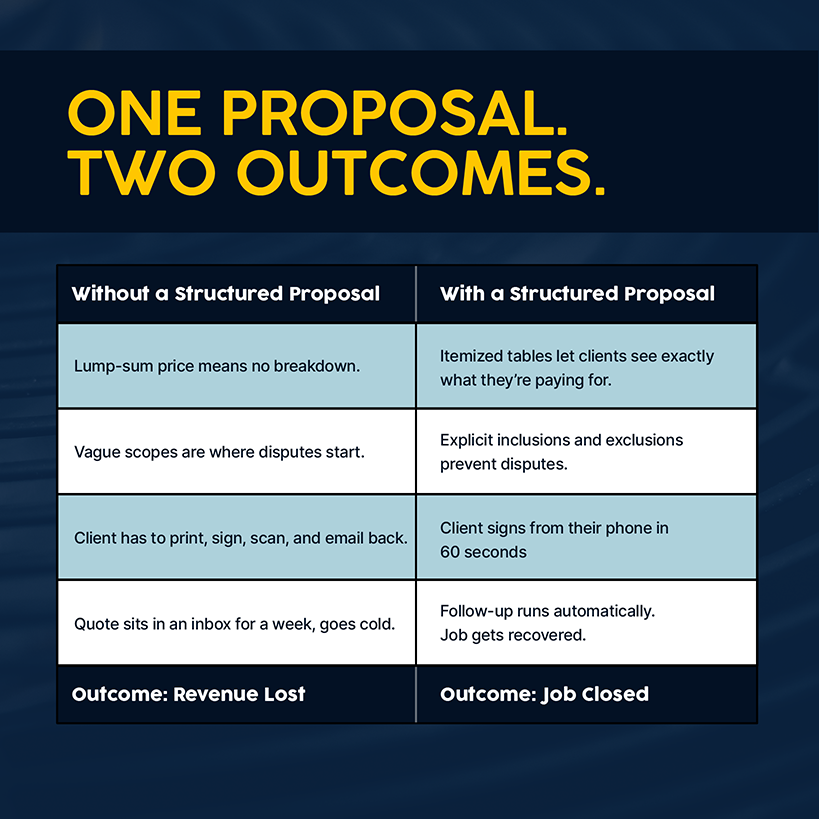
End with a clean signature block: lines for both parties, printed name fields, and date. Enable e-signatures wherever possible. Proposals with digital signature capability are 4x more likely to close and close 40% faster than those requiring physical signatures.
How To Write A Plumbing Proposal That Customers Approve
To grow a plumbing business, you need a structured proposal and bidding process. Building the right habits makes your proposal more likely to be considered and approved.
Start With the Customer's Problem
Open by describing what you observed at the site visit.
For example: "During the site visit on April 15, we found a failing wax seal at the main bathroom toilet and evidence of a slow leak at the supply connection behind the vanity. The water damage to the subfloor suggests the issue has been ongoing for 60 to 90 days."
That's a much more detailed and helpful opening than "This proposal covers plumbing repair services." One tells the client you’ve analyzed their situation and understand what they’re facing. The other tells them you have a template.
Be Specific About What's Included — and What Isn't
Disputes arise from vague language in the scope of work, labor details, and the materials and equipment list. Write your proposal not for yourself, but for someone who wasn't at the site visit. Granular detail during the proposal shows transparency, highlights your expertise, and allows for questions before work begins, not halfway through the job.
For commercial work, this level of specificity is expected of serious plumbing contractors.
Make Pricing Easy to Understand
Just as transparency matters in the scope of work, it also matters in pricing. Break down your pricing rather than offering nothing more than a lump sum. If you're including overhead in your total, say so.
When your cost structure is open and easy to understand, prospective customers are less likely to push back.
Use Plain Language
This is especially important for residential work. A homeowner doesn't need to know you're using ASTM B88 Type L copper. They need to know you're using high-quality copper pipe that’s properly rated for the water pressure in their home. Translate technical specifications into terms that answer the question they're actually asking: Will this last?
Add Proof When It Helps
No matter how persuasive your salespeople are or how good your website looks, your own claims only go so far, especially with cautious customers. A testimonial from a property manager who's been your customer for three years can be the difference between a job won and a rejected proposal. Social proof doesn’t need to be a full case study. Oftentimes, two sentences and a client name are enough.
Use a Plumbing Proposal Template to Save Time and Win Work
Most plumbing businesses can't tell you their proposal conversion rate because they don't track it. You can only improve what you can measure. Creating — and using — a plumbing proposal template is the first step.
If your team is building estimates in spreadsheets or starting from scratch on every bid, you're wasting time you could put back into the business. Simpro®'s plumbing software lets you build reusable pre-built assemblies for your most common job types, pull live supplier pricing into estimates, present good/better/best options to clients, and send proposals with online approval and e-signature built in.
Approved quotes convert directly to scheduled jobs without rekeying, version issues, or dropped follow-ups. Businesses using Simpro build estimates up to 10x faster than manual methods, which means your proposals are in inboxes while other contractors are still doing the math.
Ready to see how that works in practice? Schedule a demo with the Simpro team.


 Back to top