
Two calls come in at the same time. One is a property manager for a commercial kitchen who has no hot water. The other caller wants a ballpark price for a faucet they may never fix.
These calls are different in scope and urgency, yet most plumbing businesses route both calls the same way, then wonder why conversion is flat.
Plumbing lead scoring and evaluation fixes this problem. You assign a point value to each incoming lead based on urgency, job size, location, and intent. Your team always knows who to call back within five minutes — and who can wait.
Whether you’re experienced or looking to start a plumbing business, this guide shows how to build that system and what to do once it’s running.
What Lead Scoring Means in a Plumbing Business
Plumbing leads convert at 12% to 16% overall, on average. But without a structured lead management approach, qualified leads that don’t convert immediately will slip through the cracks. That’s where lead scoring can help you be more organized and improve your conversion rate.
The core problem is rarely insufficient lead volume from your marketing team. Rather, your sales teams probably spend time on low-quality leads that will never convert. Meanwhile, high-value, high-urgency calls wait too long for a response.
Scoring recovers that wasted time and improves your sales process, leading to more jobs and revenue.
Related: Learn from these plumbing advertising examples to improve lead generation.
5 Factors That Should Shape Every Plumbing Lead Score
1. Urgency of the Problem
Urgency is the most reliable predictor of near-term conversion for plumbing businesses. A homeowner with a burst pipe or no hot water isn’t comparison shopping. They’ll probably select whatever plumbing company answers the phone or replies to an online inquiry. These leads have a compressed decision timeline and the highest likelihood of converting.
At the same time, an emergency lead that goes uncontacted for two hours is effectively lost, no matter what the intake form says. A points-based scoring system will prioritize emergency and urgent signals, while time-based scoring rules will flag stale hot leads, allowing your team to serve real-time buying intent elsewhere.
2. Type of Plumbing Service Needed
Not all plumbing service is equal. The customer’s needs will determine job revenue, required technician skill, and the likely length of the relationship. A repipe or water heater replacement carries significantly higher revenue potential than a faucet repair. Scoring should reflect that.
One-time residential calls, for example, offer lower lifetime value (LTV) than most commercial plumbing leads, multi-unit buildings, restaurants, and office facilities. If your scoring model treats a $12,000 chiller replacement the same as a $200 faucet call, you’re leaving the important prioritization decision to chance.
3. Location and Service-Area Fit
Geographic fit isn’t just a routing concern; it’s a crucial qualifying criterion. Don’t try to get plumbing leads outside your service area, regardless of urgency or job size. If your scoring model routinely moves such leads to the sales queue, you’re wasting dispatcher time and losing money in the long run.
Service-area fit is easy to validate at intake. Add points for confirmed addresses within your radius, and filter or redirect those that don’t. For plumbing businesses with defined territories by ZIP code or neighborhood, this filter alone can eliminate 10% to 20% of low-value intake traffic.
4. Lead Behavior and Intent Signals
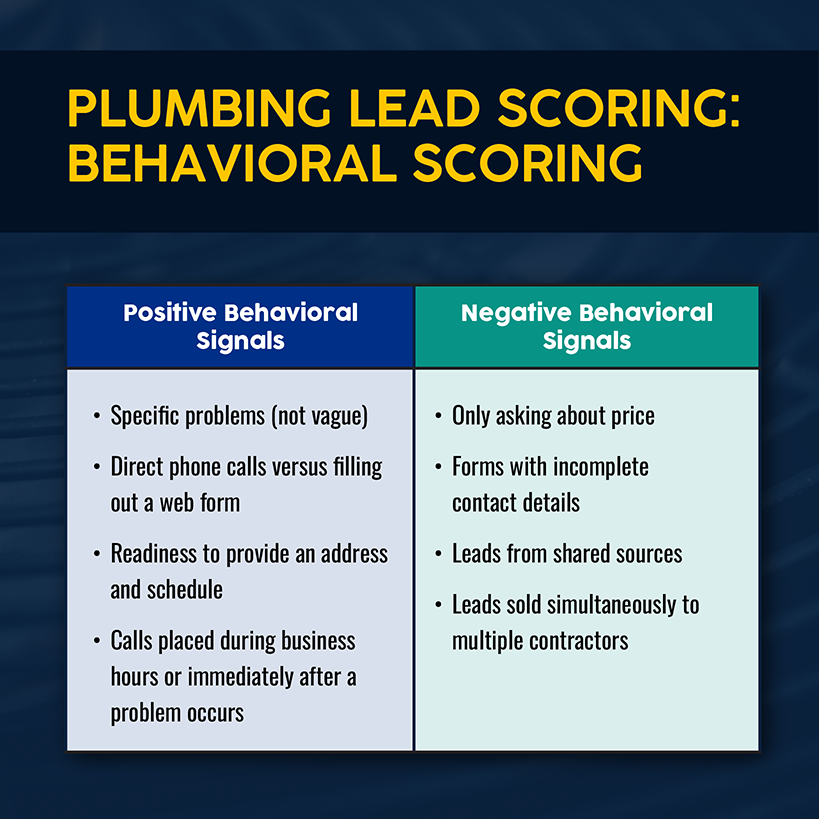
Behavioral signals reveal purchase intent beyond what demographic data captures. High-value behavioral signals for a plumbing lead include:
- Specific problems (not vague)
- Direct phone calls versus filling out a web form
- Readiness to provide an address and schedule
- Calls placed during business hours or immediately after a problem occurs
Deduct points for leads that only ask about price, submit incomplete contact details, arrive from shared lead sources, or were sold simultaneously to multiple contractors.
Negative scoring matters. Without it, your model overscores leads and fails to reduce the noise for dispatchers.
5. Revenue Potential and Customer Fit
Revenue potential looks beyond the job’s immediate value to ask a crucial question: Is this a one-time caller or a potentially recurring account? Referrals score particularly high because they arrive from a trusted source. They rarely price-shop, and they convert faster than any other source.
Property managers, commercial accounts, and existing service plan holders represent the highest long-term value for most plumbing businesses. Weight them accordingly, and pull point values from your closed-job data. Look at the last 20 or 30 jobs that came in above your average ticket. Find out what those customers had in common at intake. That pattern informs your scoring model.
How to Build a Simple Plumbing Lead Scoring Model
Regardless of company size, improve your sales readiness by developing a lead scoring model that reflects your actual data and the most important criteria.
Choose Which Criteria You Want to Score
Start with five to seven criteria, drawn from real-life customer data. Lead scoring models should cover several areas, including implicit intent signals, how they contacted you, and what they said.
The most practical starting framework for plumbing businesses includes five criteria:
- Urgency level
- Service type and job size
- Location and service-area fit
- Lead source quality
- Customer type
These map to what your intake team is already collecting, and you can easily assign point values without a complex CRM setup.
Related: See how AI in plumbing improves booking outcomes.
Assign Point Values to Each Signal
Point values should reflect your business’ historical data, not generic benchmarks. Look at your top-performing closed jobs, identify shared intake signals, and weigh those signals more heavily.
The table below illustrates a sample point framework. Calibrate the point values to your data before using them.
| Factor | Signal | Points | Notes |
|---|---|---|---|
| Urgency | Emergency (burst pipe, no hot water, flooding) | 25 pts | Shortest sales cycle; route immediately |
| Scheduled repair within 48 hrs | 15 pts | High intent; book same day | |
| Routine maintenance inquiry | 5 pts | Nurture; not urgent | |
| Service value | High-value job (repipe, water heater, commercial) | 25 pts | Higher revenue potential |
| Mid-value repair (drain clearing, fixture replacement) | 15 pts | Standard residential | |
| Low-value (faucet drip, minor leak) | 5 pts | Worth booking if capacity exists | |
| Customer type | Commercial account, referral, or existing plan holder | 20 pts | Higher LTV; lower price sensitivity |
| First-time residential caller | 5 pts | Unknown LTV; standard intake | |
| Lead source | Direct inbound call or owned-channel inquiry | 20 pts | Highest intent; converts fastest |
| High-intent organic search | 15 pts | Strong intent; fast follow-up | |
| Shared lead (sold to multiple contractors) | 5 pts | Lower conversion; more competition | |
| Location | Core service area | 10 pts | Proceed normally |
| Edge of service area | 5 pts | Evaluate against capacity | |
| Outside service area | −5 pts | Filter immediately; do not queue | |
| Negative signals | Price-only inquiry, incomplete contact info, vague problem description | −5 to −15 pts | Reduces priority; auto-route to low queue |
Table: Illustrative point framework for plumbing lead scoring. Calibrate values to your own closed-job data.
Create Score Bands for Hot, Warm, and Cold Leads
Once you have a point framework, define the following score bands that map to action triggers.
Remember that lead temperature drops over time. A 30-day-old lead isn’t warm, regardless of its original score.
| Score | Temperature | Action | Routing |
|---|---|---|---|
| 70–100 | Hot | Immediate live response | Dispatcher routes to available technician within 5 minutes. |
| 40–69 | Warm | Scheduled nurture follow-up | First contact within 24–48 hrs; re-engage at 30 and 60 days if no booking. |
| 0–39 | Cold | Automated or low-priority queue | No live dispatcher time; long-term nurture sequence; rescore if circumstances change. |
Review and Refine the Model Over Time
Plumbing lead scoring and evaluation are evolving processes. Each month, compare predicted scores against actual booking and conversion outcomes. If warm leads are converting at the same rate as hot ones, recalibrate your thresholds. If a particular lead source scores high but rarely converts, reduce its point value.
What Happens After a Lead Gets Scored?
How Hot Leads Should Be Handled
Hot leads at 70+ points need a live call, not a queue entry. Speed is the conversion variable, not a courtesy.
A MIT study found that leads contacted within 5 minutes are 21 times more likely to qualify. By contrast, the average home services business takes 6.8 hours to respond.
How Warm Leads Should Be Nurtured
Warm leads (40–69 points) have genuine intent but lack urgency. Treat them with a structured follow-up cadence. Make first contact within 24 to 48 hours, then follow up with automated re-engagement at 30 and 60 days if no booking occurs.
Use messaging that speaks to the service they asked about, rather than a generic check-in.
How Low-Priority Leads Should Be Filtered or Deprioritized
Cold leads (0–39 points) should enter automated routing rather than consuming live dispatcher time. But don’t discard them. Many cold leads reactivate when circumstances change.
The routine maintenance inquiry that scores 18 points today can become a hot lead when the water heater fails. Long-term nurture sequences preserve future value at near-zero cost.
Metrics That Show Whether Your Lead Scoring System Is Working
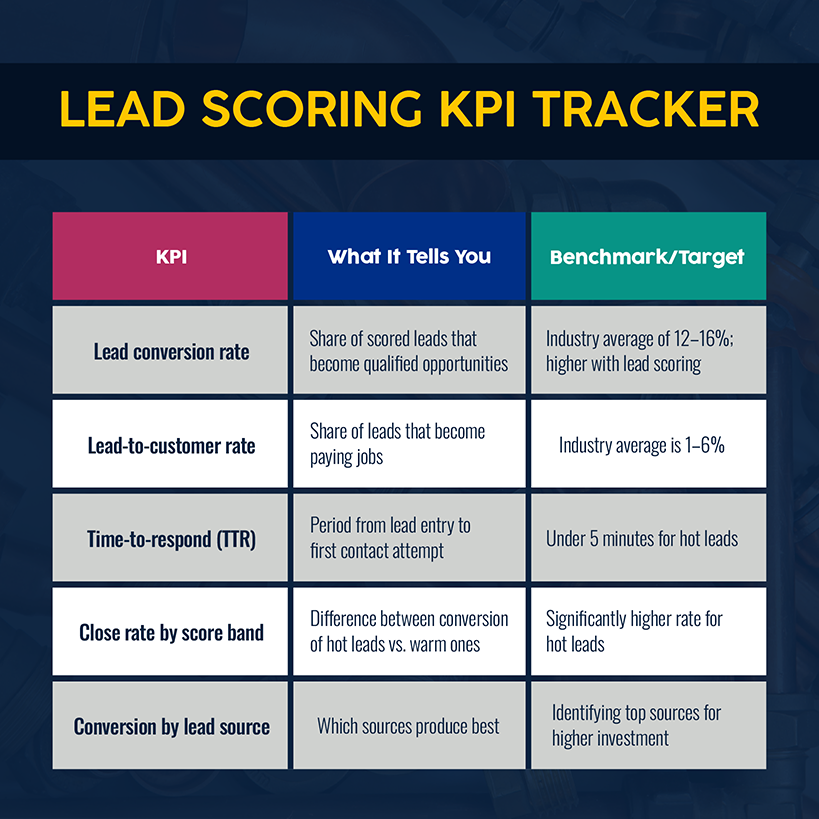
Track these key performance indicators (KPIs) on a monthly basis to evaluate whether your scoring model is correctly calibrated:
- Lead conversion rate: Share of scored leads that become qualified sales opportunities. The industry average is 12% to 16%.
- Lead-to-customer rate: The percentage of leads that become paying clients. Scoring improves this KPI by concentrating sales effort on the right leads.
- Lead generation ROI: Lead scoring can improve your return on lead generation by ensuring sales and dispatch focus on the right targets.
- Time-to-respond (TTR): Target 5 minutes or less for hot leads. The longer you take, the more likely that revenue goes to a competitor.
- Close rate by score band: Hot leads should convert at a materially higher rate than warm ones. If they don’t, recalibrate your score thresholds.
- Conversion rate by lead source: Which channels produce the best lead-to-booked-job rate? Invest more in the sources that perform.
When Software Can Improve Plumbing Lead Scoring And Evaluation
Many plumbing businesses keep their scoring model in a spreadsheet, which works until manual routing becomes a bottleneck. Your staff isn’t the problem. You don’t have the right system.
Simpro® is built for this. More than 24,000 trade businesses use it to manage quoting, scheduling, dispatch, and follow-up in one system. You need plumbing software that scores leads based on real-time signals and instantly connects with dispatch, rather than just making a note in a spreadsheet.
Related: Learn how to design websites for plumbers.
Better Lead Scoring Helps Plumbing Teams Book Better Jobs, Faster
Plumbing lead scoring and evaluation help businesses make faster, more accurate decisions. Instead of a first-in, first-out intake process, you can confidently route technicians to the best-fit, best-margin work your business needs.
You need a platform that captures those signals automatically and routes leads without manual intervention. Schedule a demo to see how Simpro helps plumbing businesses improve lead scoring, close faster, and leave less money on the table.


 Back to top