
Every HVAC company has technicians, trucks, and the same 24 hours in the day. HVAC lead scoring and evaluation is what determines whether those resources go to a $6,400 replacement job or a $180 filter call.
With HVAC lead scoring, you take control, rather than leaving that decision to whoever picks up the phone. We explore the four signals that actually predict a booked job and provide a seven-step framework for building a scoring system your dispatcher can run on a live call. Plus, we share the most common ways HVAC companies lose good leads while chasing bad ones.
What Is HVAC Lead Scoring and Evaluation?
Most HVAC companies don't have a formal lead scoring system. Instead, they have a callback queue, with a customer service representative (CSR) making key decisions. That works with low call volume and relatively similar jobs. It stops working when you're fielding 40 calls a week for emergency repairs, replacement inquiries, maintenance requests, and tire-kickers — and every one hitting the same inbox.
Lead scoring assesses and ranks each inbound contact based on factors like urgency, job value, and whether the caller is already a customer. The evaluation piece helps you capture those factors consistently and in real time for smarter routing decisions.
Related: For HVAC marketing strategies to pay off, the intake and routing side has to keep up.
Why HVAC Businesses Need Lead Scoring in the First Place
Without a scoring system, every lead gets treated roughly the same. That sounds fair, but it's expensive:
- A $150 tune-up inquiry takes the same callback time as a $12,000 system replacement.
- Emergency calls from existing service agreement customers get stuck behind cold, inbound form fills.
- Techs get dispatched 45 minutes out of their service area for jobs that could have been flagged as low-fit at intake.
- Marketing spend flows to channels like paid search, social media, and purchased lists that rarely close.
An MIT study found that calling a lead within five minutes versus 30 minutes makes you 100x more likely to reach them and 21x more likely to qualify them. Improving your conversion rates at that scale requires little more than a routing rule.
The typical HVAC operation runs referrals and shared purchased leads through the same queue. Yet referral leads convert 30% better than leads from any other channel, while shared purchased leads sold to five contractors simultaneously generate low single-digit close rates.
The Inputs That Should Shape an HVAC Lead Score
Four signals do most of the predictive work for HVAC lead quality. Evaluate every HVAC service call against these factors before it hits the dispatch queue.
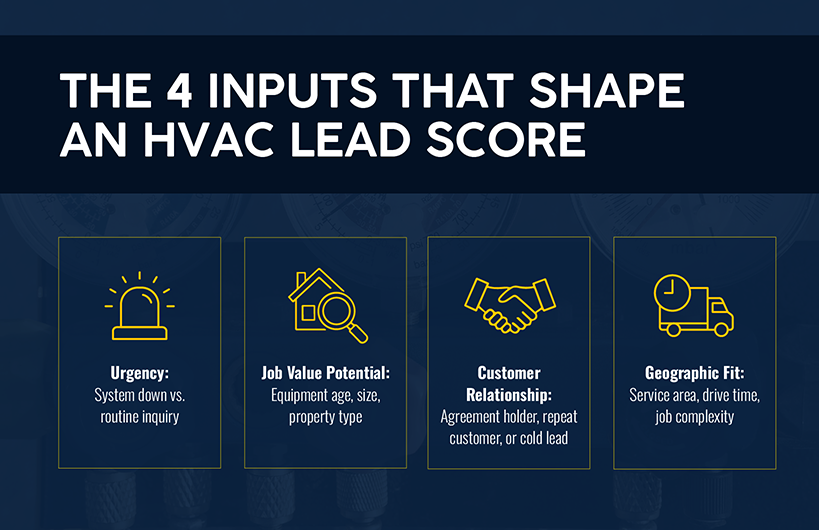
- Urgency: A system-down call in July is more important than a spring tune-up inquiry. Emergency signals should automatically push a lead to the top.
- Job value potential: Equipment age, system size, and property type indicate what a job could be worth. A 15-year-old system in a 3,000-square-foot house is a replacement conversation. A commercial property with six rooftop units can bring a service agreement, if you win it right.
- Customer relationship: An existing service agreement customer is your highest-quality qualified lead. They already trust you and pay you, and their equipment history is in your system. A repeat customer is a close second. A purchased shared lead is at the bottom.
- Geographic and logistical fit. A job 60 miles out that requires two trucks may look valuable on the surface. But the margin changes fast when you factor in drive time, fuel, and tech availability.
Why it matters: Consider a 12-truck residential operation that runs 55 calls a week but treats every inbound equally. They’re giving five-minute callbacks to a shared purchased lead for a $180 filter replacement — and a service agreement customer whose system went down in August. Instead of winning that $6,400 replacement job, the customer talks to a competitor first.
How to Build an HVAC Lead Scoring System, Step by Step
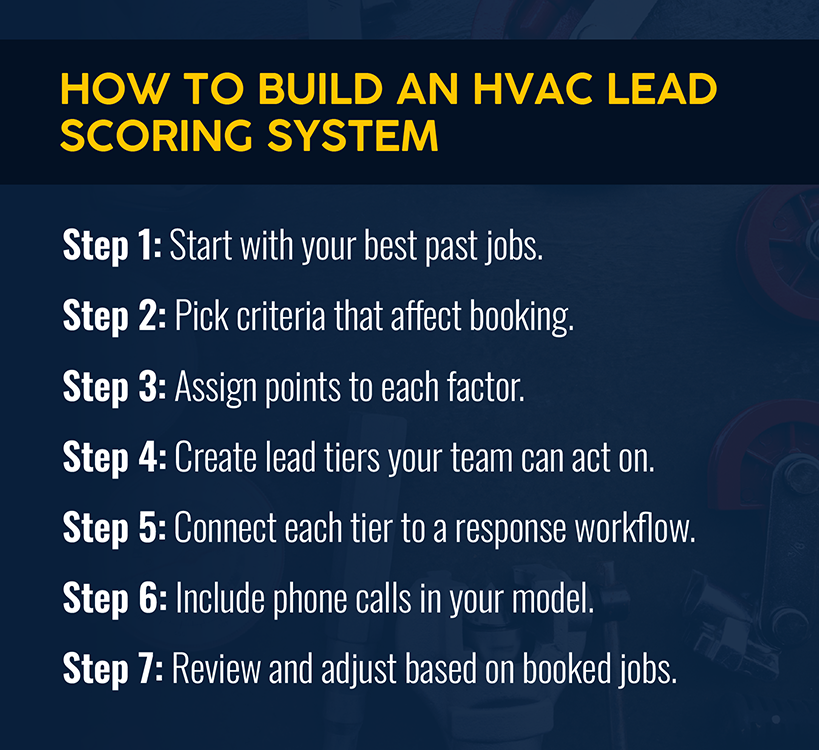
Step 1: Start with Your Best Past Jobs, Not Your Biggest Lead List
Pull your last 12 months of closed jobs. Which have the highest margins and smoothest execution, not just the highest ticket price?
This indicates what a good lead looks like before you start assigning scores. Codify what's already working rather than guessing at criteria.
Step 2: Pick the Scoring Criteria That Actually Affect Booking and Revenue
Based on your best-job analysis, identify 6–10 factors that show up consistently. A typical set for residential HVAC looks like this:
- Service type requested (emergency, replacement, maintenance, info-gathering)
- Equipment age (10+ years = high replacement probability)
- Existing customer or service agreement holder
- Property ownership (owner vs. renter)
- Location relative to your service area
- How they found you (referral, organic search, purchased lead)
For commercial work, add property size, number of units, and decision-making authority.
The operational fix: Eight to 10 factors are plenty. Too many variables on a live intake call means nothing gets scored — and you’re still treating high-quality leads the same as potential customers who aren’t ready to buy.
Step 3: Assign Points to Each Factor
Simple point values work better than complex formulas. Create a system that dispatchers can run in their heads during a call.
Here’s an example framework:
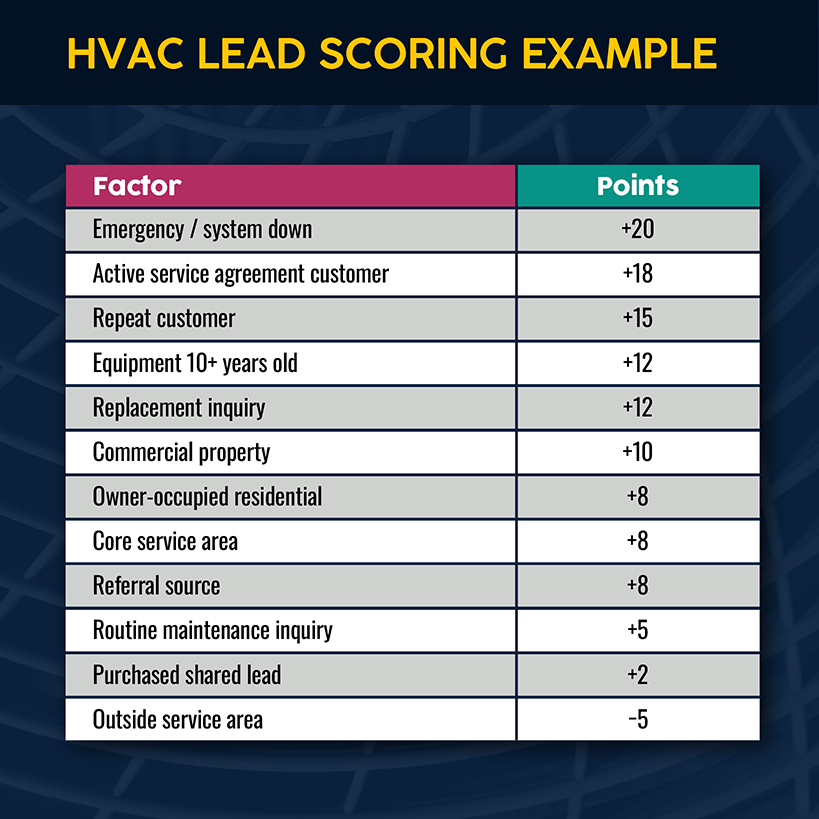
The exact numbers matter less than the relative weighting.
Step 4: Create Lead Tiers Your Team Can Act On Fast
Map your score ranges to four response tiers. Every person on your team — dispatcher, CSR, office manager — should know which tier triggers which action, without asking:
- Tier 1 (score 30+): Call back within five minutes. Dispatcher or senior CSR only.
- Tier 2 (score 15–29): Call back same day. Standard CSR queue.
- Tier 3 (score 5–14): Schedule next business day. Standard process.
- Tier 4 (below 5): Automated email acknowledgment, follow-up in 48 hours.
The tier names don't matter — what’s important is giving your team a simple HVAC lead scoring and evaluation rubric they can work with.
Step 5: Connect Each Lead Tier to a Response Workflow
Tiers without processes are just categories. Tier 1 leads need a dedicated response path, not just "call them back faster." That means defining:
- Who's responsible for the callback?
- What’s your opening line for each situation?
- Which system does the job live in?
- What happens if the first attempt doesn't reach them?
For commercial Tier 1 leads, route the callback to your senior estimator or account manager — not a general CSR. Having your sales team involved from the first call can set up a relationship worth $50,000 or more.
The operational fix: Map each tier to a named owner and a named process. If you can't answer "who calls back a Tier 1 lead at 4:45 PM on a Friday," your system has a gap — and customer satisfaction for your highest-value prospects will suffer.
Step 6: Include Phone Calls in Your Scoring Model
Most HVAC inbound leads still arrive by phone, so don’t create a digital-only scoring model. Ask these questions:
- "Is the system completely down, or is it running but not cooling or heating well?"
- "How old is the equipment? Do you happen to know?"
- "Is this your home or a rental property?"
- "Have you worked with us before, or is this your first time calling?"
Confirm their phone number and ZIP code before ending the call; both feed into your follow-up workflow.
Related: If your HVAC lead generation volume is already strong but your close rate isn't keeping pace, your ability to get more HVAC leads won’t matter.
Step 7: Review and Adjust Your Model Based on Booked Jobs
Every quarter, assess your Tier 1 and Tier 2 leads. What percentage booked? What was the average job value? Which scoring factors were present in your wins and absent from no-shows?
If commercial leads with facility managers are closing at 35% and property managers at 12%, you need a scoring adjustment.
What a Simple HVAC Lead Scoring Model Looks Like
Here's how the point framework from Step 3 plays out for a residential company handling 40–80 calls per week:
| Lead Type | Key Signals | Tier | Response |
|---|---|---|---|
| Service agreement customer, system down | Score: 38 | Tier 1 | 5-min. callback, senior CSR |
| Repeat customer, replacement, in-area | Score: 35 | Tier 1 | 5-min. callback |
| New lead, system down, owner-occupied | Score: 28 | Tier 1 | 5-min. callback |
| New lead, replacement, 12-y/o equipment | Score: 24 | Tier 2 | Same-day callback |
| Maintenance inquiry, existing customer | Score: 20 | Tier 2 | Same day |
| Tune-up request, new lead, no urgency | Score: 10 | Tier 3 | Next business day |
| Shared purchased lead, outside area | Score: 0 | Tier 4 | Automated sequence |
The right HVAC software adds the most value by automating routing and connecting lead data to job value over time. Simpro® tracks leads from first contact through quote and job creation, with job-source tracking built in so you can see which channels are producing your best customers.
Related: Can your HVAC estimating process handle Tier 1 leads at speed? That's worth examining alongside your scoring system.
Common Mistakes HVAC Companies Make with Lead Scoring and Evaluation
Most of these show up the same way: A system that looks like it’s working until you dig into the numbers.
- Scoring by call volume instead of job value. One channel generates 40 leads at 6% and produces 2.4 booked jobs. Another channel generates 12 leads at 45% and produces 5.4 — double the jobs at one-third the intake volume. Most lead generation strategies are built to generate higher top-funnel numbers, not better bottom-funnel outcomes. Track cost per sale and average job value by source, not just lead count.
- Ignoring the customer relationship signal. Service agreement customers close at 75–90% when they contact you first. When your intake process treats them like a cold shared lead, you create friction for your best customers and reward the people least likely to book.
- Not accounting for blended margin. A dispatch team that averages $4,200 per job might look healthy until you find that commercial is averaging $9,000 and residential is averaging $2,100. Weight your scoring model accordingly.
- Building a system nobody uses. Your framework needs to live on the dispatcher’s screen, not just in a document or folder. One commercial HVAC contractor routed all commercial Tier 1 inquiries to their senior estimator. This 20-minute change added $3,200 per job in recovered pipeline.
Related: Strong lead scoring connects directly to protecting your revenue and margins with AI. Knowing which leads to pursue is half the picture; the other half is fixing your job costing.
Build a Lead Scoring System with Software and Automation
At 30+ leads a week, you can’t afford inconsistent judgment calls.
Simpro's lead management module automatically captures lead data from incoming forms and email attachments. It creates jobs and quotes directly from the first contact and flags service agreement customers when they reach out. Job-source tracking is built in. Pull reports showing cost per lead, close rate, and average job value by channel to see which sources are producing profitable work.
Companies running operations through Simpro report a 30% productivity increase, enough to significantly improve close rates.
Your leads are already there. The question is whether you're working them in the right order.
A scoring system fixes this without adding headcount. Your best technicians go to your best jobs, while your HVAC profit margins reflect the jobs you won rather than the leads you almost had.
Schedule a demo to see how Simpro connects lead management, job tracking, and revenue reporting in one system built for trade businesses.
Frequently Asked Questions About HVAC Lead Scoring & Evaluation
How do you qualify HVAC leads over the phone?
Ask about urgency (is the system down or just underperforming?), equipment age, property ownership, and whether they've used your company before. Assign a priority tier before the call ends, and capture it in your CRM so it's immediately available to the dispatcher.
Can AI help with HVAC lead scoring and evaluation?
AI-powered platforms can grade leads based on call recordings, form responses, and CRM history. But for most small and midsize HVAC operations, the bigger opportunity is structured data capture and consistent routing. This type of automation connects the lead source to job outcome — and it’s more useful than a scoring algorithm you can't adjust.
What factors should count the most in an HVAC lead score?
Urgency and customer relationships carry the most weight. After that, consider job value potential, service area fit, and lead source. Remember that referrals close at 30%, compared with 5% for purchased shared leads.
How often should an HVAC company review its lead scoring model?
Quarterly. Look at which Tier 1 and Tier 2 leads converted, the average job value by tier, and whether scoring factors are over- or under-predicting quality. If you change your service mix, expand your territory, or shift marketing channels significantly, review immediately. For example, residential criteria won't translate cleanly to a commercial push.


 Back to top