
If you have been exploring how to start an electrical company in Australia, you are stepping into an industry with size, stability and long-term demand on its side. Electrical Services generated $38.1 billion in 2024, according to IBISWorld. That figure reflects far more than routine maintenance work. It ties into national priorities like renewable energy projects, electrification of homes and businesses, large infrastructure commitments and a housing pipeline that stays active even through economic cycles.
Becoming a business owner in this environment is both exciting and strategic. You are creating a service business that can grow, secure recurring commercial contracts, support apprentices, evolve into a niche speciality and eventually hold real asset value if you choose to sell or scale. The opportunity is there. The key is laying down smart foundations that help you grow sustainably and profitably.
This guide unpacks what profitability looks like today, the practical steps to get started, the traps that derail many new trade businesses and how the right tools can support your operations from day one.
How profitable can your electrical company be?
Profitability in electrical contracting has multiple layers. It depends on demand, pricing, operational discipline, your customer mix and your ability to keep cash moving. Let’s break down what the data says.
1. Demand is strong, stable and rising
Australia’s electrical industry shows slow but steady growth, expanding at 0.4% CAGR from 2019 to 2024, based on IBISWorld data. While that growth rate looks modest at first glance, the size of the industry matters - at this scale, even small percentage increases reflect thousands of new projects, ongoing service needs and a level of stability many trades don’t enjoy.
But the deeper story sits in workforce data.
Jobs and Skills Australia reports:
- 193,200 electricians are employed nationwide
- Median weekly earnings of $2,204
- Employment growth of around 7,100 new electrician jobs annually
The Powering Skills Organisation forecasts Australia will require 32,000 additional electricians over the next seven years, largely because of infrastructure upgrades and clean energy transitions.
When demand rises faster than the supply of qualified tradespeople, business owners find themselves with more opportunities, better pricing power and less pressure to undercut competitors.
2. High income potential even before starting a business
Electricians already start from a strong financial position. Median weekly earnings sit at $2,204, according to Jobs and Skills Australia. That’s noticeably higher than the national full-time average of $2,010, based on the latest ABS figures.
Those numbers matter because they show the trade itself carries solid earning power before you ever think about running your own business. When you step into ownership, the ceiling rises even further. You gain the ability to:
- Set pricing that reflects your true operating costs and expertise
- Choose the customers and job types that align with your strengths
- Build recurring revenue, which isn’t possible when you’re on wages
- Create long-term assets like brand equity, contracts and repeatable systems
- Scale through apprentices or additional technicians, increasing billable hours beyond your own
Employment offers stability. Ownership offers opportunity - not guaranteed, but genuinely achievable when the business is structured well.
3. Healthy margins are achievable with discipline
Trade-business coaches often recommend aiming for 10 to 20% net profit margins, according to ActionCOACH insights. Many electrical companies fall closer to 5 to 10% simply because their pricing is inconsistent or their job costing is unclear.
Margins improve when owners:
- Charge confidently based on their actual operating costs
- Track labour and materials accurately instead of relying on estimates
- Standardise common jobs so quoting becomes consistent
- Keep overheads in check
- Use systems that reduce unpaid hours and administration time
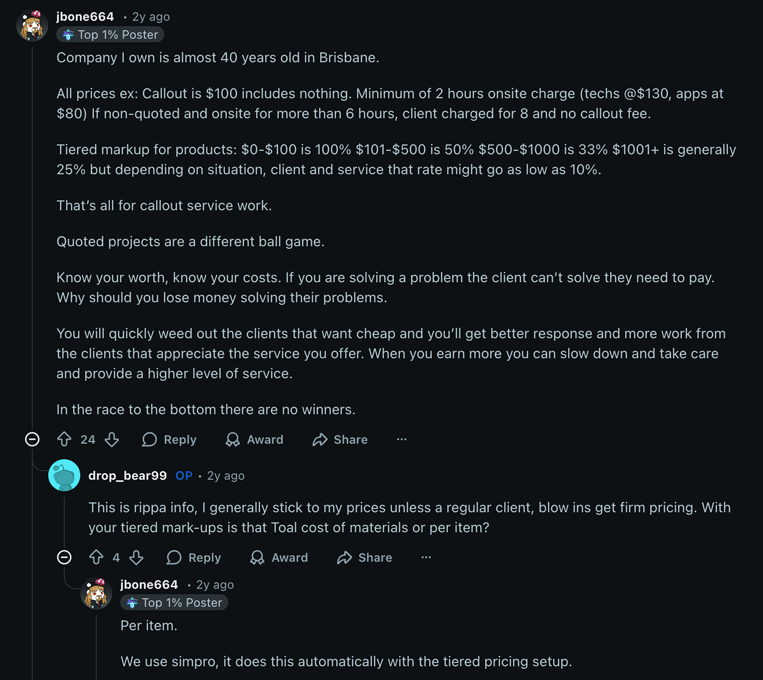
To illustrate how structured pricing works in the real world, here’s an example shared by an Australian electrical contractor on Reddit:
- $110 per hour labour rate
- $250 call-out, covering the first two hours
- 30% mark-up on materials
This isn’t inflated pricing. It’s the level required to remain profitable after covering vehicle costs, insurance, licensing, tools, superannuation, tax, software and the admin hours you can’t invoice for. Structured pricing protects your business and ensures you’re paid fairly for the expertise and responsibility electrical work requires.
4. Recurring and contract-backed revenue improves stability
Long-term sustainability comes from predictable work. Electrical businesses that rely only on domestic breakdown jobs often find themselves stuck in feast-or-famine cycles. The companies with smoother cash flow tend to build:
- Commercial maintenance contracts, where work is scheduled months in advance
- Test and tag programs, which repeat at fixed intervals
- Emergency and exit lighting checks, required under safety regulations
- RCD testing, which many sites must complete regularly
- Ongoing jobs with property managers or facility managers, who need consistent support
These services are essential, regulated and recurring. They help smooth out cash flow and create long-term relationships that reduce your reliance on constantly finding new customers. Over time, this recurring base becomes the financial backbone of your business.
5. Specialisation creates higher-value opportunities
Electrification, automation and energy trends are expanding the scope of the electrical trade. Developing expertise in a niche can lift your rates, reduce price competition and give you access to work with stronger long-term demand. Common high-value areas include:
- EV charger installations
- Solar PV and battery systems
- Industrial controls, automation and PLCs
- Smart home systems and IoT devices
- High-end residential fitouts
- Data and communications cabling
These specialisations connect directly to Australia’s net-zero goals, tech adoption and growing infrastructure needs. Customers in these segments tend to prioritise capability and compliance over the lowest quote, which positions specialised operators for stronger margins and repeat project work.
6. Systems and utilisation drive profit
Profit is shaped by two factors: how many hours are billable and how efficiently you turn those hours into completed work. Strong systems are what keep those two levers in your favour. They support:
- Routing and scheduling, so travel time doesn’t erode your day
- Accurate time tracking, which prevents unbilled labour
- Stock and materials management, reducing waste and rework
- Consistent quoting, backed by real job data
- Timely invoicing, so cash flow stays predictable
Even for small teams, increasing billable utilisation by as little as 10% can materially shift profitability. The right software is often what makes that improvement possible.
One Simpro customer summed up the impact well:
“
Simpro has completely changed the way we operate. We’ve cut admin, improved compliance and grown our margins by 35%, all while getting time back to focus on what matters.
Their experience highlights a simple truth: better systems tidy your operations, creating space for growth, accuracy and more predictable earnings.
Practical advice to get your electrical business started
Starting an electrical company requires a mix of trade knowledge, business thinking and operational setup. The checklist below expands on every essential step, explaining why each decision matters and how it connects to long-term profitability.
Get master licences to remain compliant from the beginning
Electrical licensing is managed at the state and territory level, and while the exact terminology differs, every business owner needs two core approvals in place before offering services:
- An electrical worker’s licence, which allows you to physically perform electrical work
- An electrical contractor’s licence, which allows you to advertise, quote, invoice and operate a business
Depending on your plans, you may also need specialised certifications, such as solar accreditation, test-and-tag qualifications or restricted licences for niche installations.
Check the exact requirements in your state:
- Queensland – WorkSafe QLD
- New South Wales – NSW Fair Trading
- Victoria – Energy Safe Victoria
- Western Australia – Department of Mines, Industry Regulation and Safety
- South Australia – Consumer and Business Services
- Tasmania – Consumer, Building and Occupational Services
- ACT – Access Canberra
- Northern Territory – NT Government
Regulatory compliance is not something to address later. Without proper licensing, you cannot legally operate, advertise or hold insurance coverage. Many commercial customers also require documented compliance before awarding contracts.
Set up your toolkit without overcapitalising
Your tools set the standard for the work you deliver, but that doesn’t mean you need a fully loaded van on day one. In reality, your first toolkit should focus on the equipment you’ll use every single day, not the specialised gear that might sit idle for months.
Begin with:
- A reliable multimeter and testing equipment, since accuracy and safety depend on these
- Core hand tools and insulated gear that can handle most domestic and light commercial tasks
- Ladders and basic access equipment, chosen based on the type of work you expect to take on
- Everyday consumables, like fasteners, connectors, tapes and replacement parts
- A dependable vehicle, even if it’s used, provided it’s safe and roomy enough for your gear
- PPE that meets current standards, because shortcuts on safety cost more in the long run
Buy strategically. Cash preservation is important in your first year. Add specialised tools as your niche or customer base evolves.
Define your pricing strategy with full clarity
Pricing is one of the first areas where new electrical business owners feel uncertain, mainly because you’re shifting from being paid for your time to charging for the full cost of operating a business. Your hourly rate has to cover far more than labour. It also needs to factor in the real expenses that keep you afloat:
- Vehicle running costs such as tyres, servicing and fuel
- Insurance across multiple categories
- Licensing renewals
- Tool maintenance and occasional replacements
- Tax and superannuation
- Software for accounting or job management
- Admin time you can’t invoice for
If your rate doesn’t reflect these costs, the business might stay busy, but cash will always feel tight.
A sustainable pricing model usually includes:
- A consistent base hourly rate that reflects your true operating cost
- A clear call-out fee, so both you and the customer start with the same expectations
- Mark-ups on materials, covering sourcing time, warranty risk and handling
- After-hours rates, recognising that urgent jobs disrupt planned work
- Fixed-price job packs for tasks you complete often, where time and materials are predictable
These job packs can be powerful early on. They help you quote faster, remove uncertainty for customers and reveal which services produce reliable margins. Being upfront and consistent with pricing makes you trustworthy, which carries more weight than undercutting the market.
Guarantee insurance so you are fully protected
A single incident or misunderstanding can become costly quickly, which is why insurance is one of the most important early investments you’ll make.
Most electrical businesses begin with a mix of:
- Public liability insurance, covering property damage or injury
- Professional indemnity, covering advice or design work
- Tool and equipment cover, especially if you rely on specialised gear
- Vehicle insurance, since the van is often your highest-value asset
- Workers’ compensation, if you plan to hire staff or apprentices
Estimate your costs
Startup costs vary widely, and the biggest factor is whether you already own a vehicle and a solid set of tools. To give you a grounded sense of scale, you can browse real pricing on public marketplaces and retailer sites:
- A used trade-ready van commonly ranges between $15,000 and $30,000 on major classifieds such as Carsales.
- A full toolkit may cost anywhere from $2,000 to $10,000, depending on brand, speciality and whether you need testing equipment or niche tools. You can see typical pricing on Total Tools.
- Trade insurance packages often fall between $1,500 and $5,000 per year, depending on cover level and state requirements. Master Electricians Australia outlines common insurance types for electrical contractors.
These figures are intentionally presented as ranges, not definitive totals. Costs vary by state, business structure, and whether you choose premium or entry-level equipment. That’s why it’s more accurate to build your own line-by-line budget rather than rely on generic industry averages.
Here are the main categories most new electrical companies include in their calculations:
- Vehicle purchase or upgrade
- Tools and equipment
- Licensing fees
- Insurance
- Software subscriptions
- Website and branding
- Initial working capital
This is where many new operators feel the pressure. Underestimating start-up costs can squeeze cash flow long before your customer pipeline settles. Overestimating can delay your launch unnecessarily. A structured, realistic calculation gives you a clear picture of what you need, what you can defer and how to pace your investment in those crucial first months.
Find the right customers and build your early pipeline intentionally
Demand for electrical work is strong, but customers will not appear automatically. You need a plan for how people will find you before word-of-mouth kicks in. Early-stage operators often build momentum through practical, low-cost channels such as:
- Networking with builders, plumbers and other trades, who often refer overflow or complementary work
- Reaching out to local real estate agencies that need reliable trades for tenant repairs and vacate checks
- Pitching strata and body corporate managers, who value consistent service providers
- Listing on trade directories like Hipages or ServiceSeeking
- Posting simple, useful content on social media, such as safety tips or behind-the-scenes job photos
- Building a small but informative website that shows services, qualifications and contact details
- Offering bundled or fixed-price services for your earliest customers to reduce friction
If you want more marketing ideas rooted in trade-business reality, Simpro has a helpful marketing guide for electricians.
As you explore these channels, think carefully about the type of customer you want to serve. Domestic breakdown work brings fast income but can be unpredictable. Commercial clients, strata managers and facility managers usually take longer to onboard but offer steadier and more structured repeat work. The earlier you define who you want to work with, the faster your marketing and messaging start attracting the right people instead of everyone at once.
Register your business properly and set up the systems that support growth
Strong systems give you control from day one. Without them, even simple jobs can turn into unnecessary friction. Investing the time to set these up early saves stress later. Every hour spent chasing paperwork or fixing preventable admin issues is an hour you are not quoting, delivering jobs or building relationships. Clean systems protect your margin and make your business feel organised from day one, which customers notice.
Most new electrical companies start by setting up:
- An ABN or ACN, depending on whether you operate as a sole trader or set up a company
- A clear business structure, which affects tax, liability and how you bring on future staff
- A dedicated business bank account, so personal and business spending never blend
- Accounting software, which helps you track invoices, expenses and BAS obligations without digging through paperwork
- Job management software, which keeps quoting, scheduling and job records in one place and reduces admin pressure as you grow
- Contract templates, especially for commercial clients or recurring maintenance work
- WHS documentation, including safety plans and procedures required by state regulators
- Payroll and superannuation processes, even if you only plan to hire apprentices later
- Receipt tracking, so every purchase is logged, and nothing goes missing at tax time
Other considerations that create strong foundations
Start with job costing habits
Track the actual labour and materials for every job. This gives you early insight into which services are profitable and which need redesigned pricing.
Identify your niche over time
You do not need to specialise immediately. But pay attention to the jobs you enjoy, the ones customers request repeatedly and the ones where you deliver exceptional value.
Build communication habits that customers appreciate
Simple practices like confirming appointments, sending arrival notifications and offering post-job updates create trust and repeat business. These habits cost nothing but generate real loyalty.
Avoid these traps in the beginning to keep your business moving
Starting strong matters, but staying strong is what keeps the business alive. Most electrical companies face the same handful of challenges in their first 18 months, and they usually come down to planning, systems and cash discipline. Knowing these risks upfront gives you more control as your workload grows.
Cash flow issues that stall your momentum
Cash flow is the pressure point for many new trade businesses. Even with plenty of jobs, your cash can get tied up in places you did not expect. Common bottlenecks include:
- Slow-paying clients, especially in construction or strata
- Late invoicing, often because paperwork piles up after long days on the tools
- Jobs that require upfront materials, which put an immediate strain on your bank account
- One-off work with unpredictable timing, creating revenue spikes and dips
- Weak follow-up systems, where overdue invoices slip through unnoticed
Protecting cash flow early means setting expectations and making it easy for customers to pay you. In practice, that looks like:
- Deposits for larger jobs
- Progress payments tied to clear milestones
- Invoicing as soon as the job is complete
- Short, firm payment terms such as 7 or 14 days
- Automated reminders, so follow-up happens consistently without you chasing every invoice
If you want a deeper look, Simpro has a helpful guide on practical cash-flow fixes tailored to electrical businesses.
Good systems protect your profit margin, reduce financial stress and keep your business moving even when workload varies from week to week.
Lack of evolving skills or difficulty hiring
Australia is experiencing notable skill shortages across most trade categories. Industry commentary from Gemcell describes the situation as an “unprecedented skills shortage in the electrical trades”.
Jobs and Skills Australia also notes that nearly half of the assessed trade occupations are in national shortage.
For new electrical companies, this shortage shows up in two ways.
- Hiring becomes harder and more expensive. When qualified technicians are scarce, wages rise, recruitment takes longer, and you may feel pressure to hire quickly - which can lead to mismatches or quality issues.
- Your own skill set needs to evolve faster. Customers expect electricians to understand growing areas like EV charging infrastructure, renewables, battery storage and smart home systems. These aren’t optional add-ons anymore. They’re becoming core parts of the trade.
Supply shortages and parts delays
High demand for components used in renewables, automation and construction has stretched supply chains across the industry. Batteries, EV chargers and specialised cabling often carry longer lead times, which can affect both scheduling and profitability.
To stay ahead of supply issues, it helps to:
- Build relationships with more than one supplier
- Keep a small buffer of high-use materials
- Communicate delays early
- Set timelines you can confidently deliver
Customers are generally understanding when you’re transparent. Problems tend to arise only when delays are discovered late.
Difficulty finding new jobs or managing current workloads
Winning jobs and running them well require different strengths, and both matter for a young electrical business.
- On the acquisition side, customers still compare quotes even in high-demand markets. If you rely only on word-of-mouth, your pipeline becomes unpredictable. Consistent visibility - online profiles, local networks, and timely responses keep your name in circulation.
- On the operations side, weak job management creates avoidable losses. Scope creep, untracked hours, misplaced materials and late invoicing all erode margin and frustrate customers.
Good job management software helps shorten the quote-to-cash cycle and gives you a clear view of scheduling, labour costs and profitability, so you spend more time earning and less time fixing preventable issues.
Count on Simpro to start with the right tools
Building an electrical company should feel rewarding, not overwhelming. The work itself is hands-on and demanding, so your admin systems should lighten the load, not add to it. That’s where the right electrical software becomes a safety net for your time, your finances and your customer relationships.
Simpro gives new electrical business owners access to tools that were once only practical for larger contractors. You can manage quoting, scheduling, job notes, materials, timesheets and invoicing in one place. That means fewer scattered processes and a much clearer view of where your money is coming from (and where it’s going).
Starting an electrical business is a bold move, but with strong demand, thoughtful pricing and reliable systems, you give yourself a solid foundation for steady growth. Simpro helps turn that intention into a day-to-day reality.
If you want your electrical company to run smoothly, control costs and offer a customer experience people genuinely appreciate, the right digital tools make all the difference. You can explore how Simpro works (and see what it looks like in practice) by booking a demo.


 Back to top