
TL;DR
- Estimate close rate is the share of issued estimates a customer accepts, which depends on how you define “issued.”
- Benchmarks vary by trade and work type, so segment before you compare.
- Read the rate next to gross margin, because a high close rate on thin-margin jobs can lose you money.
You give an estimate to the homeowner, who says they'll think it over. Six weeks later, it’s still unresolved. Does that estimate stay open, count as a loss, or get dropped? The answer changes your quote close rate, but most shops never decide.
A good estimate close rate depends on the work type and underlying formula. One of the few traceable benchmarks comes from the Air Conditioning Contractors of America (ACCA), which puts residential HVAC install close rates at 45% and commercial at 38%. Commonly cited rules of thumb run lower: 25%–35% for residential and 15%–25% for commercial bidding.
Which figure fits your shop depends on how you treat unresolved estimates.
What Is Estimate Close Rate?
Estimate close rate is the share of issued estimates that turn into successful sales in a set period. You'll also hear it called sales closing ratio, quote conversion rate, or bid-hit ratio.
This definition has two variables. One is the word "issued." Counting every price given over the phone, for example, typically produces a lower rate than counting only written proposals. Presenting an itemized proposal for a panel upgrade is further down the sales funnel than a ballpark quote for a water heater swap.
The second variable is what to do with unanswered quotes. Set a cutoff for what counts as a lost estimate, treating residential and commercial work separately. Base each cutoff on how long your won estimates have taken to close.
The operational fix: Only include formal written estimates in your close rate calculations. Log phone ballparks in a separate bucket so they show up in your lead data without dragging down the rate your estimators are judged on.
How to Calculate Your Estimate Close Rate
To calculate close rate, run both versions of the close rate formula:
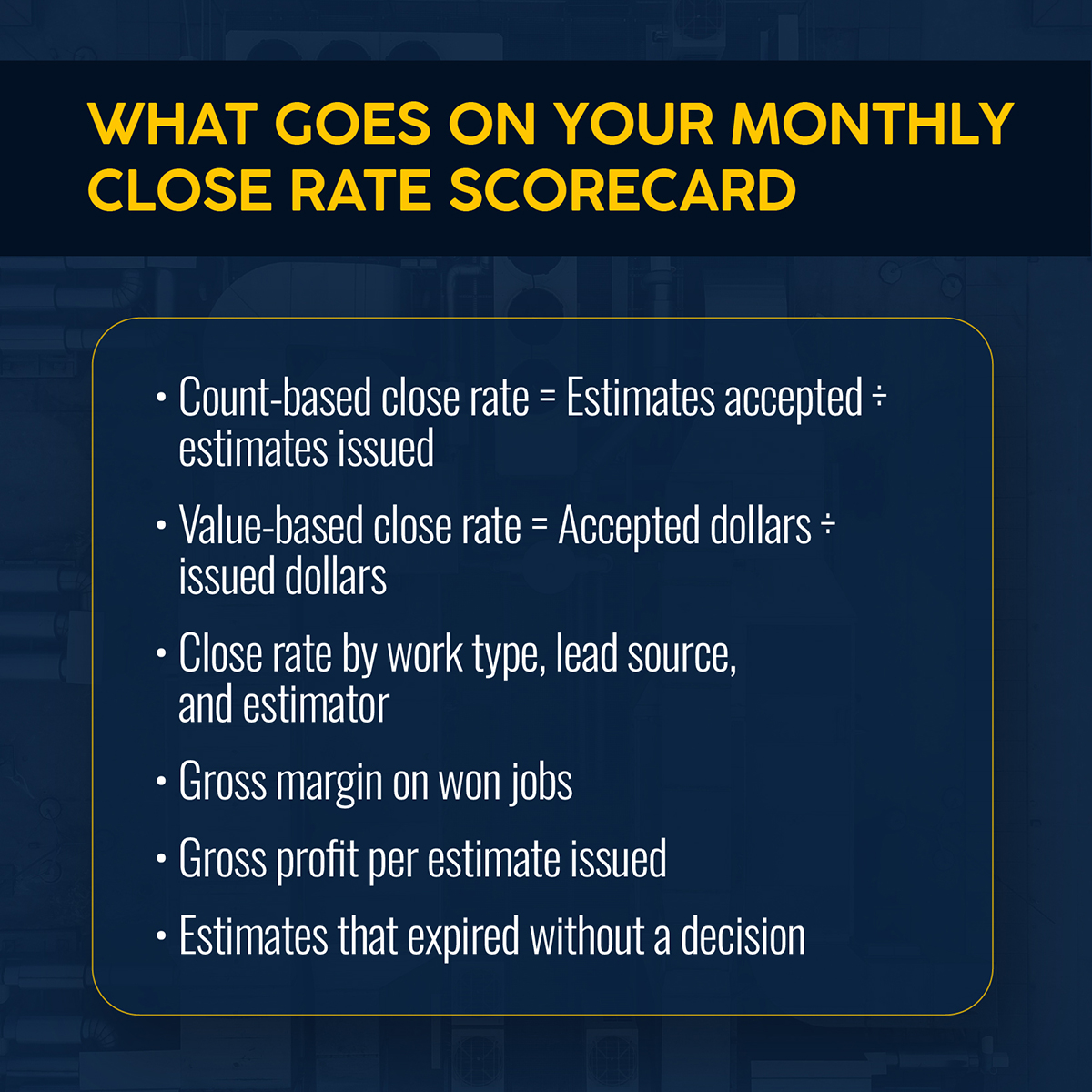
- Count-based: Estimates accepted ÷ estimates issued × 100
- Value-based: Accepted estimate dollars ÷ issued estimate dollars × 100
Let’s say your plumbing shop issues 50 written estimates worth $400,000 in March and wins 20 estimates worth $120,000. Here’s how that shows up in the formulas:
- Count-based rate: 20 ÷ 50, or 40% close rate.
- Value-based rate: $120,000 ÷ $400,000, or 30% close rate.
The winning estimates averaged $6,000 against an overall average of $8,000, suggesting a bigger number of closed deals were for small tickets.
Report both rates side by side each month. A widening gap could mean larger jobs are the ones getting away.
Two more decisions help keep the number honest:
- Measure by the month the estimate was issued. The sales cycle on commercial quotes can run for months. A $180,000 mechanical bid sent in January and awarded in April belongs in January's numbers.
- Pick a cutoff, by work type, for estimates that go unanswered. Mark them as lost or expired so undecided quotes aren't distorting the month's result. A clean count gives you something worth setting against a benchmark.
Related: Estimates sit at the front of field service operations, so a leak there affects every subsequent stage.
What Is a Good Estimate Close Rate for Service Contractors?
Industry averages don’t tell you everything, but they’re a good reference point. That said, account for your lines of work and the trades you’re in.
For example, hard-bid commercial work can reduce the overall bid-win rate for service contractors that also sell direct-award repair. Meanwhile, when several qualified bidders compete for a scope, expect a lower-than-normal win rate. This is where segmenting can help you track bid success rate more accurately over time, versus the noise created by a blended average.
Pull the last four quarters of written estimates, segment them by work type, and track win rates for each type to see if they have drifted. A residential replacement rate that slides from 45% to 38% over 12 months, for example, gives you a starting point for investigation inside your shop.
If your rate exceeds industry benchmarks or even your expectations, check the margin on won jobs. You may be underpricing the market. If your rate feels low, look at your qualification process, how many pricing options you offer, and your follow-up speed.
The operational fix: Log your rate by work type for a quarter before worrying about industry benchmarks.
How to Improve Your Estimate Close Rate Without Sacrificing Margin
The secret to improving estimate close rate is to look beyond price. While that’s always a lever to pull, it can raise your rate while lowering profit. If you want to improve your sales close rate without touching price, you need to start earlier, before the estimate.
Qualify Opportunities Before You Spend Time Estimating
Four questions separate real sales opportunities from wasted effort:
- What's the budget range?
- What's the timeline?
- Who makes the decision?
- Does the job match the work you want?
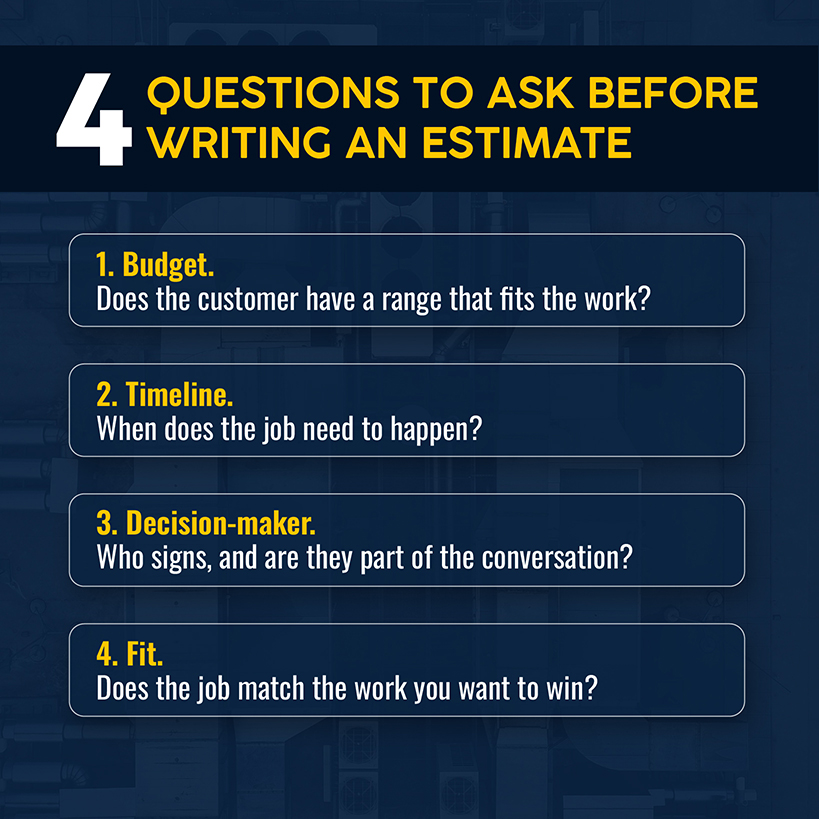
Without answers to these questions, your estimator will waste time on bids that will never come to fruition or won’t make the margin you want.
To manage sales effectively, identify which opportunities deserve a ballpark figure — like the homeowner who wants a water heater price "just to see," even though their existing heater isn’t failing. This improves your close rate and frees up your estimators to focus on jobs with a real chance of success.
Make Estimates Accurate, Clear, and Easy to Approve
Itemize labor, materials, and exclusions so the customer can see what’s covered. Even small differences make prospective customers more wary than when they get two quotes for the same panel upgrade that differ by $1,800. Even small differences make prospective customers more wary than getting two quotes for the same panel upgrade, yet they differ by $1,800.
The operational fix: Spell out scope and exclusions, and add e-signature approval so a “yes” takes one tap.
Price for the Job You Want to Win, Not Just the Lowest Bid
Build your price from current labor and material costs. Add in the margin the job needs. Being consistent here prevents you from chasing jobs that don’t make financial sense — and lets customers who prioritize the lowest bid go elsewhere.
Let’s say you quote a $6,400 tankless water heater replacement at 25% gross margin ($1,600), with a 40% win rate. If you give a $500 discount to win the job, you’ll need to win about 58% of those jobs to recover the lost margin. That’s a hard climb to sustain over the long term.
Related: Learn about protecting your margins from first quote to final invoice.
Give Customers Clear Options Where They Make Sense
Presenting good/better/best options gives customers a way to choose a higher price instead of arguing the first one down. Such options can include equipment efficiency, thermostat, financing, add-ons and warranty.
The ACCA survey found that contractors offering 4+ options closed 52% of installs, versus a 42% close rate for those who offered 1–3 options. Meanwhile, contractors offering financing reported a 49% average close rate, versus 38% for those who didn't.
Research has found that many customers default to the middle option. For example, a furnace replacement can be priced as a standard-efficiency unit, a high-efficiency unit, the same unit with a smart thermostat, or an extended labor warranty. Decide which one you want in the middle, then build the others around it.
Follow Up While the Estimate Is Still Active
Like sales leads, an estimate quickly goes stale if no one acts on it.
Whenever you create an estimate, set a follow-up date, assign it to someone, and set automatic reminders. That creates accountability and a natural touchpoint. Follow a similar process in setting cutoff dates for unanswered, lost estimates.
Learn Why Estimates Are Being Lost
Record a loss reason on every lost quote: price, timing, went with a competitor, or no decision. Every quarter, review the tally by work type to learn what you should do next.
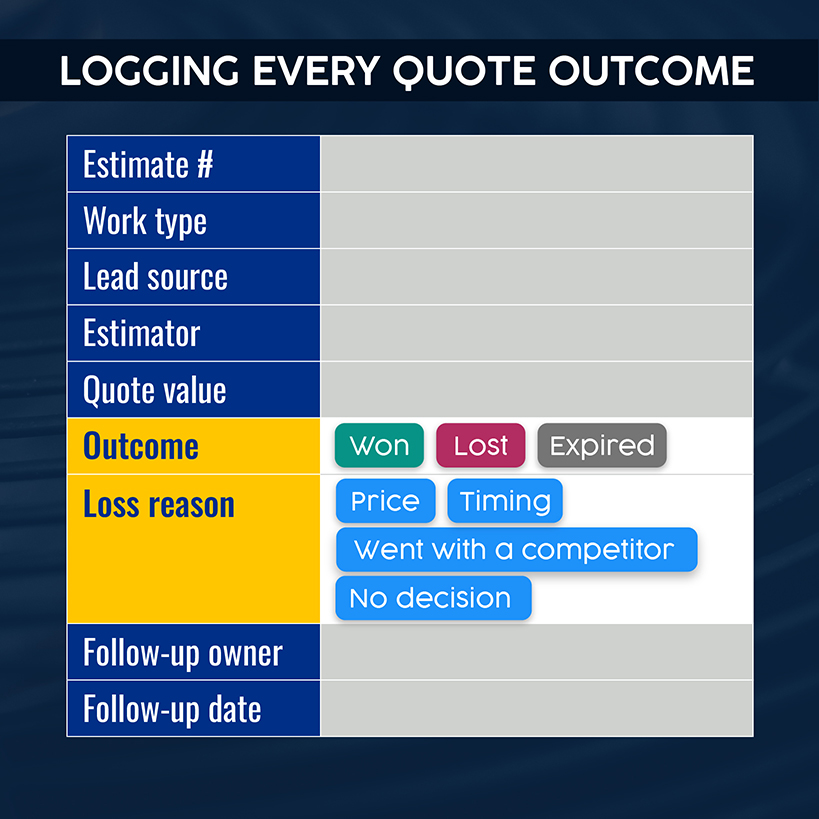
Let’s say 22 of 40 lost quotes closed as “no decision,” with only nine citing price. That suggests a possible follow-up issue, rather than an urgent need to cut prices. If price dominates the losses on one type of work, test a change there before rolling it out to the rest of the business.
In Simpro®, leads and quotes are assigned status, tags, notes and follow-up dates, allowing you to record why a quote was lost.
The operational fix: Make the loss reason a required field when a quote closes out, and have the estimator add the customer's feedback if they gave a reason.
Related: Quoting performs best when it shares data with scheduling, job costing, and invoicing on a connected operating platform.
Don't Track One Company-Wide Close Rate and Stop There
A blended rate averages your best work with your worst, which means you can’t see what’s really happening in the business.
Instead, segment your close rate data this way:
- Work type. Service repairs, replacements, maintenance agreements, and commercial bids have different ticket sizes and odds of success.
- Lead source. Referrals, repeat customers, web forms, and paid leads don’t necessarily get the same sales process.
- Estimator. The same job quoted by two people can reveal team performance trends.
- Customer type. Homeowners, property managers, and general contractors follow different sales pipelines.
Let’s say your plumbing shop issues 80 water heater replacement quotes in a quarter and wins 48, for a 60% close rate. But of 20 whole-house repipe quotes, you won only two, for a 10% close rate. If you only look at the 50% blended rate, you wouldn’t know anything was underperforming.
The operational fix: Report close rate by work type every month. Add the lowest segment to the meeting agenda.
Related: Defining close rate the same way every month builds the consistent baseline required for field service economics.
What Does a Very High or Very Low Close Rate Tell You?
Either extreme should prompt a gut-check.
| Very High Close Rate | Very Low Close Rate | |
|---|---|---|
| Likely causes | Underpricing, or quoting only sure things | Weak lead qualification, slow follow-up, unclear proposals, or bids for work you can't price competitively |
| First check | Gross margin on won jobs | Time from request to estimate, plus the loss-reason tally |
| Context | Low margin because you won on price | Lower win rate, in general, for certain jobs |
The operational fix: For a high rate, pull the last 20 won jobs and compare the quoted margin with the actual margin. For a low rate, time the gap between the customer's request and your estimate, then check how many losses were “no decision.”
Measure Estimate Close Rate Alongside Revenue and Profitability
Close rate counts wins but not margin. Two shops can issue the same 50 estimates, each averaging $8,000, and finish the month in different places:
| Shop A | Shop B | |
|---|---|---|
| Estimates issued | 50 | 50 |
| Close rate | 60% | 40% |
| Gross margin on won jobs | 15% | 25% |
| Revenue won | $240,000 | $160,000 |
| Gross profit | $36,000 | $40,000 |
| Gross profit per estimate issued | $720 | $800 |
Both shops issued the same total number of estimates. But while Shop A won more jobs, Shop B earned more, both overall and per estimate.
Two per-estimate figures show whether a close rate is paying off:
- Revenue per estimate: Revenue won ÷ estimates issued
- Gross profit per estimate: Gross profit won ÷ estimates issued
Track both beside the close rate. A price cut that lifts the rate will show up as a drop in gross profit per estimate. If your close rate declines but gross profit rises, it likely means your pricing and qualification are improving.
Related: Close rate belongs on the same dashboard as the other field service KPIs you review each month.
Turn Estimate Data Into Better Decisions With Simpro
Tracking all these numbers is easier when each quote stays connected to the job it becomes.
Simpro is purpose-built for trades and supports 250,000+ users. Customers approve quotes online, accepted quotes convert into jobs, and pre-built reports cover Lead and Quote Activity, Sales Forecast and Profit/Loss.
Quote templates and pre-builds keep estimates consistent across sales teams and estimators. Multiple quote options can include images and manuals, and follow-ups can be automated or set by hand. AI-powered tools take on repetitive quote admin, with Simpro customers citing 10x faster estimates.
Buchanan & Hall, a 25-person commercial refrigeration and HVAC shop in Stratford, Ontario, couldn’t connect quotes to jobs, so the team couldn't see how a past quote performed after the work was done. Since switching to Simpro, the office pulls past job data into quote templates and sets due dates on leads and quotes, which keeps follow-ups from slipping through the cracks.
Now that you know which numbers to watch, the next obstacle is getting them without a Friday afternoon of copy-paste. With a connected system, you can track which estimates win, which lose, and what each win earns — all in the same place where the job is built and billed.
Schedule a demo to see how Simpro tracks quotes from first request to final invoice.


 Back to top