
An AI agent HVAC deployment starts by fixing the biggest hidden leak: Unanswered calls.
Let’s say an HVAC contractor misses 10 calls per month that would have converted to repair jobs. At $300 per repair job, that’s $36,000 in revenue every year that goes to your competitors — and that’s likely on the low end. Add in bigger jobs you missed and the opportunity costs of idle drive time, tech paperwork, and slow-paying invoices, and the numbers add up.
The other reason for urgency: most HVAC contractors sense that artificial intelligence will reshape the trade long term, and small-business AI use accelerated from 40% to 58% in a single year, according to the U.S. Chamber of Commerce. Add in a labor market where the BLS projects 40,100 HVAC openings every year through 2034, and the math gets simple: not every company can afford to hire more office staff, leaving AI agents as one of the few ways to add capacity.
This guide covers what agentic AI can do for scheduling, dispatch, technician prep, job documentation, customer communication, and reporting — as well as what it doesn't replace and what to know before actually deploying AI agents.
What Is an AI Agent in HVAC?
An AI agent is software, usually built on large language models, that watches what's happening on a job, works out the best next step, and acts on it inside your systems without human intervention.
Understanding agentic AI for HVAC companies starts with the terminology. What separates agentic AI from the "automation" most HVAC platforms have offered for years? It’s simple: how much you can trust agents to work without supervision.
AI Agents vs. Chatbots vs. Automation
Traditional automation runs a fixed script: Step 1 triggers Step 2, which triggers Step 3, regardless of what Step 1 returns.
A chatbot answers whatever gets typed into it, but it has no memory of the job beyond that exchange.
Agentic AI systems work closer to how a good dispatcher thinks. They check the outcome of one action before deciding on the next, building multi-step plans instead of following a single fixed script.
| Tool | How It Behaves | HVAC Example |
|---|---|---|
| Automation | Fixed sequence, runs regardless of outcome | Sends a reminder text 24 hours before every appointment |
| Chatbot | Responds to a single prompt, no planning ahead | Answers "what are your service hours" on the website |
| AI agent | Senses an outcome, reasons through it, adjusts the plan | Notices a job ran long, reshuffles the rest of the day's board, and texts the next customer a new arrival window |
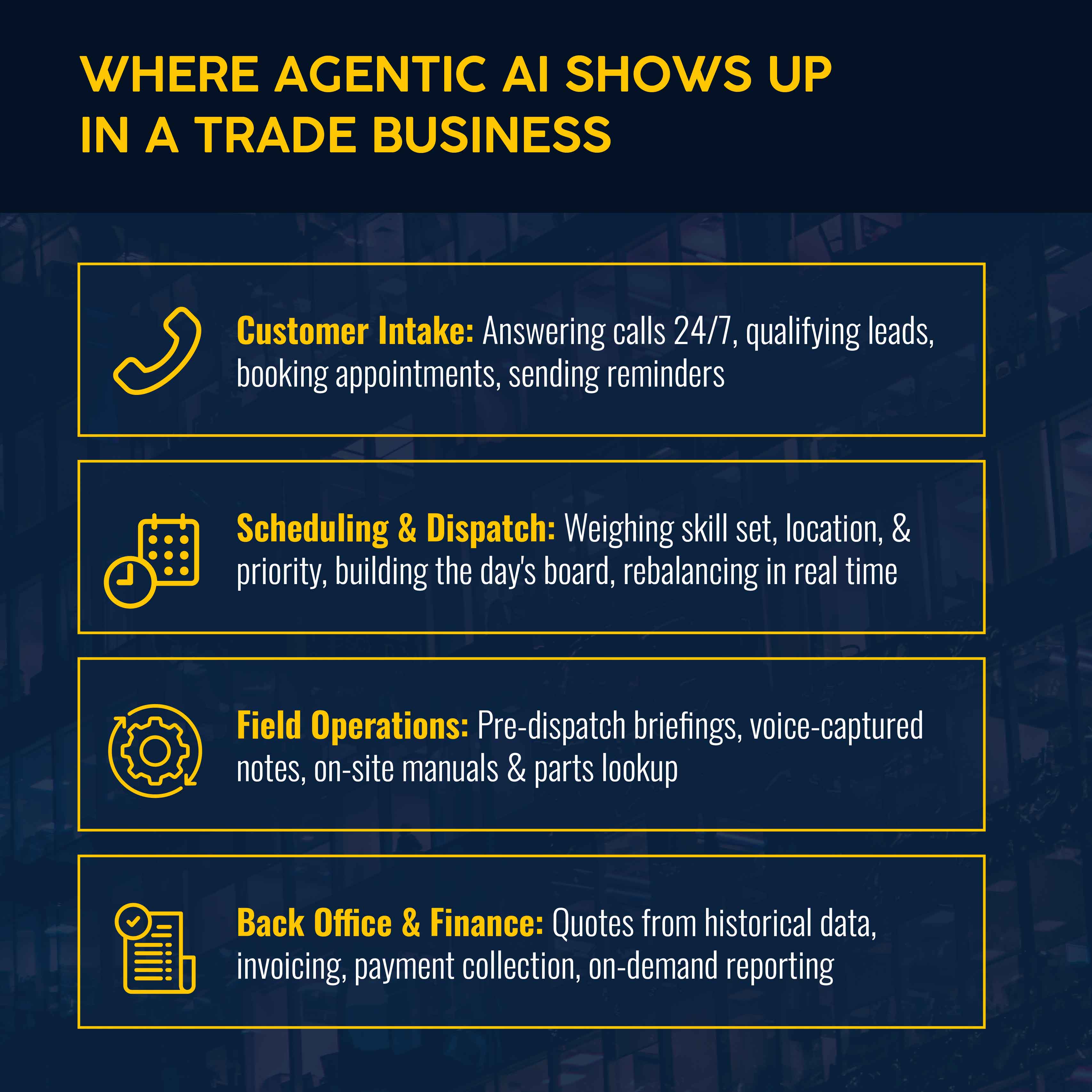
Agentic AI work shows up across a trade business in four areas:
- Customer intake: answering calls around the clock, qualifying leads, booking appointments, sending reminders
- Scheduling and dispatch: weighing technician skill set, location, job priority, and availability against real-time data, including rebalancing the board when a job cancels or runs long
- Field operations: briefing for technicians before dispatch with full job history, capturing voice notes, surfacing manuals and parts information on-site
- Back office and finance: generating quotes from historical data, creating invoices, sequencing payment collection, and running business reports on demand
Where an HVAC business starts with agentic AI depends on where they are feeling the most pain.
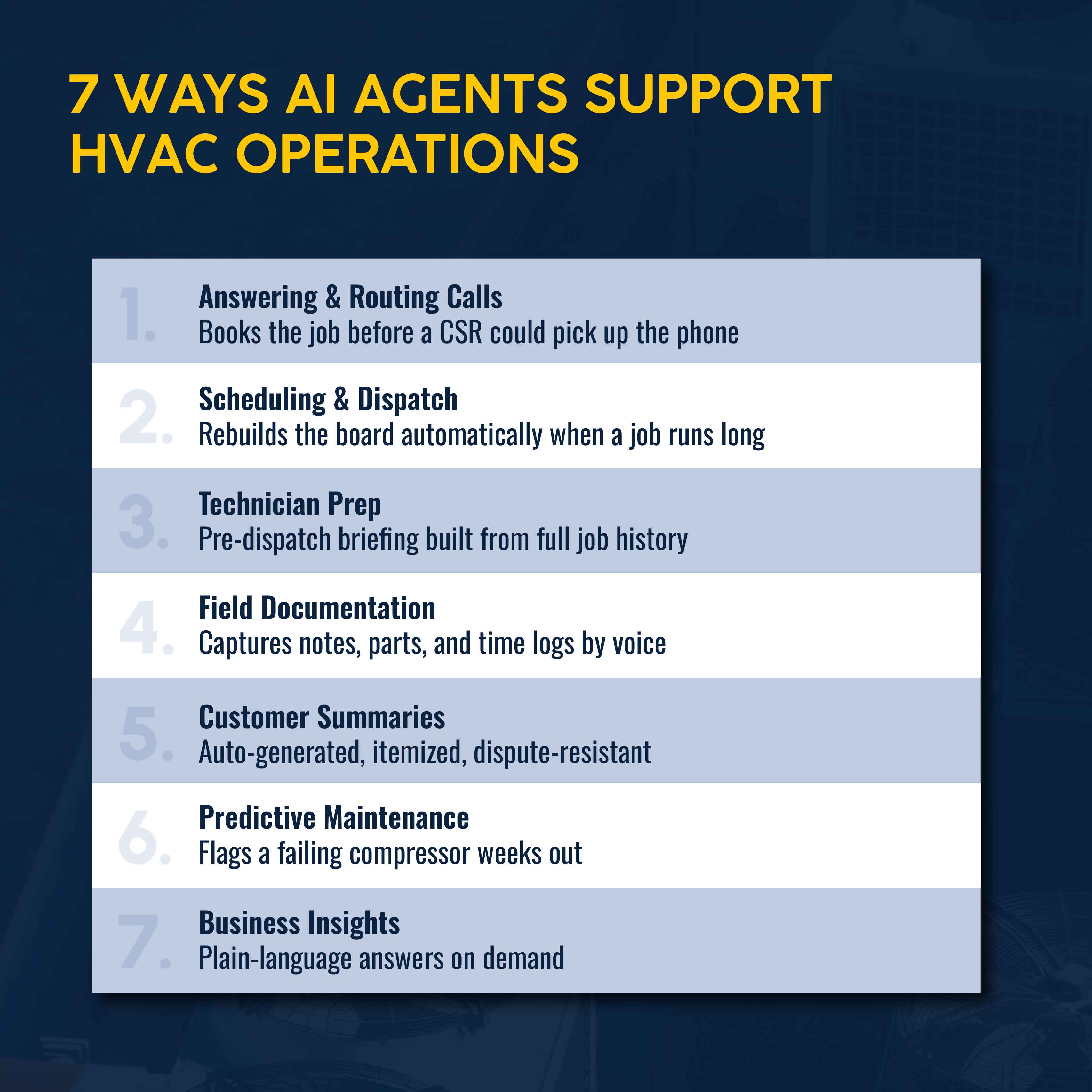
7 Ways AI Agents Can Support HVAC Operations
Contractors shouldn’t try to add AI everywhere at once. Instead, start with a single workflow and verify it before adding a second. The seven use cases below cover where the technology is already proving its worth.
1. Answering and Routing Customer Requests
A contractor with $3 million in revenue can lose $150,000 to $300,000 a year just from calls that ring through to voicemail during a rush. Your customer service representative can’t simultaneously handle intake, a no-cooling call at 9 p.m. in peak season, and a third customer calling in. Most of the time, that person hangs up and calls the next name from the search results page.
An AI agent can staff that customer service line around the clock. They’ll qualify the caller, check the job against technician availability, and book the appointment directly, all without a human being on call to pick up the phone. Al call-answering tools can pay for themselves with as little as one job booked each month, mostly by catching calls that would have gone to voicemail and failed to convert.
The operational fix: if your team is losing calls to a full voicemail box or an after-hours gap, an intake agent solves that without adding to payroll.
2. Scheduling and Dispatching the Right Technician
Dispatch is the highest-leverage seat in the building, and it's also the one most exposed to a bad morning. When a job runs long, a tech calls in sick, or a same-day emergency comes in, your dispatchers get stressed.
Picture a 15-technician commercial contractor with three trucks devoted to a rooftop unit replacement that’s running three hours over. The dispatcher has to manually reshuffle six other appointments, call each customer, and hope nobody double-books a truck in the process.
Instead, an AI agent can weigh technician skill set, location, job priority, and real-time availability, then rebuild the day's board automatically and accurately. AI scheduling for field service management is the relevant RAIN context when that dispatch logic needs to account for operating constraints. Successful HVAC businesses have reported saving more than 20 hours per week on scheduling and paperwork after adding purpose-built software.
The operational fix: if dispatch spends more time firefighting the board than planning, that's the first workflow to automate.
Related: Learn how businesses across the trades use AI in field service management.
3. Preparing Technicians Before Every Job
Repeat visits cost time and money. But they’re more likely when your technicians show up without job history, equipment notes, or a sense of what went wrong last time.
Simpro®'s JobReady agent is built for exactly this. It pulls the customer's service history, equipment records, and any open notes into a pre-dispatch briefing before the truck leaves the yard. The industry-average first-time fix rate is around 75%. Contractors using AI job-prep tools are pushing that past 90%.
The operational fix: Every percentage point of first-time fix rate gained is one less callback, truck roll, and frustrated customer to manage.
4. Helping Technicians Document Work Faster
Paperwork eats time that should go to billable work. Simpro's JobScribe agent puts a number on it: The average technician loses 30 to 60 minutes a day writing up notes, itemizing parts, and filling in job details after the fact. Instead of traveling to the next call, they’re sitting in the truck or at the office after a long day.
AI agents can capture that documentation from voice notes in the field, using generative AI to turn a voice memo into a structured job record, parts list, and time log with minimal human input. That shift is tied to a 40% drop in billing disputes, since the record matches what happened on-site instead of a technician's memory of it days later.
The operational fix: Documentation time recovered per technician per day adds up fast across a 10-tech team. Even getting 20 minutes a day back adds up to more than 1.5 hours of billable time per week, per technician.
5. Creating Customer Summaries After the Job
When customers receive a clear, itemized summary of what was done and why, they’re less likely to dispute the invoice.
An AI agent can generate that summary automatically from the technician's field notes, matching the language to what happened on-site instead of pulling from a generic template. Simpro's JobBrief agent is built for this purpose, helping reduce disputes by 25%–35% and speeding payment by 15–20 days.
The operational fix: Billing disputes often start with a customer who doesn't understand what they're paying for. Fix the explanation, and many would-be disputes disappear.
Related: Get more details about protecting HVAC margins and revenue with AI.
6. Spotting Maintenance Needs Before Breakdowns
Predictive maintenance has the longest track record of any AI application in HVAC, as equipment sensor data lends itself well to pattern recognition. An AI agent monitoring a connected HVAC system can flag a compressor weeks before it fails, letting a contractor schedule a planned repair instead of an emergency one.
A large commercial office building used AI-based predictive maintenance to reduce unplanned HVAC outages by roughly 50% and total downtime by 41.3%. AI-based monitoring can also reduce the costs of HVAC energy consumption.
The operational fix: Start with your five or 10 largest commercial service contracts. That's where a connected equipment pilot pays back fastest.
7. Surfacing Business Insights Without Manual Reporting
Most owners don't have a data analyst on staff, which means questions about job performance, cash flow, or technician utilization often go unanswered until it’s too late. Rather than wait till someone can pull a report or until the accountant flags a problem months later, an AI agent embedded in the operating platform can answer those questions directly, in plain language.
Most importantly, the agent uses the business's live data instead of a static dashboard someone has to build and maintain.
The operational fix: if a question about your business takes more than a few minutes to answer, that's a sign the reporting is manual when it doesn't need to be.
What HVAC Business Owners Should Look for Before Adopting AI Agents
Understanding agentic AI for HVAC business owners comes down to two questions: Is the AI built into the system you already use? Is your team ready to work alongside it? How you answer those questions will determine whether the tool improves operational efficiency.
General-purpose AI tools need someone to feed them data by hand. Manual steps remain, like exporting a report, pasting it into a chat window, or copying the answer back out. By contrast, AI built into your operating platform gains access to job history, technician performance, and pricing. It can act on that information directly instead of waiting for someone to hand it over.
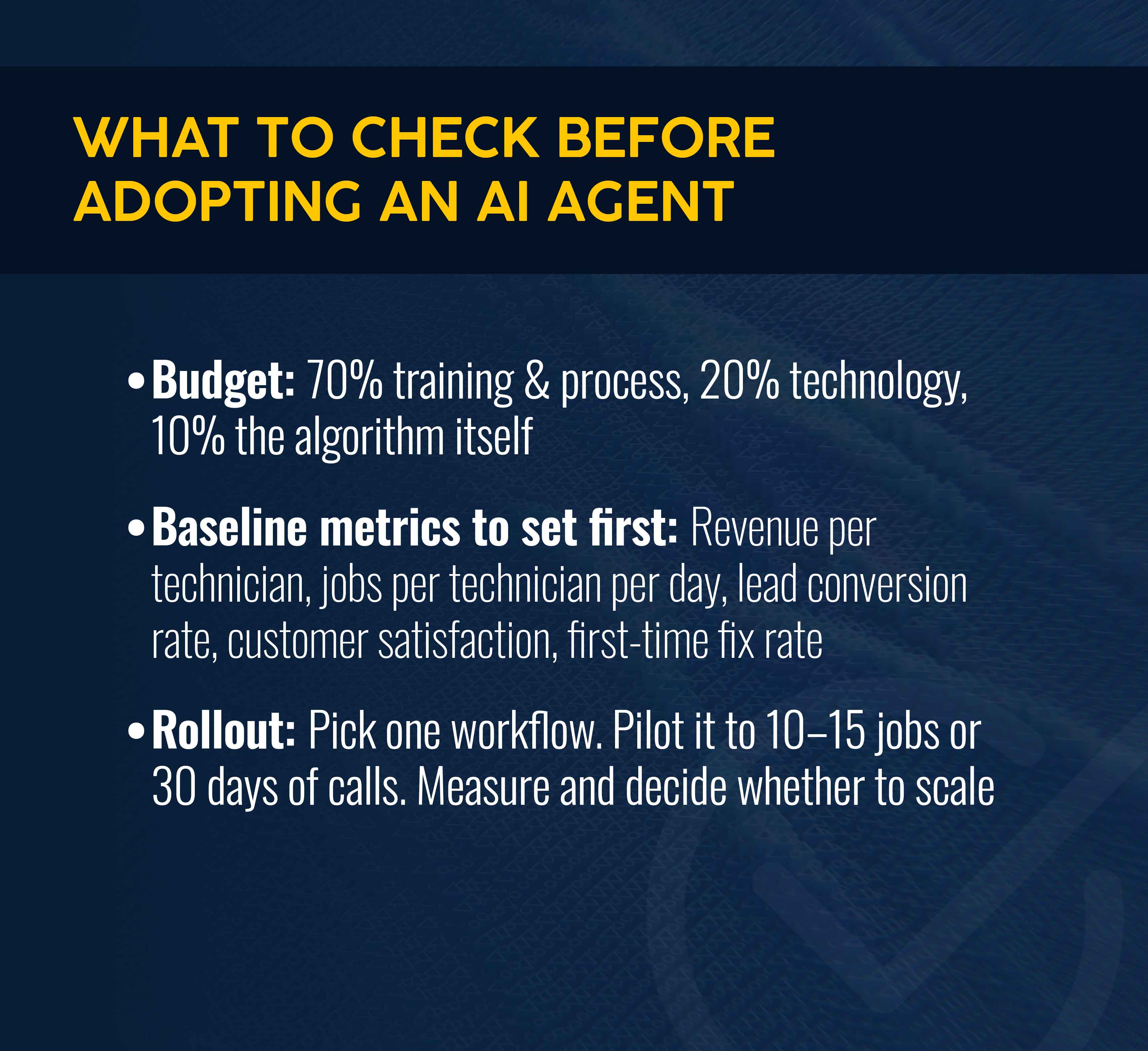
Budget is the second thing to get right when implementing agentic AI. Coaching guidance from the field service industry recommends putting roughly 70% of an AI budget toward training, process changes, and human oversight, 20% toward the technology, and only 10% toward the algorithm. Most of the value comes from how the team uses the tool, not the tool itself.
The key is to plan and act. Before turning anything on, write down what you're measuring:
- Revenue per technician
- Jobs per technician per day
- Lead conversion rate
- Customer satisfaction scores
- First-time fix rate
Without a baseline, it's hard to tell whether a new AI agent moved the needle or whether the numbers would have shifted anyway.
Start with one workflow. Pick the highest-friction challenge, measure it for 30 to 60 days, then decide whether to add a second workflow. Turning on every AI feature at once creates noise, can overwhelm your team, and results in less progress over the long run.
None of this requires waiting for a perfect setup. The contractors seeing the strongest results started with a single AI tool and built on small improvements instead of holding out for a finished rollout. A phased approach works best:
- Pick one pain point and one tool in the first month.
- Run a limited pilot against 10 to 15 jobs or 30 days of calls in the second month.
- Measure the results and decide whether to scale in the third month.
Simpro takes the platform-native approach. Simpro AI integration for field service management works from the job history, customer records, and pricing already inside Simpro rather than requiring a separate export step. Purpose-built agents cover several crucial workflows, including FieldReady for technician onboarding, JobReady for pre-dispatch briefings, JobScribe for field documentation, and JobBrief for post-job customer summaries.
AI agents don't replace your technicians. The highest-value deployments give technicians instant access to job history, manuals, and diagnostics, allowing them to do their jobs better.
Related: See what stands out among AI platforms for HVAC businesses.
Bring AI-Powered Support Into Daily HVAC Workflows With Simpro
You're manually running some version of at least three of the workflows above right now, each one costing time that could go toward another money-making job.
Cooper, Simpro's AI-powered conversational business intelligence tool, answers plain-language questions about job performance, cash flow, and technician utilization using the data already sitting inside your Simpro account.
Fast Cash automatically chases down unpaid invoices with the timing and channel most likely to get a response from each customer.
Together with other Lightning agents, you can close the exact gaps covered in this guide — the missed calls, the overloaded dispatchers, the technicians walking in blind, the paperwork nobody has time for, and the invoices that sit unpaid too long.
One HVAC contractor already using these tools inside Simpro saved 45 minutes on a single residential proposal by having an AI agent generate a good-better-best pricing option instead of building it line by line. That's one proposal. A shop writing a dozen a week gets that time back every single week, all without adding headcount.
Simpro's HVAC field service software is part of a platform that works with more than 24,000 trade businesses across HVAC, electrical, and plumbing. These agents are built and tested against how field service runs, not a demo scenario.
Ready to see how you can close admin gaps, capture revenue, and improve margins in your HVAC business? Schedule a demo to see for yourself.


 Back to top