
Your technician is backing out of the driveway when the homeowner flags them down. She’s just remembered the thermostat that keeps cutting out. Ten minutes later, it’s fixed, the customer’s happy, and the invoice says nothing about it.
One favor won’t sink your month. Multiply it across every tech, every truck, and every call, though, and your average ticket ends up smaller than the work your crews actually do.
That’s where learning how to increase average ticket size in field service starts. It’s not about pushing techs to sell more. It’s about finding out why your invoices undercount the jobs you already do. Four common causes exist, and unbilled favors are just one. Each shows up in data you already have. Fix them, and you can increase sales without growing your number of customers, booking more calls, or making a single sales pitch.
What Is Average Ticket Size in Field Service?
The definition of average ticket size differs across industries. In retail, it’s the average amount a customer spends at checkout. At the box office, it’s about event tickets and ticket sales.
For the trades, it’s invoiced revenue divided by the number of jobs:
Average ticket size = Total invoiced revenue ÷ Number of jobs
Let’s say you invoice $184,000 across 420 service calls, meaning the average amount a customer gets charged is $438. That gives you an overall view of ticket size but might hide performance gaps between different lines of work. If 300 of those calls were maintenance visits averaging $185, while 120 were repairs averaging $1,070, the blended number distorts the picture. A busy tune-up season drags the average down, even if the average ticket size for repairs didn’t change.
That's why measuring ticket size by group matters. Maintenance and demand service should be reported separately. Decide up front what counts as a ticket: For example, a $129 tune-up and a $2,400 compressor swap are both jobs but should be averaged separately.
Why Your Average Job Ticket May Be Lower Than It Should Be
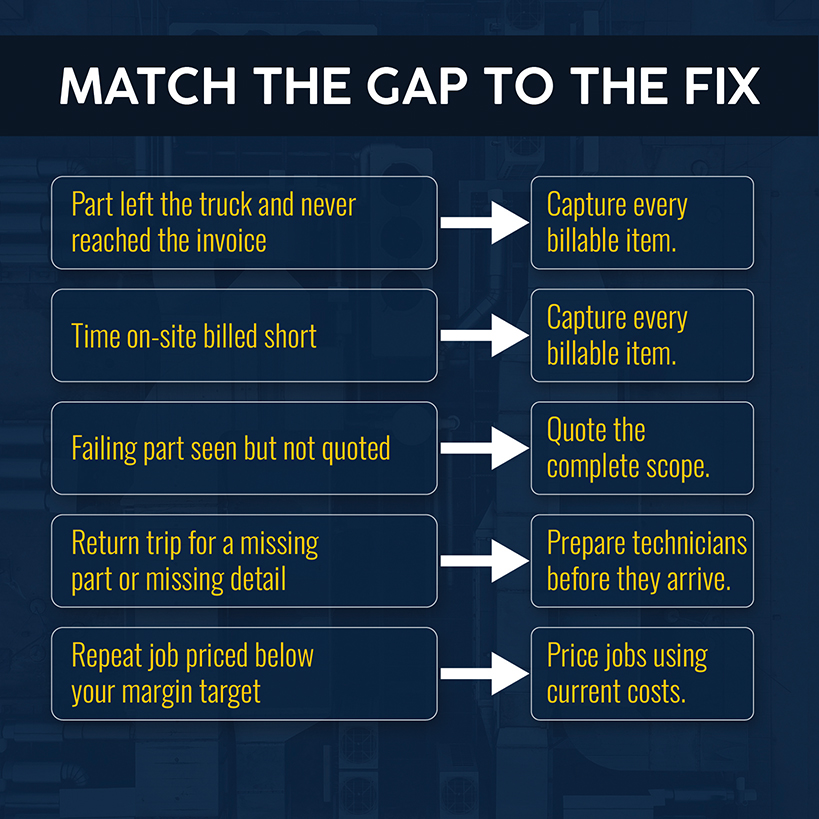
Your average job ticket can decline for four reasons:
Stale pricing. An outdated price book can underprice every ticket from the start. Federal producer price data shows nonferrous metals, a category that includes copper, up 33.0% in the 12 months ending August 2026. When costs jump like that, your margin shrinks unless your pricing keeps pace.
Unbilled work. This shows up when techs grab parts off the truck without invoicing, fail to log extra time, or don't record small tasks. If each of your six trucks excludes, on average, one $18 part per day, that adds up to $27,000 over a working year.
Partial scope. Are your techs writing up everything they spot, or just the problem they were called out to address? Failing to quote additional work is a missed revenue opportunity. Best case, it turns into a second ticket that drags down your average. Worst case, the customer goes with someone else.
Unprepared techs. A tech who arrives without the site's service history or equipment details can diagnose the problem. But they might lack the right part or model information to fix it, which creates a costly return trip.
Before addressing these four causes, rule out job mix. A busy tune-up season can reduce the blended average without changing your pricing. Compare average ticket size within each group on a month-over-month basis. If a group's average holds steady while the blended number falls, your job mix is the cause.
The operational fix, in order:
- Pull 10 invoices per tech.
- Match each against truck stock, time records, and the tech's notes.
- Tally what's missing by category.
The biggest category tells you which fix to start with.
Related: Our breakdown of lost job margin shows where the money slips out between the jobsite and the office.
How to Increase Your Average Ticket Without Relying on Upselling
The following recommendations affect every phase of a job. The goal for your average ticket is to raise it without upselling. The first five tips tighten up what you already do on calls. The last four change what you show the customer and how you read the results.
Price Jobs Using Current Costs and Margin Targets
Any pricing strategy starts with a properly built labor rate. The Bureau of Labor Statistics lists total employer compensation in construction at $51.96 an hour as of June 2026: $36.13 in wages and $15.84 in benefits. That's before truck costs, overhead, and unbilled time. If your billed labor rate doesn’t account for these factors, you might be losing money every hour.
Markup and margin are easy to confuse, and the mistake costs you money. Markup is the percentage added to your cost. Margin is the share of the sale price you keep. If you mark up a $90 part by 40%, you charge the customer $126, which is a 28.6% margin. But to earn a 40% margin, you’d need to charge $150.
Simpro® applies markups at the item or group level in its catalog, so one cost change updates each relevant price. Simpro supplier catalog importing compares live prices across suppliers, while the price discrepancies report shows where a billed price drifted from the book. Review the book quarterly, or whenever a supplier updates costs.
Related: For the cost-floor math behind a current price book, see our guide on how to price HVAC jobs.
Quote the Complete Scope of Work From the Start
Technicians often spot other issues while diagnosing whatever they were called out for. Failing to quote everything means a second truck roll — and a lower average ticket price.
Write up every item, price it, then let the customer decide what gets done now and what waits. Writing up the full scope on a $420 blower motor ticket, for instance, adds significant revenue potential from a $145 capacitor and $125 condensate line flush, but the customer still approves each line.
Pre-builds in Simpro bundle labor and materials into one billable line, so a tech can quote the full scope on-site, capture a signature, and start work without waiting on the office.
Capture Every Billable Item Completed on the Job
Enhanced Electrical, a 25-person contractor in Sparks, Nev., routinely faced weeklong jobs that generated pages of write-ups. With so much calculation by hand, receipts piled up, and materials went untracked. The owners knew they weren't billing for everything.
After moving to Simpro, materials were entered on the job, techs collected payment on service calls, and billing was accurate. Weekly invoicing time fell from 25–30 hours to 5–10.
The operational fix: Reconcile truck stock withdrawals and time records against every invoice before it goes out. A daily/weekly split keeps it manageable: time records daily, truck stock weekly. Flag anything from the truck report or clock that doesn’t make the invoice, and find who owns it.
Related: See how location-aware prompts help trades businesses ensure accurate labor tracking.
Prepare Technicians Before They Arrive On-Site
When your techs make a diagnosis but can’t fix the problem, you’re paying for two truck rolls on one ticket. Worse still, if they don’t have job history, they might waste time diagnosing something the last tech already found.
Fixing this starts with better data-sharing that empowers dispatch to assign the right tech to the right job — ideally with a pre-job briefing that provides context and tells them everything that should be on the truck.
JobReady, Simpro's AI job preparation agent, briefs the assigned tech before each job with job history, site notes, parts requirements, and context from earlier visits.
Related: See why a morning job brief is essential for technician job preparation.
Standardize Inspections and Diagnostic Workflows
Two techs can visit the same furnace and create very different writeups. One finds the failing igniter and the dirty flame sensor. The other replaces the igniter and leaves.
A standard checklist per job type closes that gap. Build it from whatever your best tech checks without being asked. Keep the checklist short enough that techs can complete it on every call. Make sure the outcome gets shared in job notes.
A no-heat checklist covers the igniter and the flame sensor. A plumbing call covers shutoffs and water heater age. Photos attached to the findings turn them into evidence for the options that follow.
Digital forms in Simpro's field app put the checklist on the tech's phone, ensuring the answers land in the job record instead of on a clipboard.
Bundle Related Work When It Saves the Customer Time or Cost
Bundle only when the customer comes out ahead. Anything else drifts into upselling and cross-selling.
For example, a water heater swap that includes the expansion tank and a new shutoff valve takes one visit, whereas the same work sold separately would require two visits, along with a service fee. Quote all three together, and the customer saves time and money.
Save bundles for the work you're sure about. Otherwise, give the customer options they can weigh against their budget.
Give Customers Clear Options Instead of a Sales Pitch
When customers face a yes-or-no question, you risk losing them unless it’s an emergency. That’s why many contractors use a good/better/best pricing strategy, which gives budget-conscious customers a viable option while offering add-ons at higher prices. In most cases, customers gravitate toward the middle tier because it feels like the best value for their money.
On a no-cool call, the “good” option repairs the failed capacitor, the “better” option replaces the capacitor and the aging fan motor, and the “best” option prices a full condenser replacement. Build each as a pre-build in Simpro so that your sell price calculates from real costs. Track your conversion rate after you add options. A higher average ticket doesn't help if fewer customers approve the work.
Use Service History to Identify Work That Is Already Due
Equipment records show what's due on schedule, such as filters, belts, water heater anodes, and backflow tests. A well-documented service history lets you recommend work based on evidence, such as the date of last service and a current photo, to make the conversation more of a service reminder than a sales pitch.
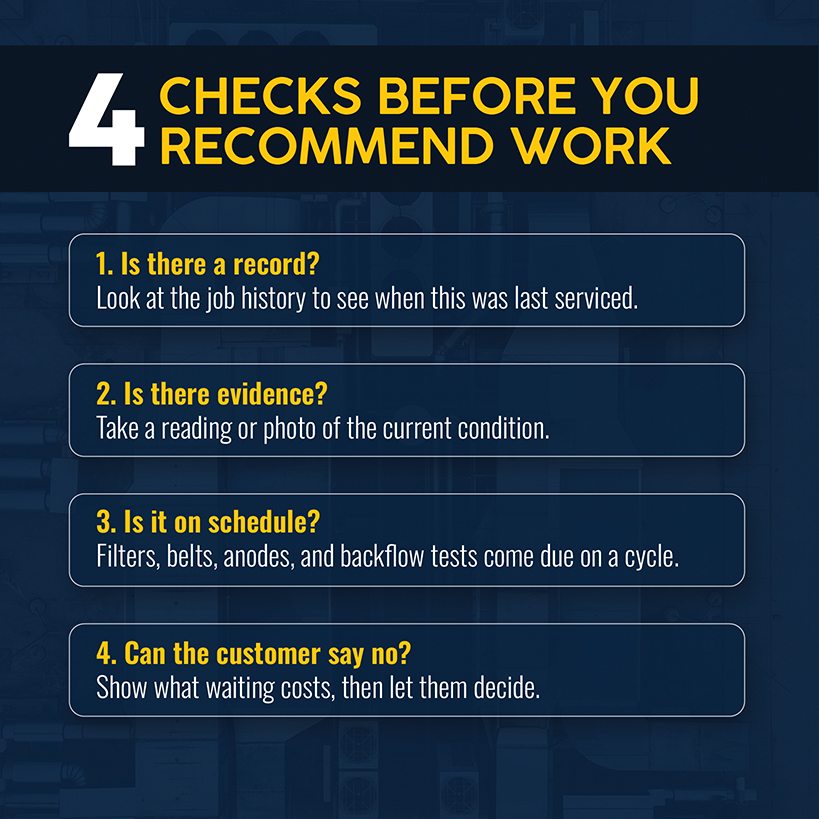
Simpro connects asset history to each tech's device in the field, while the Maintenance Planner forecasts asset servicing, so due work shows up before the visit.
Review Your Job Mix, Not Just Individual Tickets
Let’s say that a typical month sees you run 200 repairs at $640 each and 100 tune-ups at $140 each. Your average ticket is $473. If you leverage social media platforms to book 100 more tune-ups before cooling season, you’ll significantly boost your customer count while reducing the average ticket rate to $390. You’ve booked more capacity but at a lower number.
Instead of reporting on blended average ticket size, segment the report by job type and tech (and by division if you have more than one). Simpro's BI Reporting filters job data by job type, so you can compare average estimated and actual gross margin for each.
Track Average Ticket Alongside Profitability
Average ticket size can climb for reasons that hurt the business. Offering discounts on installs can add more large jobs to the mix, lifting the average ticket while shrinking the margin on each one.
To catch this, track average ticket, gross margin per job, and callback rate monthly. Margin shows whether bigger tickets still pay, while callback rate hints at possible customer satisfaction issues. If average ticket and margin climb together, your pricing and scope changes are working. If ticket size climbs while margin falls, look at your discounting. If callbacks rise, look at job quality.
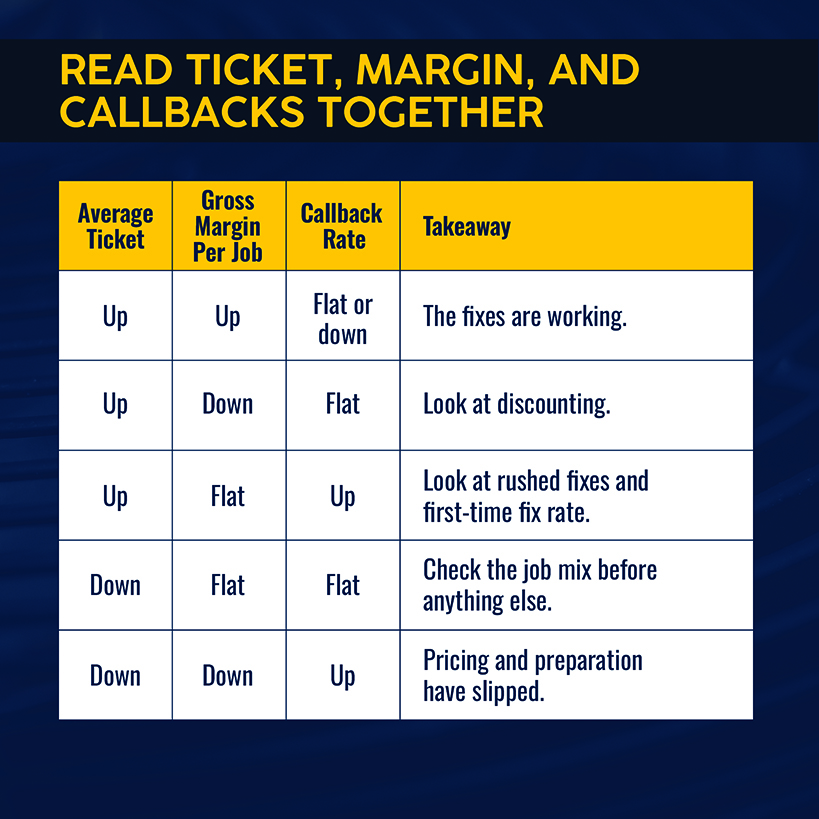
Simpro's Profit and Loss by Job report shows margin on invoiced jobs and lets you find the ones below your target margin.
Related: Our guide to the field service KPIs worth tracking explains how metrics differ from KPIs and which ones belong on your dashboard.
Set a Useful Average Ticket Target for Your Business
Every contractor needs to determine the average ticket based on their metrics, lines of business, and cost factors. For reference, an ACCA survey of more than 1,000 HVAC contractors found an average service ticket of $422 ($390 residential and $516 commercial). But your average ticket target will probably look different if you’re also offering plumbing and electrical services.
Build your target from your own invoices. Look at the trailing 12 months, segment by trade and job type, and set each target as your current average plus what the audit recovered.
If repair tickets average $640, but the invoice audit turns up $48 per ticket in unbilled parts and time, closing that gap means billing $688 — a 7.5% increase without changing the underlying product. Revisit the targets and your price book quarterly, or whenever the mix shifts. For example, a rapidly scaling maintenance business or loyalty program should prompt a review, since maintenance visits can pull the blended average down.
Increase the Value of Every Job With Better Operational Visibility
Identifying where you’re leaking average ticket size is step one. The more difficult challenge can be closing the gap across every tech and every truck, especially if you’re relying on spreadsheets and clipboards instead of unified software.
Simpro is purpose-built for the trades, more specialized than generic small-business tools, and ties the pieces together. The catalog reprices from supplier costs, field capture flows to the invoice, job history reaches the tech before the visit, and job-level margin reporting shows where a ticket landed. Every invoice matches the work being performed, with full visibility in the field and at the office.
Schedule a demo to learn how Simpro supports more than 250,000 users worldwide.


 Back to top