
You booked 40 calls last month. Ran 28 estimates. Closed 12 replacements. The revenue landed, but the math doesn't feel right, and you're not sure where the jobs are slipping away.
This guide is for HVAC business owners, ops and service managers, and comfort advisors trying to close more replacements. It covers 11 ways to attract more leads, convert more of what you already have, and build recurring revenue that makes the next quarter easier.
Let’s get into it.
What "More HVAC Sales" Actually Means
For most HVAC companies, growth comes from one of five places:
- More booked calls — getting more of your leads to actually schedule
- More estimates run — making sure every call that should get a quote gets one
- Higher replacement close rate — aiming for the industry average of 43% or higher
- Higher average ticket — growing (ethically) by presenting the right options at the right time
- More recurring revenue — maintenance plans that lock in repeat business before they shop around
Most of the 11 strategies below move at least one of those numbers. Some strategies can affect multiple numbers at once.
Set Up Your HVAC Sales Tracking First
Before adding new tactics, you need to know what's happening in your business. Start by determining your close rate by job type, main lead sources, and average ticket by service category.
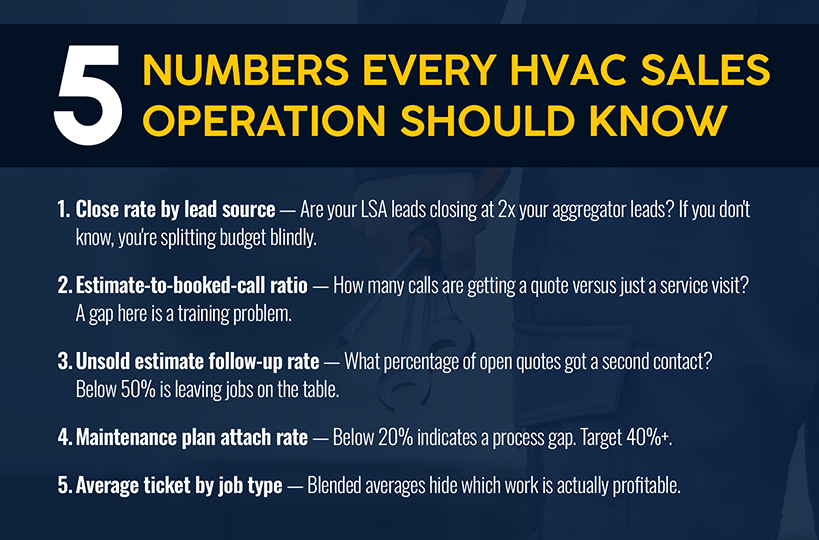
The shortcomings are usually obvious. The close rate is fine, but estimate volume is low. Or the leads are there, but call handling loses 30% of them before they book.
Your HVAC estimating process and lead source data are the two places to start. If you can't pull either in under five minutes, that's the first fix.
11 Proven Ways to Get More HVAC Sales
So, your estimating process is great. Now what?
Every HVAC company's ceiling is different. Some undersell existing customers. Some lose leads on the phone. Some run good estimates but still lose on price.
You can pick strategies that match where your target number is stuck. Here are 11 places to start.
1. Win Local Demand With Google Business Profile and Service-Area Pages
Your Google Business Profile is the lowest-cost, highest-impact sales/marketing tool you have. When someone searches "AC repair [your city]," they need to see you in the map pack.
Make sure your profile is complete: hours, phone number, service categories, and (high-quality) photos. Consistent NAP (name, address, phone) across directories keeps your local ranking clean. Add service-area pages to your website for each city or ZIP code you operate in. These pull in long-tail local searches beyond what your Google profile covers.
The operational fix: Audit your Google Business Profile listing this week. Build or update one service-area page for every leading ZIP code.
2. Use Google Local Services Ads to Capture High-Intent Calls
Google Local Services Ads (LSAs) put your business at the top of search results (above the map pack), and you pay per lead, not per click. The "Google Guaranteed" badge carries weight for customers choosing between HVAC contractors they've never heard of.
LSAs work best for high-intent keywords: "emergency AC repair," "furnace not heating," "HVAC company near me." They cost more per lead compared with most lead generation channels, but close rates are higher because the intent is there.
Running LSAs alongside organic search ensures your HVAC services are visible at every stage of the customer's decision. This fits nicely into a broader set of HVAC marketing strategies that build a pipeline across channels.
The operational fix: If you're not running LSAs, start the verification process now. Approval takes time.
3. Build a Review System That Runs Every Week
Over 90% of potential customers check reviews before calling. A contractor with 80 reviews and a 4.7 rating will take work from a contractor with 12 reviews and a 4.2 rating — even if the work quality is identical.
Reviews are one of the fastest ways to build trust with potential customers before they call. Set up a post-job text that triggers when a work order closes, along with a direct link to your Google review page. The window closes fast: Ask within a few hours, not a few days.
The operational fix: Build a review request into your job-close workflow. Make it an automatic workflow.
Hint: Simpro® software can do this for you automatically with our GiveMe5.ai integration.
4. Fix Call Handling So More Leads Turn into Booked Jobs
Your phones are where HVAC leads die. A customer calls, gets put on hold, calls back, gets voicemail, and books a competitor within 20 minutes.
Responding to HVAC leads within 5 minutes produces 9x higher conversion than waiting 30 minutes. For every call that goes to voicemail without a callback, conversion drops to near zero. Train call handlers to ask the right questions, confirm availability in real time, and book on the first call. If after-hours calls are going unhandled, a live answering service is worth the cost.
The operational fix: Track your missed call rate for one week. Above 10%? Fix this leak before anything else.
Hint: Simpro has an integration with a hyperrealistic AI receptionist who will never let you miss a call again.
5. Treat Every Web Lead Like a Live Phone Call
Form fills on your website are leads. Most HVAC companies respond within hours. By then, the customer has called two other contractors and booked one.
What you need is a text or email that fires immediately after a form submission, confirms receipt and offers to book directly. Speed matters more than personalization at this stage.
With HVAC leads across channels, remember that different sources convert at different speeds. Web forms sit in the middle of that spectrum.
The operational fix: Submit your own web form and time the response. More than 15 minutes during business hours? You’re losing revenue.
6. Convert More Service Calls Into Replacement Opportunities
When a tech tunes up a 12-year-old air-conditioning unit, they should mention replacement options. Not doing so leaves revenue on the table and leads to customers whose systems fail in August.
Consider customers with an HVAC system over 10 years old. When techs introduce replacement conversations, the close rate is 80% to 85%, versus 40% to 50% for cold leads. Trust is already established. The tech documents their findings, explains the repair-versus-replace math, and offers a path forward.
The operational fix: Build a tech inspection checklist with a “system age” field and a "replacement conversation recommended" flag. Route flagged jobs to a follow-up call within 48 hours.
7. Present "Good, Better, Best" Options to Increase Close Rate and Ticket Size
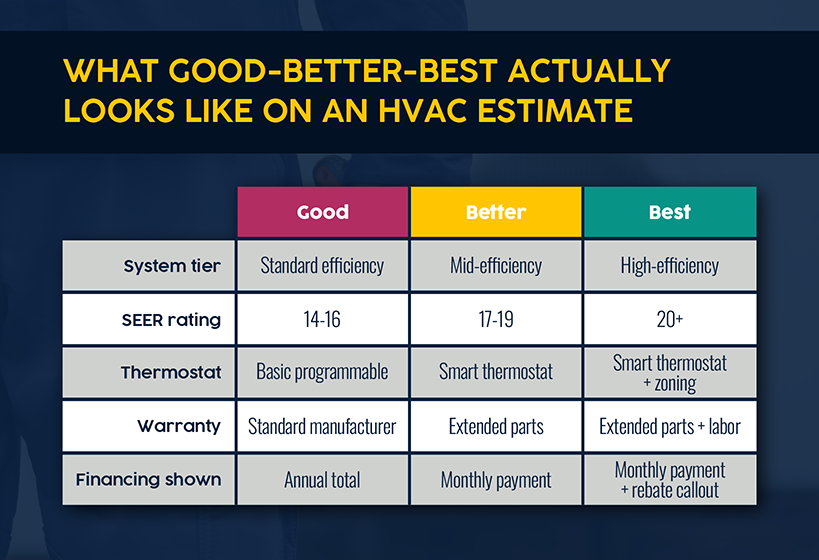
Most HVAC contractors present one price. Customers can say “yes,” “no,” or ask for a discount.
Contractors who offer four proposal options (different SEER levels, equipment tiers, thermostat packages, financing terms) close at 52%, versus 42% for contractors offering 1–3 options.
Only 10% of HVAC companies do this consistently. When customers choose between your tiers, they're comparing your options against each other, not your price against a competitor.
Your HVAC profit margins also differ based on equipment tiers. Tracking which tier you're selling most is the only way to know if “good-better-best” is working.
The operational fix: Build three standard replacement packages in your estimating tool. Get away from custom quotes, which slow the sales process and create inconsistency.
Related: For more on estimates that convert, read our guide to the HVAC estimating process and our article on writing "good-better-best" proposals.
8. Offer Financing on Every Replacement Estimate
Contractors who always present financing options close 18 percentage points more financed jobs than those who don’t. When you lead with a monthly payment instead of the total price, 42% of customers finance. Lead with the total price, and that drops to 21%.
Financing also pushes customers toward better equipment. When the monthly payment difference between mid-tier and premium is $30, more customers choose premium. For customers hesitating on a $9,000 system, answer the budget question in the estimate.
The operational fix: Add financing terms to every replacement estimate, with the monthly payment prominently displayed.
9. Follow Up on Unsold Estimates With a Simple Cadence
Most HVAC companies present a replacement estimate and follow up once (if at all). A customer who was interested but not ready gets one email and then silence.
A three-touch cadence changes that:
- Day 1: Confirm the quote and offer to answer questions.
- Day 4: Note that pricing or availability may shift.
- Day 10 or 14: Do a final check-in.
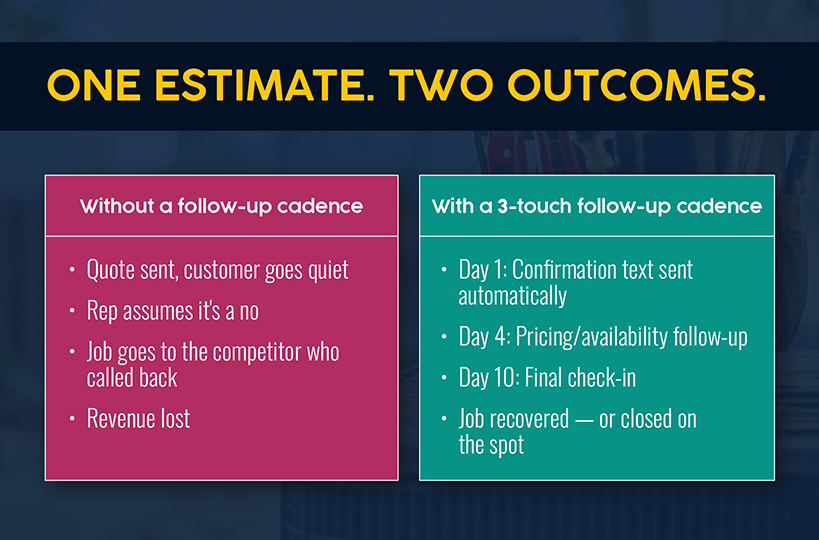
With HVAC software that tracks open quote status, this runs automatically. Businesses using Simpro report up to 30% productivity increases, in part because follow-up workflows run without manual tracking.
The operational fix: Pull your last 30 unsold estimates. If you can't say what happened to each one, you need a system to track them.
10. Build a Referral Program Customers Actually Use
Word of mouth produces close rates between 60% and 85% from neighbor recommendations. But most HVAC companies wait and hope, rather than build a system. Offer a gift card or discount for referrals that convert. Make it easy to refer: a text link after a positive job, a note on the invoice, a mention on the door hanger.
Choose multichannel marketing that adds email campaign touchpoints and direct mail to your online presence. You’ll generate 15% to 22% higher average tickets than single-channel approaches. Greater brand familiarity reduces price sensitivity at the point of sale.
The operational fix: Define what a referral is worth in increased HVAC revenue. If a referred customer is worth $800 on average, a $50 gift card is a 16:1 return.
Related: A referral program is one piece of a broader marketing strategy.
11. Use Maintenance Plans to Lock In Repeat Business and Increase HVAC Revenue
Seventy-eight percent of maintenance agreement customers buy replacements from their existing HVAC professional. A customer on a plan is the highest-probability replacement sale you have. And that conversation happens during scheduled visits.
Monthly billing converts twice as many customers into plans as annual billing upfront. Tiered options (Basic, Premium, Elite) capture 40% more revenue per customer than single-tier programs. At every visit, the tech is positioned to renew the plan, add air conditioning accessories, and flag systems approaching replacement age.
Done consistently, maintenance plans build customer relationships that span the next replacement cycle and improve the overall customer experience.
The operational fix: Track your maintenance agreement attach rate. Below 20% is a process gap. Target 40% or higher.
Build a Sales System That Works When You're Slammed
The issue isn't knowing what to do. These strategies require consistency, and consistency breaks when your team is too busy or running on manual processes.
The HVAC companies that grow long term build systems that run regardless of headcount or season. These systems include: automated review requests, quote follow-up sequences, maintenance plan renewal reminders, and tech inspection flags that trigger advisor calls.
Across the HVAC industry, the gap between operators who scale and those who grind comes down to process consistency, not effort.
Simpro® is built for trade businesses running these workflows. HVAC software that connects field operations to the sales process means tech findings flow into follow-up tasks, open quotes get tracked, and customer history is visible before every call. Over 24,000 businesses use Simpro to manage operations and pipeline, with users reporting 25% revenue increases and 10x faster estimates. If you're working to protect HVAC margins with AI as costs rise, that kind of efficiency compounds fast.
Ready to stop losing jobs you already earned? Schedule a demo, and see how Simpro connects your operations to your sales numbers.
Frequently Asked Questions About How to Get More HVAC Sales
How much should an HVAC company spend on marketing?
Most guidance targets 5% to 10% of gross revenue. LSAs and Google Business Profile optimization have lower cost per sale than most paid channels. Referral programs cost less and return more. Combining email campaign touchpoints, direct mail, and digital generates 15% to 22% higher average tickets than single-channel approaches.
What is a good HVAC close rate for service calls versus replacements?
The industry average for replacements is 43% overall: 45% residential, 38% commercial. Contractors who present “good-better-best” options and consistently offer financing will close at 52% or higher.
How long does it take to see results from HVAC marketing? What about SEO versus ads?
LSAs and Google PPC can drive calls within days but cost more per sale. SEO compounds over months — organic leads convert at around 50% once the content ranks. Run LSAs for immediate pipeline, and build SEO for long-term cost reduction.
How do I train HVAC technicians to sell without sounding pushy?
Frame it as helping the customer make an informed decision. A tech who explains the repair-versus-replace math and shows what a 13-year-old heat pump will cost over the next two winters is doing customer service, not selling. Train techs to document findings and offer a path forward. Tie incentive structures to maintenance plan attach rate (not just revenue) to reinforce the right behavior.


 Back to top