
A digital worker in field service is a role-shaped AI agent, or set of agents, assigned defined daily work inside approved systems and guardrails. It prepares, monitors, documents, communicates, recommends and escalates. Employees still own safety, accountability, empathy, policy and consequential decisions. It works with people, not imitating them.
That applies a broader idea Simpro CEO Fred Voccola has been discussing: AI is moving from a technology employees use to a worker assigned recurring responsibilities. His interviews establish the workforce thesis. The field-service framework defines where that digital work stops and human judgment begins.
| Field-service responsibility | Digital worker | Human employee |
|---|---|---|
| Preparing known job information | Assemble and summarize records | Confirm unusual or safety-critical context |
| Monitoring repeatable workflows | Detect triggers and complete approved steps | Define rules and review performance |
| Routine customer communication | Prepare or send approved updates | Handle disputes, distress, negotiation and ambiguity |
| Recommending an operational action | Rank options using available data | Approve consequential exceptions |
| Emergency, safety or compliance decisions | Surface evidence and escalate | Make and own the decision |
| Changing policies or permissions | No independent authority | Set boundaries and accountability |
| Reviewing outcomes | Record actions and surface patterns | Audit performance and improve the process |
Part 1: What Fred Voccola says about digital workers
Across the two interviews, Voccola describes digital workers as AI assigned recurring work, supported by business data and working alongside employees. He says the current effect is more augmentation than replacement, while acknowledging displacement. People still define desired outcomes, question processes, measure what machines produce and retain accountability inside this model.
| Fred's verified idea | What it means | What it does not establish |
|---|---|---|
| AI takes on workflows | Defined execution moves from a person using a tool to an agent carrying the work | Software has human identity or judgment |
| A digital worker sits beside an employee | AI and people contribute different kinds of work | AI automates every employee decision |
| People design and measure outcomes | Employees still direct the work and evaluate its output | AI independently owns business accountability |
From software tool to a type of worker
In an August 23 Channelholic interview, Voccola discusses AI agents that do more than accelerate workflows. The article describes Simpro and another vertical software company as offloading workflows to agents, or digital workers, as he calls them.
For this article, the practical distinction is that a faster tool still waits for an employee to open it and act. A digital worker receives an operational responsibility that returns every day.
Voccola also says digital workers learn from systems of record, which hold domain-specific business information. His stated aim is for a digital workforce to augment or supplement the human workforce.
Channelholic also reports stronger cost, profit and replacement claims. This article does not rely on them.
More augmentation than replacement, so far
In an August 10 Schwab Network interview, Voccola addresses the tension directly. He says AI augments workers and also replaces workers in specific roles. His assessment is that the effect has so far been more augmentation than replacement, in part because skilled workers are in short supply. He also warns that displacement is real.
Voccola then describes the organizations getting value from AI as thinking beyond a technology purchase. They treat AI as another kind of worker that sits alongside a human employee. That is the heart of his digital-colleague idea: the technology joins the flow of work instead of remaining a separate experiment.
People still design the outcome
The Schwab conversation also identifies work people continue to do. Voccola says employees define the desired outcome, push suitable execution to the machine and measure what it produces. Later, drawing on his work at Florida International University, he argues that using AI as an assistant or digital partner develops critical thinking through ongoing dialogue.
Those points do not supply a complete governance model. They establish a useful starting position: AI carries more of the execution, while people question the process, direct the outcome and evaluate the result.
Part 2: What a digital worker in field service means
Voccola's interviews describe a broad workforce shift. In field service, the idea means assigning recurring, data-supported work to role-shaped agents while employees retain safety, policy, empathy and consequential decisions. The framework helps businesses decide which responsibilities belong in field service management software and which require an employee's judgment, authority and accountability.
The phrase describes an operating model, not a human identity. IBM describes digital workers as software-based labor that performs meaningful parts of a process with employees. For field service, the practical distinction is between an action, an answer, an outcome and an ongoing responsibility.
What makes a digital worker different from ordinary automation?
| Model | What it does | Who initiates the work | What it owns |
|---|---|---|---|
| Rules-based automation | Repeats a fixed instruction | A trigger or user | One predefined action |
| AI copilot | Suggests or generates an output | A person | Advice or content |
| AI agent | Pursues a defined outcome using tools | A person, event or schedule | A bounded sequence of tasks |
| Digital worker | Performs recurring work associated with an operational role | The operating workflow | Defined daily responsibility with escalation |
These categories overlap. Digital workers combine rules, generative AI and one or more agents. What makes the model work is its operating contract: recurring work, authorized actions, a completion standard, visible performance and a path back to a person.
For the underlying mechanics and rollout sequence, see the agentic AI for field service guide.
Where digital work ends and human judgment begins
The opening matrix maps accountability, not tasks AI never touches. In a safety workflow, the digital worker surfaces evidence and tracks approved steps. An authorized employee still controls safety policy, resolves ambiguous context and owns consequential exceptions.
The NIST AI Risk Management Framework Core calls for clear human-AI roles, responsibilities and oversight. In field service, every delegated workflow needs a named human owner who sets permissions, reviews failures and decides what happens when the data is incomplete or the stakes change.
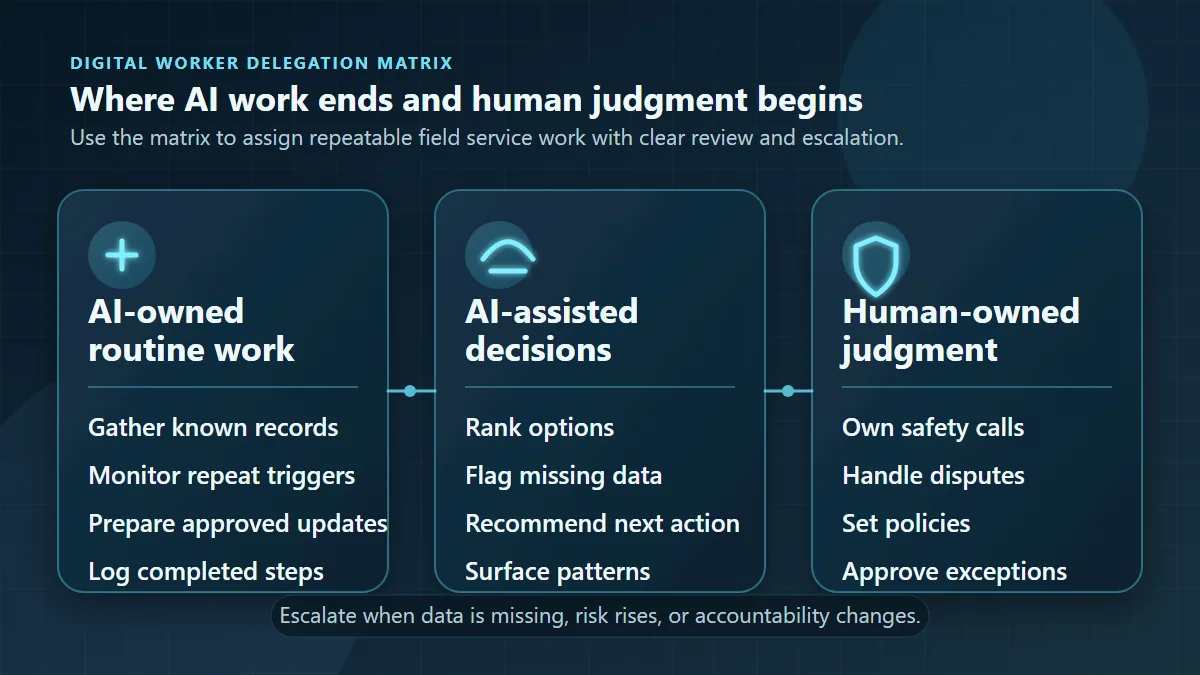
Customer emotion creates another boundary. An approved appointment update is routine. A complaint about damage, a distressed customer or a negotiation about responsibility is not. The words look similar in a system, but the judgment and accountability are different.
How agents become a digital workforce
Dependable delegation needs six conditions: a defined role, reliable and permissioned data, limited authority, visible actions, explicit escalation conditions and a human owner. The goal is not maximum autonomy. It is assignable, observable and correctable work.
Moreover, in a public conversation about how AI is changing work in the trades, Voccola gives a field-service example involving an AI agent assigned recurring preparation around a job. The useful takeaway is that scattered preparation work becomes visible, assignable and reviewable. The agent does not become the technician or dispatcher.
How Voccola's Digital Worker Applies to Field Service
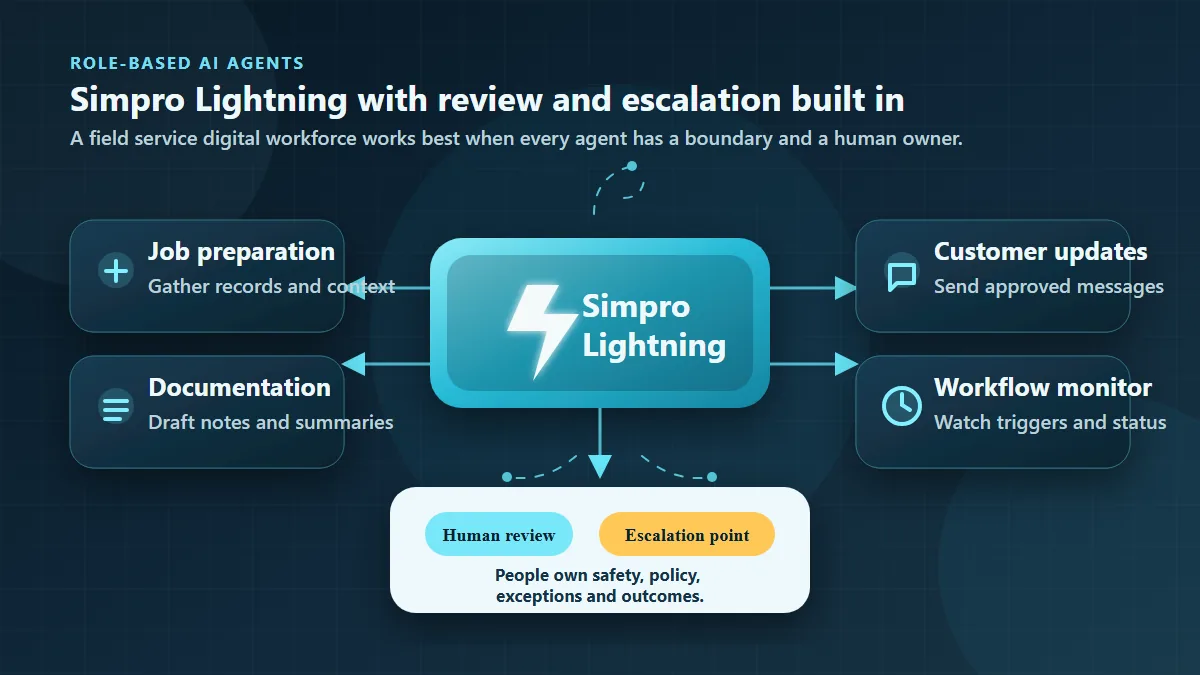
Use the division-of-labor framework as a practical lens for evaluating Simpro Lightning AI field service agents. Start with the operational responsibility, then identify the data, authority, completion standard, escalation conditions and accountable employee around it.
This order matters. Choosing a task because AI performs part of it is not the same as defining work that is safe to delegate. A useful role has a clear boundary. The agent's permitted actions are visible, and a person knows when and how to intervene.
For example, before delegating preparation work, specify the agent's permitted data sources, what a complete preparation package contains and which missing or conflicting details require review. Apply the same logic to documentation or customer communication. The operational role changes, but the human accountability test does not.
5 checks before assigning work to AI
Use these questions as a decision test for any proposed digital worker:
-
Is the outcome specific enough to measure? Define what completed, correct and on time mean.
-
Does the agent have reliable and appropriately permissioned data? Identify the source of truth and the access boundary.
-
Does the system preserve observable, explainable and reversible actions? Make review and correction part of the workflow.
-
Which conditions require immediate escalation? Include missing data, safety risk, customer distress and policy exceptions.
-
Which employee remains accountable for the result? Name the owner before the agent starts work.
If the accountable employee cannot answer all five, the workflow is not ready to delegate. Narrow the role, improve the data or strengthen the checkpoint first.
Build a mixed workforce, not a workerless business
Voccola's thesis is that AI is becoming a category of worker assigned real workflows. The field-service application is dependable delegation with retained human accountability. Bounded daily work moves to the digital worker. Employees remain responsible for judgment and consequences.
Start with one recurring responsibility, an owner and one escalation path. When the result is dependable, expand the role.
Explore AI field service management today and use this framework to evaluate where digital work belongs around your field service team.


 Back to top