
You already know you can and should be using AI to streamline your plumbing business, but for most people, it feels overwhelming to get started.
Does this sound familiar?: your phone rings at 11 p.m. A customer has a blown water heater and wants someone first thing tomorrow. By the time you call back at 7 a.m., they've already booked with someone else.
That's one version of the problem AI can solve in your plumbing business. Revenue that walks out the door after hours.
Here's another: Your best tech wrapped the last job at 4:30 p.m. but has to spend 45 minutes writing notes, updating the work order, and texting the customer a summary. None of that output is billable.
Artificial intelligence (AI) doesn't fix every problem in a plumbing business. But it can handle overnight calls and technician busywork, plus a dozen other problems that eat into margin every week. This guide will prime you on getting your own AI workflows set up by showcasing how other plumbing businesses have been successfully using AI, and give you some momentum towards rolling them out in your business.
How Plumbers Are Using AI Tools to Run and Grow Their Business
AI's most productive application for plumbing companies is a set of automated workflows in places where time and money leak. Here are some ways AI is revolutionizing plumbing, along with concrete ways to improve your business.
1. Answering Calls and Capturing Leads 24/7
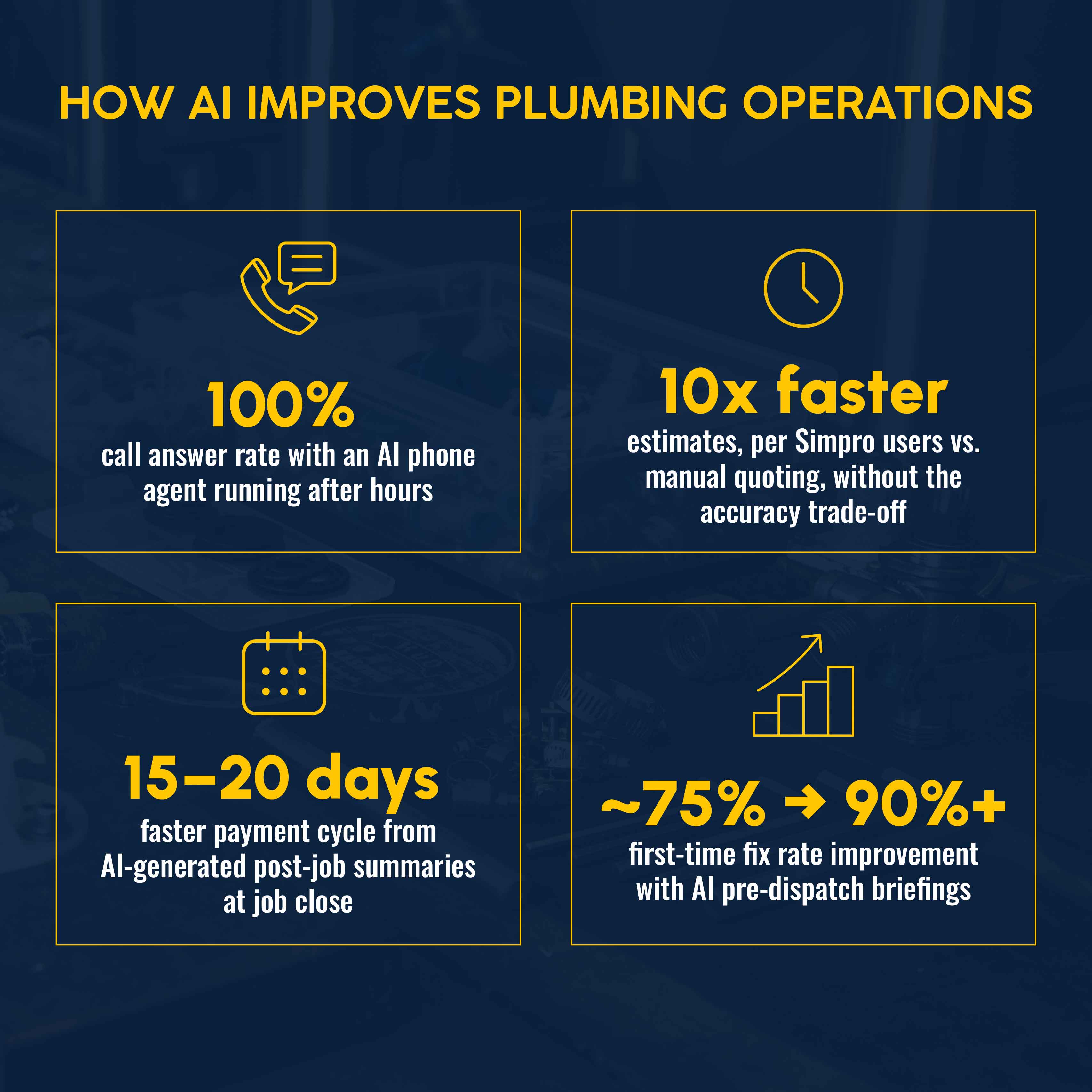
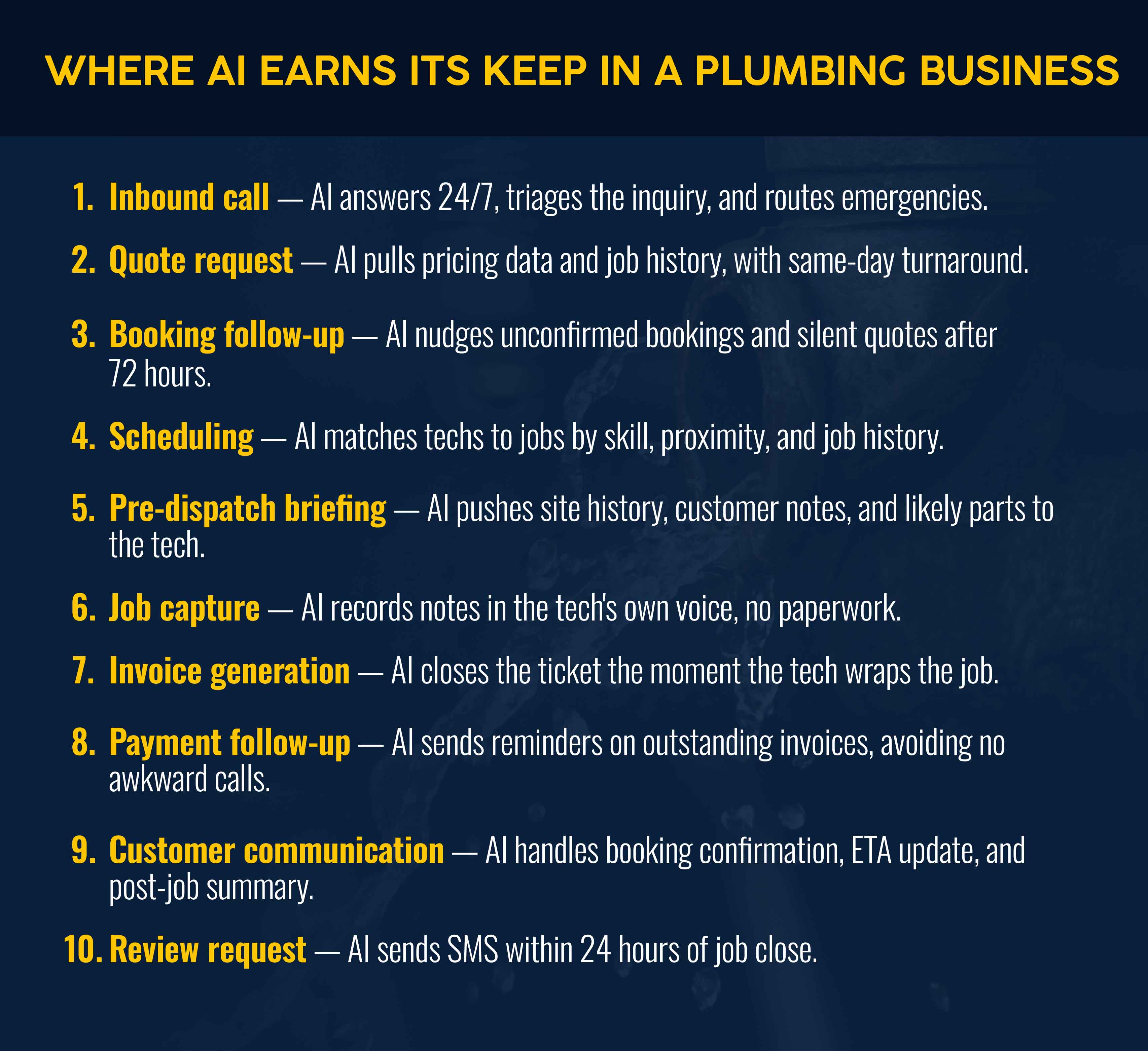
When customer calls go unanswered during after-hours, lunch, and peak job hours, you're losing potential leads and maybe even giving business to the competition. But AI call agents answer immediately, around the clock. Agents triage the inquiry (emergency dispatch for burst pipes or water damage, standard booking for everything else), handle service requests, answer frequently asked questions, and schedule appointments.
AI phone agents ensure every call is answered, eliminating the missed calls that cost plumbing businesses leads, especially after hours. For a 10-tech shop running $2 million–$3 million in annual revenue, that's a massive improvement.
The operational fix: Implement an AI call-answering tool that integrates with your scheduling software, answers common questions, and flags emergencies.
2. Booking Jobs and Automating Follow-Ups
Do your bookings take three interactions (initial call, callback for details, confirmation) and burn 20 minutes of office staff time on every job? Unconfirmed booked jobs cost your team follow-up time they don't have. AI booking tools, by contrast, can confirm appointments, send automated reminders, and follow up with customers who haven't responded.
Quote follow-ups deliver the clearest return. A customer who requests an estimate but then goes quiet could become a closed deal with the right nudge. AI tools can check in at the right time without staff remembering to do it.
The operational fix: Set up automated follow-up sequences for unconfirmed appointments and open quotes. If a quote sits for 72 hours without a response, the system sends a reminder. Your office manager doesn't have to do it.
3. Scheduling and Dispatching Technicians More Efficiently
Scheduling is a constraint problem: Various skills, different locations, and jobs of differing urgency and duration. Manual daily adjustments create time pressure, all while working with incomplete information.
AI algorithms match techs to jobs based on skill, proximity, availability, and job history. Smart scheduling produces 67% fewer job delays per week and 29% more on-job productivity, according to McKinsey research cited by Skedulo. With fewer job delays, that means more time for more jobs per tech, per day.
For a 10-tech operation, the ability to automate scheduling and take back drive time means recoverable billable hours every week.
The operational fix: Run a one-week audit on your current dispatch. How many jobs were delayed because a tech arrived unprepared, was too far away, or lacked the right skills? Use that baseline to measure improvement after adding AI scheduling.
4. Creating Faster Estimates and Quotes
A customer who waits three days for an estimate will find someone who offers a same-day turnaround. Slow quotes lose jobs.
AI estimating tools pull from your pricing database, job history, and material costs to generate accurate quotes faster. When estimating becomes AI-driven, contractors can automate up to 80% of the manual takeoff process, saving roughly 90 minutes per sheet and enabling contractors to bid on 2–3x more work with the same team. Simpro® users report estimates up to 10x faster than manual quoting — without sacrificing accuracy.
The operational fix: Measure how long standard residential jobs take from inquiry to quote. If it's over 24 hours, invest in quoting automation.
5. Speeding Up Invoicing and Payment Collection
The gap between job completion and invoice delivery is a cash-flow problem dressed up as a process problem. Techs who wrap a job at 4 p.m. and do paperwork at 9 p.m. inadvertently create a one-day delay on every invoice. Now multiply that by every tech, every day.
AI invoicing saves time every time a job closes, as invoices are generated automatically from time logs, parts used, and field-captured job notes. Automated payment reminders follow up on outstanding invoices without anyone needing to call. In tested deployments, AI-powered accounts receivable solutions can reduce the cost per invoice from $20 to less than $3.
The operational fix: Move invoice generation from end-of-day batch processing by automating whenever a job closes. Every day you compress in the invoice cycle is a day you recover in cash flow.
6. Improving Customer Communication
When customers don't hear from your business between booking and job completion, they fill that silence with anxiety, and that turns into calls to the office. AI tools can handle customer interactions and free up bandwidth for your team: booking confirmations, tech-on-the-way notifications, post-job summaries, and follow-up satisfaction checks.
The numbers back this up. 97% of local consumers read online reviews, and 80% are more favorable to businesses that respond to each review. How your company communicates after the job directly correlates to whether a satisfied customer leaves a review.
The operational fix: Automate at least three touchpoints: booking confirmation, day-of-arrival window, and post-job summary. These messages eliminate the most common reasons customers call back asking, "Where is my tech?" or "What did they do?"
7. Managing Reviews and Local Reputation
A consistent stream of five-star reviews in Google Maps is a competitive advantage that compounds. Plumbing businesses that request reviews reliably and respond to them rank higher in local search and convert more searchers into callers.
AI tools request reviews automatically post-job by SMS within 24 hours, all while generating response drafts for incoming reviews. Having a draft to edit and approve is faster than starting from scratch.
The operational fix: Automate review requests at job close. A manual process relies on someone remembering. An automated one doesn't.
8. Supporting Marketing and Lead Generation
If you're optimizing local SEO or running advertising for plumbing services, AI shortens the production cycle for ad copy, landing pages, email campaigns, and follow-up sequences. It also surfaces patterns about which neighborhoods generate the most calls, which job types convert best, and which seasonal windows produce the most revenue.
The operational fix: Before investing in new marketing channels, use AI to analyze your existing job data. You may find you're underinvesting in a ZIP code or job category that already converts well.
9. Analyzing Business Performance and Job Profitability
Most plumbing businesses know their total revenue. Fewer know which job types are profitable after factoring in labor, materials, drive time, and rework. The gap between those numbers is where your margin erodes.
AI pulls job-level data across your operation and surfaces patterns, including job types that run over budget, techs with the highest first-time fix rates, and which customers generate repeat work. That visibility is the prerequisite for making better operational decisions.
The operational fix: Identify your three most frequent job types, and calculate the margin on each, including materials, labor, and drive time. If you don't have that number, AI reporting can close that gap.
10. Giving Technicians Better Job Preparation
A tech who arrives at a job without full context — including customer history, prior work at the site, parts that failed before and notes from the last visit — is forced to call the office or begin work with incomplete information. Both choices are inefficient and risk a return visit.
AI-generated pre-dispatch briefings give techs the full job context, including customer notes, site history, likely parts required, and safety considerations. The plumbing industry's average first-time fix rate sits anywhere from 75%–80%, and those follow-up visits drain time and margin. Even slight improvements reduce truck costs and free up tech capacity.
Related: Watch our video on how AI is transforming the trades industry.
AI Systems and Tools for Plumbing Businesses
Those 10 use cases map to distinct categories of AI tools. Understanding what each category does (and where the lines blur) helps you avoid buying tools that duplicate each other or create new manual handoffs.
Here's a working overview of the main categories, along with AI system examples for plumbing business owners evaluating their options.
Related: For a deeper look at platform choices, see our guide to AI operating platforms for plumbing businesses.
1. AI Receptionist and Call-Answering Tools
These handle inbound calls, booking, lead triage, and emergency escalation. Tools like My AI Front Desk and Sameday AI are built for trades and industrial companies. They integrate with scheduling software and cover the hours your office staff can't.
One limitation worth noting: A standalone call-answering tool captures leads, but if it doesn't connect to your job management system, you're still creating manual handoffs downstream.
2. Field Service Management Platforms With AI Features
This is where the operational leverage concentrates. A field service management (FSM) platform with native AI handles scheduling, dispatch, job management, invoicing, reporting, and customer communication from one system. No more disconnected tools or manual data transfers.
Simpro's Lightning platform, part of Simpro's plumbing field service software, goes further than most. Its AI operating layer, Cooper, is purpose-built into the platform rather than bolted on after the fact. When AI is trained on your actual data (your customers, pricing, and workflows), the outputs are more accurate and useful than generic tools running on fragmented data. As the platform learns the rhythms of your business, the value of AI in plumbing compounds over time.
Lightning's four launch agents address the most expensive friction points in plumbing operations directly:
| Agent | What It Does | Stated Result |
|---|---|---|
| FieldReady | Trains every tech on company workflows, data, and standards. | Reduces onboarding from 12–16 weeks to days. |
| JobReady | Creates pre-dispatch briefing with full job history, customer notes, site data, and parts. | Increases first-time fix rate from 75% to 90%+. |
| JobScribe | Captures jobs in the tech's voice. | Eliminates 30–60 min/day of paperwork; reduces billing disputes up to 40%. |
| JobBrief | Auto-generates professional post-job summaries. | Reduces disputes 25–35%; accelerates payment 15–20 days. |
3. AI Estimating and Quoting Tools
Standalone estimating tools reduce quote time for complex jobs, but they need a live connection to your pricing database to stay accurate. If material costs change and the estimating tool doesn't update, you're bidding jobs with stale numbers.
4. AI Scheduling and Route Optimization Tools
Some businesses layer standalone route-optimization tools on top of existing scheduling software. That setup can work, but it introduces a sync dependency: Both systems need to align in real time. When a job runs long or a tech calls out sick, manual updates in two places multiply the error rate.
Businesses using an FSM platform with built-in scheduling AI avoid this problem. If you're evaluating standalone scheduling tools, confirm how they handle real-time exceptions before committing.
5. AI Marketing and Review Management Tools
Tools like Podium handle review requests, SMS follow-ups, and customer communication. When integrated with an FSM platform, they trigger automatically at job close with no manual steps required. This means increased productivity and more time for workers to spend on more complex tasks.
6. General AI Tools for Admin, Writing, and Planning
ChatGPT and similar tools are useful for office work and general planning. They can shorten the timeline for creating job descriptions, training documentation, email drafts, and ad copy. For anything involving live job data, scheduling, or customer records, however, you need purpose-built field service AI.
How to Choose the Right AI Tools for Your Plumbing Business
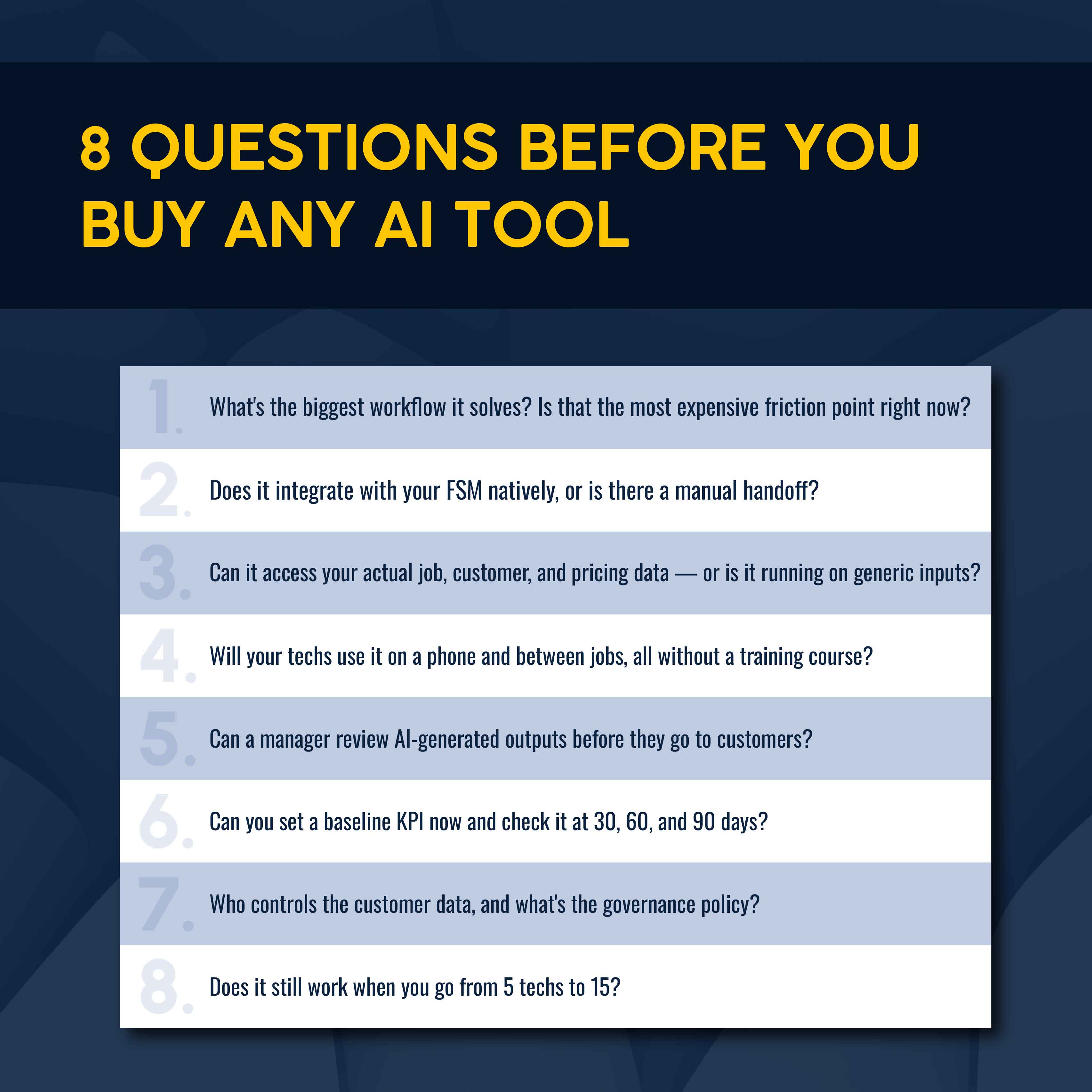
Before adopting another AI-powered tool, work through these questions:
- What problem are you solving first? Start with the workflow that costs the most time or creates the most errors, rather than adapting to the most popular tools out there.
- Does it integrate with your existing job management software? A tool that doesn't connect to your FSM creates new manual work. Integration isn't optional.
- Can it access accurate job, customer, and pricing data? AI performs as well as the data it runs on. Before deploying, confirm your data is clean, current, and accurate.
- Is it built for mobile field teams? Your techs aren't sitting at desks. Any software they use should function on a phone or tablet and on the go, without needing a lot of training.
- Can managers review AI-generated outputs before they go to customers? A human in the loop for quotes and customer summaries is worth the extra step, especially early in deployment.
- Can you measure the result? Define a baseline KPI before you deploy (first-time fix rate, time-to-invoice, or quote response time) and check it at 30, 60, and 90 days.
- Is customer data protected? Confirm data governance and access policies before any tool accesses customer or job records.
- Can it scale as the business grows? A tool that works for five techs but breaks at 15 is a problem waiting to happen. Here's a crucial plumbing business statistic: The average contractor manages five or more software systems, and one-third have no integration strategy. Salesforce research shows companies with unified platforms are 1.9x more likely to describe their AI implementation as successful, and that advantage compounds as the platform learns your business.
Use AI to Fix the Bottlenecks in Your Plumbing Business
You probably already know where the friction is. The calls that get missed. The quotes that sit too long. The techs doing paperwork at 9 p.m. The invoices that don't go out until morning.
Top AI plumbing businesses treat the technology as an operational tool and pick the workflows with the fastest ROI. Getting there doesn't require a long implementation process. Identify the right starting point, and execute.
Simpro's Lightning platform is built for exactly this: an AI-first operating system for plumbing, HVAC, electrical, and other trade businesses that connects every workflow from quote to cash in a single system. More than 24,000 businesses use Simpro to run tighter operations, dispatch smarter, and close the margin gaps that manual processes leave open.
Schedule a demo to see how it works in a plumbing business like yours.


 Back to top