
Your phone rings at 11 p.m. with a caller who’s got a burst pipe, but nobody picks up. That’s a real problem for many plumbing businesses like yours — and maybe why you're already researching AI agent plumbing tools.
Missed calls and after-hours calls can cost plumbing shops thousands of dollars a year, and most of that revenue goes to whichever competitor answers first. Add in slow follow-ups on estimates, dispatchers working from memory, and techs backlogged on paperwork, and suddenly your margin is slipping away.
We’re sharing what’s working with agentic AI for plumbing companies, typical use cases, and where you still need a person instead of a bot.
9 Practical AI Agent Use Cases for Plumbing Businesses
Across field services, 93% of companies have fully or partially implemented AI, per Geotab's 2025 State of Field Service report. But AI isn’t one-size-fits-all.
An AI agent is different from a chatbot or a generic artificial intelligence (AI) writing tool. Agentic AI is built on large language models, like many other AI tools. The difference is that it’s wired into your actual job data, so it can take in context, make decisions, and carry out multi-step tasks without human involvement. Triaging a caller, checking the schedule, booking the job — AI agents can do it all.
AI agents in plumbing don’t replace your team. It removes the manual steps between a customer's problem and a tech's truck showing up prepared. And it gives you 24/7 availability, as customers increasingly expect plumbing services to respond instantly, whether booking online or by phone.
Below are nine examples where agentic AI shows up in a normal week.
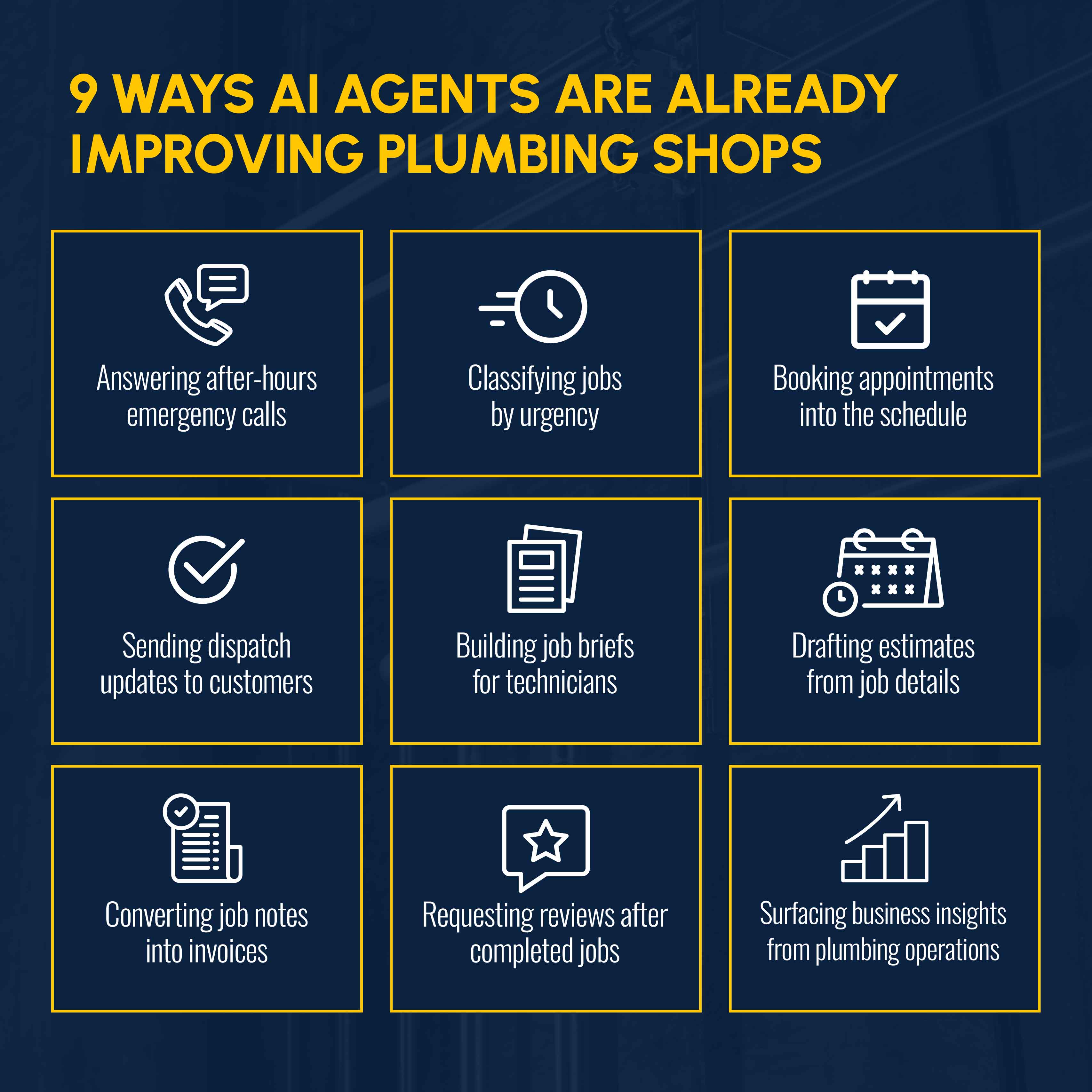
1. Answer After-Hours Emergency Calls
Plumbing businesses only answer 56% of inbound calls, and almost none after 5 p.m. Most callers won't leave a voicemail, instead calling your competitors until someone picks up.
AI voice agents solve this problem: They answer in two rings, confirm the emergency, and either contact an on-call tech or put a job on the schedule.
The operational fix: Start by adding AI call coverage for the after-hours window, then expand it to overflow calls during business hours once the AI tool proves its worth.
Solo plumbers are most affected by missed calls, as there's no one else to grab the phone while they're elbow-deep in a job. For a five-person shop, AI agents can recover thousands of dollars in revenue while costing only a few hundred dollars. That’s a lot of money staying with you instead of your competition.
2. Classify Jobs by Urgency
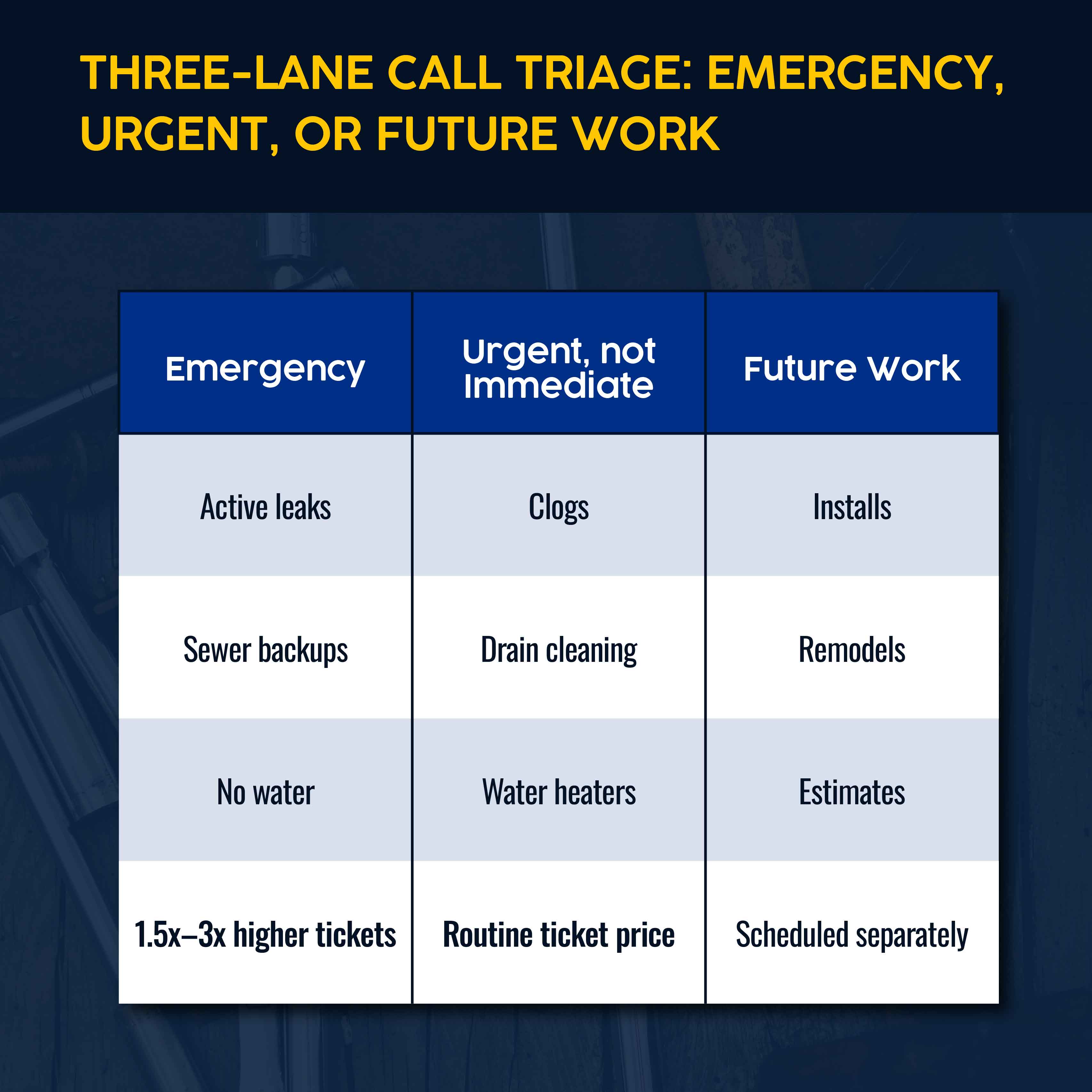
Not every call is a burst pipe. Treating them equally either burns emergency dispatch time or delays an actual emergency because of routine bookings. Adopt a three-lane triage system to separate true emergencies (active leaks, sewer backups, no water) from urgent jobs (clogs, drain cleaning, water heaters) and nonurgent future work (installs, remodels, estimates).
Emergency tickets can run 1.5x–3x more per hour than routine work, so misclassifying a job is a margin problem, not just a scheduling headache.
The operational fix: Build the triage logic, confirm the emergency, and give one safety instruction before dispatch. Route quote and estimate requests to a separate queue instead of the emergency line.
3. Book Appointments Into the Schedule
Basic scheduling tools do one thing. But they can't check parts availability or flag a return customer. That matters when trying to win over a lead. The rule of thumb: Leads contacted within five minutes convert at a 21x rate than leads contacted 30 minutes later.
An AI agent that's connected to your scheduling software can book a job instantly without needing a dispatcher to relay the details by phone. Every call automatically converts to a job record, so nothing depends on employees remembering to log it later.
Automated scheduling cuts down on the double-booking and phone tag that come from a dispatcher juggling three calls and a walk-in. The AI checks real-time tech availability instead of guessing. AI scheduling for field service management is relevant when that decision needs to work from the operating constraints already in the schedule. And if something changes, everyone’s notified.
The operational fix: Connect the AI intake to your live schedule, not a static calendar that’s manually updated.
4. Send Dispatch Updates to Customers
Sometimes technicians run late. That shouldn’t mean getting five missed calls from the customer wondering where they are. Automated dispatch updates text customers when a tech gets assigned, is on the way, or is running early or late.
AI-enabled dispatch improves customer confidence and reduces wasted trips. One in seven truck rolls is wasted, often because the customer isn’t home or because the job didn’t match what was scheduled.
The operational fix: Trigger status updates from the same job record the tech is working from. That way, texts to the customer match what's happening in the field.
5. Build Job Briefs for Technicians
The industry's average first-time fix rate is about 75%, meaning one in four jobs needs a return trip. Many of those callbacks result because techs don’t have the full picture: no job history, no note on the water heater model, no idea a part needs to be pre-staged.
A dispatch prep agent like JobReady, part of Simpro® Lightning, will pull job history, site-access notes, parts availability, and any open quotes into one brief that the tech can read before leaving the shop.
The operational fix: Require a job brief before dispatching to any address with a job history. Do this for all locations, not just complex commercial work, as most go-backs happen on seemingly routine jobs.
A 12-person shop running manual dispatch prep can burn 2.5 hours a day pulling job history and checking parts by hand. Automating that brief cuts it to roughly 40 minutes — creating enough time for each tech to fit in another service call or two.
6. Draft Estimates From Job Details
Building every quote from scratch wastes time on rote work that's mostly the same job type with different measurements. AI can draft a baseline estimate from job details already logged by the tech already logged. The best AI tools also price against your rate book, leaving the tech to adjust for site-specific factors.
The operational fix: Pair the drafted estimate with automatic follow-up. Any type of outreach puts you ahead, as nearly half of salespeople never even attempt a follow‑up after the initial inquiry.
Try this basic sequence:
- Send a same-day text recapping the job and next-step options.
- Send a follow-up email a couple of days later.
- Do a final check-in after one week.
Quote speed, accuracy and transparency make a big difference. Foster Plumbing was able to standardize its quoting and estimating process, winning over customers even when it couldn’t offer the lowest price.
Related: Capture value with AI: See where plumbing businesses recover revenue that used to slip through because of manual quoting.
7. Convert Job Notes Into Invoices
Paperwork can eat up to one-third of a technician's working day, diverting hours from service work.
Voice-to-job-record tools let a tech narrate what they did on-site, and the AI structures that into a job record and a customer-facing summary without anyone having to retype it that night. Businesses running this kind of automation can recover 30–60 minutes of admin time per tech, per day. Invoices go out faster, and billing disputes drop because the invoice matches what actually happened.
The operational fix: Flag any invoice where the billed amount doesn't match the original estimate. That’s where a manual check pays off versus letting every job auto-invoice without review.
8. Request Reviews After Completed Jobs
Asking for a review is a customer service task that's easy to let slip. A job that closes clean and on budget is the easiest review request you'll ever send, but only if you’re not distracted by the next call coming in.
When AI agents detect completed documentation and invoicing, they can trigger a review request automatically instead of leaving it to whoever remembers.
The operational fix: Time the request to the invoice being paid, not the job being closed. A customer who's already settled up is more likely to leave a review than one still waiting on a bill.
9. Surface Business Insights From Plumbing Operations
Many shops only check performance once a month. By then, a slipping close rate or a dead lead source has already cost them money. A daily dashboard that tracks calls answered versus missed, jobs booked versus jobs lost, revenue per lead source, and quote-to-close rate creates a living data stream you can act on today, not next quarter.
The operational fix: Keep a light human review rhythm on top of the automation. A five-minute daily dashboard check, a weekly spot-check of a handful of AI-handled calls, and a monthly deeper review keep the numbers honest without turning into a second full-time job.
That dashboard matters even more once commercial accounts enter the mix. A restaurant or apartment complex on a service agreement needs its own tracking for inspection intervals, backflow testing, and compliance filings. Those are exactly the easy-to-miss tasks that AI agents flag before they become a compliance problem.
The Plumbing Workflows AI Agents Should Not Fully Own
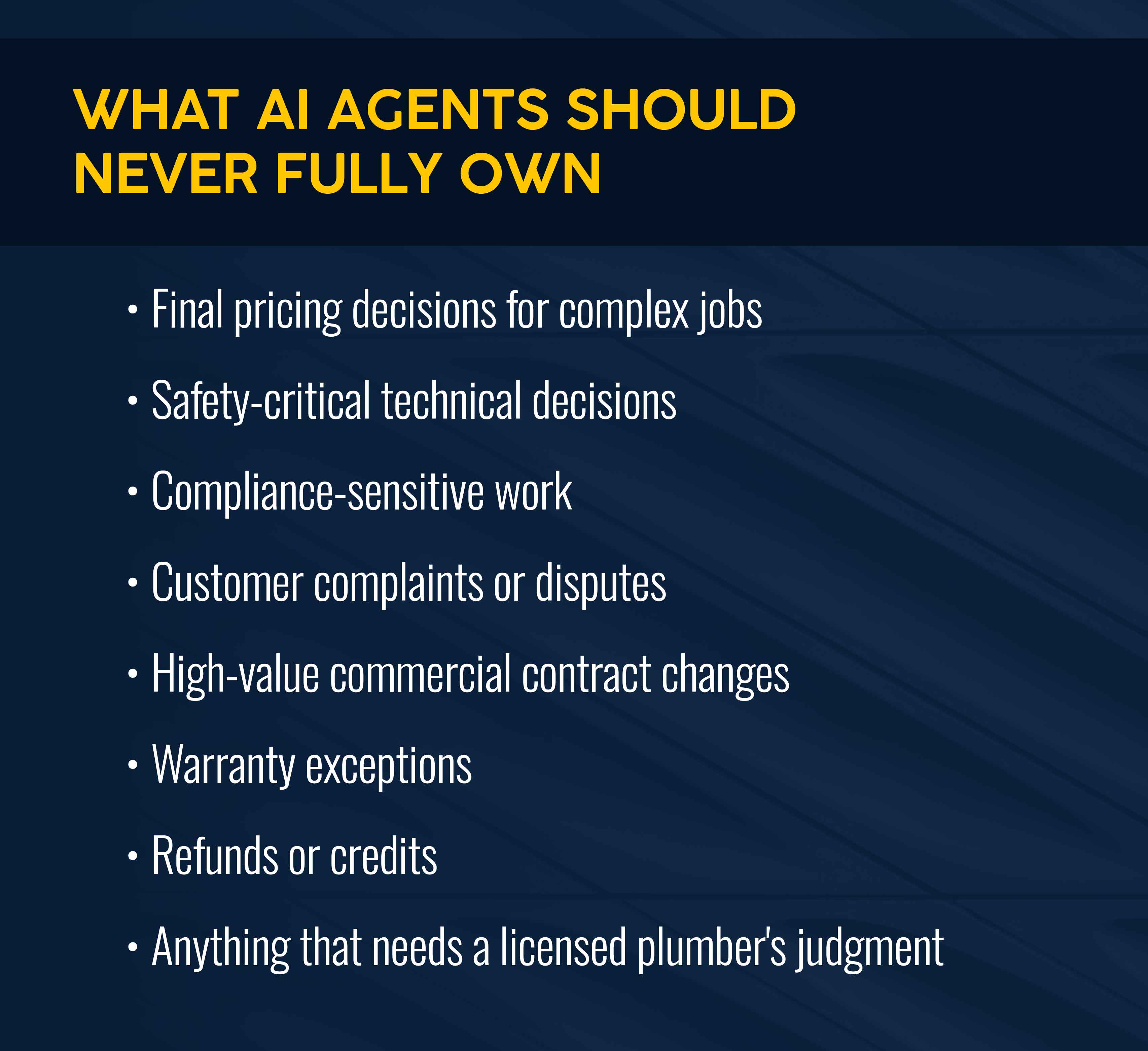
Using an AI agent in plumbing doesn’t mean you should hand off judgment calls that carry legal, safety, or relationship risk.
Some decisions need a person who can be held accountable for them, including:
- Final pricing decisions for complex jobs
- Safety-critical technical decisions
- Compliance-sensitive work
- Customer complaints or disputes
- High-value commercial contract changes
- Warranty exceptions
- Refunds or credits
- Anything that needs a licensed plumber's judgment
The use cases above make sense for growing plumbing businesses because they handle volume and speed. Using AI agents frees up your licensed staff to focus their attention where it really matters instead of being on hold with a customer who simply wants an appointment window. When a customer is upset or negotiating a commercial contract, they’ll want to talk to a person. That’s when you need human-powered customer service — routing that conversation to an agent erodes the trust that keeps accounts coming back.
AI Agents Work Best When They Are Part of the Plumbing Operating System
Understanding agentic AI for plumbing business owners starts by shifting the framing: Each agent is a specialist filling a gap your shop previously couldn’t afford to hire.
Agentic AI for plumbing companies works best when it's built into the platform your team already runs on. A lot of what's marketed as AI-powered in field service is just automation with a chatbot bolted on. Or it’s a bunch of automation tools that aren’t connected to your job records, schedule, and invoicing data.
Most contractors feel this: 70% use field service management systems to unify systems, while nearly one-third lack a strategy for data centralization.
Simpro built AI field service management with Simpro Lightning, one of the first true AI platforms for plumbing businesses, around that idea. Lightning is powered by an AI engine called Cooper, which answers operational questions in real time, all relying on your own business data. Day-one agents include:
- FieldReady: Cut onboarding from 12–16 weeks down to days, offsetting the national shortage of plumbing workers.
- JobReady: Create dispatch briefs that push first-time fix rates from 75% toward 90% or more.
- JobScribe: Eliminate 30–60 minutes of paperwork per tech per day, while reducing billing disputes by up to 40%
- JobBrief: Automatically generate customer-facing job summaries
- Fast Cash: This collections agent handles invoice follow-up so unpaid work doesn't sit for weeks.
Simpro’s plumbing software is purpose-built for growing service businesses, covering scheduling, dispatch, and job costing for more than 24,000 businesses. Having one platform matters even more once commercial work enters the mix. Most AI tools built for home services are tuned for one-off residential calls, not the service intervals and compliance filings required by the restaurant, medical, and apartment complex sectors.
Run the numbers, and the case is straightforward: A midsize shop running a full AI stack across call handling, dispatch prep, and collections can see $60,000 to $120,000 a month in revenue lift against a few hundred dollars a month in tooling costs. You don’t need to ramp up hiring, as the platform has all the data needed to make each agent useful on day one.
Owners sizing up agentic AI usually ask similar frequently asked questions:
- Does it sound robotic?
- What happens when it gets a call wrong?
- How fast can it actually go live?
These are all good questions. But if your team is losing customer calls after 5 p.m., requoting jobs from memory, or waiting until month-end to find out revenue is down, the fix is deploying agents built for exactly that work.
Schedule a demo to see how Simpro's AI agents fit into your plumbing operation.


 Back to top