
You want to turn your plumbing business into a franchise. After all, the business works. Your trucks are busy. You have repeat business. And you're turning away jobs.
Turning away work means there’s untapped demand. A franchise is one way to capture it. But before you commit, there's a hard question to answer: Does your business run without you, or does it run because of you?
This is the honest readiness check most business owners skip. It requires understanding legal structures, franchise economics, training systems, and how to manage multiple locations without losing your margins.
Is Your Plumbing Business Ready to Franchise?
Franchising isn't for everyone. You’re making a legal commitment to deliver a replicable system to someone who paid to operate under your brand. How do you know whether you’re ready?
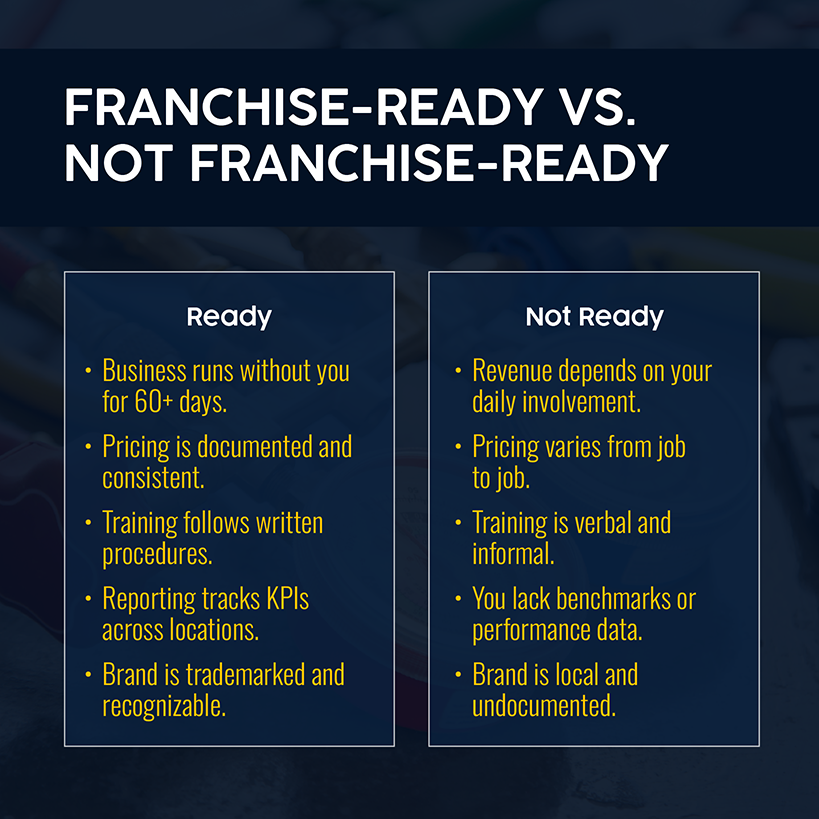
The University of Chicago's Polsky Center studies building and scaling new businesses. They identify four baseline requirements that determine if your business is franchise-ready:
- Growing demand that outpaces current supply
- Proven profit over time
- Strong brand recognition
- Operations and processes that you can teach
That last one is the kicker. The biggest test isn't whether you run the business well. It's whether the system runs without you.
8 Steps to Franchise a Plumbing Business
If you think you’re ready, here's what the process actually looks like.
1. Make Sure Your Plumbing Business Is Franchise-Ready
Before you call a franchise attorney, do an audit. Franchise growth isn’t guaranteed, as 47% of franchise brands operate 25 or fewer units. And those are the success stories.
Can you walk away from your primary location for 60 days and have it run at the same quality and margin? If the answer is "probably not," you're not ready to scale.
Franchisees typically earn less than the original unit during startup because of franchise fees, royalties, and ramp-up costs. That’s why your plumbing company needs a proven business model before it works for someone else. Just like when you were starting a plumbing business, a solid operational groundwork makes this step significantly easier.
2. Standardize Your Core Plumbing Operations
Franchising runs on consistency. Imagine that two technicians from different locations show up for the same type of job, but each handles it differently. You hurt your brand if you can’t offer consistent pricing, process, and customer experience.
Take these two crucial steps to create consistency:
- Document all core processes from the start: This includes dispatch protocols, job intake, customer service and business scripts, safety compliance, and inventory management.
- Define your brand standards: What are the fixed requirements that every franchisee must meet, such as customer service and pricing standards? What's flexible, such as local scheduling adjustments, community engagement, and minor promotional variations?
Nearly two-thirds of franchises are using technology to improve franchise business operations efficiency, according to data from the International Franchise Association and FRANdata. Standardized digital workflows are fast becoming the infrastructure that makes consistency possible across locations.
3. Build an Operations Manual That Someone Else Can Use
The operations manual is a franchise’s legal and operational backbone. It defines the specifications, standards, and procedures that franchisees must follow to operate under your brand.
A complete manual covers:
- Pre-opening procedures
- Equipment and inventory requirements
- Daily operational checklists
- Administrative and reporting obligations
- Payroll and software systems
- Marketing guidelines
- Customer service standards for management and field staff
To test your manual, hand it to someone with no plumbing industry experience. If they can follow it and produce consistent results, it's ready. If they'd need to call you to fill in the gaps, it isn't.
4. Protect Your Brand Before You Scale It
You can technically franchise without a federally registered trademark. Most franchise attorneys will tell you not to. Each franchise agreement is a trademark license, and your franchisee's right to operate under your brand is only as strong as your trademark protection.
Federal registration with the U.S. Patent and Trademark Office (USPTO) gives you exclusive nationwide rights to your brand, legal presumption of ownership, and the ability to take legal action against unauthorized use. Without it, a copycat can use your name, and you'll have little recourse. USPTO registration currently runs $350 per mark, per class.
Another way to promote and protect your brand is by investing in a professional-looking website for plumbers. When prospective buyers find you online, they should discover a polished brand identity that appeals to franchisees and their customer base.
5. Work With a Franchise Attorney to Create the Legal Structure
This step is non-negotiable. The Federal Trade Commission requires franchisors to give every prospective franchisee a Franchise Disclosure Document (FDD) at least 14 days before signing anything or paying anything.
The FDD has 23 mandated disclosure items, including:
- Background
- Litigation history
- Initial fees
- Franchisee obligations
- Territory rights
- Training
- Marketing fund requirements
- Financial performance data
Some states, including California, Illinois, and Minnesota, require additional registration filings. A qualified franchise attorney helps you navigate this.
The FDD process requires you to commit to the franchise system before you sell it. If you haven't documented your operations and don’t have clean financials, the legal development process will be longer and more expensive — and it won't fix the underlying gaps.
6. Define the Franchise Economics
If you’re evaluating a franchise opportunity, model the expected return on investment before proceeding.
Standard franchise economics for service-based businesses like plumbing typically include:
- Initial franchise fee: Generally $20,000–$30,000, though established brands can command more.
- Royalty rate: Typically 4%–8% of gross revenue. Plumbing and home-service franchises tend to run closer to 4%.
- Advertising fund contribution: Effective marketing strategies need an additional 2%–4% of gross revenue for regional or national brand marketing support.
- Total franchisee startup investment: The typical range is $100,000–$300,000.
Include territory definitions as part of this calculus. Clearly define geographic boundaries, protected zones, and territory rights before your attorney drafts the FDD. Vague territory language is one of the most common sources of franchisee disputes.
7. Create Training and Support Systems for Franchisees
Comprehensive training and support aren't optional. Franchise agreements typically mandate participation as a condition of operating under your brand. Plus, anyone considering investing in a plumbing franchise will scrutinize these support systems.
Formal training programs should begin four to six weeks before a franchisee's opening. They should cover day-to-day operations, administrative processes, technology systems, performance evaluation, and customer service protocols.
Beyond initial training, ongoing support can compound franchise improvement over time. Make time for regular check-ins, update training as technology and regulations evolve, and create peer networks among plumbing franchise owners.
8. Create Systems to Manage Multiple Locations Consistently
Multilocation oversight is where most plumbing operators struggle. You can’t drive across town to check on a crew when you're managing six or eight franchisee locations.
Franchises need centralized visibility into scheduling, dispatch, job-completion rates, and revenue performance — in real time, across all locations. That means standardized workflows that enforce your operations manual at the system level. And you need reporting that benchmarks franchisee performance against network standards, and holds them accountable.
This is where purpose-built plumbing apps and field service management (FSM) tools become foundational. These aren’t just feature upgrades. They’re the operational infrastructure that lets you scale your franchise while maintaining oversight.
Signs Your Plumbing Business Isn’t Ready to Franchise
Before you spend money on attorneys and franchise development consultants, check for these disqualifiers:
- Revenue depends too heavily on your personal involvement.
- Pricing changes case by case with no documented structure.
- Service quality varies significantly by technician.
- Dispatch is disorganized or runs on informal communication.
- Training happens verbally, not from documented procedures.
- Customer retention is weak or inconsistent.
- Reporting is limited or inconsistent, and you can't benchmark performance.
If you’re falling short in one or two areas, fix them before you franchise. If you struggle with most or all? You’re not ready to franchise.
Franchise Expansion vs. Company-Owned Expansion: Which Path Fits Your Business?
Both models can work. They serve different strategic goals.
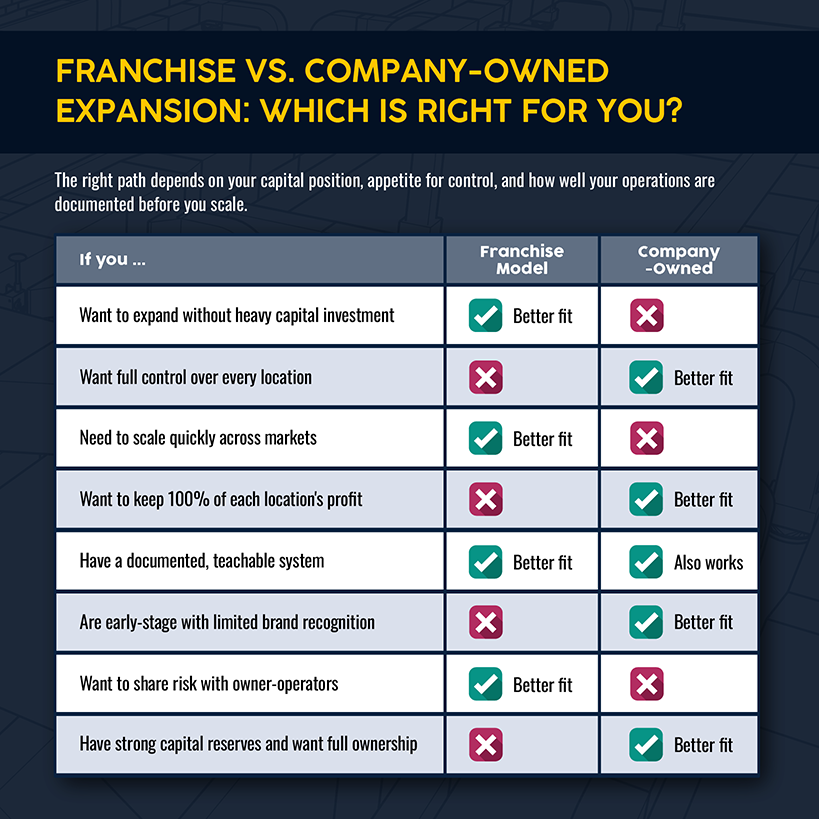
Franchising means licensing your brand, systems, and operations to independent owners who invest their own capital. You collect upfront fees and ongoing royalties.
- Pros: Expansion is faster and requires less capital from you.
- Cons: You have less direct control over each location.
Company-owned expansion means you open and operate additional locations, keeping 100% ownership, brand control, and profit from each unit.
- Pros: You maintain full operational consistency.
- Cons: You fund all the startup costs, so your available capital limits growth.
For SMB and mid-market plumbing operators, the capital efficiency of franchising is often the deciding factor. Franchise networks that build solid systems early can scale aggressively without shouldering the balance sheet burden themselves.
Also, a University of Michigan study shows that franchised businesses are 6.3 percentage points more likely to survive the 12-month mark than independent businesses.
What You Need Before Talking to a Franchise Attorney or Consultant
Don't book that first meeting until you can produce:
- Financial statements showing consistent profit over at least one to three years
- A documented operational model that works without founder involvement
- Evidence of brand recognition strong enough to attract franchise buyers
- A clear picture of what franchisees will receive in training, support, and standards, and your ability to deliver it reliably
Don’t meet with a franchise attorney unless you’re prepared. When plumbing services companies haven’t documented their processes or financials, they delay the development process, spend more, and still have foundational gaps to fix.
How Software Helps You Franchise a Plumbing Business at Scale
The operations manual tells franchisees what to do. FSM software enforces it.
When you standardize workflows, every franchisee location runs the same job sequence, speaks the same language, and tracks the same metrics. Real-time dashboards let you see how each location performs, creating visibility and accountability across the network.
Purpose-built plumbing software handles the five core operational challenges of franchise networks:
- Inconsistent service delivery
- Cross-location scheduling and dispatch
- Standardized job management
- Centralized customer data
- Real-time visibility into each location's revenue and completion rates
Real-world example: Zebra Plumbing used Simpro® to centralize job management, dispatch, and reporting across locations. That's the kind of infrastructure any serious franchise network needs.
Simpro supports over 250,000 users across 24,000+ businesses. Customers have reported 25% revenue increases and 30% productivity improvements — outcomes that matter even more when you have multiple franchise locations with different owners and teams.
Build the System First, Then Franchise the Business
Franchising a plumbing business is a process. The businesses that do it well tighten their operations before the legal work starts. Everything is documented, teachable, consistent, and measurable.
If you're wondering whether your operation is truly ready to reproduce, you're asking the right question.
Simpro works for trade businesses that are serious about operational infrastructure. Whether you're preparing to franchise or building the operations to get there, it's worth seeing what the platform can do for your business.
Schedule a demo, and let's talk about what your operation looks like at scale.


 Back to top