
You've heard enough about AI to feel like you should be doing something, and not enough to know what. Every week brings another headline, another vendor demo, another competitor mentioning they "just added AI" to their website while you're still building tomorrow's schedule by hand.
This beginner's guide to adopting AI for HVAC business owners is meant to close that gap. You need to cut through the hype and get a plain-language walkthrough of what AI could do for you. If you're getting started with AI as an HVAC business owner, here's your on-ramp to find out what to do, what you don't need to bother with, and how to get started and see results.
What Does Adopting AI Actually Mean for an HVAC Business?
Start with the vocabulary: the word "AI" is used as an umbrella term for things that work in very different ways.
- Artificial intelligence (AI) is software that understands what you ask and responds rather than following fixed rules.
- Generative AI creates something new from what you feed it, such as turning voice notes into a finished report you can put in front of a customer.
- Machine learning improves at a task by studying patterns in your own records, like which calls become callbacks.
None of that replaces a technician's judgment on a rooftop unit throwing a code nobody's seen before. AI-powered tools take over the repetitive, data-heavy work around that judgment so your team's time goes where it's needed.
Here's why it matters for HVAC companies: 69% of trade businesses see AI's biggest impact in optimizing workflows. Considering that average margins across the HVAC industry run 5%–12%, wasted hours compound fast. That's the real case for AI in HVAC, a fix for how your business operates today, not a bet on the future.
Related: AI operating platforms for HVAC businesses can improve field service operations without a full overhaul.
Before You Start: Pick One Problem, Not 10
Shops that get discouraged by AI usually tried to fix everything at once. Find the costliest workflow and start there.
| If your biggest problem is... | Start with AI for... |
|---|---|
| Missing calls during peak season or after hours | Call answering and booking |
| Dispatch eating 2+ hours every morning | Scheduling and route optimization |
| Techs showing up without the right parts or context | Job preparation and briefing |
| Paperwork piling up after every job | Voice-based field documentation |
| Commercial invoices sitting unpaid for 40+ days | Automated invoicing and collections |
| No visibility into margins without pulling a report | Plain-language business questions |
Pick one row, get it working, then move to the next. The roadmap later in this guide shows what that sequencing looks like across 90 days.
7 Beginner-Friendly Ways to Use AI in Your HVAC Business
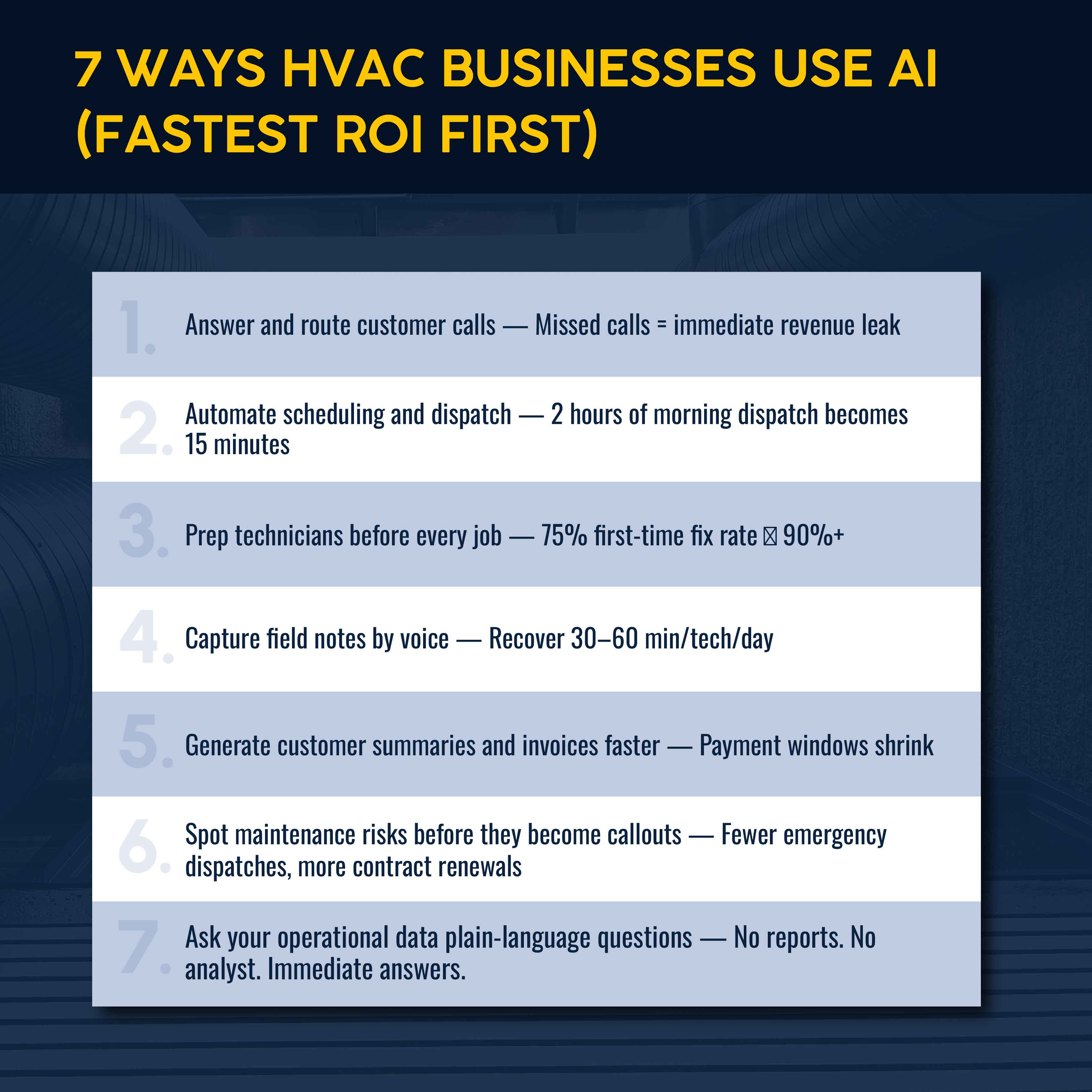
Each of these solves one specific, familiar problem. They're ordered by how fast you'll see a return. Each of them lives within field service management (FSM) platforms already built for trade businesses, so there's no separate software to buy.
1. Use AI to Answer, Triage, and Route Customer Calls
Only 52% of calls to HVAC businesses get answered, according to Invoca. Miss 12 calls a week at a 40% conversion rate, and that's five jobs walking to a competitor every week.
How AI helps you: An AI answering tool isn't a phone tree reading a script. It holds an actual conversation, figures out what the customer needs, and books the appointment or texts your dispatcher a summary. It does what a good office manager does, minus the overtime.
What changes day to day: Right now, a call after 6 p.m. is a coin flip on whether it gets returned. With this running, every call gets answered or texted back within seconds, day or night, without pulling anyone off a job site.
What setup looks like: Connect the tool to the phone number you already use with no new number and no new hardware. Most shops see it working within the first week. The upcoming Simpro® Pulse CSR agent is built for this: answering calls, booking appointments, and feeding into your job management system.
The operational fix: Losing calls during peak season or after hours? This is the fastest return on this list, usually measurable within 30 days.
2. Use AI to Improve Scheduling and Dispatching
Manually building tomorrow's schedule can eat two hours at a 10-technician shop when you're matching skills, locations, and urgency by memory and a whiteboard.
How AI helps you: AI-powered scheduling tools automate scheduling by factoring in technician skills, location, traffic, job urgency, and parts availability, rebuilding in real time when a cancellation or emergency call comes in. Your dispatcher still makes the final call, but the software narrows the options.
What changes day to day: Instead of working the phones and a whiteboard every morning, your operations manager reviews a schedule the system already built. A 10-technician team recovering 30 minutes per tech daily adds up to roughly 1,250 hours a year, which is more than half of a full admin role you didn't have to hire.
What setup looks like: This depends on technician profiles and job history already logged in your FSM platform. If that data exists, turning this on is a settings decision. Simpro's scheduling tools, powered by Cooper — the AI engine at the center of Simpro Lightning, assign the closest qualified tech and optimize routes automatically.
The operational fix: If dispatch takes your operations manager more than 30 minutes most mornings, this is worth testing before anything else on the list.
3. Use AI to Prepare Technicians Before They Arrive On-Site
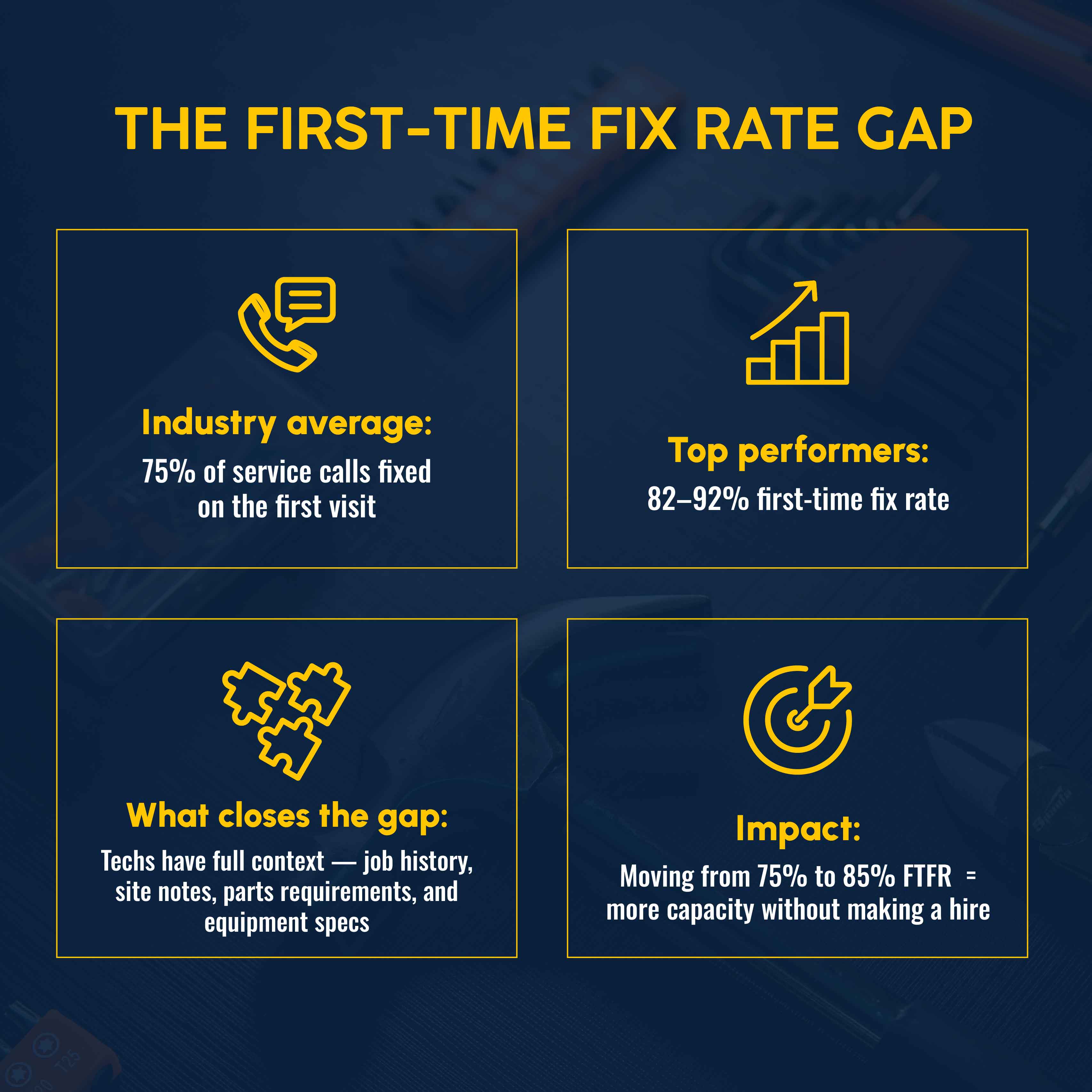
The industry average first-time fix rate sits around 75%; top performers hit 82%–92%. The gap usually comes down to whether the tech knew what they were walking into.
How AI helps you: AI job-prep tools pull together customer data, service history, site notes, and equipment specs into a short pre-job brief before the tech leaves the shop. Simpro Lightning's JobReady agent is already helping shops push first-time fix rates to 90% or higher.
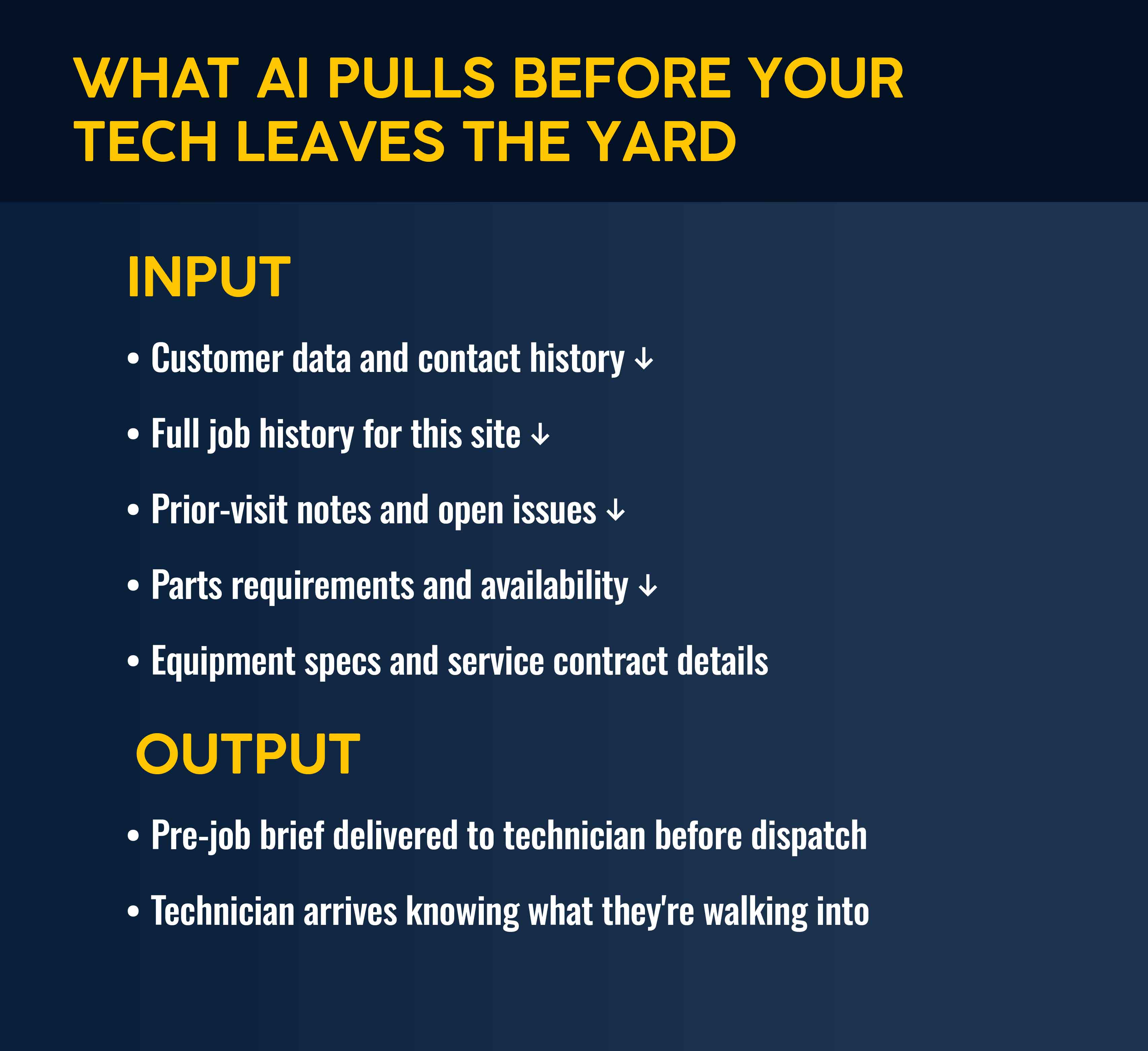
What changes day to day: A tech six months on the job shows up with the context a 20-year veteran would carry in their head, instead of piecing it together on the drive over.
What setup looks like: This runs on service history your team already generates. Techs just need to log notes consistently.
The operational fix: If return trips are eating into your schedule, better prep is the fix — not a longer training program.
4. Use AI to Capture Field Notes and Job Documentation
Technicians can lose 30–60 minutes a day to manual documentation. Across a 10-person field team, that's 1,250 to 2,500 hours a year not going toward billable work.
How AI helps you: Voice-based AI documentation, like Simpro Lightning's JobScribe agent, lets a tech talk through what they found and fixed — nothing invented, just what the tech already knows turned into a record.
What changes day to day: Techs talk instead of type, on the phone they already carry. Short adjustment period, nothing new to configure.
What setup looks like: Enable it inside your FSM platform. Most shops run a quick team walkthrough rather than formal training.
The operational fix: Admin work done in the field is a direct tax on billable hours. Voice documentation removes it without adding a new process, and it feeds directly into the next use case.
5. Use AI to Create Customer Updates, Estimates, and Invoice Summaries Faster
Commercial customers expect documentation: post-job summaries, itemized work, clean invoices. Building those by hand takes time and invites errors that delay payment and dent customer satisfaction.
How AI helps you: AI tools compile job details automatically after each visit and generate accurate customer-facing documents. Simpro Lightning's JobBrief agent has reduced billing disputes 25-35% and sped up payment by 15–20 days.
What changes day to day: The invoice goes out the same day the job closes instead of sitting in a drafts folder. That means fewer confused calls questioning a charge, a quiet win for customer service and a growing customer base.
What setup looks like: Set the summary format once; it runs the same way every time a job closes. Simpro's Fast Cash goes further, using AI to follow up on unpaid invoices based on how each customer actually pays, rather than a static 30/60/90-day reminder.
Related: Find out how to protect HVAC margins and revenue with AI once your billing workflow is running smoothly.
6. Use AI to Spot Maintenance Risks and Repeat-Visit Patterns
Your service history already holds the answer to why certain HVAC systems keep failing and which maintenance contracts are due. Most HVAC companies don't have a system built to surface it.
How AI helps you: AI systems that analyze historical job and asset data can flag patterns before they become an emergency callout — an equipment failure signature weeks before a compressor gives out, air quality degrading from an under-maintained filter, or a repeat-visit pattern pointing to something bigger. Customers on monitored maintenance agreements renew at far higher rates, and predictive maintenance makes those agreements easier to sell, including energy efficiency upgrades.
What changes day to day: Instead of reacting to a breakdown, your team gets a heads-up while it's still a minor repair. Simpro's Maintenance Planner add-on forecasts asset servicing and manages contract obligations without manual tracking; Data Feed automates extraction from supplier invoices so asset-record gaps stop forming.
What setup looks like: No new sensors needed. This runs on records you're already generating, as long as they're logged consistently.
The operational fix: If your team spends more time responding to failures than preventing them, point an AI tool at the service history you already have before investing in anything new.
7. Use AI to Ask Better Business Questions Without Building Reports
Most HVAC operators know their total revenue. Fewer know margin by job type, revenue per technician, or which accounts are behind — not because the data doesn't exist, but because pulling it usually means a spreadsheet and an afternoon.
How AI helps you: Conversational business intelligence tools let you ask plain-language questions about how your business operates. Simpro Lightning's JustAsk works across your Simpro data — jobs, customers, finance, field operations — so "which technicians have the lowest first-time fix rates this quarter?" gets answered without touching a report.
What changes day to day: Decisions that used to wait for a spreadsheet now happen the same afternoon.
What setup looks like: If your other workflows run through the platform, there's nothing separate to build, and answers pull from data you're already generating.
The operational fix: Don't run your business on gut feel just because pulling the numbers is a hassle. This closes that gap without adding a hire or a weekly reporting habit.
Related: Learn how AI in field service management is changing what operators can see and act on in their own data.
What Should HVAC Businesses Not Use AI For?
Here are a few places where AI adds friction rather than removing it:
- Customer situations that need judgment. AI handles triage, scheduling, and documentation. A frustrated commercial account still needs a person who can read the room.
- Messy or incomplete data. AI surfaces patterns from existing records — spotty job history means you're automating a guess.
- What happens on the roof or in the mechanical room. AI job prep gets a tech there better equipped. What they do once they're in front of the unit is still a skilled trade.
- Everything, all at once. Adoption stalls when shops automate every workflow in the first 90 days. One thing running well beats five things half-configured.
A Simple AI Adoption Roadmap for HVAC Business Owners
| Timeline | What to Do | Goal |
|---|---|---|
| First 30 days | Audit your FSM platform for unused AI features. Identify the costliest workflow. Record a baseline number. | One AI feature live. A "before" number on record. |
| Days 31–60 | Add a second capability adjacent to the first — job prep after dispatch, documentation after call answering. Measure both. | Two workflows running, with documented results on at least one. |
| Days 61–90 | Add a third workflow based on the next bottleneck. Share results with your team. | Three workflows embedded. Team understands its role. |
The number matters more than the order. Pick one metric before you turn anything on, measure for 30 days, enable the tool, and measure again. That before-and-after becomes your own case for what comes next.
How Simpro Helps HVAC Companies Get Started With AI
Simpro is an FSM platform built for trade businesses — job management, scheduling, quoting, inventory, invoicing, and service contracts in one system. Simpro Lightning is the AI layer built natively into it, with Cooper as the AI engine at the center, reading your actual jobs, customers, technicians, and financial records from day one — no migration required.
Cooper powers agents built for how HVAC businesses operate:
- FieldReady cuts technician onboarding from 12–16 weeks to days
- JobReady preps technicians before dispatch using service history and customer data
- JobScribe captures field notes by voice
- JobBrief generates post-job customer summaries
- Fast Cash handles accounts receivable automatically
- JustAsk answers plain-language questions against live Simpro data
Simpro customers have cut quote time from two hours to 30 minutes, reduced invoicing admin by 90%, and grown field headcount without adding office staff — documented across more than 24,000 businesses and 250,000+ users.
You're Not Behind — You Just Haven't Started Yet
If it feels like every other HVAC business has figured this out and you're the last one at the whiteboard, that's mostly noise. Most operators are exactly where you are: curious, a little skeptical, and unsure which of the seven things above to touch first. You don't need a technology strategy — you need to fix the one problem actually costing you money, whether that's missed calls, a slow dispatch board, or invoices sitting for 40 days. Solve that one, let the results build your confidence, and the next tool gets a lot less intimidating.
Schedule a demo to see how Simpro Lightning's AI agents work inside an HVAC business at your scale — no jargon required.


 Back to top