Fred Voccola, Chairman and CEO of Simpro Group, hosted technology, investment, education, and public policy leaders in Miami, Florida, for the inaugural The Coming Disruption: AI-First Summit. Designed to bring together CEOs, founders, academic leaders, and global investors managing hundreds of billions of dollars in capital, the summit focused on defining one of the biggest questions of our time: How is artificial intelligence fundamentally disrupting organizations, industries, and society?
Drawing from his work and thought leadership behind the best-selling book The Coming Disruption, Voccola framed AI not as a productivity enhancement, but as a transformational force that will reward decisive leadership and punish incrementalism.
AI as the Most Powerful Tool Humanity Has Ever Created
In his keynote address, Voccola described AI as “the most powerful tool humanity has ever had,” emphasizing that this moment demands courage, adaptability, and a relentless focus on outcomes.
He highlighted Miami as a fitting backdrop for the summit — a city shaped by immigrants, entrepreneurs, and risk-takers who left uncertainty behind in pursuit of something better. That same entrepreneurial DNA, he noted, is required of leaders today: comfort with change, clarity of purpose, and willingness to re-architect organizations around outcomes rather than legacy processes.
This ethos is also reflected in Simpro’s decision to establish Miami as its North American headquarters — a strategic move that aligns the company with a city increasingly recognized as a global hub for technology, innovation, and entrepreneurship. For Simpro, Miami represents not only geographic expansion, but a commitment to building the future of the trades alongside forward-thinking leaders who embrace change and growth.
AI, Data, and the Future of Public Safety
Voccola joined a fireside chat with leading security experts to explore AI’s role in public safety. The discussion focused on how AI can analyze massive, fragmented datasets to uncover patterns that humans cannot detect at scale.
They discussed a future in which public safety leaders can leverage centralized, case-driven data repositories, enabling AI to surface insights that help prevent what was described as “crimes of passion” — crimes that exploit complexity, speed, and data overload. The conversation underscored AI’s potential to enhance decision-making and prevention, not just reaction.
The same principles apply powerfully to the trades and field service industry, where disconnected systems, operational complexity, and reactive decision-making increasingly burden businesses. When AI can analyze large volumes of historical job data, asset performance, technician behavior, customer interactions, and supply chain signals, it enables smarter scheduling, predictive maintenance, more accurate quoting, and proactive service delivery. Rather than reacting to inefficiencies, AI empowers trade businesses to anticipate issues, improve margins, and deliver consistent, high-quality outcomes at scale.

Disrupting Industries — AI in Software
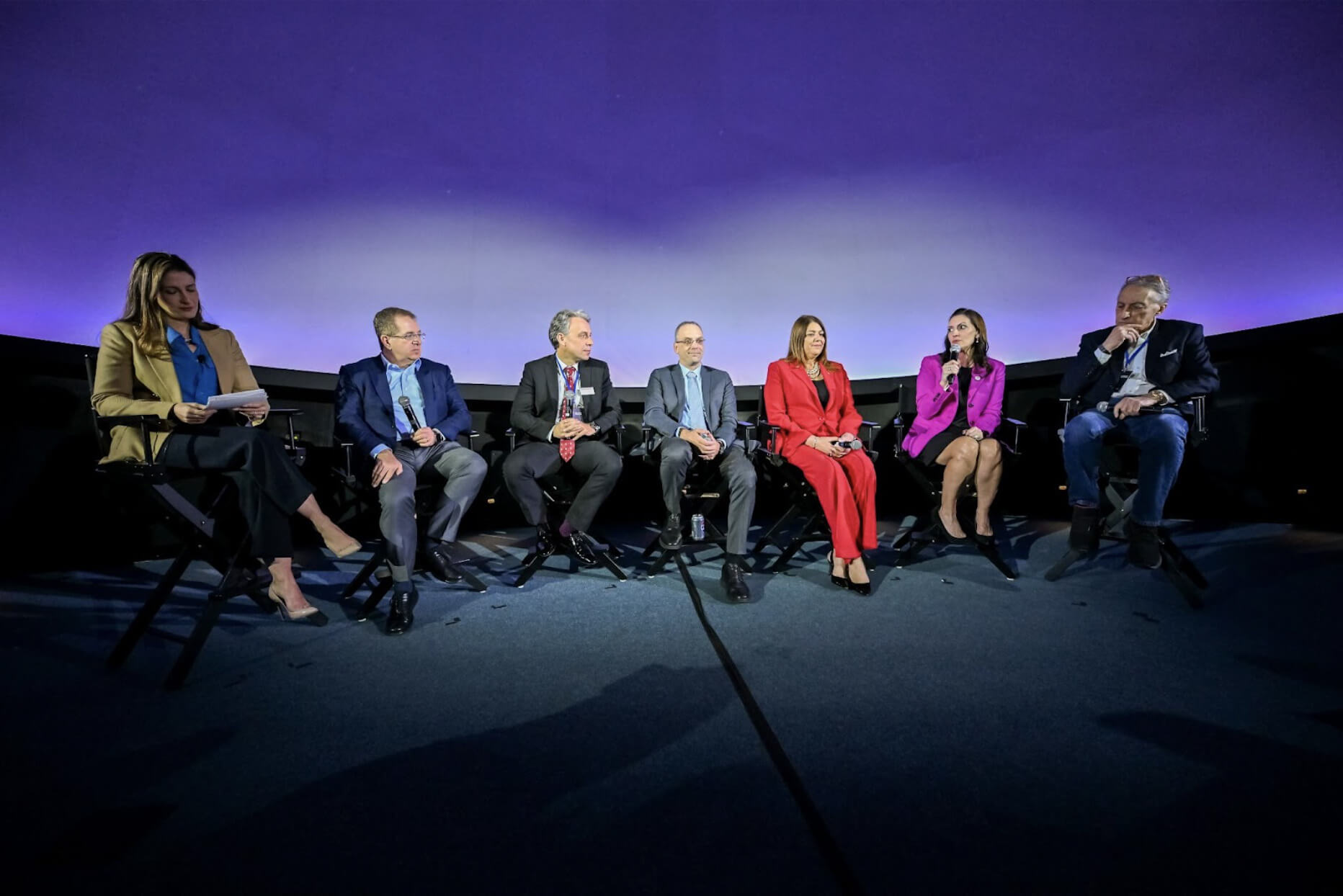
A standout panel of software and technology leaders examined how AI is redefining competitive advantage across industries. Several core themes emerged:
- Data, not speed, is the true moat in the AI era. Proprietary, well-connected data creates a durable advantage far beyond raw compute power.
- Platform depth and execution excellence are critical differentiators. AI amplifies the value of connected systems that can distinguish signals from noise.
- Outcome-driven ROI must replace activity-based metrics. Leaders emphasized running pilots, validating impact, and scaling only when measurable results are proven.
- Talent and execution matter more than ever. Small teams of exceptional engineers, data architects, and go-to-market leaders can drive disproportionate impact when paired with AI-first strategies.
Panelists also discussed the evolving economics of software, including the shift away from seat-based pricing toward usage- and outcome-based models, particularly as AI agents replace traditional user workflows.
For the trades, this shift represents a fundamental change in unit economics and profitability. AI-first platforms like Simpro's field service management software enable trade businesses to move beyond labor-constrained growth by reducing administrative overhead, optimizing technician utilization, improving first-time fix rates, and unlocking insights across the entire operation. The result is not only greater efficiency, but materially higher profitability — allowing businesses to grow revenue, protect margins, and reinvest with confidence even amid ongoing labor and cost pressures.
Higher Education and Workforce Transformation
The summit also featured a panel with university presidents, deans, and workforce leaders examining how AI is reshaping learning, credentialing, and career readiness. The discussion focused on moving beyond traditional curricula toward outcome-based education models that prepare students for continuous adaptation in an AI-driven economy.
This conversation is especially relevant for the trades industry, which continues to face a persistent workforce shortage and widening skills gap. AI is not a replacement for skilled tradespeople — craftsmanship, experience, and hands-on expertise will always be irreplaceable. Instead, AI presents an opportunity to augment the next generation of technicians, enabling them to operate with greater confidence, consistency, and expertise earlier in their careers. By training future trades professionals to leverage AI-powered tools, the industry can scale knowledge, improve quality and safety, and make trade careers more sustainable and rewarding.
A Clear Mandate for Leaders
Across every session, one message was consistent: AI-First is not optional. Organizations that hesitate — or treat AI as an add-on rather than a foundational shift — will struggle to compete in the years ahead.
The event reinforced Fred Voccola’s role as a trusted voice guiding executives through one of the most consequential transitions in modern history — one that is now decisively reshaping the trades, the backbone of society. As AI moves from experimentation to execution, the opportunity for the trades is clear: operate smarter, deliver better outcomes, and increase profitability without sacrificing craftsmanship. Through Simpro’s AI-first operating platform, these principles are no longer theoretical — they are being put into practice, helping trade and field service businesses scale with intelligence, resilience, and sustained financial performance.


 Back to top